
Cold Brew vs Hot Coffee: Health Claims Tested by Science


I grew up in Buenos Aires, where coffee is less a drink and more a pause in the day. My grandmother would make a small pot in the afternoon, and we'd sit, and nobody was in a hurry. Years later, in Barcelona, I found the same feeling in a cortado at a corner café. Slow mornings. Quiet cups.
So when cold brew took over every menu and every feed, I got curious. People kept telling me it was “the healthy one.” Less acid. More antioxidants. Better for your stomach. Easy claims, repeated so often they started to sound like facts.
I went looking for the actual studies. And what I found surprised me, because a lot of the “cold brew is healthier” story doesn't hold up the way the internet says it does. The truth is calmer and more interesting than the marketing. Let me walk you through it, the way I'd explain it to a friend over a cup.
Quick Answer
For most healthy people, cold brew and hot coffee are about equally healthy. Cold brew is often slightly lower in total acid and tastes smoother, while hot coffee usually holds slightly more antioxidants. The bigger health factors are how much you drink, what you add to it, and how well your body tolerates it.
Key Takeaways
Cold Brew vs Hot Coffee: The Full Comparison
Here's the honest side-by-side, based on what the research shows rather than what sounds good on a label.
| Feature | Cold Brew | Hot Coffee |
|---|---|---|
| Brew temperature | Cold to room temp (about 4–20°C / 39–68°F) | Hot (about 90–96°C / 195–205°F) |
| Brew time | 12–24 hours | 2–5 minutes |
| pH (acidity level) | Roughly 4.9–5.8 | Roughly 4.85–5.1 |
| Total (titratable) acid | Usually a bit lower | Usually a bit higher |
| Antioxidants | Slightly lower at the same ratio | Slightly higher at the same ratio |
| Caffeine (as served) | ~100–200 mg per cup; concentrate much higher | ~95–165 mg per cup |
| Taste | Smooth, mellow, low bitterness | Bright, aromatic, more complex |
| Best for | Warm days, sipping, meal prep, sensitive palates | Aroma lovers, quick brewing, cold mornings |
| Storage | Keeps 1–2 weeks refrigerated | Best fresh; flavor fades within hours |
| Cost per cup | Slightly higher (more grounds) | Lower (fewer grounds) |
| Calories (black) | Near zero (about 3–5 per cup) | Near zero (about 2–5 per cup) |
Notice how close most of these rows are. That's the theme of this whole article. Now let's unpack the parts that actually matter.
What Makes Cold Brew Different
Cold brew starts a concise story: cold water, coarse grounds, and time. You steep the coffee for 12 to 24 hours, then strain it. No heat, ever.

Because the water is cold, extraction is slow and selective. Cold water is lazy. It pulls out caffeine and plenty of flavor, but it leaves behind some of the bitter, sharp, and oily compounds that hot water grabs quickly. That's the real reason cold brew tastes so mellow.
Most cold brew is made as a concentrate, using a high ratio of coffee to water, usually around 1 part coffee to 4–8 parts water. You then dilute it with water, milk, or ice before drinking. This concentrate step is the source of endless confusion about caffeine, which we'll clear up soon.
One thing people forget: cold brew is usually strained through a metal mesh or cloth, not a paper filter. That detail matters more than it sounds, and I'll come back to it in the heart-health section.
What Makes Hot Coffee Different
Hot coffee is fast chemistry. Water near boiling meets the grounds, and in a few minutes it extracts a wide range of compounds, sharp acids, sweet sugars, bitter notes, and the aromatic oils that make your kitchen smell alive.

That speed and heat are why hot coffee has more aroma and more complexity. Heat volatilizes the fragrant compounds, which is why a fresh hot cup smells like so much more than an iced one. It's also why hot coffee extracts more antioxidants: heat simply pulls more of them into the cup.
The trade-off is that hot brewing also extracts more of the compounds that read as bitter and acidic. Whether that bothers you depends a lot on the beans, the roast, and your own stomach.
Hot coffee comes in filtered forms (drip, pour-over) and unfiltered forms (French press, espresso, moka pot). That split, filtered vs unfiltered, turns out to be one of the most underrated health variables in this whole comparison.
The Science Behind Brewing Temperature
Brewing is really about solubility, which is a fancy word for “what dissolves into the water and how fast.” Temperature is the master dial.
Hot water dissolves compounds quickly and pulls out a broad mix: caffeine, chlorogenic acids, sugars, oils, and hundreds of aroma molecules. Cold water dissolves the same compounds much more slowly, and some of the larger, less-soluble ones barely come out at all.
Chlorogenic acids are a good example. These are the main antioxidants in coffee. Heat extracts more of them and also breaks some of them down into smaller acids that taste sharp. Cold brew extracts fewer chlorogenic acids overall and breaks down fewer of them, so it ends up smoother, but also, on average, a little lower in antioxidants at the same coffee-to-water ratio.
Roast level plays its own role. Darker roasts have already lost some chlorogenic acid to the roasting heat, and they tend to be a bit less acidic in the cup. Lighter roasts keep more antioxidants but taste brighter and more acidic. This is true whether you brew hot or cold, and honestly, roast choice moves the needle on acidity and antioxidants at least as much as brew temperature does.
The Acidity Question: What's Real and What's Marketing
Cold brew is often called low-acid coffee, but the science shows the difference is modest. In peer-reviewed testing, cold and hot brew made from the same coffee frequently land at a similar pH, roughly in the 4.85–5.8 range.
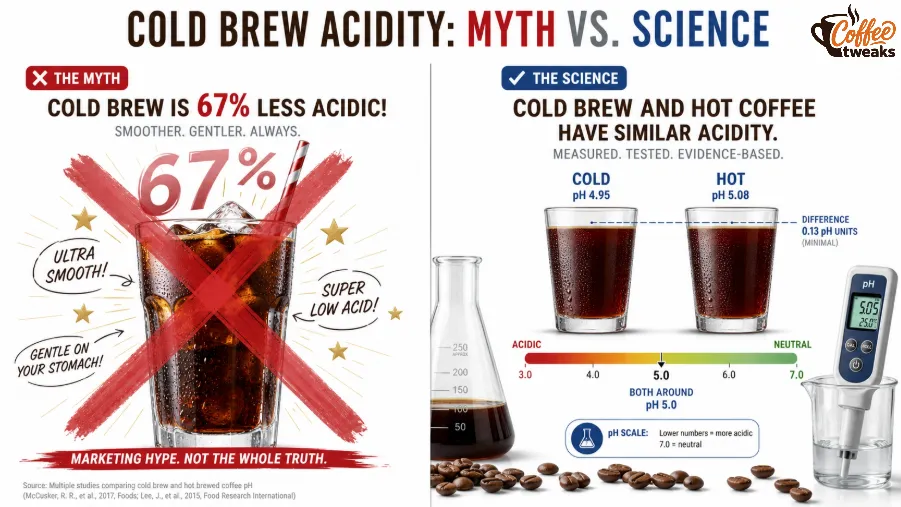
Cold brew tends to have somewhat less total acid, which likely explains its smoother taste, but it is not dramatically less acidic than hot coffee.
Let me separate two things people mix up, because this is where most articles go wrong.
pH measures how strong the acid is. A landmark 2018 study by Niny Rao and Megan Fuller at Thomas Jefferson University, published in Scientific Reports, brewed the same coffees hot and cold at the same ratio. The pH values came out comparable, between about 4.85 and 5.13 for both. Not half. Not a full point apart. Comparable.
Titratable acidity measures the total amount of acid in the cup. Here cold brew does tend to win, a little. That same body of research, and a 2020 roast-level study, found cold brew carried somewhat less total acid. A 2020 study measured cold brew as roughly 0.2 to 0.34 pH units less acidic than hot, depending on roast. Real, but small.
So where did “67% less acid” and “pH 6.5” come from? Mostly from marketing and from articles copying each other. The strongest lab studies don't support those numbers.
| Acidity claim you'll see online | What the research actually shows |
|---|---|
| “Cold brew has 67% less acid” | Not supported; differences are modest |
| “Cold brew pH is 6.0–6.5” | Measured pH is usually 4.9–5.8, close to hot |
| “Cold brew is dramatically less acidic” | Slightly lower total acid; similar pH |
| “Smoother means less acidic” | Smoothness is partly taste perception, not just pH |
Here's the honest takeaway: if sharp, acidic coffee bothers you, cold brew might feel gentler, partly from slightly lower total acid and partly because the smooth, low-bitterness taste masks the sharpness. That's a real, everyday benefit. Just don't expect a huge chemical difference.
Want the deeper mechanics? A companion piece on coffee acidity explained walks through pH, roast, and origin in more detail.
Antioxidant Comparison: The Myth Worth Correcting
Contrary to popular belief, hot coffee usually contains more antioxidants than cold brew when brewed at the same ratio. Heat extracts more chlorogenic acids and related compounds, which are coffee's main antioxidants. Cold brew's gentler extraction leaves more of them behind in the grounds.
This one caught me off guard, because I'd read the opposite a dozen times. But the 2018 Rao and Fuller study found hot brew had higher total chlorogenic acid content and higher antioxidant activity than cold brew from the same beans.
A 2024 review of many studies reached the same general conclusion: higher brewing temperature and longer contact time tend to yield greater antioxidant activity.
| Antioxidant factor | Effect on antioxidant level |
|---|---|
| Higher brew temperature | More antioxidants extracted |
| Longer brew time | Generally more extracted |
| Lighter roast | More chlorogenic acid retained |
| Darker roast | Less chlorogenic acid |
| Cold water | Fewer antioxidants at same ratio |
Now, a fair caveat. Cold brew uses more grounds per batch, so a strong concentrate can still deliver plenty of antioxidants per glass. And antioxidant numbers vary wildly with bean origin, roast, and grind. So this isn't “hot coffee is the healthy one.” It's simply that the confident claim “cold brew has more antioxidants” is, for a standard brew, backwards.
And honestly? For your health, this difference is small. Both drinks are rich sources of polyphenols. Which brings up the bigger point I'll make near the end.
Caffeine Comparison: It's All About Dilution
Cold brew concentrate has more caffeine than hot coffee, but cold brew as you actually drink it is usually about the same, sometimes slightly more.

The confusion comes from one word doing two jobs: “cold brew” describes both the strong concentrate and the diluted drink.
Here's the clearest way I've found to think about it.
| Drink | Typical caffeine |
|---|---|
| Cold brew concentrate (undiluted, per 8 oz) | ~150–240 mg |
| Cold brew diluted 1:1 (per 8 oz) | ~75–120 mg |
| Ready-to-drink cold brew (per 12 oz) | ~150–205 mg |
| Hot drip coffee (per 8 oz) | ~95–165 mg |
Cold brew uses more grounds and a long steep, so the concentrate is genuinely strong. Undiluted, it can hit two or three times a regular cup. But almost nobody drinks concentrate straight. Once you dilute it, you're often right back around hot-coffee territory.
The practical lesson: if you're watching your caffeine, the number on the cup depends on how much water or milk went in, not on the fact that it's “cold brew.” A café cold brew can be gentle or a genuine jolt depending on the shop's recipe. When in doubt, ask, or start small.
This caffeine point matters for the next few sections, because caffeine, not acidity, is the real driver behind several of coffee's stomach and sleep effects.
Digestive Health and Gut Health
Both cold brew and hot coffee can stimulate digestion, and neither is clearly better for the average gut. Coffee gets the digestive system moving, encourages a bowel response in many people, and can feed beneficial gut bacteria through its polyphenols. These effects come from compounds found in both versions.
Coffee is one of the more reliable ways to, let's say, get things going in the morning. That effect isn't mainly about caffeine, since decaf can do it too. It's about coffee's acids and other compounds prompting the gut. Cold or hot, that mechanism is similar.
For gut health specifically, coffee's polyphenols act a bit like fuel for friendly gut microbes. Both brews carry polyphenols, so both offer this potential benefit. The difference between them here is small.
Where people differ is tolerance. Some feel jittery or crampy from a big hit of caffeine; others feel nothing. If coffee unsettles your stomach, the lever that helps most is usually less caffeine and food alongside it, not switching hot for cold.
If gut health is your focus, a dedicated coffee and gut health guide goes deeper on the microbiome side.
Acid Reflux, GERD, and Sensitive Stomachs
Cold brew's slightly lower acidity does not reliably prevent acid reflux, because acidity isn't the main trigger.
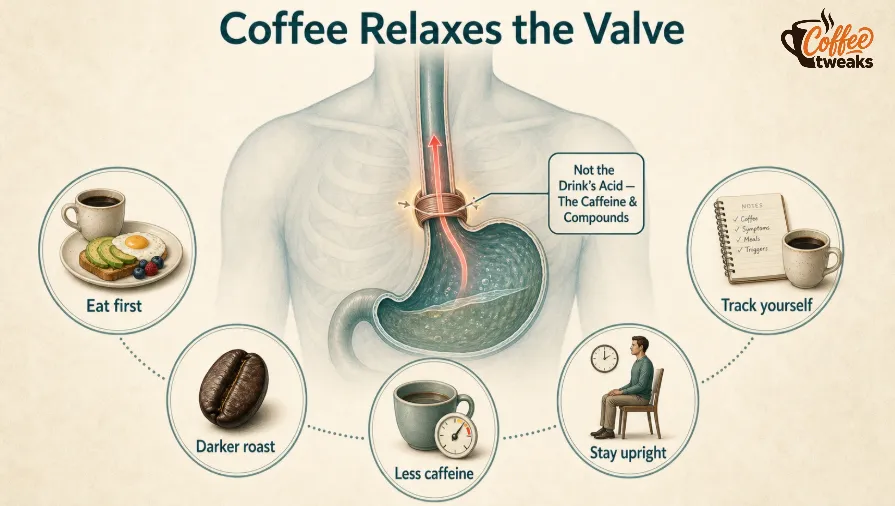
Coffee tends to worsen reflux by relaxing the valve at the top of the stomach and by prompting the stomach to make more acid, effects driven largely by caffeine and other compounds, not by the drink's own pH.
This is the section I most wanted to get right, because the “cold brew is safe for reflux” advice is everywhere, and it's shakier than it sounds.
Here's the chain that actually causes reflux from coffee. Coffee relaxes the lower esophageal sphincter, the muscular ring that keeps stomach contents down. When it loosens, acid can rise. Research published in the New England Journal of Medicine found that both regular and decaf coffee lower the pressure of that valve.
Coffee also nudges the stomach to secrete more of its own acid. Your stomach acid is far stronger (around pH 1.5–3.5) than any coffee, so the coffee's own mild acidity is a small player next to what your stomach is doing in response to drinking it.
That's why “less acidic coffee” often disappoints. In one company-funded trial on a low-acid coffee, researchers found no improvement in heartburn, regurgitation, or stomach upset. And because cold brew concentrate can carry more caffeine, a strong cold brew could, in theory, be worse for reflux than a modest hot cup.
What does the big-picture evidence say? It's genuinely mixed. A 2026 systematic review from the American College of Gastroenterology, pooling 40 studies and over 122,000 people, found coffee drinkers had only slightly higher odds of reflux (about 18% higher), and the authors called the clinical meaning unclear.
Earlier reviews found no significant link at all. Notably, the American College of Gastroenterology no longer recommends that people with reflux automatically quit coffee.
So what actually helps if coffee triggers you? These levers beat the hot-vs-cold choice:
If, after all that, cold brew feels easier on your stomach, that's a real and valid reason to choose it. Just know you're likely benefiting from lower total acid plus a smoother taste plus, hopefully, gentler caffeine, not from some big acidity rescue.
This is educational information, not medical advice. If you have persistent reflux or diagnosed GERD, please talk with your doctor about what's right for you.
Dental Health
Both cold and hot coffee are acidic enough to affect tooth enamel over time, and both can stain teeth, so the practical tips matter more than the temperature. Coffee's acids can soften enamel slightly, and its dark pigments cause staining with regular drinking.
Since cold and hot coffee sit in a similar pH range, neither is meaningfully kinder to enamel. A few habits protect your smile either way:
One small note: adding sugar or sweet syrups does more damage than the coffee itself, by feeding the bacteria that cause cavities. That's true for both.
Heart Health, Blood Pressure, and Cholesterol
For most people, moderate coffee of either type supports rather than harms heart health, but how you filter your coffee can affect cholesterol more than whether it's hot or cold. The key players are oily compounds called diterpenes, which paper filters remove and metal or cloth strainers let through.
This is where an underrated variable sneaks in. Coffee beans contain two oily compounds, cafestol and kahweol, known as diterpenes. In controlled studies, unfiltered coffee has been shown to raise LDL (the “bad”) cholesterol, in some cases by around 10% or more. Paper filters trap these oils; metal and cloth strainers don't.
Here's what that means across brew methods:
| Brew method | Diterpene level | Cholesterol effect |
|---|---|---|
| Paper-filtered drip / pour-over | Very low | Minimal |
| French press | Higher | Can raise LDL |
| Espresso / moka | Higher | Can raise LDL |
| Boiled / Turkish | Highest | Notable LDL rise |
| Cold brew (mesh/cloth strained) | Less studied, likely not negligible | Uncertain; probably some |
Notice that hot vs cold isn't the deciding line, paper vs no-paper is. Most cold brew is strained through mesh or cloth, so it doesn't get the diterpene-trapping benefit of a paper filter. There's less research on cold brew's exact diterpene load than on French press or boiled coffee, so I won't overstate it.
But if cholesterol is a concern for you, running your coffee, hot or cold, through a paper filter is a simple, evidence-based move.
On blood pressure: caffeine can cause a short-term bump, especially in people who don't drink coffee often. Regular drinkers largely adapt. Over the long term, moderate coffee is associated with neutral-to-favorable heart outcomes in large studies. And again, this is driven by compounds in both brews, so neither cold nor hot has a clear edge on blood pressure.
The big, reassuring picture: large studies consistently link moderate coffee drinking with lower risk of heart disease and lower overall mortality. That benefit belongs to coffee itself, not to a particular temperature.
Blood Sugar and Type 2 Diabetes
Regular coffee of either type is linked to a lower risk of type 2 diabetes, thanks to chlorogenic acids and other polyphenols found in both. This is one of coffee's most consistent health findings, and it doesn't depend on brew temperature.
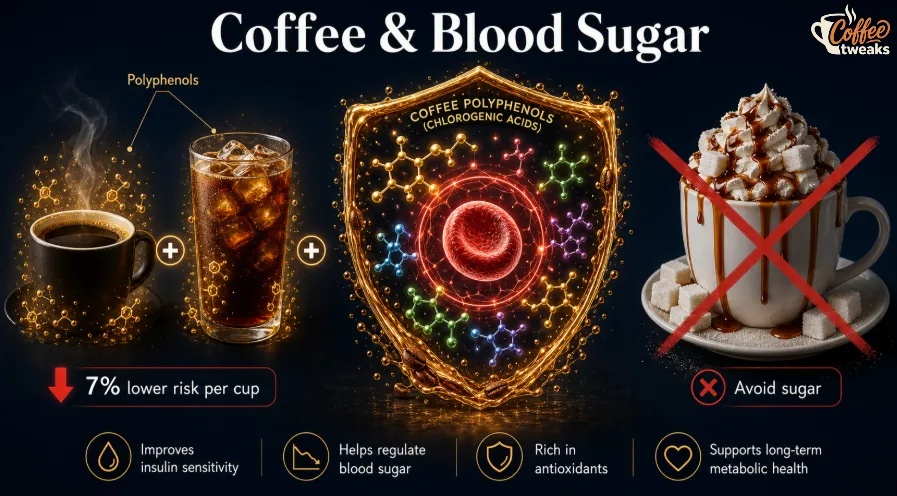
The evidence here is strong and repeated. Meta-analyses have found that each additional daily cup of coffee is associated with roughly a 7% lower risk of type 2 diabetes, with heavier coffee drinkers seeing meaningful risk reductions. The likely heroes are chlorogenic acids and related polyphenols, which appear to improve how the body handles glucose and reduce oxidative stress.
Since hot coffee tends to hold slightly more of these polyphenols at the same ratio, you could argue hot has a hair's-edge advantage for blood sugar.
But this is speculative and small; no study has shown hot-coffee drinkers get less diabetes than cold-brew drinkers. What clearly does undo the benefit is loading your cup with sugar and syrups. Black or lightly sweetened is the move, whichever temperature you choose.
Curious about the metabolic side? A future piece on coffee for weight loss ties this together with appetite and energy.
Weight Loss
Both cold brew and hot coffee are nearly calorie-free when black, and caffeine gives a modest, temporary metabolic and appetite effect either way. Neither brew has a weight-loss advantage on its own.
Black coffee has almost no calories, hot or iced. Caffeine can slightly raise metabolism and blunt appetite for a short while, which is the same for both drinks. The real weight story isn't the coffee, it's the extras. A black cold brew and a black drip coffee are both near zero. A sweet iced coffee drink can carry as many calories as a dessert.
If weight is your goal, the honest advice is boring but true: enjoy either brew black or with a splash of milk, and skip the sugary syrups.
Exercise Performance: Before and After Workouts

Caffeine before exercise can boost performance, and both cold brew and hot coffee deliver it, so choose by comfort and timing. After a workout, either works for recovery fluids, and cold brew is often more refreshing.
Caffeine is one of the better-studied performance aids. Taken 30–60 minutes before training, it can improve endurance, strength output, and perceived effort. Cold brew and hot coffee both provide this. The practical question is what sits well in your stomach before you move, and for many people a cool, smooth cold brew is easier to drink pre-workout than a hot cup, especially before running or in warm weather.
Just mind the dose. A strong cold brew concentrate can deliver a big caffeine hit that leaves you jittery mid-session. Start moderate.
After exercise, coffee isn't dehydrating at normal amounts, and either version fits fine. On a hot day post-run, iced cold brew simply feels better, and that counts for something.
A separate coffee before workout guide covers timing and dose in detail.
Hydration
Coffee in moderate amounts hydrates you more than it dehydrates you, and this is true for both cold brew and hot coffee. The old “coffee dehydrates you” idea is largely a myth for regular drinkers.
Caffeine is a mild diuretic, but the water in your coffee more than makes up for it at typical intakes. Regular coffee drinkers develop tolerance to the diuretic effect anyway. So your daily cups count toward your fluids, cold or hot.
Cold brew over ice can feel more hydrating on a warm day simply because it's cold and easy to drink, but chemically, both hold their water fine.
Mental Focus and Energy
Caffeine sharpens alertness, focus, and reaction time, and both brews provide it, so the effect comes down to dose and timing. The type of brew matters less than how much caffeine you take and when.
Caffeine blocks a sleepiness signal in the brain, which is why coffee makes you feel awake and focused. Cold brew and hot coffee both do this. What changes the experience is the amount and the timing. A gentle cup gives a clean lift; a giant concentrate can tip into jitters and a harder crash.
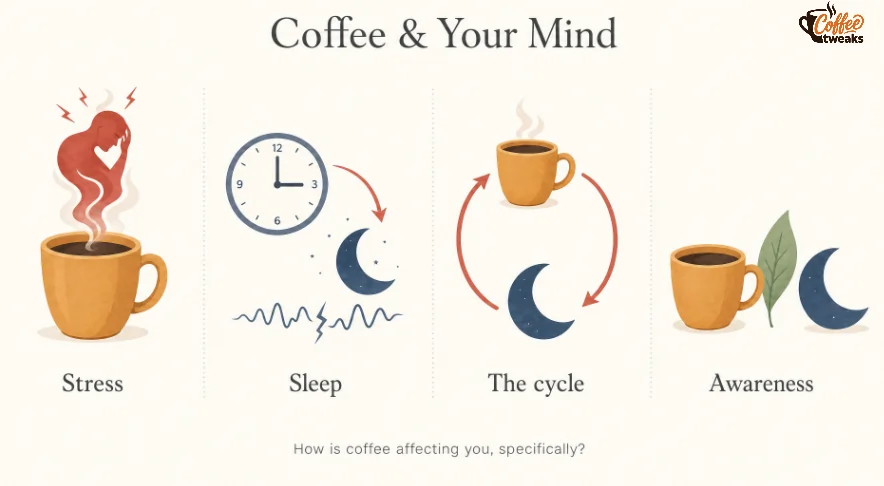
Some people say cold brew gives a “smoother” energy. There's no strong evidence that the type of caffeine differs, but a well-diluted cold brew delivers its caffeine steadily, and its lack of bitterness makes it easy to sip slowly, which can feel smoother in practice. Perception is part of the experience.
Sleep and Anxiety
Caffeine, not brew temperature, drives coffee's effects on sleep and anxiety, so watch the dose and the clock rather than the brewing method. Cold brew concentrate's higher caffeine can be a hidden culprit for both.
Caffeine has a long half-life, often 5–6 hours, meaning half of it is still in your system that long after your cup. Drink coffee too late and it can quietly steal deep sleep even if you fall asleep fine. This is identical for cold and hot.
The trap with cold brew is that a strong concentrate carries more caffeine than people expect, so an afternoon cold brew can disrupt sleep more than an equal-size hot coffee.
For anxiety, caffeine can heighten jitteriness and a racing feeling in sensitive people. Again, it's the caffeine and the dose, not the temperature. If coffee makes you anxious, lowering the amount and switching to earlier in the day helps far more than choosing cold over hot. A smaller cup, or a half-caf blend, is often the fix.
Inflammation, Polyphenols, and Chlorogenic Acids
Coffee's polyphenols, especially chlorogenic acids, have antioxidant and anti-inflammatory effects, and both cold brew and hot coffee contain them. These compounds are a big reason coffee is linked to better long-term health.
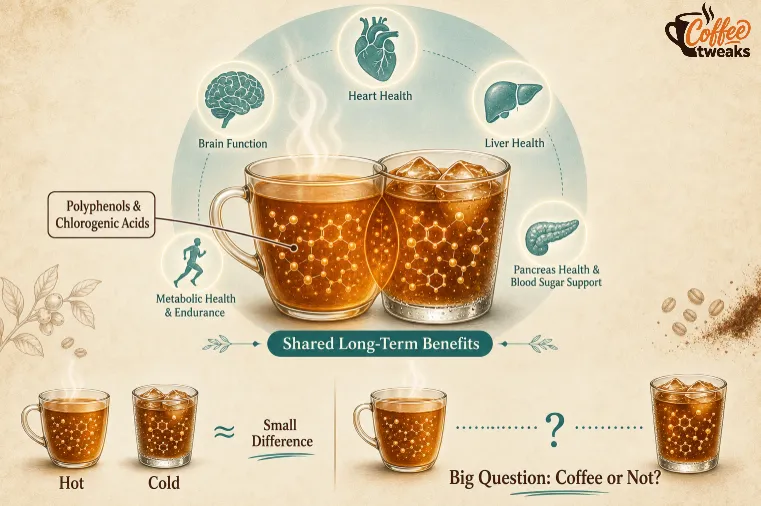
Here's the point I've been building toward. Nearly all of coffee's proven benefits, lower diabetes risk, favorable heart outcomes, lower overall mortality, come from compounds present in both brews: caffeine, chlorogenic acids, and other polyphenols.
Chlorogenic acids in particular help calm oxidative stress and low-grade inflammation, which sit behind many chronic diseases.
Hot coffee tends to hold slightly more chlorogenic acid at the same ratio. Cold brew uses more grounds, which narrows the gap in a strong batch. Either way, both are among the richest sources of these polyphenols in a typical Western diet.
No large study has ever shown that cold-brew drinkers are healthier than hot-coffee drinkers, or the reverse. The health difference between the two is small compared to the difference between drinking coffee and not, or drinking it black versus drowning it in sugar.
That's the whole point, really. We argue about hot versus cold, when the science keeps pointing at the same quiet conclusion: coffee is good for most of us, and the details we obsess over are minor.
Who Should Drink Cold Brew
Cold brew tends to suit you if:
Cold brew is not a magic fix for reflux or a low-caffeine option by default. Watch the concentrate strength if either of those matters to you.
Who Should Drink Hot Coffee
Hot coffee tends to suit you if:
When Cold Brew Wins vs When Hot Coffee Wins
| Situation | Better pick | Why |
|---|---|---|
| Hot summer afternoon | Cold brew | Refreshing, easy to drink |
| You want max aroma | Hot coffee | Heat releases fragrance |
| Sharp coffee upsets you | Cold brew | Smoother, less total acid |
| You're in a hurry | Hot coffee | Ready in minutes |
| Watching cholesterol | Hot, paper-filtered | Filter removes diterpenes |
| Meal-prepping the week | Cold brew | Keeps 1–2 weeks |
| Pre-workout in the heat | Cold brew | Sits easier, refreshing |
| Cozy cold morning | Hot coffee | Warmth and comfort |
| Slightly more antioxidants | Hot coffee | Heat extracts more |
| Sensitive to caffeine | Either, diluted | Control the dose |
Common Myths, Corrected
Expert Tips and Best Brewing Practices
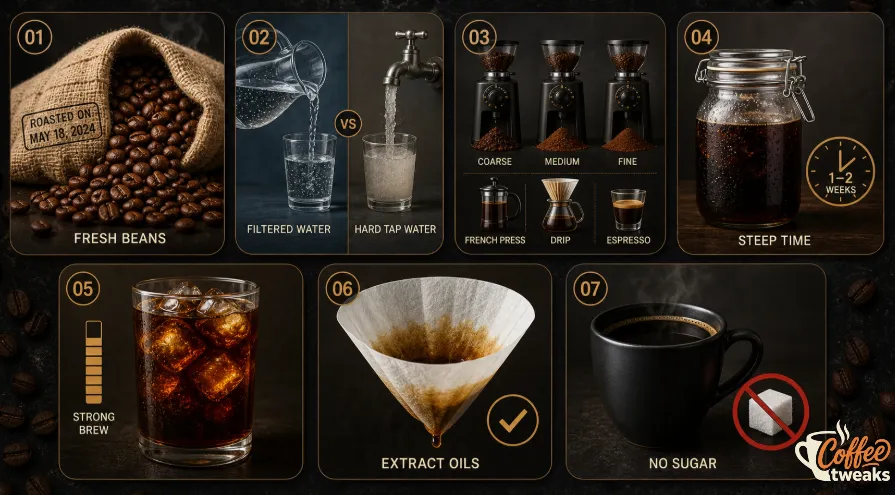
A few habits get you the best cup, hot or cold:
Ready to try it at home? A step-by-step how to make cold brew at home guide and a best coffee beans for cold brew roundup pair nicely with this.
Buying Advice
If you're shopping with health in mind:
Skip products that promise miracle “70% less acid” health results. The chemistry doesn't support big claims, and a good, fresh coffee you enjoy will serve you better than a marketing gimmick.
Frequently Asked Questions
Is cold brew healthier than hot coffee?
For most people, no meaningful difference. Cold brew has slightly less total acid; hot coffee has slightly more antioxidants. Both share coffee's proven benefits. The healthiest choice is the one you enjoy, drink mostly black, and tolerate well.
Which has more antioxidants, cold brew or hot coffee?
Hot coffee usually has more at the same coffee-to-water ratio, because heat extracts more chlorogenic acids. Cold brew's higher grounds ratio narrows the gap, but the popular claim that cold brew has more antioxidants is generally a myth.
Is cold brew less acidic than hot coffee?
Slightly. Their pH is often similar, but cold brew tends to have a bit less total acid and tastes smoother. Claims of “67% less acid” are not supported by the strongest studies.
Which has more caffeine, cold brew or hot coffee?
It depends on dilution. Cold brew concentrate is much stronger. Once diluted for drinking, cold brew is usually about the same as hot coffee, sometimes a little more.
Is cold brew better for acid reflux or GERD?
Not reliably. Reflux is driven mostly by caffeine relaxing the stomach valve and prompting acid, not by the coffee's own acidity. Drinking with food, choosing a darker roast, and limiting caffeine help more than switching to cold brew.
Can cold brew reduce heartburn?
It might feel gentler for some people, thanks to lower total acid and a smoother taste, but there's no strong evidence it prevents heartburn. A strong cold brew's extra caffeine could even make reflux worse.
Is hot coffee better for antioxidants?
Yes, modestly, at the same ratio. Heat pulls more antioxidant compounds into the cup. The health impact of this difference is small, since both are polyphenol-rich.
Does brewing temperature affect health?
Only a little. Temperature shifts antioxidant and acid levels slightly. Bigger health factors are the amount you drink, whether you filter it, and what you add.
Which is better for weight loss?
Neither has an edge. Both are near-zero calories when black, and caffeine gives the same modest effect. Sugary add-ins are what undo the benefit.
Which is better before a workout?
Both deliver a performance boost from caffeine. Cold brew often sits easier in the stomach before exercise, especially in heat, but watch the dose to avoid jitters.
Which is better after a workout?
Either works. Coffee hydrates at normal amounts, and cold brew simply feels more refreshing after a hot session.
Which is better for digestion?
About the same. Coffee stimulates the gut either way. If it unsettles you, less caffeine and drinking it with food help most.
Which is better for gut health?
Similar. Both carry polyphenols that can benefit gut bacteria. There's no clear winner.
Which is better for anxiety?
Whichever has less caffeine in your cup. Anxiety from coffee is driven by caffeine, not temperature. A smaller or half-caf cup helps more than switching to cold.
Which is better for sleep?
The one with less caffeine, and earlier in the day. Cold brew concentrate can carry hidden extra caffeine, so it may disrupt sleep more if you drink it late.
Which is better for fasting?
Both are fine during a fast when black, since both are near-zero calories. Adding milk, sugar, or syrup breaks a strict fast either way.
Which tastes smoother?
Cold brew, clearly. Cold water extracts fewer bitter and sharp compounds, giving a mellow, mild cup.
Which is easier on your teeth?
Neither has a real advantage; both are acidic and can stain. Rinsing with water, using a straw for iced, and limiting sugar protect your teeth.
Is cold brew or hot coffee better for cholesterol?
Filtering matters more than temperature. Paper filters remove oily diterpenes that can raise LDL cholesterol. Most cold brew is strained through mesh, so paper-filtered hot coffee may be the cholesterol-friendlier choice.
Which is better for blood sugar?
Both are linked to lower type 2 diabetes risk through their polyphenols. Hot coffee holds slightly more of these compounds, but the difference is small. Skipping sugar matters far more.
Does cold brew have fewer calories than hot coffee?
No. Both are near-zero calories when black. Calories come from milk, cream, sugar, and syrups, not the brew method.
How long does cold brew last compared to hot coffee?
Cold brew keeps 1–2 weeks refrigerated in a sealed container. Hot coffee is best fresh and loses flavor within hours.
Is cold brew stronger than hot coffee?
As a concentrate, yes. As served after dilution, usually similar. “Stronger” often refers to bold taste, which can be true even when caffeine is comparable.
Who should avoid cold brew?
Anyone very sensitive to caffeine should be cautious with strong concentrate. It's not a low-caffeine choice by default.
Who should avoid hot coffee?
Those bothered by bright acidity or bitterness may prefer cold brew. For cholesterol concerns, avoid unfiltered hot methods like French press unless you filter through paper.
When should you choose cold brew?
On warm days, when you want a smooth cup, when meal-prepping, or when sharp coffee bothers your palate.
When should you choose hot coffee?
When you want aroma and complexity, need coffee fast, prefer warmth, or want a paper-filtered, antioxidant-rich cup.
Is drinking coffee every day healthy?
For most adults, moderate daily coffee (roughly 2–4 cups) is linked to neutral-to-beneficial health outcomes. Cold or hot, keep it mostly black and mind your caffeine timing.
What's the single healthiest way to drink coffee?
Fresh beans, paper-filtered, black or lightly sweetened, in moderation, and timed so caffeine doesn't wreck your sleep. Temperature is your preference to make.
Final Verdict
If you came here hoping for a clear winner, here's the honest answer: for the vast majority of people, cold brew and hot coffee are similarly healthy, and the choice comes down to taste, comfort, and how your own body responds.
Cold brew earns its place with a smoother, mellower cup, slightly less total acid, and easy make-ahead convenience. Hot coffee earns its place with richer aroma, a touch more antioxidants, and the option of a cholesterol-friendly paper-filtered brew. The differences are real but small.
What actually moves your health is bigger and simpler: drink coffee in moderation, keep it mostly black or lightly sweetened, filter it if your cholesterol needs care, and pay attention to how caffeine affects your sleep and your stomach. Do that, and both cups are on your side.
No exaggeration when I say the healthiest coffee is the one that fits your life, the one you look forward to, sip without regret, and feel good after. For me, some mornings that's a warm cortado that fills the kitchen with its smell.
On a hot Barcelona afternoon, it's a slow glass of cold brew on the balcony. Neither is “the healthy one.” They're both just coffee, and coffee, it turns out, has been quietly good to us all along. And honestly? That's the whole point. 🌿