Coffee for Weight Loss in 2026: Does It Actually Burn Fat?

🌿 A note before we start: I'm a coffee writer, not a doctor or dietitian; everything here reflects published research, not medical advice.
A few years ago, I went through this phase where I genuinely believed my morning black coffee was doing something magical for my waistline. I had skipped the creamer, ditched the sugar, and I felt sharper, lighter, less hungry by noon. I told myself the coffee was working. Burning fat. Melting things.
Then I started actually reading the research.
What I found was way more interesting than “coffee equals fat burner” and also way more honest. The truth is layered, context-dependent, and kind of fascinating once you get into it. So grab your mug. Let's actually talk about this. ☕
So, Does Coffee Actually Help With Weight Loss?
Short answer: Yes, but not in the way most people think.
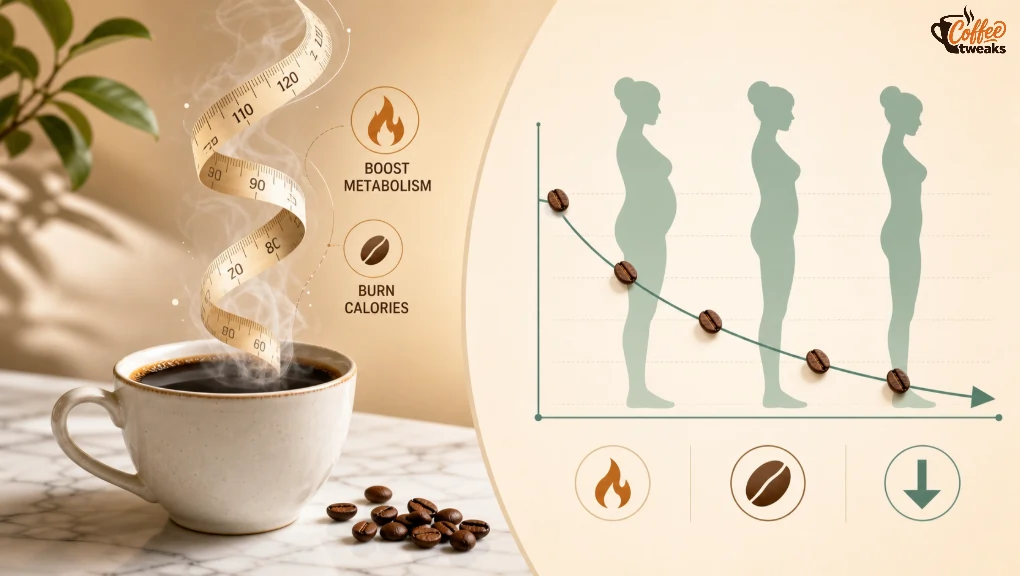
Coffee and caffeine have real, measurable effects on metabolism, fat burning, and appetite. The research is not fake. The effects are not zero. But they are modest, they diminish over time, and coffee alone cannot replace the fundamentals of weight management.
Here is the full picture.
What the Research Actually Found ☕🔬
Researchers at Harvard T.H. Chan School of Public Health found that drinking four cups of coffee daily was associated with roughly a 4% reduction in body fat over a 24-week period. The researchers were careful to frame this as an association, not proof of direct causation, and called for further studies to understand exactly why.
A separate systematic review and meta-analysis examining randomized controlled trials found that higher caffeine intake was linked to modest reductions in weight, BMI, and fat mass across study populations. For every doubling of caffeine intake in the reviewed trials, participants saw measurably smaller increases in weight and fat compared to lower-intake groups.
Okay but hear me out: “modest” in research language means statistically real but small in everyday terms. These studies are not describing dramatic transformation. They are describing small, consistent signals that add up over time under the right conditions.
And a few important caveats before we go further 🌿:
I think you deserve to know all of that upfront, not buried at the bottom.
How Caffeine Affects Your Metabolism 🔥
Caffeine raises your metabolic rate and triggers fat release. The effect is real. The size of it depends on who you are.
When caffeine enters your bloodstream, it stimulates the release of adrenaline, which tells your fat cells to break down stored fat and release it as free fatty acids. This process is called lipolysis, and it has been consistently demonstrated in research.
At the same time, caffeine activates thermogenesis, which is your body generating heat as a byproduct of metabolic activity. One foundational study found that a single 100 mg dose of caffeine (roughly one small cup of coffee) increased resting metabolic rate by 3 to 4% over a 150-minute window. When multiple doses were tracked across a full day, total energy expenditure rose by approximately 8 to 11% during that period.
In real numbers: lean participants in this research burned around 150 extra calories per day. Post-obese participants burned around 79 extra calories. That is a real thermogenic effect. It is not enormous, but it is not nothing either.
More recent research on fat oxidation confirms that caffeine consumption is associated with a higher rate of fat being used as fuel during physical activity, particularly during and after exercise. This is one reason caffeine is among the few substances that sports nutrition researchers consistently back with evidence.
The Chlorogenic Acid Nobody Talks About 🌱

Coffee contains more than caffeine. The other compounds matter too, even if the research is still catching up.
Chlorogenic acid is a polyphenol found in especially high concentrations in green and lightly roasted coffee beans. Emerging research suggests it may influence glucose metabolism and how the body handles fat at a cellular level, with some studies pointing toward anti-inflammatory and potential metabolic benefits.
I want to be honest here: the chlorogenic acid research is genuinely interesting but still developing. Much of it comes from animal models or small human trials. I would not make sweeping claims based on it, and the researchers who study it tend not to either. It is a promising direction, not a settled answer.
What is interesting, though, is one clinical trial that found decaffeinated coffee reduced hunger and increased levels of peptide YY (a satiety hormone) in participants, even without any caffeine at all. Plain caffeine dissolved in water showed no such appetite effect. This suggests that whatever appetite-suppressing qualities coffee has may actually come from its non-caffeine compounds, not the stimulant itself.
That is a nuance worth sitting with. ☕
Does Coffee Suppress Appetite? 🤔
Sometimes. For some people. For a limited window. The evidence is genuinely mixed.
Some studies show that caffeine can reduce food intake at a meal, particularly when consumed 30 minutes to 4 hours beforehand. One trial found that overweight and obese participants who drank higher-caffeine coffee before a meal ate measurably less at that meal and consumed fewer total calories throughout the rest of the day, compared to participants who drank water or low-caffeine coffee.
But when the same researchers looked at coffee consumed 3 to 4.5 hours before eating, the appetite-reducing effect largely disappeared. Timing matters. Body weight matters. Caffeine sensitivity matters.
Other studies found no statistically significant change in appetite feelings at all, even when calorie intake dropped slightly. The two effects, actual hunger perception and actual food consumed, do not always move together.
No exaggeration when I say the honest answer here is: coffee might help some people eat a little less under certain conditions. For others, it may do nothing noticeable. Both outcomes appear consistently enough in the research that neither camp is wrong.
The Tolerance Problem Nobody Mentions ⚠️
Your body adapts to caffeine. The metabolic boost that worked at first diminishes with regular use.
This is probably the most important thing I can tell you in this entire article, and it tends to get quietly skipped over by the headlines.
Caffeine tolerance is a well-established physiological reality. Your body adapts to regular exposure by downregulating the receptors caffeine acts on, which means the adrenaline spike, the thermogenic response, and the metabolic lift all become smaller over time.
Most of the studies showing impressive metabolic effects from caffeine were conducted on caffeine-naive participants or people consuming caffeine in controlled, intermittent doses specifically designed to prevent tolerance from forming. If you have been drinking two or three cups a day for several years, your metabolic response is significantly blunted compared to what those study subjects experienced.
One long-term observational study followed people for 12 years and found that increasing caffeine intake was associated with slightly less weight gain over time. The key word in that finding is increasing, not simply consuming. Your body responds to the change, not the maintenance of a habit it has already adapted to.
This does not mean your daily coffee is doing nothing. It means the metabolic effects are quieter in habitual drinkers than early research headlines suggested.
Black Coffee Calories: The Simplest Mechanism of All 🖤☕

A plain black coffee has almost zero calories. That single fact may matter more than everything else in this article.
An 8-ounce cup of brewed black coffee contains roughly 2 to 5 calories. An espresso shot is around 3 calories. If you are replacing a 300-calorie sweetened latte, a 400-calorie blended coffee drink, or even a 250-calorie bottled iced coffee with a plain black cup, you are creating a meaningful calorie deficit through that one swap alone.
A calorie deficit is the foundational mechanism behind fat loss, as essentially all major health organizations and nutrition researchers agree. You do not need to overthink it beyond that.
A study tracking coffee consumption habits found that increased coffee intake was associated with modest weight loss, but adding sugar nearly cancelled the effect for that group. The unsweetened coffee drinkers and the sugared coffee drinkers had noticeably different outcomes. The coffee was not the problem. The add-ins were.
This changed my whole morning, honestly, not because of some metabolic revelation, but because I realized the simplest version of the habit was also the most useful one.
Who Benefits More (And Who Should Be Careful) 🌿
Caffeine affects people very differently. Your response depends on your body, your habits, and your health status.
Lean individuals tend to see stronger thermogenic responses to caffeine than people with higher body fat percentages. Infrequent or new coffee drinkers experience more pronounced metabolic effects than regular consumers. People who are genetically fast metabolizers of caffeine clear it from their system quickly; slow metabolizers feel it for hours longer and may be more susceptible to side effects.
For some people, increasing coffee intake is genuinely not the right move, and I think that is worth saying clearly rather than assuming everyone reading this is in perfect health. If you are managing anxiety, elevated blood pressure, heart arrhythmias, adrenal issues, sleep disorders, or if you are pregnant or breastfeeding, the caffeine conversation looks different for you. Caffeine raises cortisol and heart rate, and those are not neutral actions for everyone.
There is also a real paradox worth naming: poor sleep is one of the strongest independent predictors of weight gain in the research literature. If drinking more coffee disrupts your sleep even slightly, the net effect on your weight could be the opposite of what you intended. More caffeine, worse sleep, more weight gain. That is a cycle that plays out for real people.
The FDA's general guidance sets 400 mg of caffeine per day as the upper threshold for most healthy adults, roughly three to four standard cups of brewed coffee. That is a population-level ceiling, not a personal prescription. If you have any doubt about what is right for your situation, a registered dietitian or your primary care doctor is genuinely the right call. ☕🌿
The Real Evidence vs. The Hype 📊

Here is a clear-eyed summary of what the research actually supports:
What the evidence reasonably backs:
What the evidence does not support:
The Bottom Line on Coffee for Weight Loss☕🌿✨
Coffee has genuine, evidence-backed effects on metabolism and fat burning. Those effects are real but modest, variable between people, and diminish with habitual use.
I still drink black coffee every morning. I love it. I genuinely believe it is doing something useful as part of a broader routine that includes good sleep, movement, and not eating like I am untouchable.
But I want to be the kind of writer who gives you the full picture. The effects are modest. They vary between individuals. The research has real limitations. And the simplest mechanism, replacing calorie-heavy drinks with plain black coffee, may honestly outperform all the interesting metabolic science.
And honestly? That is the whole point.
Coffee is one legitimately useful piece of the puzzle. Not the whole puzzle, not a shortcut, not a substitute for the fundamentals. Just a small, honest tool with a pretty good research file behind it.
If you want personalized guidance on caffeine and weight management, please talk to a registered dietitian or your healthcare provider. They know your full picture in ways a coffee blog simply cannot.