The Colombian Coffee Guide for People Who Already Drink It

Most people think “Colombian coffee” is a flavor.
It isn't.
It's a country. A huge, mountainous, tilted-three-ways country that grows hundreds of different cups across elevations that swing from 1,200 to over 2,300 meters. Saying you “like Colombian coffee” is like saying you like wine.
Cool. Which one? Red? Natural orange thing from a guy with a beard? A $9 bottle from the gas station?
Real talk… if you already buy Colombian on the regular and you're still grabbing whatever bag says “Colombia, smooth & balanced” — you're leaving the best part on the table. This guide fixes that. By the end you'll know which region to chase based on what you actually like to taste. ☕🎯
The One Thing Every Colombian Coffee Guide Gets Wrong
They treat Colombia as a single flavor: “smooth, mild, balanced, low acid.”
That's the export-blend version. That's the supermarket can. That's what Colombia sells in bulk to people who aren't paying attention.
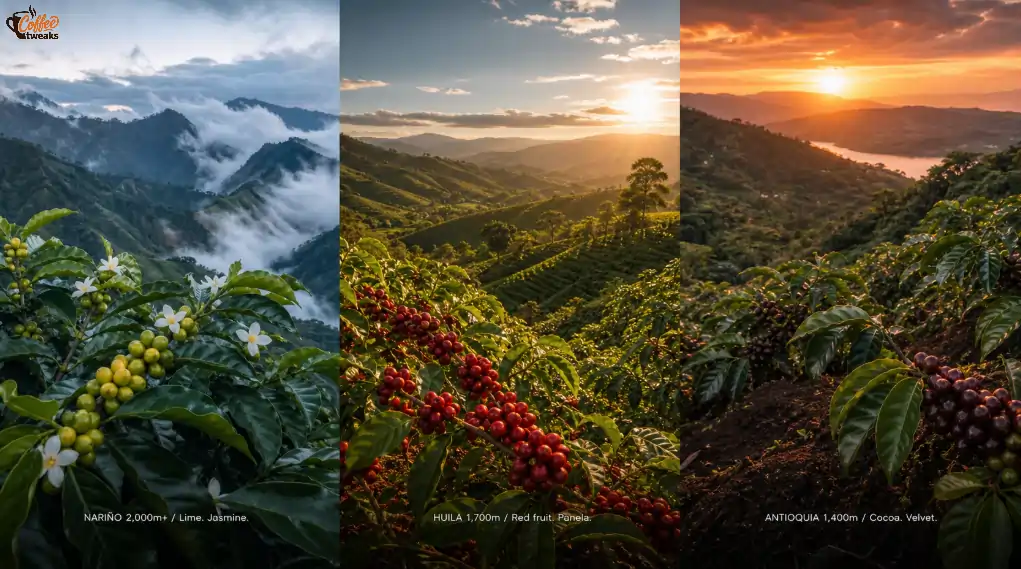
Here's the thing. The Colombia you should be buying, single origin, region-stated, ideally farm- or co-op-level, is anything but uniform. A Nariño can taste like lime zest and jasmine. A southern Huila can taste like ripe red fruit and panela. An Antioquia can taste like a chocolate bar that went to finishing school.
Same country. Wildly different cups. The variable that does most of the work? Altitude.
Why Altitude Decides Almost Everything
High up, it's colder. Cold slows the cherry down. The bean takes longer to mature, packs in more sugars and acids, gets denser.
Denser bean = more to extract = more complexity, more brightness, more “ooh what is that.”
So when a bag brags “grown at 1,950 meters,” that's not marketing fluff. That's a flavor promise. Believe it.
Maya's Take: If you've been telling yourself you “don't like acidic coffee,” I'd bet money you've only had low-grown, dark-roasted Colombia. High-grown Nariño at a medium roast is not acidic in the battery-acid sense. It's bright. Like biting fruit. Try one before you write off the whole category. I've been wrong before. Not about this.
The Regions, Ranked by What They Actually Taste Like
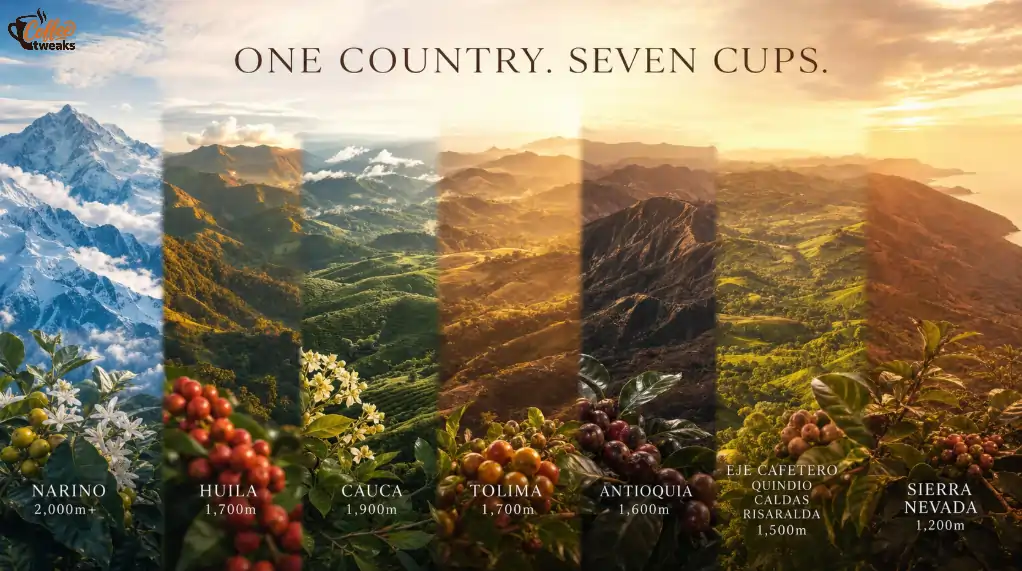
Three Andean mountain ranges slice Colombia into thousands of microclimates. That's the whole secret. Here's how the big ones break down.
| Region | Typical Altitude | Flavor Signature | Acidity | Best For |
|---|---|---|---|---|
| Nariño | 1,800–2,300m | Lime, jasmine, tropical fruit, bright | High | Filter nerds, fruit chasers |
| Huila | 1,500–2,000m | Red fruit, caramel, panela, complex | Med-High | The all-rounder, espresso + filter |
| Cauca | 1,700–2,100m | Citrus, floral, clean, tea-like | High | Pour-over, clarity seekers |
| Tolima | 1,400–2,000m | Stone fruit, brown sugar, soft | Medium | Easy daily driver |
| Antioquia | 1,300–1,900m | Chocolate, nut, full body | Low-Med | Espresso, milk drinks |
| Quindío / Caldas / Risaralda | 1,300–1,800m | Classic “Colombian”: caramel, nut, balanced | Medium | The safe, reliable cup |
| Sierra Nevada | 900–1,600m | Mild, chocolatey, soft, low acid | Low | Cold brew, dark roast lovers |
Nariño — the southern overachiever
Way down south, near Ecuador, grown stupidly high. The cold + equatorial sun combo creates intensely sugary, bright coffees. Lime, white flowers, sometimes a tropical thing that makes people accuse it of being Ethiopian.
👉 Buy this if: you want the loudest, fruitiest, most “wait, this is Colombian?” cup in the country.
Huila — the one I'd hand a beginner and a snob
Biggest specialty-producing region for a reason. Sits in a high valley with a long, slow ripening window. The result is consistently complex but approachable — red fruit, caramel, that brown-sugar panela sweetness Colombians actually grew up on.
👉 Buy this if: you want one bag that's great as both espresso and pour-over. Low-key obsessed with southern Huila (Pitalito, Timaná) lots. And I'm not apologizing for that.
Cauca — clarity in a cup
Sits between Nariño and Huila and splits the difference, leaning clean and tea-like. Citrus, florals, very transparent. Doesn't hit you over the head. Rewards a careful pour-over.
👉 Buy this if: you like a delicate, articulate cup over a bold one.
Tolima, Quindío, Caldas, Risaralda — the dependable middle
These are the heart of the old Coffee Axis (Eje Cafetero). This is “classic Colombian” — caramel, nuts, balance, medium acidity, nothing scary. Quindío and Caldas especially are the cups your parents think of when they think Colombia.
👉 Buy this if: you want reliable, crowd-pleasing, never-offends coffee. Great for filling the daily-drinker slot.
Antioquia — the chocolate region
Lower, warmer, bigger body, less acidity. Heavy on cocoa and nut. This is your espresso and your latte base.
Buy this if: you drink milk drinks or want that thick, chocolatey shot. Antioquia loves a medium-dark roast.
Sierra Nevada — the coastal outlier
Northern coastal mountains, lower altitude, hotter. Soft, mild, low-acid, chocolatey. Often shade-grown and organic.
👉 Buy this if: you want cold brew or a smooth dark roast that won't fight you in the morning.
“Supremo” Doesn't Mean What You Think
Let's kill this myth right now.
Supremo is a bean size. Not a quality grade. Not a flavor tier.
Colombia grades exportable coffee largely by screen size. Supremo = the biggest beans, screen 17/18. Excelso = slightly smaller, screen 15/16. That's the actual difference.
And here's the kicker: Supremo and Excelso beans often come off the same farm, same harvest, sometimes the same tree. One just got caught in a bigger sieve.
| Feature | Supremo | Excelso |
|---|---|---|
| Screen size | 17/18 (largest) | 15/16 |
| What it tells you | Bean is big | Bean is medium-large |
| What it tells you about taste | Almost nothing | Almost nothing |
| Common marketing claim | “Premium / highest grade” | “Standard” |
Big beans aren't automatically better. Some argue smaller, denser Excelso beans can carry more concentrated flavor. The point isn't that Supremo is bad — plenty of Supremo is delicious. The point is the word “Supremo” on a bag tells you about geometry, not greatness.
Maya's Take: If a roaster's only selling point is “SUPREMO” in big letters and zero info about region, altitude, farm, or process… that's a bag hiding behind a screen size. Hard pass. The label you actually want says region + altitude + process + harvest year. ☕
Washed vs Natural Colombian — and Why It Matters Now
For decades Colombia was a washed-coffee country, full stop. Wash the fruit off, ferment, dry the clean seed. That's where the “clean, bright, balanced” reputation comes from.
Colombia got very good at funky experimental processing over the last decade. A natural or anaerobic Huila can taste nothing like the washed version from the same farm.
👉 Buy this if you want the region's true voice: washed.
👉 Buy this if you want a fruit explosion / wine-y party: natural or anaerobic.
When to Buy — Harvest Timing Most Guides Skip
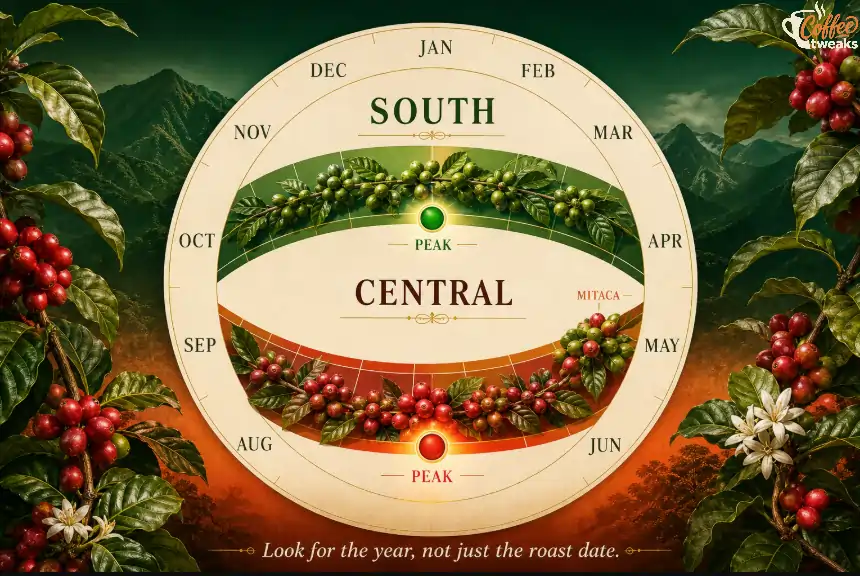
Colombia's near-equator position gives it two harvests a year in most regions: the main crop (best quality) and the mitaca (smaller fly crop). Different regions harvest at different times, so something's always fresh.
Rough guide:
For you, the buyer: a region-stated bag is freshest a few months after its harvest. A Nariño bought in late summer/autumn is likely from that year's main crop. Always look for a “harvest” or “crop year” date on the bag, not just a roast date. Green coffee ages. A bag with no harvest year is a bag betting you won't ask.
Why Colombian Tastes Different From Ethiopian or Brazilian
Quick mental model, because people ask me this constantly.
That balance is the actual Colombian superpower. Not “smoothness.” Range. It can do bright-and-fruity (Nariño) or deep-and-chocolatey (Antioquia) depending on where you point your money.
Roast & Brew, Region by Region
Don't dark-roast a Nariño. You paid for that altitude. Don't pour-over an Antioquia and wonder why it's flat.
| Region | Roast I'd buy | Brew I'd use |
|---|---|---|
| Nariño | Light–medium | Pour-over (V60), filter |
| Huila | Medium | Anything — espresso and filter |
| Cauca | Light–medium | Pour-over, Chemex |
| Tolima | Medium | Drip, French press |
| Antioquia | Medium–dark | Espresso, moka pot, milk drinks |
| Quindío/Caldas/Risaralda | Medium | Drip, all-rounder |
| Sierra Nevada | Medium–dark | Cold brew, French press |
Maya's Take: If you're brewing high-grown washed Colombia (Nariño, Cauca), do yourself a favor and brew it as filter at least once. A 1:16 ratio, water around 94–96°C, medium-fine grind. The fruit shows up in filter in a way it never will buried in milk. ☕🎯
How to Read a Bag Like You Know What You're Doing
A good Colombian single-origin bag tells you four things. Demand all four:
- Region (ideally sub-region): “Huila, Pitalito” beats “Colombia.”
- Altitude: numbers in meters. Higher = brighter.
- Process: washed / natural / honey / anaerobic.
- Harvest year + roast date: freshness on both clocks.
Variety (Caturra, Castillo, Pink Bourbon, Gesha) is a nice bonus. Pink Bourbon and Gesha lots from Huila and Nariño are some of the most exciting coffees coming out of Colombia right now, and priced accordingly.
If a bag only says “Colombian Supremo, 100% Arabica” and nothing else? You now know exactly how much that tells you. Almost nothing.
FAQ
Is Colombian Supremo better than Excelso?
Not necessarily. Supremo just means larger beans (screen 17/18) versus Excelso (15/16). They often come from the same farms and harvests. Size, not quality.
Which Colombian region has the fruitiest coffee?
Nariño, hands down — high altitude near Ecuador gives lime, floral, and tropical notes. Cauca and high-grown Huila are close behind.
Why does some Colombian coffee taste like chocolate and some like fruit?
Altitude and processing. Lower regions (Antioquia, Sierra Nevada) lean chocolate and nut; high regions (Nariño, Cauca) lean bright and fruity. Natural processing adds even more fruit.
Is Colombian coffee actually low in acidity?
Only the low-grown, dark-roasted stuff. High-grown washed Colombia from Nariño or Cauca is brightly acidic in a pleasant, fruit-like way.
When is the best time to buy fresh Colombian coffee?
Southern regions (Nariño, Huila, Cauca) harvest mainly April–July; central regions (Tolima, Quindío) skew September–December. Look for a harvest/crop year on the bag.
Washed or natural Colombian — which should I buy?
Washed for the region's clean, true character. Natural or anaerobic for big, jammy, fruit-forward intensity.
What to Remember Before You Buy Colombian Coffee
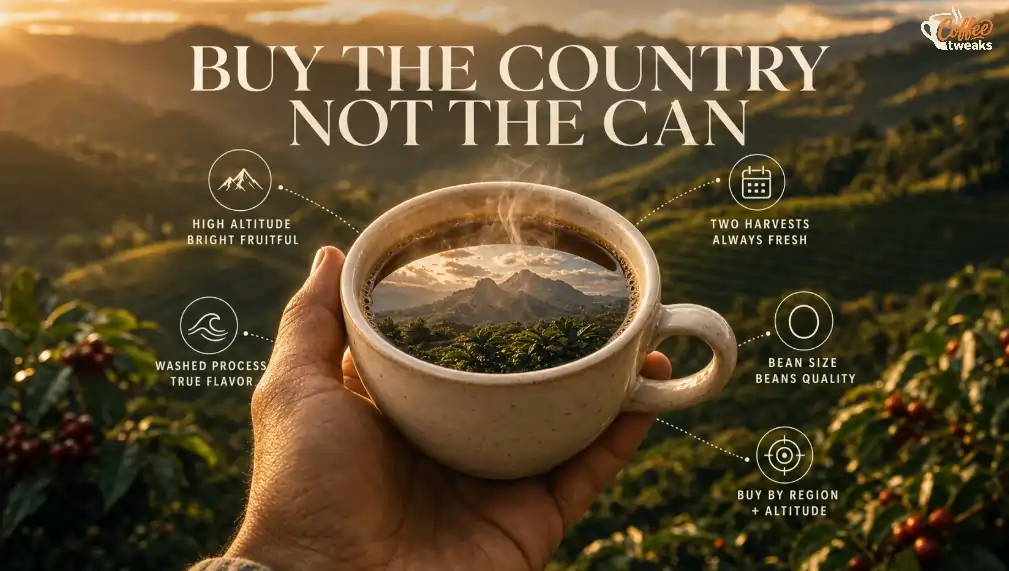
You already knew Colombian coffee was good. Now you know how to buy the right one.