How Much Coffee Is Too Much? The Caffeine Limit Guide

📋 Medical Disclaimer: This article is educational content, not medical advice. I'm a coffee expert, not a doctor. If you're experiencing chest pain, irregular heartbeat, severe anxiety, or any symptoms that worry you, please talk to a healthcare professional. This article is here to help you make smarter decisions about your coffee habit, not to diagnose you.
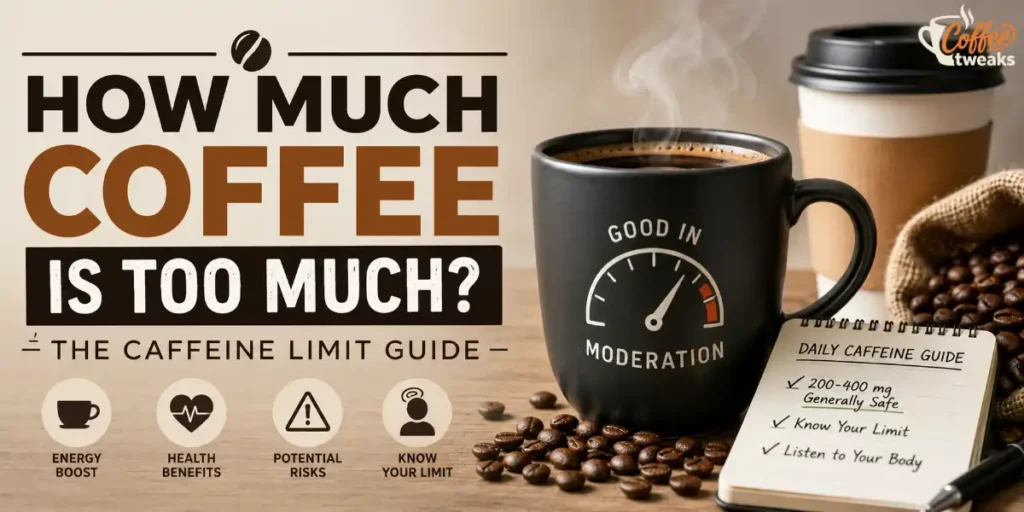
Quick Verdict: For most healthy adults, coffee becomes “too much” when total caffeine passes 400 mg per day, roughly four small 8-oz brewed coffees, not four giant mugs. If you drink 4–6 cups daily, don’t panic; do the caffeine math. Worry if you’re getting jittery, anxious, sleepless, nauseous, or feeling heart palpitations. Pregnant readers should stay closer to 200 mg per day. Because espresso, cold brew, drip coffee, and coffee-shop sizes vary wildly, your cup count is basically useless without serving size. Count milligrams, not cups. ☕🎯
You drink 4 cups a day. Maybe 5. Maybe 6 on the rough ones. And somewhere between the second and third cup, a little voice asks: is this too much?
Here's my answer before we get into anything: probably not, but it depends entirely on what counts as a “cup,” what you're putting in it, and whether your body is actually handling it.
The number that gets thrown around constantly, 400 mg of caffeine per day, sounds simple. It isn't. Four “cups” of coffee can mean 200 mg, or it can mean 700 mg, depending on where you're drinking them and what you're calling a cup.
That gap is where most advice fails you. Let's fix that. ☕
The Safe Daily Caffeine Limit (Actually Explained)
The FDA's Number
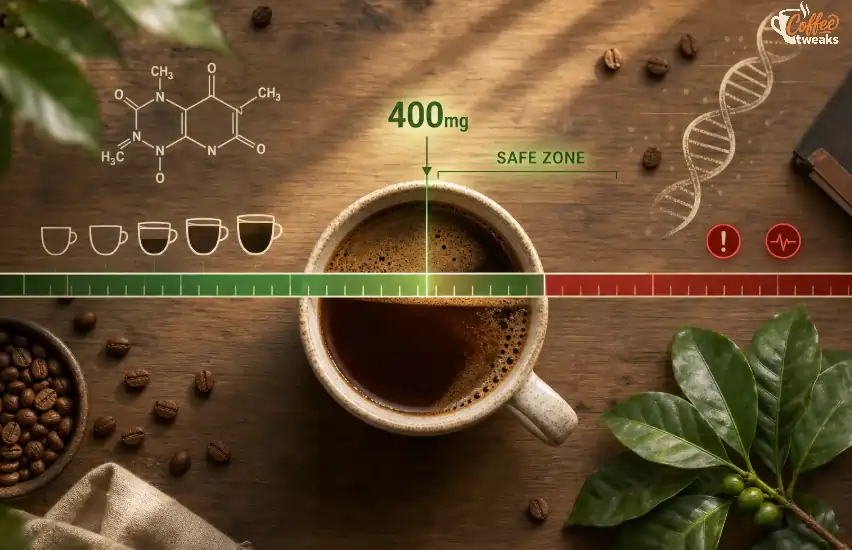
The FDA has cited 400 mg of caffeine per day as an amount not generally associated with dangerous effects for most healthy adults.
That number didn't appear from nowhere. It's based on decades of research into how caffeine affects heart rate, blood pressure, sleep, anxiety, and other systems. For most healthy non-pregnant adults, staying under 400 mg daily is where the evidence says you're in a safe zone.
The same FDA guidance is very direct about one thing: rapid consumption of around 1,200 mg of pure caffeine, the kind found in highly concentrated powders and supplements, not in brewed coffee, can be toxic. We're not talking about normal coffee drinking. We're talking about people misusing pure caffeine products. It's worth knowing, but don't let it panic you about your morning routine.
What Mayo Clinic Says
Mayo Clinic lands in the same place. Up to 400 mg per day seems safe for most adults. They also flag who should be more careful: people who are pregnant, breastfeeding, sensitive to caffeine, or experiencing headaches, restlessness, or nervousness after coffee.
That last group is important. Some people metabolize caffeine slowly — genetically — and feel 200 mg the way others feel 600 mg. If you've always felt wired on one cup, that's not weakness. That's your CYP1A2 enzyme working differently. It's real, it's biological, and it means your personal limit isn't necessarily 400 mg.
The Harvard Health Angle
Harvard Health frames it well: two to five cups a day may actually protect against heart disease, type 2 diabetes, and some cancers. But “too much” can cause anxiety, blood pressure spikes, and insomnia.
I've been wrong before. Not about this: moderate coffee consumption is not something you need to feel guilty about. The research is pretty consistently in your corner — up to a point.
Is 4 Cups of Coffee Too Much? Let's Do the Math ☕
This is where it gets honest.
Not All Cups Are Equal
| Coffee source | Serving size | Approximate caffeine |
|---|---|---|
| Home brewed coffee | 8 oz | ~96 mg |
| Filter / drip coffee | 1 mug (12 oz) | ~140–180 mg |
| Espresso shot | 1 oz | ~63 mg |
| Double espresso | 2 oz | ~125 mg |
| Instant coffee | 1 mug (8 oz) | ~60–100 mg |
| Cold brew (standard) | 8 oz | ~150–200 mg |
| Energy drink | 8 oz | ~79 mg |
| Energy shot | 2 oz | ~200 mg |
| Starbucks Grande brewed coffee | 16 oz | ~330 mg |
| Dunkin' large brewed coffee | 20 oz | ~270–300 mg |
Real talk… look at that Starbucks Grande. One drink. 330 mg. You're already at 82% of your daily limit in one order. If you grab two of those, you've blown past 400 mg before your second work meeting.
This is why “four cups” is a meaningless metric without defining the cup.
Four Cups: The Real Math
| What “4 cups” looks like | Total caffeine | Over the limit? |
|---|---|---|
| 4 x 8 oz home brewed coffees | ~384 mg | Basically at the limit |
| 4 x 12 oz drip coffee mugs | ~560–720 mg | Yes, meaningfully over |
| 4 x double espresso drinks | ~500 mg | Yes |
| 4 x instant coffee mugs | ~240–400 mg | At or near the limit |
| 4 x Starbucks Grande brews | ~1,320 mg | Significantly over |
| 4 x standard espresso shots | ~252 mg | Well under the limit |
The bottom line on 4 cups: if you're drinking small home-brewed coffees, you're probably fine. If you're on your fourth large drip or second Starbucks Grande, you're not.
Am I Over the Limit? A Self-Check 🎯
Before you count milligrams, ask yourself these questions:
If you answered yes to most of those… the math doesn't matter anymore. Your body is already telling you something. That's more reliable than any chart.
Too Much Coffee Symptoms — What to Actually Watch For

The Mild “I Overdid It Today” Signs
These happen to most coffee drinkers at some point. They're not dangerous, they're just your body saying that was too much, today.
These usually resolve within a few hours as your body metabolizes the caffeine. Drink water. Don't drink more coffee. You're fine.
Anxiety and Jitteriness
Here's the thing. Caffeine works by blocking adenosine, the chemical in your brain that makes you feel tired. When adenosine is blocked, adrenaline increases. That's the “alert” feeling you're chasing.
But for some people, especially those with existing anxiety or panic tendencies, that adrenaline hit tips into anxiety. Heart-fluttery. Slightly panicked. Hyper-aware of every sound. Sound familiar?
If coffee regularly triggers anxiety, your personal limit is lower than 400 mg, regardless of what the guidelines say.
Harvard Health specifically notes that caffeine can worsen anxiety and that people prone to panic attacks may be especially sensitive. That's not a reason to quit coffee. It's a reason to know your number.
Heart Rate and Palpitations
Cleveland Clinic lists heart palpitations as a key symptom of too much caffeine, along with increased heart rate and raised blood pressure.
Most of the time, caffeine-induced palpitations are not dangerous in healthy people. They're uncomfortable, and they're a signal. If your heart is doing something weird after your third coffee, that's your cue to stop for the day, not push through.
The British Heart Foundation says moderate coffee, roughly four to five cups per day at reasonable sizes, should be fine for most people. But people who experience palpitations or have existing heart conditions should treat caffeine more carefully, and some may want to avoid it.
If you're getting palpitations regularly, or if they're accompanied by chest pain, dizziness, or shortness of breath, that's a conversation to have with a doctor. Not an article. A doctor.
The Emergency Warning Signs
These are not “too much coffee” symptoms. These are emergency symptoms that caffeine at very high levels or in concentrated forms can cause:
If you or someone around you is experiencing these, call emergency services. Don't wait it out.
Again, we're not talking about brewed coffee here. We're talking about caffeine overdose, which in the context of normal coffee drinking is extremely rare. But it matters to say it.
Coffee and Sleep: The Calculation Nobody Does
Caffeine's Half-Life
This is where I see coffee drinkers go wrong constantly. They know caffeine affects sleep. They stop at 6pm. They still can't sleep at midnight. They blame stress.
Sleep Foundation puts caffeine's half-life at anywhere from 2 to 12 hours, with the average being around 4 to 6 hours for most people. Half-life means the time it takes for half the caffeine to leave your system.
Let's do the actual math. If you drink a 200 mg coffee at 3pm, and your half-life is 6 hours:
You have 50 mg of caffeine in your bloodstream at 3 am. And you're wondering why your sleep is light.
Harvard Health notes that caffeine can take up to 8 hours to wear off for some people. For slow caffeine metabolizers, it can be even longer. Pregnancy also significantly extends caffeine's half-life, up to 15 hours in the final trimester.
When to Stop Drinking Coffee
There's no universal answer. But here's a practical framework:
| Your sleep time | Stop caffeine by | Why |
|---|---|---|
| 10 pm | 2 pm | 6-hour half-life, two cycles |
| 11 pm | 3 pm | Same math |
| Midnight | 4 pm | Conservative buffer |
| 6 am wake-up | No coffee after 2pm | Protects sleep architecture |
If you're already sleeping well and waking refreshed, your current cut-off is fine. If you're waking at 3 am with your brain racing, move your last coffee earlier. A week. See what happens. You might be surprised.
Caffeine by Coffee Type: What's Actually in Your Cup
Brewed and Drip Coffee
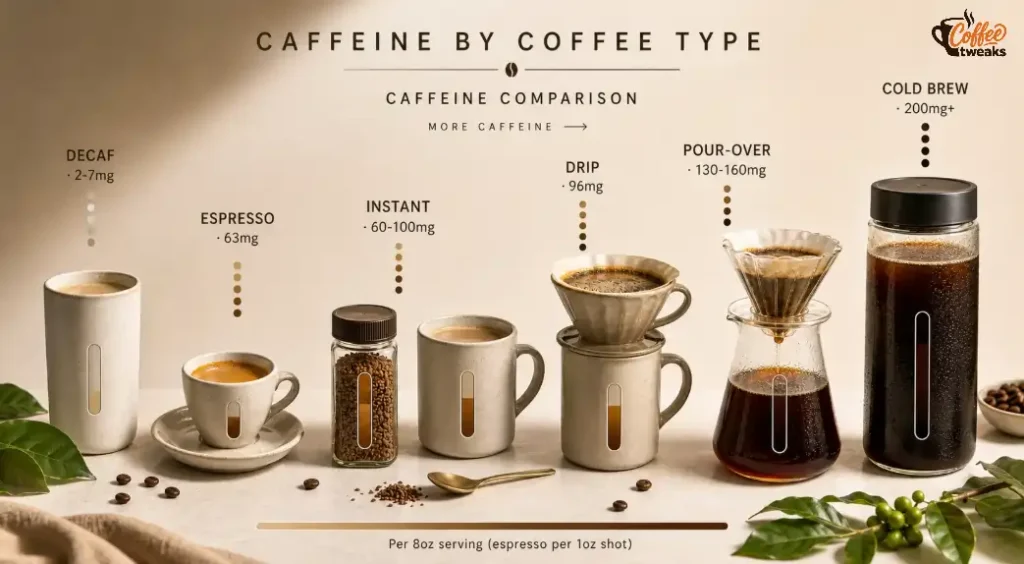
Brewed drip coffee is the benchmark. Around 96 mg per 8 oz. That's the number Mayo Clinic uses.
But here's what changes everything: serving size, roast level, and brewing time. Lighter roasts retain slightly more caffeine than dark roasts. Longer brew times extract slightly more caffeine. A 12 oz mug of drip can easily sit at 140–180 mg. Double that for a 24 oz travel tumbler.
Espresso
Espresso is the most misunderstood one. ☕
People assume espresso is the highest-caffeine option. It's not — by volume, yes. By serving, usually no.
A single 1 oz espresso shot clocks in at around 63 mg. A double is around 125 mg. Compare that to your 12 oz drip coffee at 150+ mg.
The confusion comes from concentration. Espresso is around 2,500 mg/L. Drip coffee is around 400–800 mg/L. But you're drinking a 1 oz shot, not a litre of espresso.
This is why an Americano (espresso + water) has similar or less caffeine than the same volume of brewed coffee. The water doesn't add caffeine — it just makes it taste different.
Cold Brew and Pour-Over
Cold brew is where people genuinely underestimate their intake.
Cold brew concentrate can run 150–200+ mg per 8 oz serving — and many people drink it in 12 oz servings, or mix it stronger than they realize. Commercial bottled cold brews sometimes hit 250 mg per bottle.
Pour-over varies more than any other method because the ratio is entirely in your hands. A typical pour-over with a 1:15 ratio (1g coffee per 15ml water) in a standard 300 ml cup sits around 130–160 mg. Dial the ratio stronger, you push higher.
Instant and Decaf
Instant coffee gets dismissed a lot. Low-key, it's fine. It typically sits at 60–100 mg per mug — often lower than drip, which makes it a reasonable choice if you want caffeine without going hard.
Decaf isn't zero. It's very low, around 1–7 mg per 8 oz cup. Mayo Clinic confirms: brewed decaf sits at roughly 1 mg per 8 oz. Not zero, but close enough to zero that it won't move the needle on your daily total.
Energy Drinks vs Coffee
People don't usually think to compare these, but they're drinking both. Here's why it matters:
| Drink | Serving | Caffeine |
|---|---|---|
| Standard energy drink | 8 oz | ~79 mg |
| Energy shot | 2 oz | ~200 mg |
| Home brewed coffee | 8 oz | ~96 mg |
| Starbucks cold brew | 16 oz | ~205 mg |
An energy shot is 200 mg in 2 oz. A Red Bull is 80 mg per 8.4 oz can. Add that to your three coffees and you've quietly added another 80–200 mg to your day without thinking about it.
Track your total caffeine. Not just your coffees.
Who Should Actually Cut Back?
Most of the people reading this with a 4–6 cup habit are probably fine on the numbers alone. But numbers aren't everything. Here are the groups where “probably fine” becomes “genuinely cut back”:
Pregnant or Breastfeeding
This is non-negotiable. The NHS recommends no more than 200 mg of caffeine per day during pregnancy, because caffeine crosses the placenta and the developing fetus cannot metabolize it the way adults do.
During pregnancy, your own caffeine half-life extends significantly, meaning the same 200 mg cup hits harder and lasts longer than it did before.
For breastfeeding: NHS advises trying not to exceed 300 mg per day while breastfeeding. Caffeine passes into breast milk, though in smaller amounts than into your bloodstream.
If you're pregnant and currently drinking 4 cups of drip coffee per day — that's almost certainly over 400 mg and well over the safe limit for pregnancy. This is one situation where you do need to cut back.
Anxiety or Panic Symptoms
If your coffee habit is making your anxiety worse, it's not a willpower issue, it's chemistry. Caffeine raises adrenaline. Adrenaline triggers the fight-or-flight system. For people with anxiety disorders, panic disorder, or generalized anxiety, that spike can trigger or worsen symptoms.
Cleveland Clinic lists anxiety as a direct symptom of caffeine sensitivity. Harvard Health connects caffeine to worsened anxiety and sleep disruption. If you're anxious, your 400 mg limit might effectively feel like 600 mg.
Cut to 100–200 mg per day. See if it helps. You don't have to quit. You just have to find your actual personal limit.
Sleep Problems
If you've been sleeping badly and you're drinking coffee, especially past 2–3pm — caffeine is the obvious first variable to change. Not ambien. Not melatonin. Not a new mattress.
Caffeine stays in your system longer than you think. Move your last cup to noon for one week. If your sleep improves, you found your answer. It's annoying. It's also free.
Heart Symptoms or High Sensitivity
Some people get palpitations from a single coffee. Some get them only from the fourth. Both situations are real. If coffee regularly causes a racing heart, palpitations, or a fluttery chest sensation, you're in the “lower personal limit” camp.
The British Heart Foundation is clear: most people with heart disease can drink moderate coffee, but individual sensitivity matters. If you've got a known heart condition and a heavy caffeine habit, your cardiologist should be part of that conversation.
How to Cut Back Without Feeling Like You're Being Punished

I'm not here to take your coffee away. I'm here to help you drink it smarter.
Reduce Gradually
Cold-turkey caffeine withdrawal is miserable. Headache. Fatigue. Irritability. Brain fog. It usually peaks around 24–48 hours and lasts up to a week.
Don't do it cold turkey. Instead:
Your brain adapts. The headaches don't last. The key is going slowly enough that your adenosine receptors can adjust without a full system protest.
Swap In Decaf or Half-Caf
I know. Half-caf sounds like giving up. It's not.
A half-caf drip at 50–70 mg still gives you the ritual, the flavour, the warmth, and enough caffeine to avoid withdrawal. If you're drinking 5 cups a day and you switch two of them to half-caf, you've cut your intake by 20–40% without losing the habit that structures your day.
For evening coffee cravings, and yes, some of us genuinely want the taste without the buzz, decaf is a real option. The flavour gap between good decaf and full-caf has narrowed significantly as Swiss Water and CO2 decaffeination methods have improved.
Track Your Total Caffeine
Most people have no idea how much caffeine they're actually consuming. They count coffees, not milligrams.
For one week, add it up. Use the tables above. Include energy drinks, pre-workout, tea, and soft drinks. Most people are surprised — in one direction or the other.
If you're at 350 mg, relax. If you're at 700 mg and wondering why you're anxious and sleeping badly… now you know. The number matters less than knowing yours.
Myth vs Fact: The Caffeine Claims That Need to Die ☕🎯
| Myth | Fact |
|---|---|
| “Espresso has the most caffeine” | Espresso is more concentrated, but a full 8 oz drip coffee usually has more total caffeine than a single shot |
| “Four cups is always safe” | It depends entirely on what counts as a cup — four large shop coffees can easily top 800 mg |
| “Decaf has no caffeine” | Decaf has very low caffeine — roughly 1–7 mg per cup — not zero |
| “Caffeine only affects sleep if you drink it late” | The half-life is 4–6 hours for most people. Afternoon coffee absolutely affects sleep |
| “I've built a tolerance, so it doesn't affect me” | Tolerance to the alertness effect builds, but caffeine's effect on sleep architecture is harder to build tolerance to |
| “Coffee dehydrates you” | Caffeinated drinks contribute to your fluid intake. The mild diuretic effect doesn't outweigh the liquid you're drinking |
| “Caffeine overdose is from drinking too much coffee” | Serious caffeine toxicity is primarily a risk from concentrated supplements and pure caffeine products — not brewed coffee |
Who Should Worry? The Honest Answer

Here's my honest read, as someone who has pulled about 10,000 espresso shots and spent years obsessing over caffeine science.
If you drink 4–6 normal home-brewed 8 oz coffees per day, you're likely near the recommended limit but not dramatically over it, and if you feel fine, sleep reasonably well, and don't experience anxiety or heart symptoms, you don't have an urgent problem.
If those same 4–6 “cups” are large drip mugs, cold brews, or coffee-shop orders — do the math. You may be 200–400 mg over your limit without realizing it.
And if any of these describe you, pay attention:
Those aren't coffee-snob concerns. They're your body's signals. They're worth listening to.
The Numbers That Matter
FDA guideline: 400 mg/day is not generally associated with dangerous effects for most healthy adults. Toxic effects are observed around 1,200 mg of pure caffeine — not brewed coffee.
Pregnancy: 200 mg/day maximum during pregnancy. 300 mg/day while breastfeeding. Both NHS limits exist because caffeine crosses the placenta and passes into breast milk.
Sleep: Caffeine's half-life is 2–12 hours. Most people metabolize it in 4–6 hours. A 3pm coffee means measurable caffeine still in your system at 9pm.
Heart: Caffeine temporarily raises blood pressure and heart rate. For most people, this is not dangerous. For people who experience regular palpitations, the calculation is different.
Personal limit: The 400 mg guideline is for most healthy adults. If you're caffeine-sensitive, anxious, pregnant, or experiencing symptoms — your number is lower. Find your number, not the average.
Frequently Asked Questions
How much coffee is too much per day?
For most healthy adults, too much coffee typically means exceeding 400 mg of caffeine per day. That's the level the FDA and Mayo Clinic both cite as a general safe threshold. But your actual limit depends on body weight, caffeine sensitivity, medications, and whether you're pregnant.
Is 4 cups of coffee a day too much?
It depends on what a “cup” means. Four standard 8 oz brewed coffees sit around 380 mg — just under the 400 mg threshold. Four large coffee-shop coffees can easily exceed 800 mg. Define your cup, then do the math.
What happens when you drink too much coffee?
Common symptoms include jitteriness, anxiety, heart palpitations, headache, nausea, upset stomach, restlessness, and difficulty sleeping. Severe caffeine overdose — usually from concentrated supplements, not brewed coffee — can cause tremors, vomiting, and irregular heartbeat.
How much caffeine is in an espresso shot?
A single 1 oz espresso shot contains roughly 63 mg of caffeine. A double shot is around 125 mg. Despite the reputation, a full mug of drip coffee usually contains more total caffeine than a single espresso.
How long does caffeine stay in your system?
Caffeine has a half-life of 2–12 hours, with an average of 4–6 hours for most people. That means a 200 mg coffee at 3pm still has around 100 mg of caffeine circulating in your body at 9pm.
How much coffee is safe during pregnancy?
The NHS recommends no more than 200 mg of caffeine per day during pregnancy. That's roughly one to two small brewed coffees. Caffeine crosses the placenta, and the fetus cannot metabolize it the way adults do.
Is cold brew stronger than regular coffee?
Cold brew concentrate can be significantly stronger — 150–200+ mg per 8 oz, compared to around 96 mg for standard brewed coffee. Many people underestimate cold brew because it tastes smoother and less bitter. Smoother doesn't mean less caffeine.
What's the best way to cut back on coffee without withdrawal?
Reduce gradually — cut 25 mg every few days rather than going cold turkey. Swap one or two cups for half-caf. Move your last coffee 30 minutes earlier each week. Caffeine withdrawal headaches peak at 24–48 hours and typically resolve within a week with a gradual approach.
Can too much coffee cause anxiety?
Yes. Caffeine raises adrenaline by blocking adenosine, which is the same mechanism that makes you feel alert. For people with existing anxiety or panic tendencies, this can tip into genuine anxiety symptoms. If coffee regularly makes you feel anxious, your personal limit is lower than 400 mg regardless of general guidelines.
Does decaf coffee have caffeine?
Very little — roughly 1–7 mg per 8 oz cup, compared to 96 mg for standard brewed coffee. Not truly zero, but low enough that it won't contribute meaningfully to your daily total.
Can coffee cause heart palpitations?
Yes, particularly when caffeine intake is high or when someone is sensitive to caffeine. Most caffeine-related palpitations in healthy people are uncomfortable but not dangerous. Regular palpitations, or palpitations with chest pain or dizziness, warrant a conversation with a doctor.
What is caffeine half-life?
The time it takes for half of the caffeine you consumed to be eliminated from your body. For most adults this is 4–6 hours, but it ranges from 2 to 12 hours depending on genetics, liver function, medications, and whether you're pregnant.
Should I switch to half-caf?
If you're over your limit, yes. Half-caf typically contains 50–70 mg per 8 oz cup — enough to avoid withdrawal, maintain the ritual, and reduce total daily intake without feeling deprived.
Is it bad to drink coffee on an empty stomach?
Coffee on an empty stomach can increase acid production and cause nausea or digestive discomfort in some people. It doesn't cause significant harm for most people, but if your stomach is sensitive, eating before your first coffee may help.
When should I see a doctor about my caffeine intake?
If you experience chest pain, irregular heartbeat, severe palpitations, difficulty breathing, uncontrollable tremors, seizures, severe vomiting, or extreme anxiety — seek medical attention. For general concerns about anxiety, sleep, or heart rate in relation to coffee, your GP is a reasonable first call.
What counts as caffeine? Is it just coffee?
No. Caffeine is found in tea, green tea, energy drinks, cola, chocolate, some pain medications, pre-workout supplements, and certain flavoured waters. Your total daily caffeine includes all of these — not just your coffee cups.
Can I build a tolerance to caffeine?
Yes, partially. Regular caffeine users develop tolerance to the stimulant effects over time. But tolerance to caffeine's sleep-disrupting effects is incomplete — meaning even long-term heavy users can still experience sleep disruption from late-day caffeine.
Are energy drinks worse than coffee?
Depends on the product. A standard energy drink has around 79 mg per 8 oz — less than drip coffee. An energy shot can have 200 mg in 2 oz. The risk is that energy drinks are often consumed in addition to coffee, stacking caffeine in ways that aren't obvious.
What happens if I drink coffee every day?
For most healthy adults, daily coffee consumption is not harmful and may have health benefits including reduced risk of type 2 diabetes, certain liver conditions, and some cognitive decline. The concern is quantity, timing, individual sensitivity, and population-specific risks like pregnancy.
How do I know if I'm caffeine-sensitive?
You likely metabolize caffeine slowly if: one or two cups makes you feel significantly wired or jittery, you feel anxious after small amounts, you have trouble sleeping even if your last coffee was in the morning, or you feel your heart rate increase noticeably after caffeine. Caffeine sensitivity has a genetic component — some people's CYP1A2 enzyme simply processes caffeine more slowly.
Safe Caffeine Limit Daily: Coffee Intake Summary 🎯
| Question | Short answer |
|---|---|
| How much coffee is too much? | More than 400 mg caffeine/day for most healthy adults |
| Is 4 cups safe? | Depends on cup size, four 8 oz home brews: probably fine. Four large shop coffees: likely too much. |
| What are the symptoms of too much coffee? | Jitteriness, anxiety, palpitations, upset stomach, insomnia, headache |
| Is espresso stronger than drip? | More concentrated, but usually less total caffeine per serving |
| When should I stop coffee for sleep? | At least 6 hours before bedtime, earlier if you're sensitive |
| Should I worry about my 4–6 cup habit? | If you feel fine and sleep well, probably not. If symptoms are present, yes. |
| When to see a doctor? | Chest pain, irregular heartbeat, severe anxiety, palpitations, vomiting, or seizures |