
Coffee and Diabetes: The Surprising Protective Effect

Real talk… most people who are worried about blood sugar look at their morning cup and wonder if they should cut it out.
The research says: don't you dare.
Multiple large-scale studies, we're talking meta-analyses covering over a million people, tracked for up to 24 years, consistently show that regular coffee drinkers have a significantly lower risk of developing type 2 diabetes. Not slightly lower. Not “maybe lower depending on how you read the data.” Significantly. Consistently. Across continents.
I've spent years obsessing over what coffee does to the body, not just what it tastes like, but what it actually does. And the coffee and type 2 diabetes research is one of the most fascinating bodies of evidence I've found. Largely because it runs completely against the assumption almost everyone makes.
Let me break down what the studies actually show, why it works, and what it means for how you drink your coffee. ☕
What the Numbers Say
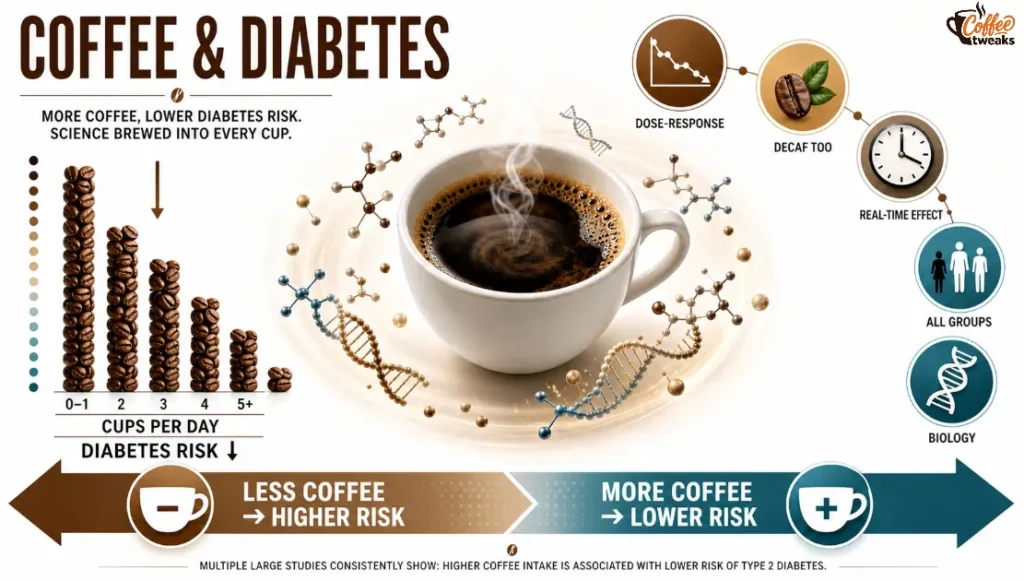
The short answer: Drinking 3–4 cups of coffee per day is associated with approximately a 25% lower risk of developing type 2 diabetes compared to near-zero consumption. That's not a rounding error. That's a consistent, replicated, peer-reviewed finding.
The landmark research here comes from pooled analyses of up to 30 prospective cohort studies. More than a million participants. Over 50,000 diabetes cases tracked across the US, Europe, and Asia.
Here's what the data shows:
That last point is the one that matters. When a result shows up in Stockholm and Tokyo and Iowa and it still looks the same, you're not looking at an artifact of one cultural diet. You're looking at something real.
Researchers adjusted for smoking, obesity, age, sex, physical activity, and a battery of other variables. The association didn't move. Adjusting for 6 confounders or 15 confounders, virtually identical results.
Does Coffee Actually Prevent Diabetes?
Yes, with one caveat: The evidence is observational, not from randomized controlled trials. But that distinction matters less here than it usually does, and I'll explain exactly why.
The studies here are mostly prospective cohort studies. People reported coffee consumption, researchers tracked diabetes diagnosis over decades. That's not a double-blind drug trial.
Here's the thing. Observational evidence becomes a lot more compelling when:
I've been wrong before. Not about this. The convergence of dose-response, bidirectionality, global replication, and a plausible biological mechanism is about as strong a case as you get in nutritional epidemiology.
The Caffeine Paradox: And Why It Doesn't Mean What You Think
Here's where most health coverage gets it completely wrong. And I'm not apologizing for that observation.
Caffeine, acutely, raises blood glucose. In the short term — like, right after you drink a coffee, caffeine stimulates your sympathetic nervous system, triggers epinephrine release, and pushes blood sugar up. Short-term clinical trials confirm this. It's real. It's not a myth.
So logically… coffee should be bad for diabetes risk. Right?
Except. Decaffeinated coffee performs almost identically in the diabetes risk data.
That one finding kills the “caffeine is the active ingredient” hypothesis completely. Meta-analyses found a relative risk reduction of ~7–9% per additional cup for caffeinated coffee and ~6% for decaffeinated. Not meaningfully different.
So what's actually happening?
Tolerance. With habitual coffee consumption, and we're talking about one to two weeks of regular intake, the acute caffeine-driven glucose response fades. The sympathetic nervous system adapts. Long-term trials lasting 8–24 weeks showed no significant changes in insulin sensitivity or fasting glucose from caffeinated coffee compared to placebo.
The short-term caffeine response that worried researchers in early studies is essentially a blip. The long-term effects come from something else entirely.
The Real Mechanisms: What Coffee Does at the Cellular Level
This is the part I'm low-key obsessed with.
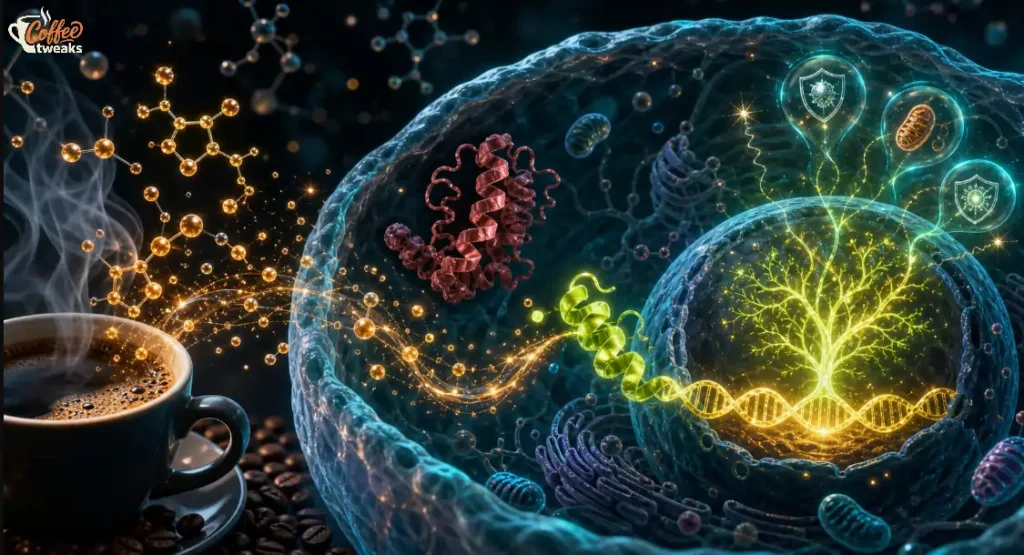
Coffee is, by a significant margin, the largest single dietary source of phenolic compounds in the Western diet, accounting for roughly 70% of total dietary phenolics in many populations. It beats green tea. It beats wine. It certainly beats the blueberry smoothie you had last Tuesday.
These phenolic compounds don't just float around your system doing nothing. They trigger a specific adaptive cellular response called the Nrf2/Keap1 pathway, a master regulator of cellular defense that most people have never heard of.
Here's how it works:
This is hormesis, the idea that mild, repeated stressors trigger protective adaptations. The same principle behind why moderate exercise is good for you despite technically damaging muscle fibers.
What This Does to Your Liver
The liver is where most of this action happens first. Animal studies using luciferase-reporter systems confirmed the liver is the primary site of coffee phytochemical activity on Nrf2-regulated gene expression.
In practice: coffee phytochemicals accumulate in the liver, improve fat oxidation, support mitochondrial function, and reduce endoplasmic reticulum stress. This directly reduces the risk of non-alcoholic fatty liver disease (NAFLD).
Why does that matter for diabetes? Because NAFLD is a major driver of insulin resistance. Fix the liver's metabolic function, and you're interrupting one of the core pathways through which type 2 diabetes develops.
What This Does to Your Pancreatic Beta Cells
Here's the part most coverage completely ignores, and it's arguably the most important mechanism.
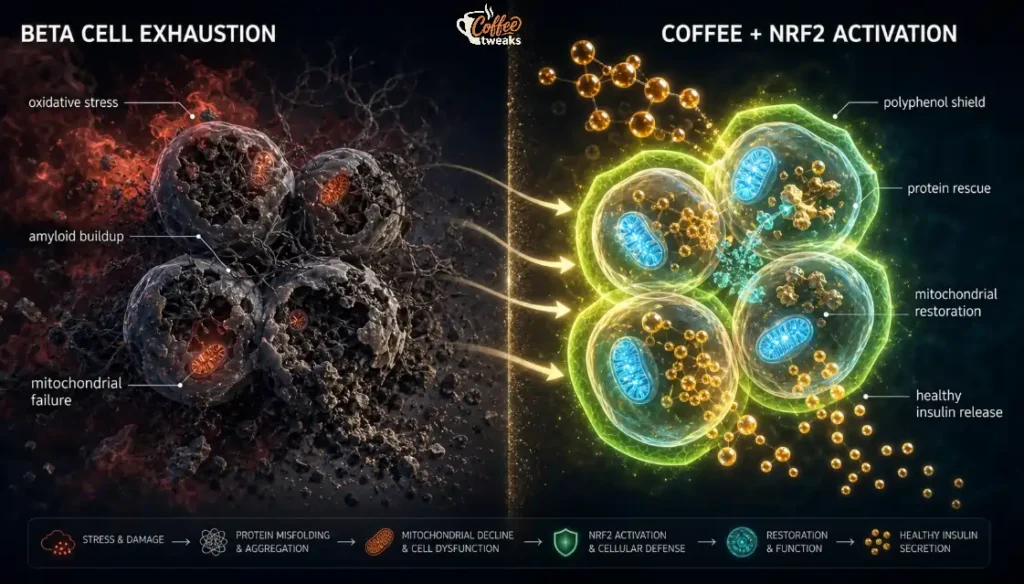
Type 2 diabetes doesn't just happen because of insulin resistance. It happens because the pancreatic beta cells, the ones that produce insulin, eventually fail under the strain of years of overwork.
Before diagnosis, there's typically a long prediabetic period of hyperinsulinemia: the pancreas is pumping out more and more insulin to compensate for rising insulin resistance. That sustained high-output state generates oxidative stress, misfolded proteins, and toxic amyloid deposits in the tissue. Eventually, beta cells die.
Coffee appears to interrupt this process through:
A Keap1 gene knockdown study — which hyperactivates Nrf2 — largely prevented beta cell loss and diabetes development in animal models.
This is long-term cellular preservation. That's why the protective effect only shows up in studies measuring outcomes over years or decades, not in two-week trials measuring morning blood glucose. Those studies are looking at the wrong timeframe.
How Much Coffee, and What Kind?
| Variable | Finding |
|---|---|
| Optimal intake | 3–4 cups per day — strongest risk reduction (~25%) |
| Per-cup benefit | ~6–7% additional relative risk reduction |
| Caffeinated vs. decaf | Both show similar protective effects |
| Filtered vs. boiled/French press | Filtered shows slightly better outcomes |
| With sugar or cream | Added sugars directly counteract the benefit |
| Risk plateau | Curve may flatten beyond 6 cups/day — don't go chasing more |
The decaf finding is worth sitting with. If you've been avoiding coffee for blood sugar reasons and switched to decaf to hedge, you're not actually losing much. The phytochemical profile is largely preserved. The Nrf2 activation still happens. The beta cell protection still applies.
What significantly degrades the benefit is adding sugar. Not a little. Any.
A black espresso and a caramel Frappuccino are not the same beverage. They both contain coffee. That is where the similarity ends. The added sugar and saturated fat in heavily modified coffee drinks directly worsen insulin resistance. Whatever protective contribution the coffee makes gets buried under the metabolic damage from everything else in the cup.
Black coffee. Or close to black. That's the version the research is talking about.
Coffee and Diabetes: Two Very Different Conversations
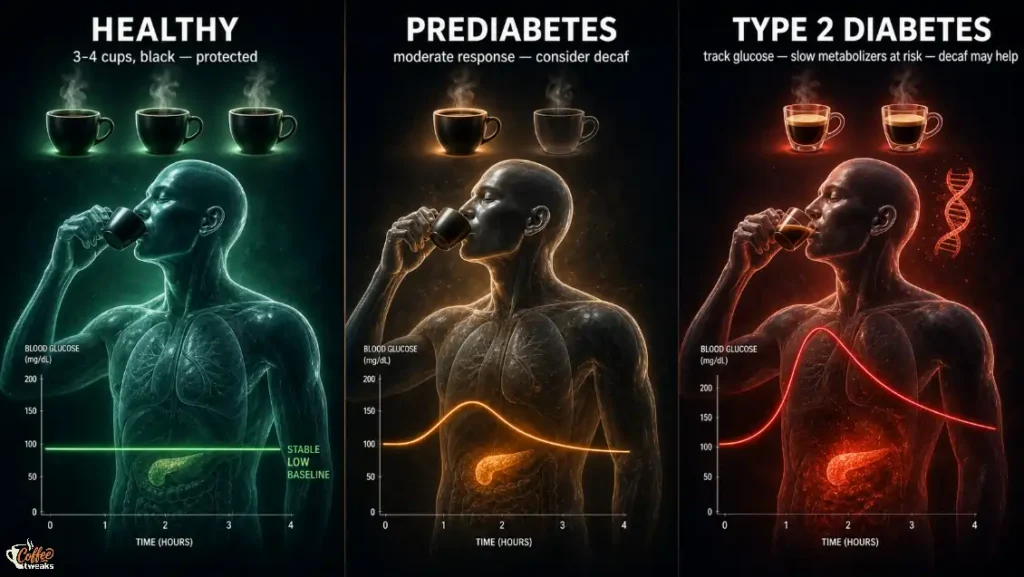
I want to be precise here because conflating these two contexts is one of the more common mistakes in health coverage.
👉 Context 1: Does coffee reduce the risk of developing type 2 diabetes?
Strong, consistent, replicated evidence says yes. The data is solid.
👉 Context 2: Should someone who already has type 2 diabetes drink coffee freely?
More complicated. And the answer is not the same.
In people who already have type 2 diabetes, caffeine can still acutely elevate post-meal blood glucose, and tolerance to this effect may be incomplete in people with existing insulin dysfunction. Continuous glucose monitoring studies in diagnosed diabetics showed measurably higher blood sugar on coffee-drinking days than on non-coffee days.
The caffeine sensitivity also varies by genetics. Slow caffeine metabolizers (a common genetic variant in the CYP1A2 gene) show more pronounced and longer-lasting blood glucose responses than fast metabolizers. If you're a slow metabolizer with type 2 diabetes, drinking two espressos before breakfast, you might be doing more harm than the research would suggest for the general population.
The practical split:
What Coffee Cannot Do
Real talk… I see a lot of health writing that takes a real finding and quietly inflates it into a cure narrative. I won't do that.
Coffee, at best, is one evidence-backed, genuinely useful piece of a metabolically sensible lifestyle. It's not a substitute for one.
FAQ
Does black coffee raise or lower blood sugar?
In the short term, caffeine in coffee can temporarily raise blood glucose by stimulating epinephrine release. Long-term, habitual coffee consumption is consistently associated with significantly lower type 2 diabetes risk — the opposite direction. The short-term and long-term effects operate through different mechanisms.
How many cups of coffee per day reduce diabetes risk?
The strongest association appears at 3–4 cups per day, where researchers have found approximately a 25% lower risk of developing type 2 diabetes. Each additional cup adds roughly 6–7% of relative risk reduction. The benefit appears to plateau around 6 cups.
Is decaf coffee good for diabetes prevention?
Yes — and this is one of the most important findings in this research. Decaffeinated coffee shows nearly identical diabetes risk reduction compared to caffeinated coffee (~6% per cup vs. ~7–9%). This confirms the protective effect comes from coffee's phytochemicals, not caffeine.
Can coffee help with insulin sensitivity?
Long-term, habitual coffee consumption appears to preserve insulin sensitivity by protecting pancreatic beta cell function and improving liver metabolic health through Nrf2 pathway activation. Short-term, caffeine can temporarily reduce insulin sensitivity — but this effect fades with regular consumption over one to two weeks.
Should people with type 2 diabetes drink coffee?
The picture is more complicated for people who already have type 2 diabetes. Caffeine can still cause acute post-meal blood glucose spikes in this group, and continuous glucose monitoring studies have shown measurably higher blood sugar on coffee-drinking days. Decaffeinated coffee may offer a better balance. Always discuss with your doctor, especially if you metabolize caffeine slowly.
What's the healthiest way to drink coffee for blood sugar control?
Black coffee — or as close to black as possible. Added sugars directly counteract the protective benefit by increasing insulin resistance. Filtered coffee shows slightly better outcomes than boiled or French press methods in some research. Habitual, moderate intake over the long term is what the research reflects — not occasional high-dose consumption.

The Bottom Line ☕🎯
The surprising part isn't that coffee might help lower diabetes risk.
The surprising part is how consistently researchers keep finding the same result.
A relative risk of around 0.75 for high versus zero coffee consumption. Dose-dependent. Bidirectional with changes in intake. Replicated across every major population group. Explained by increasingly well-understood mechanisms, Nrf2 activation, beta cell preservation, hepatic lipid handling, amyloid aggregation inhibition.
This is not a wellness trend. This is not a headline someone invented. This is two decades of epidemiological and molecular evidence, all pointing the same direction.
Drink your coffee. Drink it black, or close to it. Drink it habitually, not heroically. And read the actual research instead of the version of it that's been summarized three times into something unrecognizable.