How Much CBD Should Be in Your Coffee? A Dosage Guide

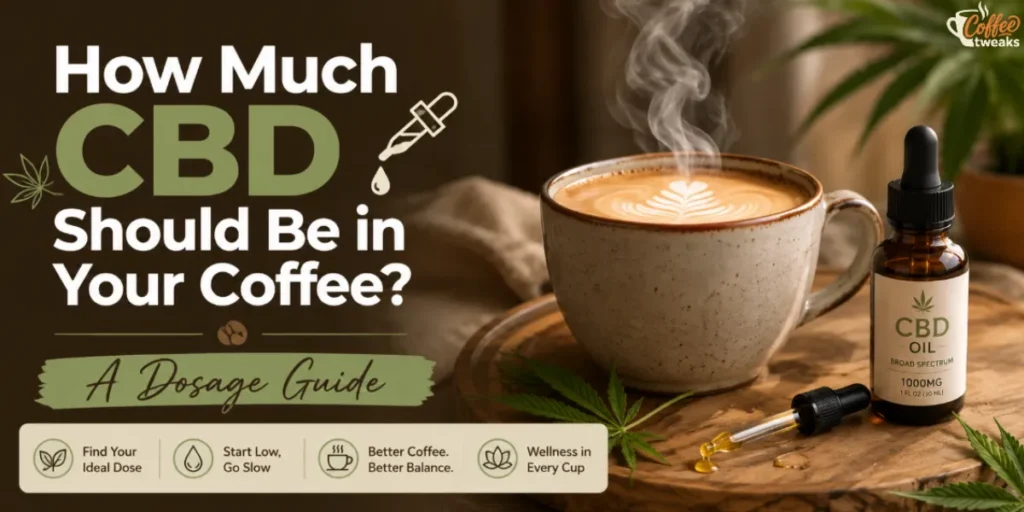
Most CBD coffee dosage advice is written by people trying to sell you a bag of coffee. That's the problem. The number they land on is almost always the number that happens to be in their product.
So let me give you the honest version.
For a first-time buyer, the right cbd coffee dosage is 10 to 15 mg per cup. Not 5 (you probably won't feel it). Not 50 (you're wasting money and courting a nap). Somewhere in that 10–15 range, taken with a little fat, on a couple of consecutive mornings, and adjusted from there.
That's the answer. The next 3,900 words explain why it's the answer, why so much of what you've read is wrong, and how to dial in the effective cbd amount for your body instead of the marketing department's.
Let's go.
The Short Answer
Here's your CBD coffee dosage by experience level. Screenshot it if that's all you came for.
| Experience level | Starting dose (per cup) | Notes |
|---|---|---|
| Total first-timer | 10–15 mg | Take it with cream, milk, or MCT oil. Two mornings minimum before you judge it. |
| Occasional CBD user | 15–25 mg | You know how CBD feels. Start mid-range and read your own signals. |
| Regular / high-tolerance | 25–40 mg | Diminishing returns start creeping in past 40 mg for most people. |
| Sleep support (with decaf) | 40–60 mg | Yes, people do this. Yes, it needs decaf. More on that below. |
Two rules underneath the whole chart. First: your body only absorbs a fraction of what you swallow — oral CBD bioavailability runs roughly 6 to 19%, so the label number is not the effective number. Second: fat helps. A high-fat meal can raise CBD absorption several-fold, which is why black-coffee purists get less from the same milligrams.
One more framing before we move on: every number in that table is cbd per cup, not per day. If you drink two cups, you're doubling the dose, which is fine for a lot of people but worth doing on purpose rather than by accident. That's the featured-snippet version. Now the part that actually makes you good at this.
Why “How Much CBD in Coffee” Is the Wrong First Question
Here's the thing. “How much CBD in coffee” sounds like a dosage question. It's actually five questions wearing a trench coat.
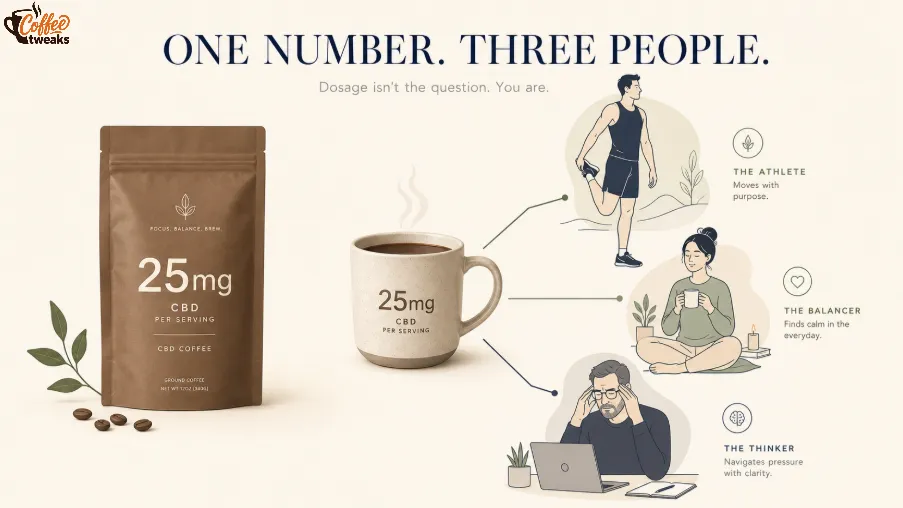
The dose that works for you depends on your body weight, your CBD tolerance, the type of CBD (isolate, broad-spectrum, or full-spectrum), how the coffee was made, and — the one everybody skips — what you're actually trying to accomplish.
A 200-pound daily-CBD user chasing post-workout recovery and a 130-pound newcomer who wants to stop white-knuckling their third espresso are not the same math problem. Feeding them the same “start with 25 mg” line is lazy.
Body weight matters because CBD distributes through fatty tissue, so a larger body generally needs a larger dose to reach the same blood concentration — the rough rule of thumb people use is to scale the starting dose up a little for higher weight and down for lower.
Metabolism matters too. Some people clear CBD fast and need to redose; others feel one cup all morning. And tolerance is real: drink CBD coffee daily for a month and your 15 mg cup may quietly stop announcing itself, not because the product got weaker but because your system adjusted. None of that fits on a bag label, which is exactly why a single stamped number fails.
And yet that's most of the internet. A single recommended number, stamped on every article, usually matching whatever the author sells.
Real talk: there is no universal cbd coffee dosage, and anyone who gives you one without asking a single question about you is guessing. What there is — and what this CBD dosage guide is built around — is a repeatable method for finding your number fast, without lighting $60 bags of coffee on fire to get there.
So before we talk milligrams by goal, absorb the one idea that reorganizes everything: the number on the bag is the input, not the outcome. How much CBD in coffee ends up doing something in your bloodstream depends far more on absorption and intention than on the printed dose. Get that, and the rest of this guide clicks into place.
CBD Coffee Dosage by Goal (What Are You Actually Trying to Do?)
Dose to the outcome, not to a vibe. Here's how the ranges break down by what you're chasing.
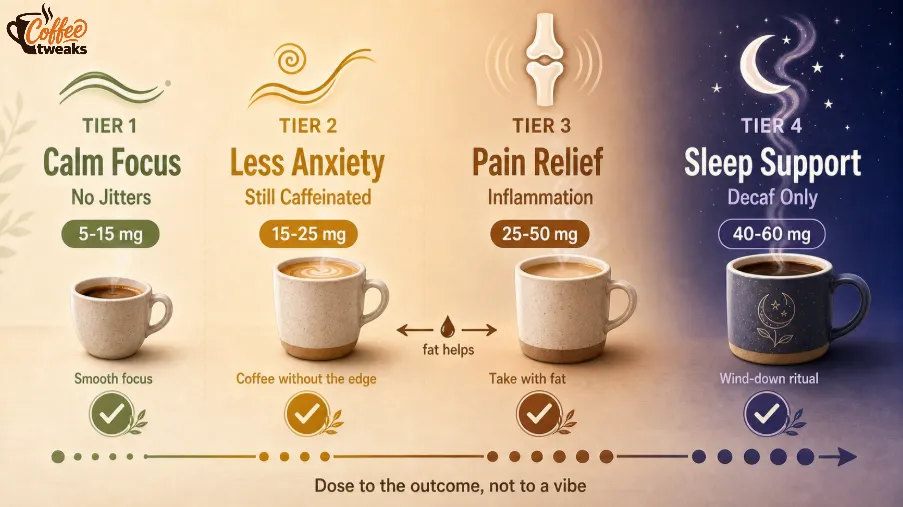
For Calm Focus Without Jitters — 5–15mg
This is the entry point, and it's where the “calm alertness” everyone raves about actually lives. At 5 to 15 mg per cup, you're not sedating anything. You're taking the sharp edges off caffeine — that slightly-too-wired, jaw-tight feeling around cup number two — while keeping the alertness.
Lower doses of CBD tend to feel subtle and clarifying rather than heavy. If you're new and nervous, start at the top of this band (12–15 mg cbd per cup), because going too low is the single most common way first-timers conclude “CBD does nothing” when really they just took a homeopathic amount.
👉 Maya's take: If your only goal is smoother focus, don't overthink it. Fifteen milligrams and a splash of oat milk. Done.
For Anxiety Reduction While Still Caffeinated — 15–25mg
Want the coffee but not the anxiety spiral coffee sometimes triggers? This is your zone. At 15 to 25 mg, CBD's interaction with your serotonin system starts pulling more weight (the mechanism section explains this — it's genuinely interesting and genuinely oversold elsewhere).
A note I won't bury: CBD is not a treatment for an anxiety disorder, and I'm not telling you to swap a prescription for a latte. What I'm telling you is that for ordinary, garden-variety “coffee makes me jittery and a little on-edge,” this range is where people report the caffeine feeling usable again.
👉 Maya's take: 20 mg is my default recommendation for the anxious-but-caffeine-loyal crowd. It's high enough to notice, low enough to keep your morning.
For Pain or Inflammation Management — 25–50mg
Higher goals need higher numbers. For achy-joint, post-workout, low-grade-inflammation use, the useful cbd per cup climbs to 25 to 50 mg. This is also where bioavailability becomes your enemy: swallow 40 mg, absorb maybe 6–19% of it, and the effective cbd amount reaching your bloodstream is single digits. That's not a reason to skip it — it's a reason to take it with fat and be patient across days, not minutes.
I'll say the quiet part: for serious or chronic pain, coffee is a poor delivery system, and a sublingual tincture or a properly dosed capsule will serve you better than hoping your French press does the job.
👉 Maya's take: 30–40 mg with whole milk or MCT if pain is the target. And keep expectations honest — this is management, not a miracle.
For Sleep Support (Yes, People Do This With Decaf) — 40–60mg
People genuinely drink CBD coffee at night. With decaf. It sounds unhinged until you realize the ritual — warm mug, no screens, wind-down — is half the point, and the 40 to 60 mg of CBD is the other half.
The non-negotiable: decaf. Putting 50 mg of CBD into a fully caffeinated cup at 9 p.m. is a contradiction with a heartbeat. You'll get the alerting punch of caffeine fighting the settling effect of CBD, and caffeine usually wins the first round.
👉 Maya's take: 50 mg, decaf, an hour before bed, with a little fat. If regular sleep trouble is the issue, though, see someone about it — a nightcap mug is a comfort, not a sleep-medicine plan. ☕🎯
The Caffeine-CBD Interaction (What Actually Happens in Your Body)
This is the section every other guide either skips or wildly overstates. Let me do neither.
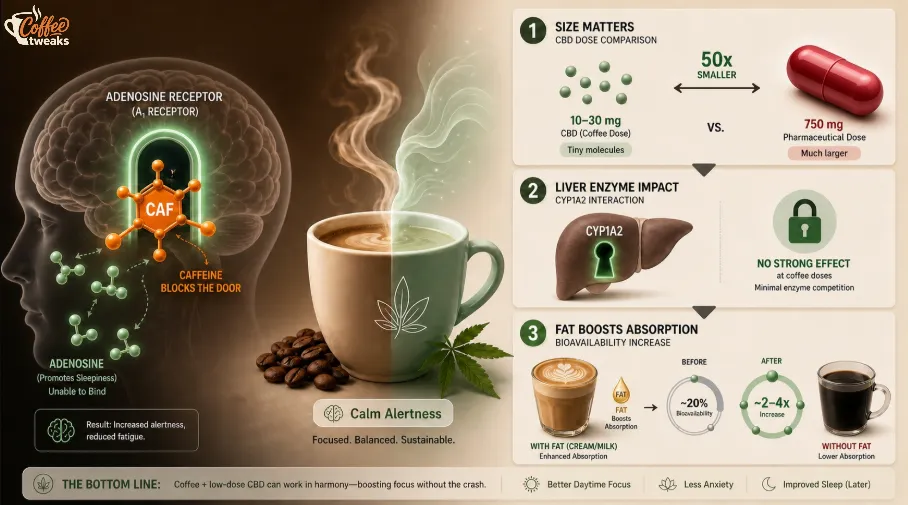
Start with caffeine. Caffeine works mostly by blocking adenosine receptors — adenosine is the molecule that builds up in your brain across the day and makes you feel progressively sleepy, so caffeine essentially crowds the door and keeps drowsiness from checking in. That's the wired, alert feeling.
The catch is that caffeine doesn't remove adenosine; it just holds it off, and it also bumps up adrenaline. In sensitive people, or past cup two, that adrenaline tips into jitter, a racing pulse, tight shoulders, and the specific low-grade anxiety that makes you feel busy and uneasy at the same time.
Now CBD. CBD has what pharmacologists politely call “promiscuous” pharmacology — it touches a lot of systems. The one that matters for the coffee experience is the serotonin 5-HT1A receptor, the same calming receptor targeted by certain anti-anxiety medications.
Research indicates CBD interacts directly with 5-HT1A, and that interaction is thought to underlie much of its anxiety-reducing and mood-modulating effect. It also nudges the endocannabinoid and GABA-related systems, which broadly tilt toward “settle down.”
Put them together and you get the marketing phrase everyone loves: calm alertness. Caffeine keeps the lights on; CBD keeps the room from getting loud. For a lot of people, that combination is real and pleasant.
Now the part almost nobody tells you honestly. There's a well-known clinical study (Thai and colleagues, 2021) showing that CBD inhibits CYP1A2, the liver enzyme that clears about 90% of your caffeine. When CBD blocks it, caffeine hangs around longer and hits harder.
Sounds dramatic — and here's the catch the fear-mongers leave out: that study used CBD at 750 mg twice a day, a pharmaceutical dose. Your CBD coffee has 10 to 30 mg. That's roughly 50 times less. At coffee doses, the caffeine-potentiation effect is, for practically everyone, negligible.
So the responsible read is: the mechanism is real, the scare is not, and the only people who should actually think about it are those taking very high therapeutic CBD doses alongside heavy caffeine — or anyone on medications that also lean on CYP1A2. If that's you, talk to a pharmacist, not a coffee blog.
Two more physical realities. Bioavailability: oral CBD is poorly absorbed — 6 to 19% — because it's fat-loving, water-fearing, and gets chewed up in first-pass liver metabolism. And fat fixes a lot of that: taking CBD with a high-fat meal has been shown to increase absorption several-fold.
Which is exactly why your CBD belongs in a cup with cream, whole milk, or MCT oil, not in black drip coffee you're drinking on an empty stomach. The dose is the same. The result is not.
The Dosage Math Most People Get Wrong
Let's do the arithmetic that turns “25 mg” into a reality check.
You add 25 mg of CBD to your coffee. Oral bioavailability, best case, is around 19%; on a bad day (black coffee, empty stomach) it's closer to 6%. So the effective cbd amount actually entering your bloodstream is somewhere between 1.5 mg and roughly 5 mg. From a 25 mg dose.
That's not a scam — that's pharmacology. But it reframes everything. It's why “start low, go slow” isn't a throwaway cliché in this one specific case; it's why the range between “did nothing” and “too much” is narrower than it looks, and why patience beats megadosing.
A few variables swing that absorption number hard:
Worked example: A first-timer wants a genuine “calm focus” effect and buys a 10 mg-per-cup oil-based coffee, drinks it black, fasted. Effective dose: maybe 0.6–1.9 mg. Conclusion they'll draw: “CBD coffee is a hoax.” Correct conclusion: they under-dosed and sabotaged absorption. Same person at 15 mg, with whole milk, two mornings running? Completely different verdict.
The math isn't there to depress you. It's there so you stop blaming the compound for a delivery problem.
What's Actually in CBD Coffee Products Right Now (Brand Breakdown)
Enough theory. Here's what's actually on shelves, with real numbers and my honest read on whether the dose is doing something or just decorating the bag.
Sträva Craft Coffee
4mg, 10mg, 20mg, or 30mg per serving (broad-spectrum). Sträva is the established name, Colorado-roasted, and sells tiered strengths so you can match the cbd per cup to your goal.
Their own guidance lands at beginners 10–15 mg, regular 20–25 mg, higher tolerance 30 mg+ — which, credit where due, matches the honest ranges rather than pushing everyone to the max. Their 4 mg option, though? That's a flavor of CBD, not a dose. Skip it unless you're microdosing on principle.
Buddha Beans Coffee Co.
4mg, 10mg, 20mg per serving, plus a Colombian bag delivering roughly 25mg per cup (broad-spectrum, 0% THC). Their pitch is that CBD is infused into the bean during roasting rather than sprayed on afterward, which — if true and lab-verified — is the thing that actually matters for consistent dosing.
No oily film, less cup-to-cup lottery. Of the mainstream options, the in-bean approach is the one I'd point a first-timer toward, purely for dose reliability.
Extract Labs (Bearded Man pods)
20mg per pod (CBD isolate). Isolate is tasteless, so it plays clean with coffee flavor, and 20 mg in a K-cup is a legitimately effective starting dose for most people. The trade-off: isolate means no entourage effect from other cannabinoids. For pure convenience and a real dose, though, pods at 20 mg are hard to argue with.
There's also a growing crop of water-soluble and “nano” CBD coffees and add-ins that deserve a mention, because they change the math. Standard oil-based CBD is the poorly-absorbed default we keep talking about; water-soluble versions are emulsified into tiny particles engineered to survive digestion better, and some brands claim several times the bioavailability of ordinary oil.
Take those multiplier claims with salt — marketing outruns the lab here constantly — but the underlying idea is sound, and if a product is genuinely water-soluble, a “smaller” number on the label can outperform a bigger one from an oil-based competitor. Read the fine print and the lab results, not the headline.
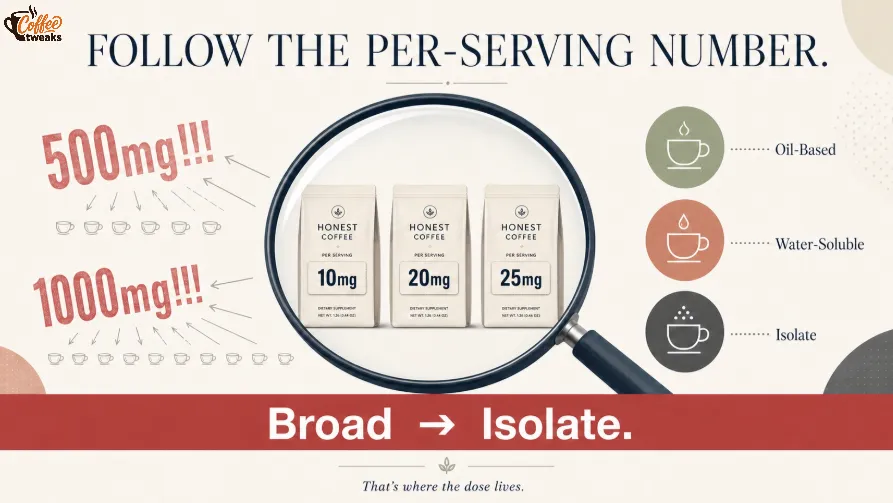
A pattern worth naming: notice how many of these cluster at 10–20 mg per serving. That's not a coincidence — it's roughly the range where a normal person feels something without the dose becoming the whole personality of the cup. When you see a product screaming “500 mg!” on the front, check the servings-per-bag before you get excited.
Five hundred milligrams across 25 cups is 20 mg a cup. Same as everyone else, louder font. And be openly skeptical of any coffee that advertises a huge total but hides the per-serving dose — that's the oldest trick in this aisle.
One current, important asterisk on this whole category — because it affects the exact products above. As of mid-2026, U.S. federal law is mid-shift: a provision (Section 781 of the late-2025 appropriations package) redefines hemp by total THC and caps finished hemp products at 0.4 mg of total THC per container, with the change set to take effect November 12, 2026.
Industry estimates suggest it could pull the vast majority of current broad- and full-spectrum products offside unless they reformulate — typically toward CBD isolate.
Translation for you: the broad-spectrum coffees you buy today may be reformulated, relabeled, or gone by next year, and isolate-based products are the ones best positioned to survive. Check current status and lab results before you buy, because this space is genuinely in motion.
How to Find Your CBD Coffee Dosage (A 7-Day Protocol)
Stop guessing. Run this instead. Seven days, one variable at a time, and you'll know your number cold.
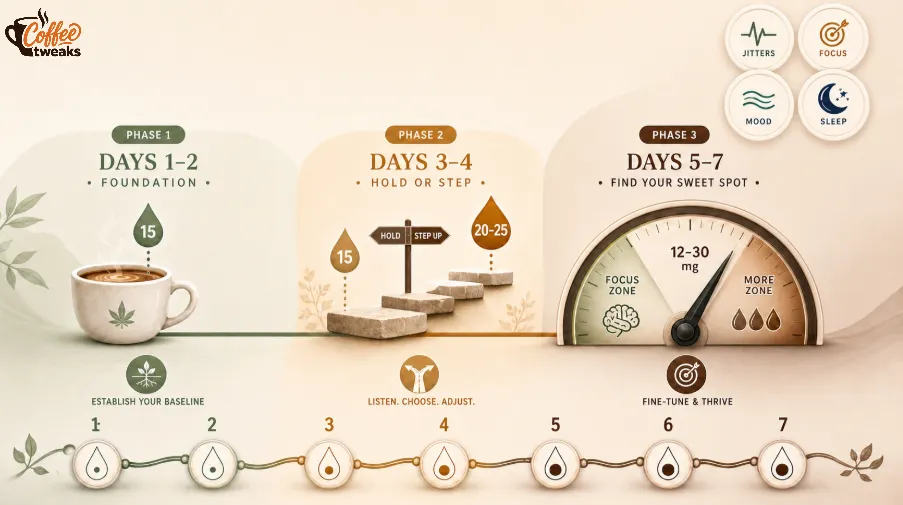
Track four things each day, one line each: jitters (worse/same/better), focus (sharper/flat), mood/calm (edgier/steadier), and sleep that night (if you're dosing later).
A notes app is fine. The point is signal, not journaling for its own sake. Keep the coffee, the fat, and the timing constant across the week — if you switch beans on day 4 and change your dose the same morning, you've contaminated your own experiment and learned nothing. One variable at a time is the entire discipline.
Seven days is usually enough to land on a number you trust. If you're still ambivalent at the end, it's almost always because you kept changing things or judged too fast — reset and run it clean once more. This cbd dosage guide can hand you the ranges, but your own week of notes is what turns a range into your dose.
Here's my one honesty disclaimer, and I'm putting it where the dosing advice actually lives instead of hiding it in a footer: I'm not a doctor, and this is a self-experiment, not a medical protocol. If you take prescription medication — especially anything metabolized by the liver — clear CBD with a pharmacist before you start. That's not lawyer-speak. CBD really does interact with real drugs, and a pharmacist will tell you in ninety seconds whether you're fine.
5 Dosage Mistakes First-Time CBD Coffee Buyers Make
Assuming More = Better
More CBD is not more effect past a point — it's just more money and, eventually, more drowsiness. Most people hit useful results in the 15–30 mg band and get diminishing returns above 40. Doubling your dose because 20 mg “only kind of worked” is the reflex to resist; the fix is usually better absorption (add fat, be consistent) or a few more days, not a bigger number. Megadosing is how you turn a focus tool into an afternoon nap you didn't schedule.
Not Accounting for Bioavailability
This is the big one. You are absorbing a fraction of what the label says — 6 to 19% orally. If you dose as though 25 mg means 25 mg reaching your brain, you'll be baffled when it underdelivers. Internalize that the printed number and the effective cbd amount are different quantities, take it with fat to close the gap, and suddenly the compound “works” — because you finally let it.
Ignoring CBD Type (Isolate vs. Full-Spectrum)
Isolate is pure CBD. Broad-spectrum adds other cannabinoids minus THC. Full-spectrum keeps trace THC for the so-called entourage effect. These are not interchangeable, and the same milligram count feels different across them. A first-timer who reacts to full-spectrum and blames “the dose” may just need isolate, or vice versa. Know which one is in your cup before you decide CBD does or doesn't work for you.
Drinking It on an Empty Stomach
CBD is fat-loving and poorly absorbed in water, and your empty stomach is the worst possible venue for it. Black coffee, fasted, first thing? You've quietly slashed your own absorption. The cheapest, easiest upgrade in this entire guide is fat — cream, whole milk, MCT oil — and maybe a bite of actual food. Same dose, dramatically better result.
Expecting Immediate Results from Day One
Oral CBD takes 30 minutes to two hours to come on, and the effects tend to be a gentle dimmer switch, not a light switch. Judging it on a single cup, ten minutes in, is how good products get one-star reviews. Give any dose two or three consecutive mornings before you rule on it. I've been wrong before. Not about this. Patience is the difference between “CBD coffee is a scam” and “oh, there it is.”
CBD Coffee Dosage FAQ
How many mg of CBD should I put in my coffee?
Put 10–15 mg per cup if you're new, 15–25 mg if you have some tolerance. Take it with cream, milk, or MCT oil to improve absorption, and give it two or three mornings before deciding. Higher goals like pain or sleep support push the range to 25–60 mg, but most people find their sweet spot between 15 and 30.
Can you put too much CBD in coffee?
Yes — not dangerously for most healthy adults, but pointlessly. Very high doses (research has tested well over 1,000 mg) are generally tolerated, but past roughly 40–60 mg you mostly get drowsiness, dry mouth, and a lighter wallet, not more benefit. The bigger risk is drug interactions, so check with a pharmacist if you take prescriptions.
Does CBD in coffee actually work?
For many people, yes — for taking the jittery edge off caffeine and adding a mild calm-focus. It's not a cure for anything, and the effect is subtle, not dramatic. It works best when you dose adequately (15 mg+), take it with fat, and give it a few days. Under-dosing and empty-stomach drinking are why some people feel nothing.
Is 10mg of CBD enough to feel anything?
For a sensitive first-timer, sometimes — especially with fat to boost absorption. For many people, 10 mg is right at the threshold, so if it does nothing, that's a signal to step to 15 mg, not to quit. Because oral absorption is only 6–19%, 10 mg swallowed may deliver just 1–2 mg to your bloodstream.
Does hot coffee destroy CBD?
No. CBD doesn't meaningfully degrade until around 320°F (160°C), and coffee brews at roughly 195–205°F (90–96°C) — well below that line. Your brewing method isn't cooking off the CBD. What actually costs you potency is poor absorption and CBD sticking to the mug, not the heat.
How long does CBD coffee take to kick in?
Usually 30 minutes to 2 hours, since oral CBD goes through digestion first. If you dropped a tincture in and held some under your tongue, part of it may act faster (15–30 minutes). Expect a gradual settle, not a sudden switch. Don't judge the dose before the two-hour mark has passed.
My Final Take on CBD Coffee Dosage ☕🎯
If you remember one thing: start at 15 mg, with fat, for two mornings, then adjust. That single sentence beats 90% of the CBD coffee dosage advice online, most of which is a product number in a costume.
The compound is legitimately useful for softening caffeine's rough edges and adding a little calm to your focus. It is not magic, not medicine, and not something to megadose because the first cup was quiet. The people who “don't get” CBD coffee almost always under-dosed, drank it black on an empty stomach, or quit after one cup — all three fixable in a day.
You're not behind for not knowing this. Nobody told you, and plenty of brands would rather you didn't. Now you know how much cbd in coffee actually does something, why the label number lies, and how to find your real dose without wasting a single bag.
Dose to your goal. Add the cream. Give it three mornings. That's the whole game.
This guide is informational, not medical advice. CBD can interact with prescription medications — check with a pharmacist or physician before starting, especially if you take anything metabolized by the liver.