How to Make CBD Coffee at Home: Using CBD Oil in Your Brew

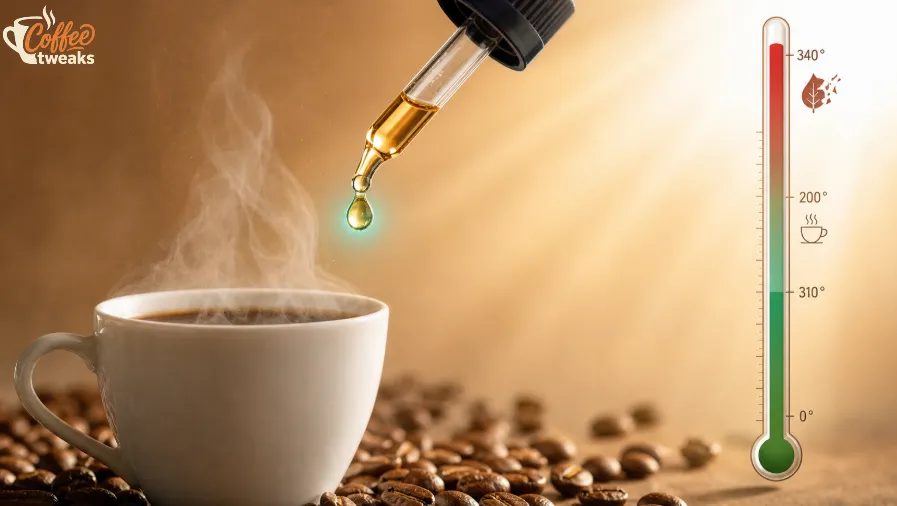
Quick answer: Brewing coffee doesn't destroy CBD — brew temperatures (195–205°F / 90–96°C) stay well below CBD's degradation threshold (320–356°F / 160–180°C). The real challenges in making CBD coffee at home are that CBD oil doesn't dissolve into black coffee without a fat carrier, and that dosing “a few drops” without doing the math leads to wildly inconsistent results.
CBD starts to break down at roughly 320–356°F (160–180°C). Drip coffee brews at 195–205°F (90–96°C). That's a gap of more than 100°F, and it's the first thing to get straight before you learn how to make CBD coffee at home properly.
Here's the thing nobody tells you: most “does CBD coffee even work” articles quote a heat-degradation number without ever checking it against actual brew temperature.
Once you line the two up, the conclusion is straightforward — your coffee isn't hot enough, for long enough, to meaningfully destroy the CBD you're adding. The real failure points aren't thermal. They're about solubility, dosing precision, and timing, and that's where the rest of this guide focuses.
Does Heat From Brewing Actually Destroy CBD?
Worth going a level deeper, though, because “it doesn't cross the threshold” isn't the same as “heat has zero effect, ever.”
Research on CBD stored in an e-liquid formulation found measurable degradation even at low, non-brewing temperatures — up to 20% loss after 30 days at 98.6°F (37°C) in the dark, and up to 15% loss at room temperature under regular light exposure.
That's not a brewing-heat effect. That's slow oxidative degradation over weeks, driven by cumulative time, light, and air exposure more than by any single heat spike.
Translate that to your kitchen: a few minutes of contact with 195–205°F water during brewing is a completely different exposure than a bottle of CBD oil left open on a sunny counter for a month.
Duration matters as much as peak temperature. If you're microwaving leftover CBD coffee or leaving it on a hot plate for hours, you're stacking exposure in a way a single brew cycle simply doesn't.
One correction worth making explicitly: a lot of CBD coffee content conflates degradation with decarboxylation, and they're different processes. Decarboxylation — converting CBDA (the acidic, raw-plant form) into active CBD — happens in a lower range, roughly 200–245°F (95–120°C), and it's a conversion, not a breakdown. It's relevant to raw flower or crude extract.
It does not apply to a bottle of CBD oil you bought online or at a dispensary, because that CBD has already been decarboxylated during manufacturing. What you're dosing into your coffee is already CBD. The number that matters for your cup is the higher degradation threshold, not the lower decarb one.
Why CBD Oil Won't Just Dissolve Into Black Coffee
Technically speaking, but also taste-wise: CBD is fat-soluble, not water-soluble. Coffee is mostly water. Add CBD oil directly to black coffee and you'll watch it separate into an oily film on the surface — it hasn't distributed through the cup, so your first sip and your last sip contain noticeably different amounts of CBD.
This is a solubility problem, not a quality problem. Even a clean, well-made CBD oil will do this in black coffee, because oil and water don't mix regardless of brand or price point. It's the core mechanical issue with adding CBD oil to coffee directly, and it's why a plain CBD oil coffee mix needs a fat carrier to actually work as a consistent dose.
Fat fixes it, structurally. Milk, cream, half-and-half, or a spoonful of coconut oil all give CBD something to bind to, and an emulsified drink — even a rough, unshaken one — distributes cannabinoid content far more evenly across the cup than oil floating alone on black coffee.
Here's the nuance most articles skip. Adding CBD to coconut oil or MCT oil — the cbd coconut oil coffee approach — is usually marketed as boosting absorption because medium-chain fats supposedly “bypass digestion” and go straight into the bloodstream via the lymphatic system. That explanation gets a technical detail backwards.
Medium-chain fatty acids are actually absorbed through the hepatic portal vein — direct to the liver, first-pass metabolism included. It's long-chain fats (dairy fat, or sesame oil in one head-to-head formulation study) that get packaged into chylomicrons and routed through the lymphatic system, which is the pathway that genuinely skips first-pass liver processing.
In that comparison study, a long-chain sesame oil vehicle actually outperformed MCT-containing formulations for in vivo bioavailability, even though MCT looked better in lab-dish solubility testing.
That's one study, not a settled verdict, so this isn't a case for throwing out your MCT oil. But the “MCT bypasses everything” line repeated across CBD marketing oversimplifies the actual pharmacokinetics.
A splash of cream or whole milk in your CBD coffee isn't the compromise choice — by this evidence, it may be doing comparable, or even better, work than a dedicated MCT carrier.
CBD Oil vs. CBD Coconut Oil vs. Isolate: Which for Your Coffee
| Format | Solubility in coffee | Flavor impact | Best for |
|---|---|---|---|
| Standard CBD oil (hemp seed or olive oil carrier) | Needs an added fat (milk/cream) to disperse evenly | Earthy, “hempy” undertone, more noticeable in black coffee | Readers who already use a tincture and want to fold it into an existing routine |
| CBD coconut oil / MCT blend | Disperses somewhat more easily thanks to a lower melting point and neutral fat structure | Mild coconut or neutral fat flavor, blends well into cream-based drinks | Readers making a latte or cream-forward cup who want smoother mixing |
| CBD isolate (powder or isolate-based oil) | Still needs a fat carrier, same as the others, but carries no plant flavor of its own | Neutral, no hemp taste | Readers who dislike full-spectrum flavor, or who need effectively zero THC for drug-testing reasons |
Dosing CBD Coffee: A Framework, Not a Guess 📊
The math needs to be exact here, because dosing by “a few drops” is how people either feel nothing or feel more than they meant to.
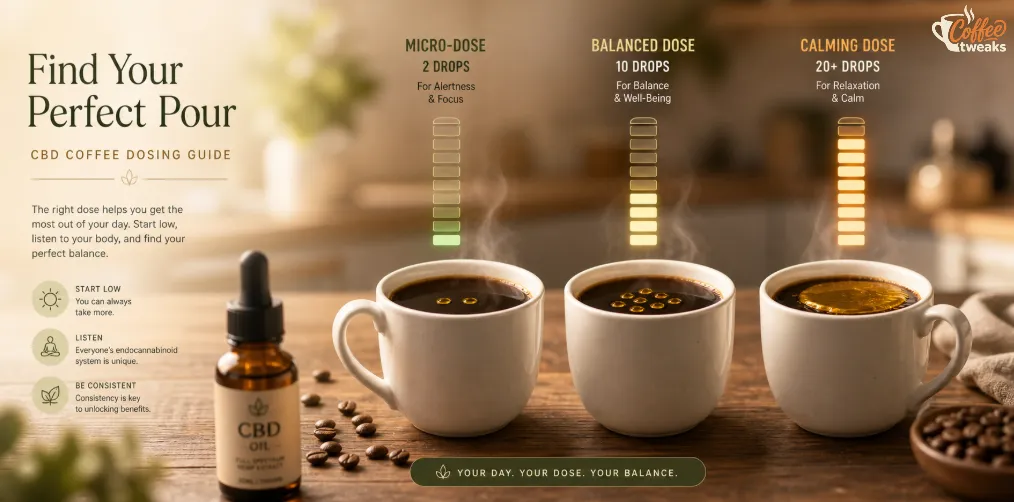
General potency tiers, drawn from common consumer CBD dosing guidance:
| Goal | Typical range | Notes |
|---|---|---|
| Alertness / mental clarity (microdose) | 2–10 mg | Some CBD brands' coffee-specific guidance targets this range for a focus effect rather than sedation |
| Moderate, balanced effect | 15–25 mg | The range several commercial CBD coffee products land on per cup |
| Calming / higher need | 30 mg+ | More likely to produce a relaxed, sedating effect — probably a better fit for an evening cup than a workday one |
The numbers matter here, but so does the caveat: none of these tiers come from a clinical dose-response trial for “CBD in coffee” specifically. They're drawn from general consumer CBD guidance, not peer-reviewed research on this exact use case.
The only CBD product with FDA-approved, rigorously studied dosing is Epidiolex, a seizure medication used at doses far higher than anything relevant to a homemade cup of coffee. Treat the ranges above as a reasonable starting framework, not a medical prescription.
Doing the math on your own bottle, because every tincture is labeled differently:
- Find the total mg of CBD and the total mL of liquid on the label — say, a 30 mL bottle labeled 1,500 mg CBD.
- Divide: 1,500 mg ÷ 30 mL = 50 mg per mL.
- Estimate drops per mL. Most standard droppers deliver roughly 20 drops per mL, though this varies by manufacturer — check your specific bottle if it lists a drop count.
- Divide again: 50 mg/mL ÷ 20 drops/mL = 2.5 mg per drop.
- For a 10 mg starting dose: 10 ÷ 2.5 = 4 drops.
Run this math for your specific bottle before you start. Potency varies enormously between products, and “a dropper full” means something different depending on which bottle is in your hand.
Start-low-go-slow, in practice: begin at the bottom of the microdose range (2–5 mg) for at least three to four days before increasing. CBD's subjective effects can take repeated dosing to stabilize, and starting high tells you nothing useful about your actual tolerance — it just means you're guessing at a bigger number.
The Actual Method: How to Make CBD Coffee at Home, Step by Step ⚙️
This homemade CBD coffee recipe works with any brew method you already use — the steps below apply after the coffee itself is made.
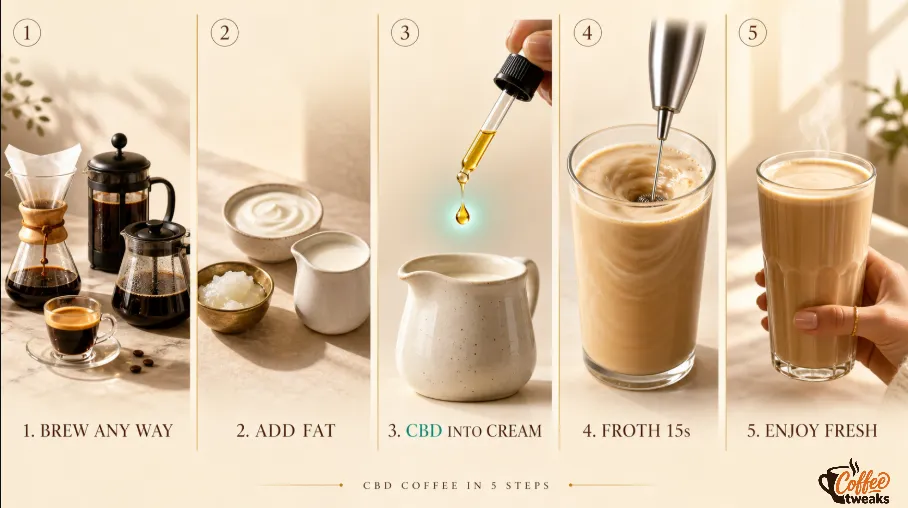
- Brew your coffee normally first. Drip, pour-over, French press, or espresso all work. Don't add CBD oil to the grounds or the brewing water — add it to the finished cup. This sidesteps the entire filter-retention question, covered in the next section.
- Add your fat carrier. A splash of whole milk, cream, half-and-half, or a small spoonful of coconut oil. This step determines whether your dose distributes evenly or separates on top.
- Measure your CBD oil using the math from your own bottle, not a guessed “dropper full.” Add it to the fat first, not directly into the black coffee — mixing it into cream or milk gives it a head start on emulsifying before it hits the larger volume of coffee.
- Stir for longer than feels necessary. A quick stir leaves visible oil droplets on the surface. Fifteen to twenty seconds of real stirring, or a milk frother if you have one, gets you a genuinely even distribution.
- Drink it reasonably promptly. Not because CBD is unstable at drinking temperature — it isn't, per the temperature math above — but because reheating, especially in a microwave, adds a second and avoidable heat exposure on top of the first, and a stirred emulsion can start separating again as the cup cools.
Coconut oil variant: if you're using CBD-infused coconut oil or a CBD/MCT blend instead of a standard tincture, melt it slightly first if it's solid at room temperature, then follow the same sequence — mix it into milk or cream before combining with the full cup, rather than dropping it into black coffee directly.
The Filter Question — Where It Actually Matters (and Where It Doesn't)
This is worth being precise about, because most CBD coffee content treats filter choice as universally important, and it isn't. It depends entirely on when you add the oil.
Coffee's own natural oils — cafestol and kahweol, if you want the names — are well studied here. Paper filters strip out the large majority of these oil-based compounds from a brew, while metal mesh and French press let them pass straight through, which is the well-documented reason paper-filtered coffee has less impact on cholesterol than French press or Turkish coffee.
Researchers don't fully agree on the exact mechanism — whether the paper fiber directly absorbs the oil, or mostly traps the fine solid particles the oil clings to — but the outcome (less oil-soluble compound reaching the cup with paper versus metal) is consistent across the literature. If you want the full breakdown of how brew method changes what ends up in your cup.
Here's the part that actually matters for your dosing: if you add CBD oil to your cup after brewing — the method above, and the one worth defaulting to — the filter never touches your CBD oil at all. The coffee has already passed through the filter before the oil goes in. Filter type is irrelevant to your dose in that scenario.
Filter choice only becomes relevant if you try to infuse CBD oil into the grounds or the brewing water itself, letting it travel through the brew cycle alongside the coffee.
In that case, by analogy to how paper filters behave with coffee's own oils, a paper filter would likely retain a meaningful portion of your added CBD oil too, reducing what reaches your cup and making your dose less predictable.
To be upfront about the limits of this: I haven't found a study measuring CBD oil retention in coffee filters specifically. This is a reasoned extension from established oil-filtration behavior, not a directly tested figure, and it's the honest caveat to flag.
Practical takeaway: add CBD oil after brewing, to the cup, not to the grounds. It's more predictable, and it makes the filter question moot entirely.
Does CBD Actually Cancel Coffee Jitters?
A lot of CBD coffee marketing says yes, cleanly, without much nuance. The actual research is more careful than that, and it's worth walking through properly.
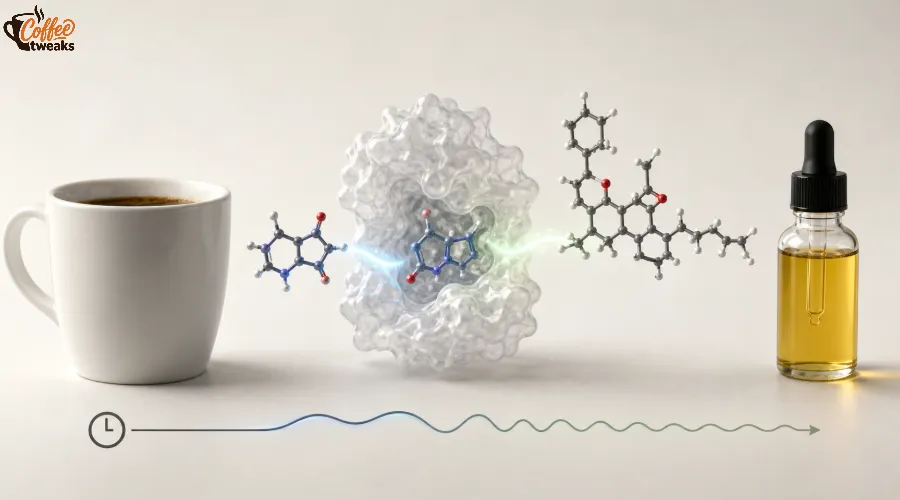
The relevant study is Ferretti et al. (2024), published in Experimental and Clinical Psychopharmacology — the first human laboratory data directly examining simultaneous CBD and caffeine effects.
Participants received caffeine at a dose comparable to a strong cup of coffee (roughly 200 mg) alongside CBD in the range found in retail products (25–50 mg). The finding: the combination didn't produce adverse effects and was generally well tolerated, with some participants reporting a positive experience.
That's meaningfully different from “CBD cancels jitters.” The study's own authors describe it as preliminary. It established that combining CBD and caffeine at these doses doesn't cause problems in a small controlled sample.
It didn't establish a mechanism by which CBD actively counteracts caffeine's stimulant effects, and jitteriness specifically wasn't the outcome it was designed to measure.
There's a separate pharmacokinetic thread worth knowing about, and it complicates the “calming” narrative rather than supporting it. Caffeine is metabolized primarily by an enzyme called CYP1A2, and CBD is a documented inhibitor of that same enzyme.
A pharmacokinetic review of cannabinoid-drug interactions found that co-administered cannabinoids could increase caffeine's peak concentration by around 15% and its total exposure (AUC) by as much as 95% in some analyses.
The numbers matter here, because that means CBD may slow down how quickly your body clears caffeine — which, if anything, could extend caffeine's effects rather than blunt them.
Put both findings together and the honest summary is this: at typical retail doses, mixing CBD and caffeine appears safe based on the limited human data available, but it doesn't reliably eliminate jitters through some calming mechanism.
If anything, CBD's effect on caffeine metabolism cuts in the opposite direction. If jitters are the actual problem you're solving for, reducing your caffeine dose is the more evidence-backed fix than adding CBD to counteract it.
Full-Spectrum, Broad-Spectrum, or Isolate — Which for Your Cup
The practical difference comes down to what's still in the oil besides CBD, and how much that matters to you.
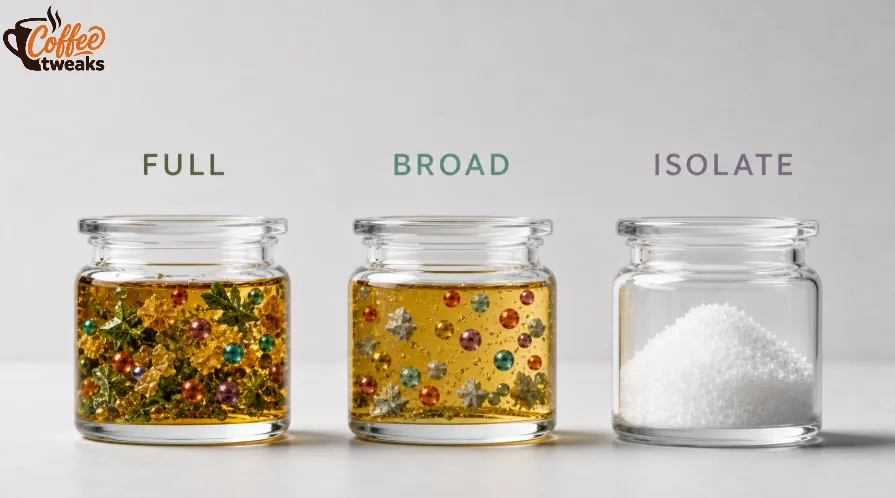
One flag worth taking seriously no matter which format you pick: a 2024 analysis of over 200 commercially available CBD products found that roughly a quarter didn't match their labeled product type, and the large majority deviated from their stated potency by more than 10%.
A current, batch-specific Certificate of Analysis from third-party testing isn't optional homework here — it's the only real way to know what's actually in the bottle you're dosing from.
Frequently Asked Questions
How much CBD oil should I put in my coffee?
Start at 2–5 mg for your first several uses, added to a fat carrier like milk or cream so it disperses evenly. Increase gradually based on how you respond, using your bottle's mg-per-mL label to calculate exact drop counts rather than guessing at “a dropper full.”
Can you cook CBD oil in coffee?
Adding it to a freshly brewed, already-hot cup is fine — brew temperatures (195–205°F) stay well below CBD's degradation threshold (320–356°F). Actively boiling or simmering CBD oil for an extended period, or repeatedly reheating it, is a different exposure and more likely to cause some loss.
Does CBD coffee get you high?
No, not from the CBD itself. CBD is not intoxicating. Full-spectrum products contain trace THC (up to 0.3% by federal definition), which at that concentration isn't associated with a noticeable high, but isolate or broad-spectrum products sidestep the question by containing effectively none.
How long does CBD coffee take to work?
Oral CBD, swallowed along with your coffee, typically takes 30 to 90 minutes to produce noticeable effects, since it passes through digestion first. That's slower than sublingual CBD held under the tongue, which can take effect in 15 to 30 minutes.
Does CBD coffee actually reduce caffeine jitters?
Current human research shows the combination is well tolerated at typical retail doses, but it doesn't establish that CBD actively blocks jitters — and CBD's effect on caffeine metabolism, via the CYP1A2 enzyme, could extend caffeine's presence in your system rather than shorten it. If jitters are the problem you're solving for, lowering your caffeine dose is the more directly evidenced fix.