Caffeine Overdose: What Actually Puts You at Risk

A caffeine overdose happens when you take in more caffeine than your body can process safely. It is real, it is treatable, and it is very rarely caused by coffee.
Most healthy adults tolerate up to 400 mg per day without trouble. Intoxication symptoms typically begin somewhere around 1,000–2,000 mg taken at once. Doses in the 5,000–10,000 mg range have proven fatal in case reports.
In the largest published review of caffeine poisoning cases, tablets were the source in 43% of incidents. Powders, 10%. Beverages, 5%.
Read that again. Your latte is not the problem. Concentrated caffeine is.
Real talk: if you searched “caffeine overdose” because you saw a scary headline and then counted your cups, you can relax a little.
But not entirely. Because the risk is real — it just doesn't live where most articles say it does.
I've pulled over 10,000 espresso shots. I've read the toxicology literature on this because people ask me constantly. And what I keep finding is that the internet's version of caffeine danger is wrong in both directions.
It overstates the risk from coffee. It badly understates the risk from powders, pills, and pre-workout tubs.
Here's the thing. Let's fix both.
🔑 Key Takeaways
What a Caffeine Overdose Actually Is
Caffeine works by blocking adenosine — the molecule that makes you feel sleepy. That's the useful part.
At higher doses it does something else. It floods your system with adrenaline-like signalling, pushes calcium around inside your muscle cells, and drives your heart and nervous system harder than they're built to run.
Doctors call the severe version caffeine toxicity or caffeine poisoning. The mild chronic version has an older name: caffeinism.
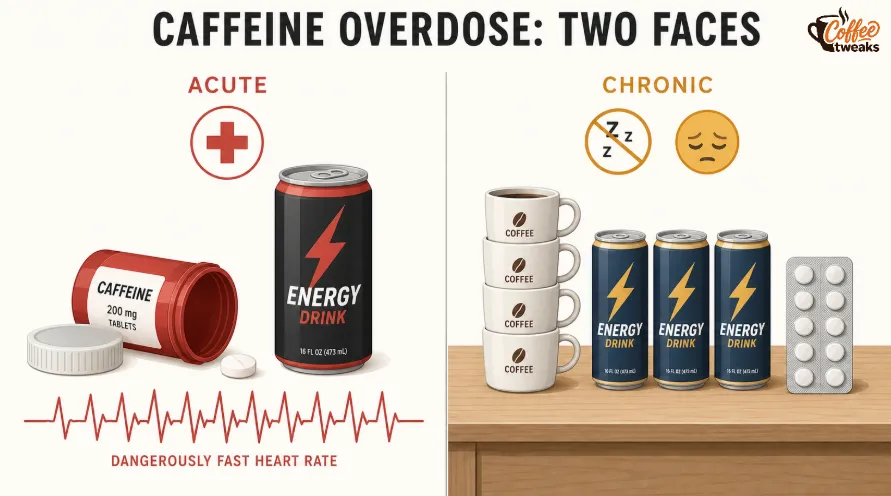
The distinction that matters for you:
| Overconsumption Type | Acute overconsumption | Chronic overconsumption |
|---|---|---|
| What happens | One large dose, fast | Too much, every day, for weeks |
| Typical source | Pills, powder, stacked energy drinks | Coffee plus soda plus pre-workout plus painkillers |
| Symptoms | Vomiting, racing heart, agitation, tremor | Anxiety, insomnia, jitters, headaches, stomach upset |
| Risk level | Can become a medical emergency | Miserable, rarely dangerous |
Most people who worry about “overdosing” are describing the second column. That's not a poisoning. That's a signal to cut back.
The Number Almost Every Article Gets Wrong
You've read this a hundred times: 400 mg a day is safe, and that's four or five cups of coffee.
The first half is right. The second half is out of date.
The FDA's current consumer guidance puts 400 mg at roughly two to three 12-ounce cups of coffee. The older “four or five cups” line assumed 8-ounce cups of relatively weak coffee — a serving size almost nobody actually drinks.
That gap matters. If you believe 400 mg means five cups and you're drinking 16-ounce specialty coffees, you might be at 700–900 mg while telling yourself you're fine.
Europe's food safety agency landed in the same place from a different direction. EFSA concluded that up to 400 mg per day and up to 200 mg in a single sitting don't raise safety concerns for healthy adults.
I've been wrong before. Not about this. The “four or five cups” figure has aged badly, and repeating it is how people accidentally double their intake.
Where the Real Risk Actually Lives
This is the part almost nobody covers properly, and it's the single most useful thing in this article.
In 2025, researchers at Hannover Medical School published the largest analysis of caffeine poisoning ever assembled — 216 individual cases pulled from published medical literature spanning 1883 to 2023.
They recorded where the caffeine came from.
| Source of caffeine in poisoning cases | Share of cases |
|---|---|
| Tablets | 43% |
| Powders | 10% |
| Beverages | 5% |
| Injections | 4% |
| Unknown / unrecorded | 38% |
Beverages. Five percent.
And “beverages” in that dataset includes energy drinks and caffeine shots, not just coffee.
Here's why. To reach a toxic blood level from brewed coffee, you'd need to drink well over 100 cups in a short window. Your stomach, your bladder, and your gag reflex will all quit long before your bloodstream gets there.
Concentrated caffeine removes every one of those natural brakes. That's the whole story.
⚠️ The concentration problem, in one number
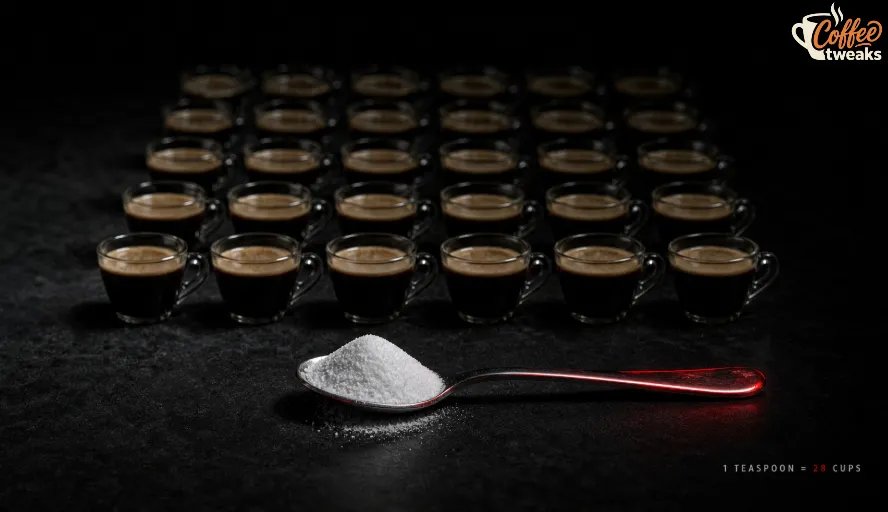
The FDA warns that a single teaspoon of pure powdered caffeine holds roughly the same caffeine as 28 cups of coffee.
A half cup of some liquid concentrates carries the equivalent of more than 20 cups.
The FDA considers bulk pure caffeine powder so dangerous that no warning label can make it acceptable — a 10 kg container holds hundreds of potentially lethal doses. Since 2018, selling it in bulk to consumers has been treated as unlawful.
If you own a tub of pure caffeine powder, the safest move is to get rid of it.
How Much Caffeine Is Dangerous? The Honest Dose Ladder
I want to be careful here, because this is exactly where health sites oversimplify.
These are population-level thresholds drawn largely from case reports — not predictions about you specifically. Individual responses vary enormously. Some people get sick well below these numbers. Some tolerate far more.
| Single dose (adult) | What the evidence says typically happens |
|---|---|
| Up to 200 mg | No safety concern for healthy adults (EFSA) |
| ~250 mg | Alertness, focus, improved performance |
| ~500 mg | Nervousness, anxiety, palpitations become common |
| ~1,200 mg | FDA cites this as the level where toxic effects appear |
| 1,000–2,000 mg | Intoxication symptoms typically begin |
| 5,000–10,000 mg | Reported as potentially fatal in the medical literature |
Two honest caveats.
First: these ranges overlap between people to a degree that surprises most readers. In that 216-case analysis, dangerous heart rhythms were documented in someone who'd taken as little as 0.05 g, and seizures in someone at 0.5 g. Those are outliers with almost certainly other factors involved — but they're real cases, and they're why “how much is dangerous” has no single answer.
Second: the median intoxication dose across all those published cases was 12 grams, not 10. The range ran from under a gram to 106 grams. People have survived doses previously assumed to be unsurvivable, because modern intensive care is good.
So when someone tells you the lethal dose of caffeine is exactly ten grams, they're quoting a rounded textbook figure, not a biological constant.
The LD50 Myth (And Why the Number You Read Is Probably Wrong)
Search “caffeine lethal dose” and you'll hit LD50 numbers within about four seconds. Usually 150–200 mg/kg, extrapolated to “roughly 10 grams for an adult.”
Three problems.
Low-key obsessed with getting this right, because it cuts both ways: the myth makes some people feel invincible and sends others into unnecessary panic.
What we actually know about human lethality comes from reported fatalities and clinical case reports — messy, retrospective, and honest about their limits — not from lab-derived LD50 math.
What Blood Caffeine Levels Actually Mean
This is the “lethal blood concentration” part, and it deserves clarity rather than drama.
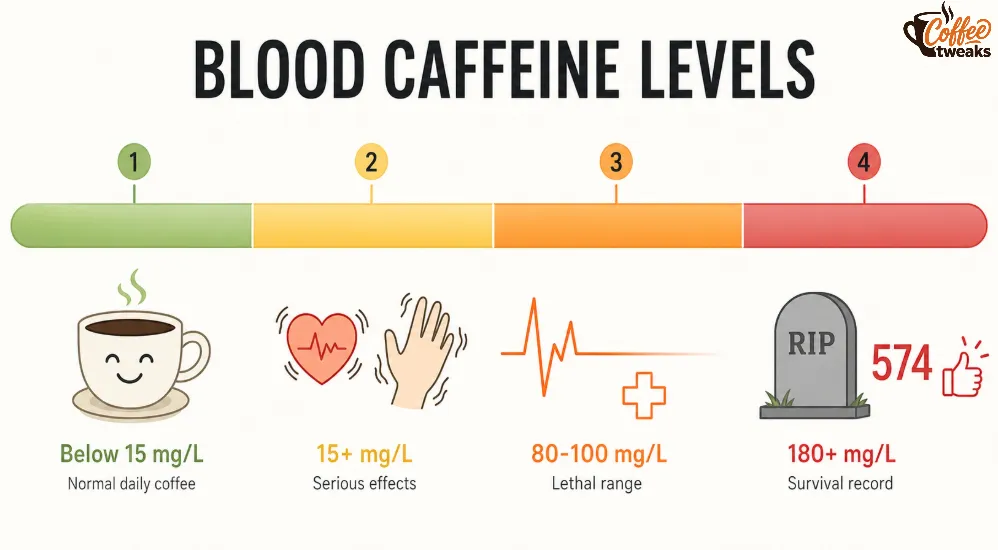
Caffeine concentration in blood is measured in milligrams per litre (mg/L).
| Blood concentration | What's associated with it |
|---|---|
| Normal daily coffee drinking | Well below the toxicity range |
| ~15 mg/L and above | Serious effects, including arrhythmias and seizures, have been reported |
| 80–100 mg/L | Traditionally described as the potentially lethal range |
| Postmortem case series | Median around 180 mg/L across 51 poisoning deaths, range 33–567 |
| 574 mg/L | Highest concentration a patient is documented to have survived, with blood-cleansing treatment |
Notice how wide those bands are. Someone died at 33 mg/L. Someone else lived through 574.
That variation isn't measurement noise. It's underlying health, other substances involved, how fast treatment arrived, and how each person's liver handles the drug.
Which brings me to the part that determines your actual risk more than any dose table.
Your Personal Multiplier: Metabolism
Caffeine is broken down almost entirely by one liver enzyme, CYP1A2. Roughly 95% of clearance runs through it.
The typical half-life in a healthy adult is about 5 hours. Meaning: five hours after a 200 mg dose, about 100 mg is still circulating.
But “typical” hides a huge amount of variation.
| Factor | Effect on caffeine half-life |
|---|---|
| Smoking | Roughly halves it (~3 hours) |
| Genetics (CYP1A2 variants) | Fast or slow metabolizer status varies widely |
| Oral contraceptives | Roughly doubles it |
| Third-trimester pregnancy | Up to ~15 hours — around triple normal |
| Liver disease or cirrhosis | Significantly prolonged |
| Fluvoxamine (an SSRI) | Extended from ~5 hours to ~31 hours in one study |
| Ciprofloxacin and similar antibiotics | Meaningfully prolonged |
| Newborns and premature infants | Dramatically prolonged; measured in days, not hours |
That fluvoxamine finding deserves a second look. Same dose of caffeine, six times longer in the body. If you're on that medication and drinking your usual three coffees, you're effectively stacking doses on top of each other all day.
There's a documented case of a man who died from caffeine toxicity after eating high-caffeine energy mints. He had liver cirrhosis, which impaired his ability to clear the drug. His dose wasn't the whole story. His metabolism was.
This is why “how much caffeine is dangerous” is genuinely the wrong question. The better question is: how much caffeine, in what form, in whose body, over what timeframe.
Caffeine Overdose Symptoms, By Stage
Symptoms escalate in a rough sequence. Knowing the sequence tells you where you are.
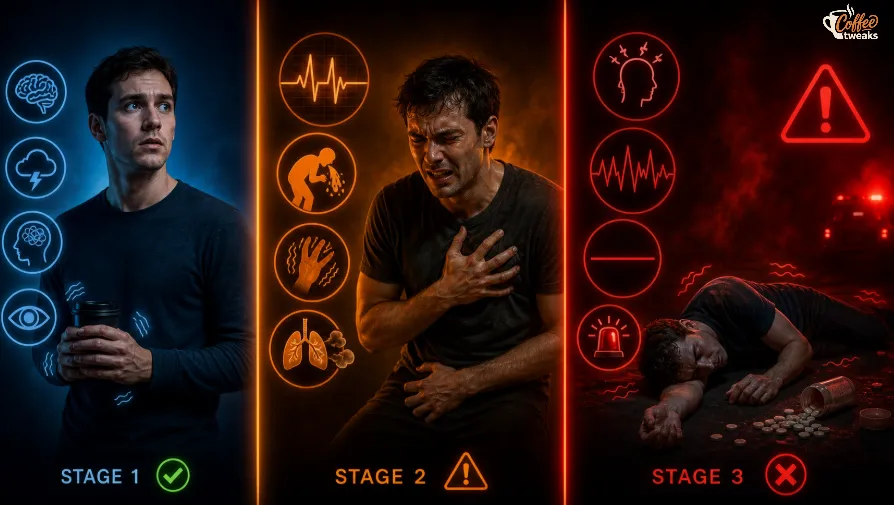
Stage 1 — Too much, not dangerous
This is the zone almost everyone who searches this topic is actually in. Unpleasant. Not an emergency. It passes as your body clears the caffeine.
Stage 2 — Genuine caffeine intoxication
In the case-report analysis, vomiting appeared in about 60% of patients and a fast heart rate in about 87%. Repeated vomiting after a large caffeine dose is a meaningful signal, not just an upset stomach.
Stage 3 — Medical emergency
🚨 Call emergency services now if you see these
Seizures. An irregular or wildly racing heartbeat. Chest pain. Loss of consciousness. Confusion or disorientation after a large caffeine dose.
In the published case data, seizures and wide-complex irregular heart rhythms were the two features most strongly linked to poor outcomes.
Do not drive yourself. Do not wait to see if it settles. Do not try to sleep it off.
Bring the packaging if you have it. Knowing the product and dose changes the treatment.
Poison control centres will talk you through a situation that doesn't need an ambulance, too. Calling them is not an overreaction. It's what they exist for.
Real Caffeine Sources, Compared Honestly
Here's where I get to be the coffee person rather than the toxicology person.
| Source | Typical caffeine |
|---|---|
| Espresso, single shot (1 oz) | ~63 mg |
| Espresso, double shot | ~125 mg |
| Brewed coffee, 8 oz | ~80–100 mg |
| Brewed coffee, 12 oz | ~113–247 mg |
| Specialty coffee shop brew, 16 oz | ~188 mg average |
| Cold brew, 12 oz | Often 150–250 mg |
| Black tea, 8 oz | ~30–50 mg |
| Cola, 12 oz | ~30–40 mg |
| Energy drink, 8 oz | ~40–250 mg |
| Large energy drink can | Some reach ~350 mg |
| Caffeine tablet (stay-awake type) | 100–200 mg |
| Pre-workout, one scoop | ~254 mg average across 100 top products |
| Pure caffeine powder, 1 tsp | ~3,200 mg |
Look at the bottom row. Then look at everything above it. That's the entire risk picture in one table.
The variability nobody warns you about
Now the uncomfortable part, and this is coffee-specific.
Those numbers are averages. Real cups wander a long way from them.
Researchers bought the same specialty coffee, from the same outlet, on six consecutive days. Caffeine content ranged from 259 mg to 564 mg per serving.
Same drink. Same shop. More than double the caffeine depending on the day.
Espresso is no better. Measured shots have come in anywhere from about 25 mg to 214 mg for a single ounce, depending on the bean, the roast, the grind, the dose, and how the barista pulled it. Robusta beans carry roughly twice the caffeine of arabica by weight, and plenty of blends use them.
I say this as someone who cares about extraction: the caffeine number on any coffee menu is an estimate, not a measurement. Treat it as a range.
For a healthy adult, this is a minor annoyance. If you're pregnant, on medication that slows clearance, or managing a heart condition, it's worth building in a margin.
Pre-Workout Powders: The Most Under-Discussed Risk
This category gets a fraction of the attention energy drinks get, and it deserves more.
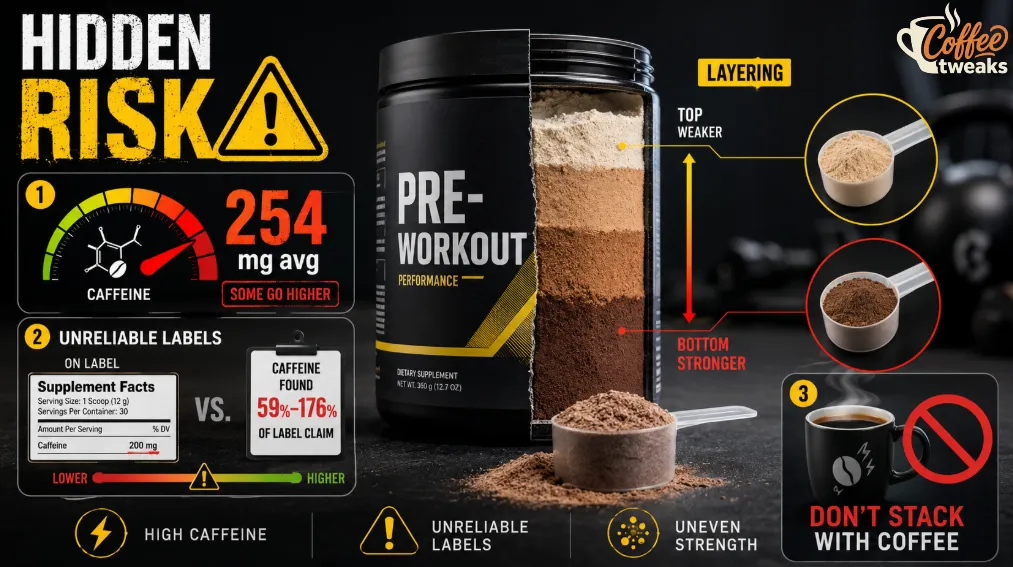
Three things stack badly here.
Add proprietary blends that don't disclose amounts at all, and you have a product where the person taking it genuinely doesn't know their dose.
That's not scaremongering. That's just what the analytical data shows.
Practical fix: buy products that state caffeine content explicitly rather than hiding it in a blend, shake or stir the container before scooping, and don't stack a pre-workout with coffee on the same morning.
Energy Drinks, Kids, and Where the Numbers Are Moving
Adults have wide latitude with caffeine. Children and teenagers don't.
The American Academy of Pediatrics discourages caffeine for children and recommends teenagers stay under about 100 mg per day. EFSA's guidance for children and adolescents works out to roughly 3 mg per kilogram of body weight.
For a 30 kg child, that's about 90 mg. One large energy drink can blow through it several times over.
Calls to US poison centres about children and energy drinks rose roughly 24% between 2022 and 2023. A separate analysis of 32,482 paediatric caffeine energy product exposures from 2011 to 2023 found the overall rate rose 17% — but exposures involving powders and granules rose 633%.
That number is the whole argument. The category growing fastest is the concentrated one.
Regulation is finally moving. In June 2026, the FDA added caffeine labelling to its 2026 regulatory priority list, signalling draft guidance on how manufacturers disclose caffeine content. Right now, companies only have to list caffeine as an ingredient when it's added on its own — they don't have to tell you how much.
This is happening against a backdrop of legal pressure. The Texas Attorney General opened an investigation into Celsius Holdings in June 2026 following the death of a 17-year-old consumer. And Panera settled its remaining Charged Lemonade lawsuits in July 2025, having discontinued the drink; its largest size carried around 390 mg of caffeine plus guarana, and the first wrongful death suit involved a 21-year-old with a diagnosed heart rhythm condition.
That last case is instructive and I don't want it misread. She didn't die because 390 mg is inherently lethal. She died because a large stimulant dose met an underlying cardiac condition, in a product she had no clear way to assess.
Which is the point of labelling. People with heart conditions can avoid what they can see.
Myth vs Fact
| Myth | Fact |
|---|---|
| “The lethal dose is exactly 10 grams.” | It's a rounded figure from case reports. Published cases span under 1 g to over 100 g, with survival at extreme doses. |
| “The LD50 proves how much would kill you.” | LD50 values come from rodents and don't extrapolate to humans. The best rat figure is also roughly double what most sites quote. |
| “400 mg is four or five cups of coffee.” | FDA now describes it as about two to three 12-oz cups. |
| “You can overdose on coffee.” | Possible in theory, extraordinarily difficult in practice. Beverages accounted for 5% of poisoning cases. |
| “Decaf has no caffeine.” | Decaf typically holds 2–15 mg per 8 oz. Low, not zero. |
| “Cold water or a cold shower reverses it.” | Nothing speeds up caffeine clearance meaningfully. Your liver sets the pace. |
| “Eating food fixes an overdose.” | Food may slow absorption slightly. It doesn't treat toxicity. |
| “If you're a heavy coffee drinker you're immune.” | Tolerance reduces jitteriness. It doesn't protect against a large concentrated dose. |
| “Energy drinks are just strong coffee.” | Many combine caffeine from multiple sources — guarana, green tea extract, yerba mate — which are often not totalled on the label. |
What Treatment Actually Looks Like
Worth knowing, because it removes some of the fear.
There's no antidote for caffeine. There are also, notably, no international treatment guidelines for caffeine intoxication — the evidence base is entirely case reports.
What hospitals do:
That case-report analysis found something encouraging: patients who received blood-cleansing treatment had a 95% survival rate versus 73% without, despite having ingested far higher doses on average.
Severe caffeine poisoning is survivable. Getting there quickly is what determines the outcome.
Staying in the Safe Zone
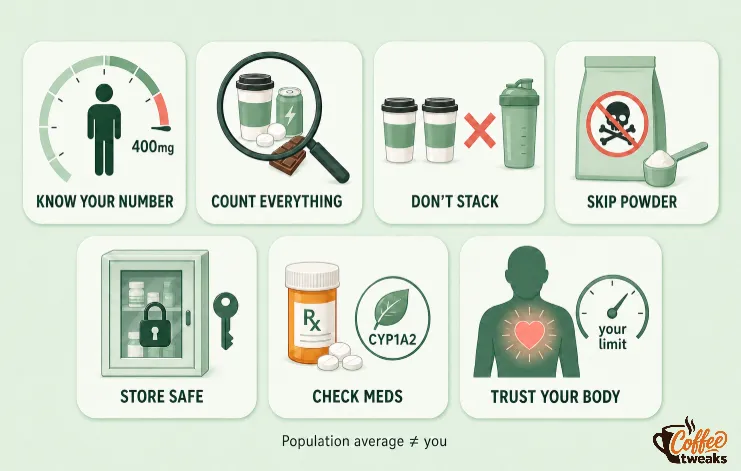
Simple rules that actually cover the risk.
FAQ
Can you die from drinking too much coffee?
Theoretically. Practically, almost never. The volume of liquid needed to reach a toxic caffeine level from ordinary coffee is beyond what a person can physically drink and hold down. In the largest published review of caffeine poisonings, beverages of any kind — including energy drinks — accounted for about 5% of cases.
How many cups of coffee is 400 mg?
Roughly two to three 12-ounce cups, per current FDA guidance. If you drink 16-ounce specialty coffee, one or two may get you close. Actual content varies substantially between shops and even between days at the same shop.
What are the first signs of caffeine overdose?
Repeated vomiting, a fast heartbeat you notice at rest, hand tremor, rapid breathing, and marked agitation. Ordinary jitters and insomnia are signs you've had too much — not signs of poisoning.
How long does caffeine stay in your system?
The half-life averages about 5 hours in healthy adults, but ranges from roughly 1.5 to 9.5 hours. Full clearance takes multiple half-lives. Pregnancy, oral contraceptives, liver disease, and certain medications extend it substantially.
Can you overdose on caffeine pills?
Yes, and this is where most documented cases come from. Tablets were the source in 43% of published poisoning cases. A single stay-awake tablet holds 100–200 mg, and the packaging makes taking several easy in a way that drinking several coffees is not.
Is a caffeine overdose reversible?
Usually, with prompt medical care. There's no antidote, but supportive treatment works well, and haemodialysis can remove caffeine directly in severe cases. Survival rates in treated patients are high even at very high doses.
What should I do if I've had too much caffeine but feel okay?
Stop consuming more, drink water, sit down, and wait. Nothing accelerates clearance — that's your liver's job and it works at its own pace. If symptoms escalate beyond discomfort into vomiting, chest pain, or an irregular heartbeat, call for help.
Does caffeine tolerance protect you?
Partly. Regular consumption blunts the jittery, anxious effects. It does not meaningfully protect your heart from a large concentrated dose, and it doesn't change how fast your liver clears the drug.
The Bottom Line
For almost everyone reading this, coffee isn't the problem. Highly concentrated caffeine products are.
That's not a comfortable message for a coffee site to leave at “drink whatever you want,” and I'm not going to. The honest version is more useful:
Coffee gives you natural limits — volume, taste, time, a full bladder. Powders and pills strip all of them away and hand you a substance where the difference between a serving and a hospital visit fits on a teaspoon.
Know your number. Count every source. Skip the pure powder. And if you see seizures or a heartbeat that's gone wrong, call for help immediately rather than waiting it out.
And I'm not apologizing for that. ☕