Decaf Coffee Health Benefits 2026: What Survives Processing

Real talk.
Most people think decaf is regular coffee with everything good stripped out. A sad, watered-down consolation prize for people who “can't handle” real coffee.
That's wrong.
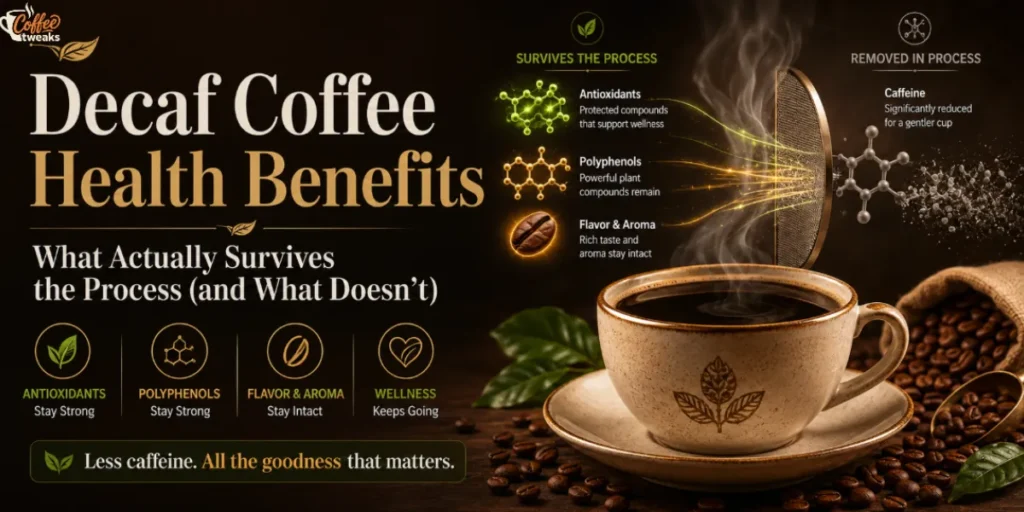
Take the caffeine out, and a surprising amount of the good stuff stays behind. The antioxidants. The polyphenols. Most of the reasons coffee shows up in study after study as one of the healthier things in the average diet.
But here's the part nobody tells you: how your decaf was made matters as much as the fact that it's decaf. The method. The roast. Two bags on the same shelf can be very different cups, health-wise.
So let's sort out what's real, what's marketing, and what the research actually says.
Quick answer: Yes, decaf coffee is healthy. It keeps most of coffee's antioxidants and polyphenols, and large studies link it to lower risk of type 2 diabetes, heart disease, and early death. It loses caffeine and a small share of chlorogenic acids. The decaffeination method and roast level decide how much survives.
Key takeaways
First, what “decaf” even means
Decaf doesn't mean caffeine-free. It means most of the caffeine got removed, usually at least 97% of it.

That leaves a little behind. A brewed cup lands somewhere around 2 to 5 mg of caffeine, though some brands run higher, up to about 15 mg. Regular coffee sits at 70 to 140 mg depending on the bean and brew.
For context: a square of dark chocolate can carry more caffeine than a cup of decaf.
So when someone says decaf kept them up at night, the caffeine almost certainly wasn't the culprit. It's a rounding error next to a real cup.
The takeaway here is simple. Decaf strips the stimulant. It does not strip the coffee.
Does decaf still have antioxidants? (The question everyone's really asking)
Short version: yes. And more than the internet gives it credit for.
Coffee is one of the biggest sources of antioxidants in the average Western diet. Not because coffee is a superfood, but because people drink so much of it. The main players are polyphenols, especially a family called chlorogenic acids.
These compounds mop up free radicals, the unstable molecules tied to inflammation, aging, and chronic disease. They're a big part of why coffee keeps showing up on the healthy side of the ledger.
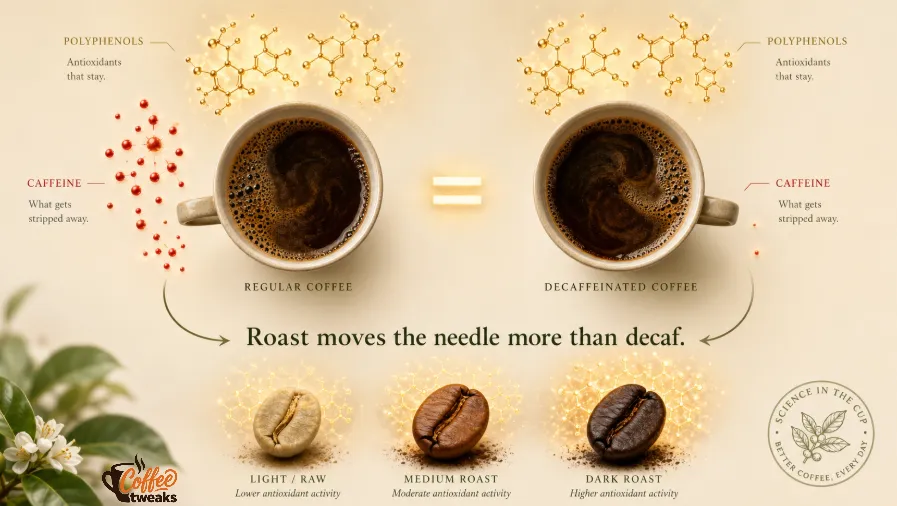
Here's where it gets interesting. Caffeine is not the antioxidant. The polyphenols are. Pulling the caffeine out doesn't automatically pull out the good stuff.
So how much do you actually lose?
This is where honest gets messy, and where most articles either oversell or panic.
The research doesn't agree. A few findings, side by side:
Notice the spread. Some say slightly less, some say no change, some say more depending on how you measure. That's not a settled “decaf loses its antioxidants.” It's a small, inconsistent effect that depends on the bean and the method.
Anyone telling you decaf has dramatically fewer antioxidants is overstating it. Anyone selling you decaf as an antioxidant upgrade is overstating it the other way.
The bigger factor nobody mentions: roasting
Roasting changes antioxidant levels more than decaffeination does.
Light roasts hold onto more chlorogenic acids. Dark roasts break some of them down but build up other compounds during roasting, including melanoidins, which have their own antioxidant activity.
So the real answer to “does decaf have antioxidants” isn't just yes. It's: your roast choice moves the needle more than the fact that it's decaf. Keep that in your back pocket, it comes up again below.
Regular vs decaf coffee, side by side
| Factor | Regular coffee | Decaf coffee |
|---|---|---|
| Caffeine per cup | ~70–140 mg | ~2–15 mg |
| Chlorogenic acids | Baseline | Roughly similar, small and inconsistent drop |
| Other polyphenols | Yes | Yes |
| Melanoidins (from roasting) | Yes | Yes |
| Acute blood pressure bump | Yes, for a few hours | Minimal to none |
| Lowers type 2 diabetes risk | Yes | Yes, slightly less |
| Lowers heart disease + death risk | Yes | Yes |
| Lowers irregular-heartbeat risk | Yes | Not clearly |
| Good after 2 p.m. | Risky for sleep | Yes |
| Safer during pregnancy | Watch the 200 mg limit | Better fit, still counts toward limit |
Caffeine figures vary by bean, roast, and brew. Treat them as ranges, not guarantees.
How your decaf was made (and why it changes the cup)
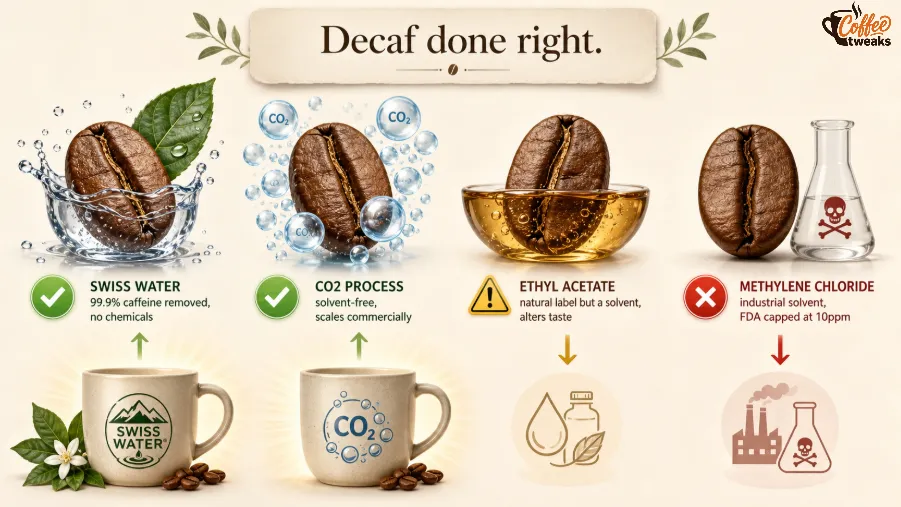
Not all decaf is decaffeinated the same way. There are four main methods, and they split into two camps: solvent-free and solvent-based.
That last one is where the news is.
The methylene chloride question
Methylene chloride is an industrial solvent. It's used in paint stripping and metal degreasing, and it's classified as a carcinogen by several health bodies. In 2024 the EPA banned most industrial and consumer uses of it, though that ban did not cover food.
In food, the FDA still allows it in decaf, with residues capped at 10 parts per million in roasted decaf. Independent testing of decaf brands has generally found levels below that limit.
In late 2023, a coalition of advocacy groups petitioned the FDA to strip methylene chloride and three other solvents from the approved food-additive list, arguing a cancer-causing additive can't legally stay approved. As of mid-2026 the FDA had reopened and then closed a public comment period and had not yet issued a decision. It's still pending.
Where does that leave you? Two honest points.
One: the amounts in decaf are trace, well below the legal cap, and the coffee industry's position is that European-method decaf carries the same health benefits as any coffee. Two: if you'd rather not think about it at all, the fix is easy. Swiss Water and CO₂ decaf skip solvents entirely. Look for those words on the label.
Not panic. Just an easy upgrade if you want it.
Decaffeination methods compared
| Method | Solvent? | Caffeine removed | Flavor impact | Antioxidant retention |
|---|---|---|---|---|
| Swiss Water | None | ~99.9% | Low | Good |
| CO₂ | None | High | Low | Good |
| Ethyl acetate | Yes (from fruit) | High | Higher, noticeable | Moderate |
| Methylene chloride | Yes (industrial) | High | Low | Moderate |
Dark roast vs light roast decaf: which is healthier?
This is a trick question, because it depends on what you want.
Light roast decaf keeps more chlorogenic acids. If you're chasing the antioxidant angle, lighter holds more of them.
Dark roast decaf breaks down some of those acids, but builds up N-methylpyridinium (NMP), a compound that actually calms stomach acid production. It also develops more melanoidins.
So if antioxidants are your priority, lean light. If a sensitive stomach is your priority, lean dark. Dark roast decaf is, for a lot of people, the gentlest coffee you can drink, low caffeine, low chlorogenic acid, and a compound that dials down acid.
There's no single “healthiest” roast. There's the healthiest roast for your goal.
Decaf Coffee Health Benefits Backed by Research
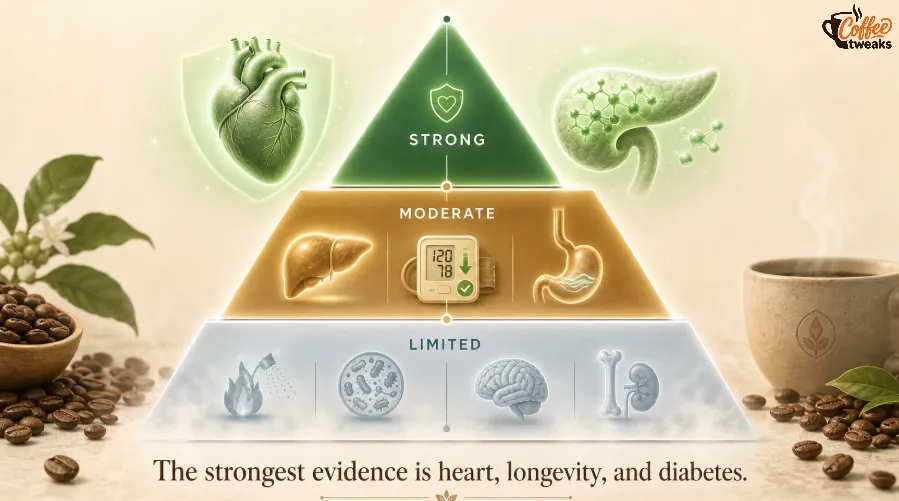
Health writing loves to blur weak and strong evidence into one confident paragraph. I won't do that. Here's the split.
Evidence at a glance
| Benefit | How strong is the decaf evidence? |
|---|---|
| Lower type 2 diabetes risk | Strong |
| Lower heart disease + death risk | Strong |
| Lower irregular-heartbeat risk | Weak / not shown for decaf |
| Liver protection | Moderate (mostly animal + general coffee data) |
| Lower blood pressure vs regular | Moderate |
| Easier on acid reflux | Moderate |
| Reduced inflammation | Limited |
| Gut, mood, sleep, bone | Limited / logical |
Strong evidence
Heart disease and living longer: This is the headline finding, and it's a good one.
A 2022 study using the UK Biobank followed nearly 450,000 people for over 12 years. Decaf coffee at 2–3 cups a day was linked to lower rates of cardiovascular disease and lower all-cause mortality, a roughly 14% lower death risk at that intake compared with non-drinkers.
But there's a catch worth knowing. In that same study, ground and instant coffee were linked to fewer arrhythmias (irregular heartbeats, including atrial fibrillation). Decaf was not.
So the arrhythmia benefit seems tied to something the caffeine or full-strength coffee brings that decaf doesn't. If you switched to decaf specifically for heart-rhythm reasons, know that the mortality benefit still shows up, the rhythm benefit is less clear.
Type 2 diabetes: Big, consistent, well-replicated.
A meta-analysis of 28 studies covering over a million people found each extra daily cup lowered diabetes risk. Caffeinated coffee cut risk about 9% per cup, decaf about 6% per cup. A later analysis of 30 studies landed in the same place: roughly 7% for caffeinated, 6% for decaf. Both protective.
Decaf just a hair behind. The chlorogenic acids, not the caffeine, are the leading suspect here.
Moderate evidence
Liver health. Animal studies show decaf coffee reduces liver fat, inflammation, and fibrosis, and researchers have specifically shown caffeine isn't required for coffee's liver benefits. Human data on coffee and liver disease is strong; the decaf-specific human data is thinner but points the same direction.
Blood pressure. Caffeine gives an acute blood pressure bump for a few hours after you drink it. Decaf skips that. In one controlled trial, people who swapped regular for decaf saw a small but real drop in blood pressure. Long-term coffee drinking isn't strongly tied to high blood pressure either way, but if you're caffeine-sensitive or watching your numbers, decaf removes the short-term spike.
Acid reflux. Decaf is genuinely gentler, but not neutral. In reflux patients, switching from regular to decaf cut the time the esophagus spent exposed to acid dramatically.
The important nuance: caffeine isn't the main irritant. The chlorogenic and caffeic acids stimulate stomach acid too, and those stay in decaf. So decaf helps a lot of mild-reflux folks, less so for serious GERD. Pair it with a dark roast and don't drink it on an empty stomach, and you've stacked the deck in your favor.
Limited or early evidence
Treat these as “promising, not proven.”
Who benefits most from decaf, and who should check with a doctor
Decaf earns its place for specific people. Here's who.
Health authorities including ACOG recommend keeping caffeine under 200 mg a day during pregnancy from all sources. High caffeine intake has been associated with risks like low birth weight and miscarriage, though the exact relationship is still debated and confounded by things like nausea.
Decaf makes staying under that limit easy, a couple of cups still leaves you far below 200 mg. That's the upside, and it's real.
Two caveats. First, decaf still counts toward your daily caffeine total, so tally it in. Second, if the solvent question matters to you during pregnancy, choose Swiss Water or CO₂ decaf. And the non-negotiable: talk to your own doctor or midwife. General guidance isn't personal medical advice, and pregnancy is exactly when the difference matters.
Quick reference
| Great fit for decaf | Check with a doctor first |
|---|---|
| Caffeine-sensitive people | Pregnant or trying to conceive |
| Evening / after-dinner drinkers | Breastfeeding |
| People cutting caffeine gradually | Managing a heart-rhythm condition |
| Mild acid reflux | Diagnosed GERD or ulcers |
| Anxiety worsened by caffeine | On medications affected by caffeine |
| Older adults watching bone health | Any condition where your doctor flagged coffee |
How to actually buy and brew good decaf
Enough theory. Here's what to do at the shelf and in the kitchen.
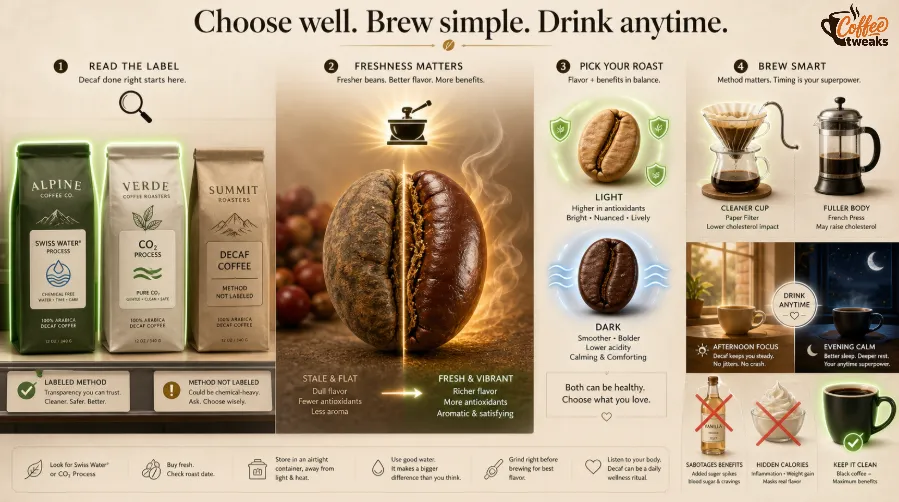
Read the method on the bag: “Swiss Water Process” or “CO₂ / sparkling water process” means solvent-free. If a bag says nothing about method, it's often the traditional solvent route. Not dangerous by the limits, but if you care, the label tells you.
Buy whole bean when you can: Decaf beans are a little more fragile and stale faster. Whole bean, ground fresh, tastes noticeably better. Decaf has a reputation for tasting flat, and stale beans are half the reason.
Match roast to goal: Light roast for maximum antioxidants. Dark roast for the gentlest cup on your stomach. Both are fine choices, pick for your reason.
Brewing: Any method works. If cholesterol is on your radar, use a paper filter, unfiltered brewing (French press, some espresso) lets through compounds that can nudge LDL up. That's true for regular and decaf alike.
Timing: This is decaf's superpower. Drink it whenever, especially the afternoon and evening cups that regular coffee ruins.
Daily amount: The research sweet spot for the heart and mortality benefits sat around 2–3 cups a day. More isn't automatically better. And “it's decaf so I can drink unlimited cups” is a myth, the caffeine is trace, but the acids and your fluid balance still exist. Reasonable is reasonable.
Skip the sabotage: A cup of decaf is about two calories. Load it with syrup and whipped cream and you've undone the health angle. The bean isn't the problem, the additions usually are.
Five decaf myths worth killing
I hear these constantly. Let's put them down.
There's a pattern in all five. People treat decaf as an all-or-nothing thing, either fake coffee or a health loophole. It's neither. It's coffee with one ingredient turned down.
FAQ
Is decaf coffee actually healthy, or is that marketing?
It's real. Decaf keeps most of coffee's antioxidants and is linked in large studies to lower risk of type 2 diabetes, heart disease, and early death. It loses caffeine and a small, inconsistent share of chlorogenic acids.
Does decaf coffee have antioxidants?
Yes. The polyphenols, mainly chlorogenic acids, largely survive decaffeination. Studies disagree on the exact amount, ranging from a small drop to no change, and your roast level affects them more than the decaf process does.
Is decaf coffee safe during pregnancy?
It's generally considered a safer fit than regular because the caffeine is trace, and it makes staying under the recommended 200 mg daily caffeine limit easy. It still counts toward that limit. Choose solvent-free decaf and confirm with your own doctor.
Can caffeine-sensitive people drink unlimited decaf?
No. The caffeine is very low, so sensitivity is rarely an issue, but “unlimited” isn't the right frame. Decaf still has coffee acids and still counts as fluid intake. Two to three cups is a sensible ceiling for most people.
Which decaf method is healthiest?
Swiss Water and CO₂ use no chemical solvents and retain antioxidants well. They're the easy pick if you want to skip the methylene chloride question entirely.
Is decaf better for acid reflux?
Usually gentler, not neutral. Switching from regular to decaf sharply reduces esophageal acid exposure, but decaf's chlorogenic acids still stimulate some stomach acid. A dark roast, with food, is the most reflux-friendly setup.
Does decaf raise blood pressure?
No meaningful acute spike, unlike caffeine. Swapping regular for decaf has even produced small blood pressure reductions in trials.
Is dark roast decaf healthier than light roast?
Depends on your goal. Light roast holds more antioxidants. Dark roast is easier on the stomach thanks to lower acid and a compound called NMP. Neither is “healthiest” across the board.
Does decaf help you sleep?
Indirectly. It won't put you to sleep, but it removes the caffeine that keeps you up, so it's a smart evening swap.
Will decaf still give me the heart benefits of coffee?
The lower heart-disease and mortality links show up for decaf. The reduced irregular-heartbeat benefit seen with caffeinated coffee did not clearly appear for decaf in the largest study.
The bottom line
Decaf isn't a compromise. It's a different tool.
You give up caffeine and a sliver of antioxidants. You keep most of what makes coffee good for you, and you gain the ability to drink it at 8 p.m. without paying for it at midnight.
The two decisions that matter most: pick a solvent-free method if the chemical question bugs you, and match your roast to your goal. Do that, and decaf stops being the sad cousin of “real” coffee.
It's just coffee. Minus the part some of us are better off without.