
CBD Coffee for ADHD (2026): Does It Actually Help Focus?

Real talk.
CBD coffee gets hyped as the ultimate productivity drink. Focus. Calm. Better mornings. Sounds great.
The science? Much messier.
I've spent weeks pulling apart the clinical research, the pharmacology, and the Reddit threads on this one. Here's what actually happens when CBD meets caffeine, and whether adults with ADHD should bother.
The Quick Verdict
There is no clinical trial showing that CBD improves ADHD symptoms. The one randomized trial that tested a cannabis-derived compound (a THC/CBD combo, not CBD alone) on adult ADHD found no statistically significant benefit. Evidence level: Limited to none.
Caffeine, on the other hand, has a real mechanistic link to ADHD's dopamine system, though it's a weaker and blunter tool than actual ADHD medication. Evidence level: Moderate.
Combining the two doesn't “cancel each other out” in the way marketing copy implies. CBD can change how your body processes caffeine, but only in a way that's been studied at doses far higher than what's in your CBD latte. Evidence level: Limited, dose-dependent.
None of this means CBD coffee is dangerous or pointless. It means the confident claims on product pages are running way ahead of the data.
What ADHD Actually Is
Attention-deficit/hyperactivity disorder is a neurodevelopmental condition. It shows up as ongoing patterns of inattention, hyperactivity, and impulsivity that get in the way of daily life.
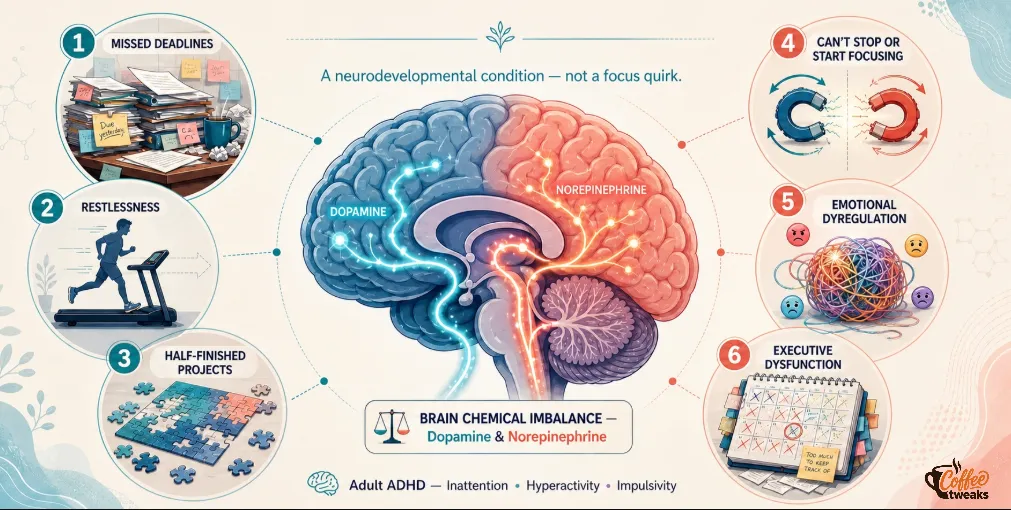
It's not a focus quirk. It's tied to real differences in how the brain's dopamine and norepinephrine systems regulate attention, motivation, and impulse control.
ADHD in adults doesn't always look like bouncing off the walls. It often looks like missed deadlines, half-finished projects, restlessness, and a brain that either can't focus or can't stop focusing on the wrong thing. Emotional regulation and executive function (planning, organizing, starting tasks) take a hit too.
Current Evidence-Based Treatments
Stimulant medications, methylphenidate (Ritalin, Concerta) and amphetamine-based drugs (Adderall, Vyvanse), are the first-line treatment for adult ADHD. They work by increasing dopamine and norepinephrine activity in the prefrontal cortex, and they help most people who try them. Non-stimulant options like atomoxetine and guanfacine are used when stimulants aren't tolerated or don't fit.
Cognitive behavioral therapy adapted for ADHD is also considered a legitimate, evidence-based part of treatment. It targets the executive-function side of things, like task initiation and time management, that medication alone doesn't fully fix.
What the science says: Stimulant medication plus behavioral therapy is the current standard of care. Nothing in this article is meant to replace that.
How Caffeine Actually Affects ADHD Brains
Caffeine blocks adenosine receptors in the brain. Adenosine is the chemical that builds up over the day and makes you sleepy. By blocking it, caffeine indirectly increases dopamine and norepinephrine activity, which is part of why it can sharpen focus.
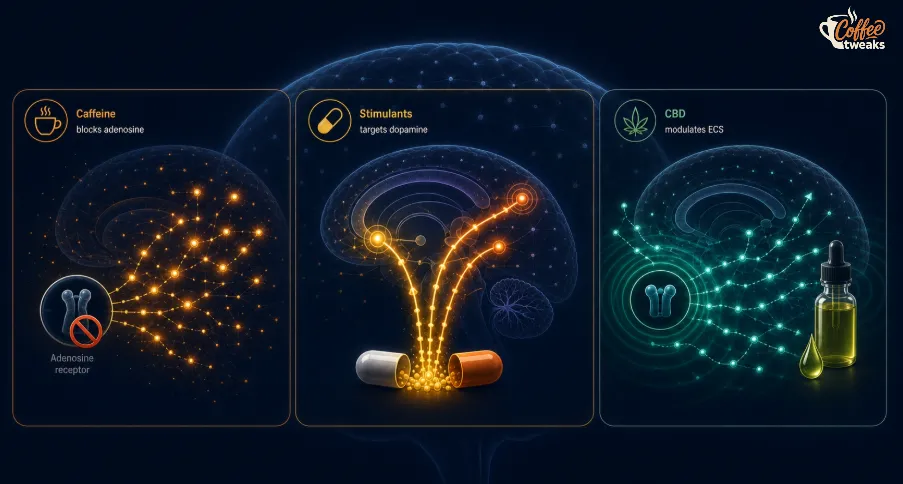
This is mechanistically similar to how stimulant ADHD medication works, just weaker and less targeted. Caffeine hits adenosine receptors broadly across the brain. Prescription stimulants act more precisely on the dopamine and norepinephrine pathways tied to attention.
Here's the catch. A large 2022 survey of over 2,000 adults found no meaningful link between ADHD symptom severity and caffeine consumption. That's a real dent in the popular idea that people with ADHD are unconsciously self-medicating with coffee. Evidence level: Moderate, with mixed findings across studies.
Some adults with ADHD also report a paradoxical response: caffeine makes them calmer or sleepier instead of more alert. This isn't universal, and researchers aren't entirely sure why it happens in some people and not others, but it's a documented pattern, not just anecdote.
One more thing worth knowing: tolerance to caffeine's focus-boosting effects tends to build quickly, and its roughly 5-to-6-hour half-life means an afternoon cup can mess with sleep, which then worsens attention and emotional regulation the next day. Coffee is not a neutral bystander here.
How CBD Affects the Brain
CBD (cannabidiol) doesn't work through the same mechanism as THC. It's non-intoxicating and interacts with the body's endocannabinoid system, a network of receptors involved in mood, sleep, pain, and stress regulation, in a much more indirect way than THC does.
Researchers have proposed several mechanisms for CBD's effects: it may slow the breakdown of the body's own endocannabinoids, modulate serotonin signaling, and reduce inflammation. None of these pathways map cleanly onto the dopamine-and-norepinephrine story that defines ADHD.
The Endocannabinoid System and ADHD
A 2024 scoping review looking specifically at the endocannabinoid system and ADHD found that this is still an emerging research area. There's preclinical evidence (mostly animal studies) suggesting some connection between endocannabinoid signaling and traits like impulsivity, but the human clinical picture is thin.
Evidence level: Theoretical/preclinical, not yet translated into reliable human data.
Can CBD Actually Improve Focus in ADHD?
Short answer: the direct evidence isn't there yet.
The most relevant human trial is a 2017 randomized controlled study that gave adults with ADHD a cannabis-derived medication called Sativex, a roughly 1:1 mix of THC and CBD, not CBD alone. Thirty participants took part. The result: no statistically significant reduction in ADHD symptoms.
Broader reviews back this up. A 2022 scoping review of cannabis use and ADHD symptoms concluded that most available studies show cannabis either worsens ADHD symptoms or has no effect, and explicitly stated there isn't enough evidence to recommend cannabis as an ADHD treatment.
That review also pointed out something important: the isolated effect of CBD by itself on ADHD is not well understood, because almost no studies separate CBD from THC when looking at ADHD outcomes specifically.
What the science says: There is currently no credible clinical evidence that CBD, on its own, improves core ADHD symptoms like inattention or impulsivity. Evidence level: Limited to none.
This doesn't mean it's impossible that CBD helps some individuals feel more settled or less anxious in a way that indirectly makes focusing easier. It means that specific, tested claim (CBD treats ADHD) doesn't hold up yet.
CBD and Caffeine: What Happens When You Combine Them
This is where the marketing gets ahead of the pharmacology.
The “opposites” framing
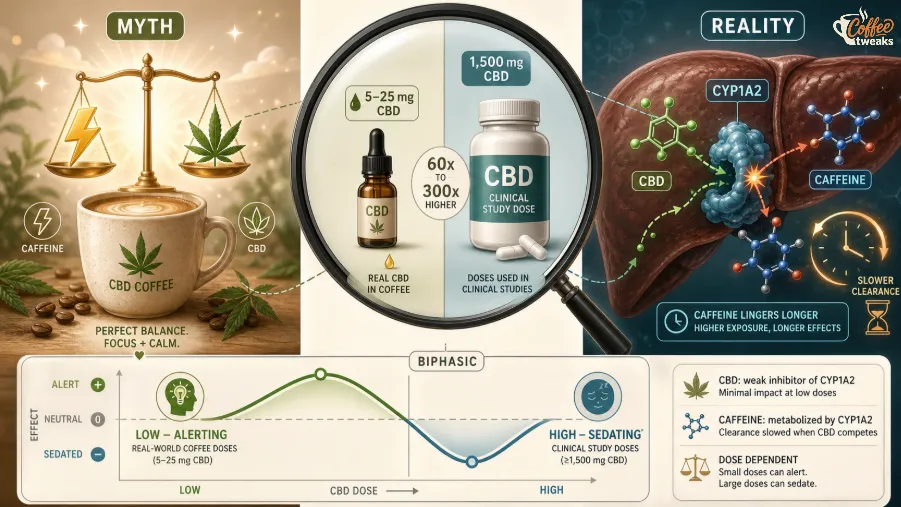
CBD coffee is often sold on a simple pitch: caffeine stimulates, CBD relaxes, so together they balance each other out and you get focus without jitters. That's a plausible-sounding story. It's also mostly a subjective, user-reported effect rather than something confirmed at the doses typically used in a cup of coffee.
What the pharmacokinetic data actually shows
There is real data on how CBD changes caffeine metabolism, but it comes from a phase 1 drug-interaction trial using a pharmaceutical-grade CBD product (the FDA-approved seizure medication Epidiolex) at doses of 750 mg, twice daily.
That's not a typo. At that dose, CBD increased caffeine's overall blood exposure by roughly 95%, by inhibiting the liver enzyme CYP1A2, which normally clears caffeine from your system.
Evidence level: Moderate, but the dose gap matters enormously. A typical CBD coffee serving contains somewhere around 5 to 25 mg of CBD. The interaction study used 1,500 mg per day, roughly 60 to 300 times more CBD than what's in your cup.
There is no published evidence that CBD coffee at typical commercial doses meaningfully changes how your body processes caffeine.
The biphasic wrinkle
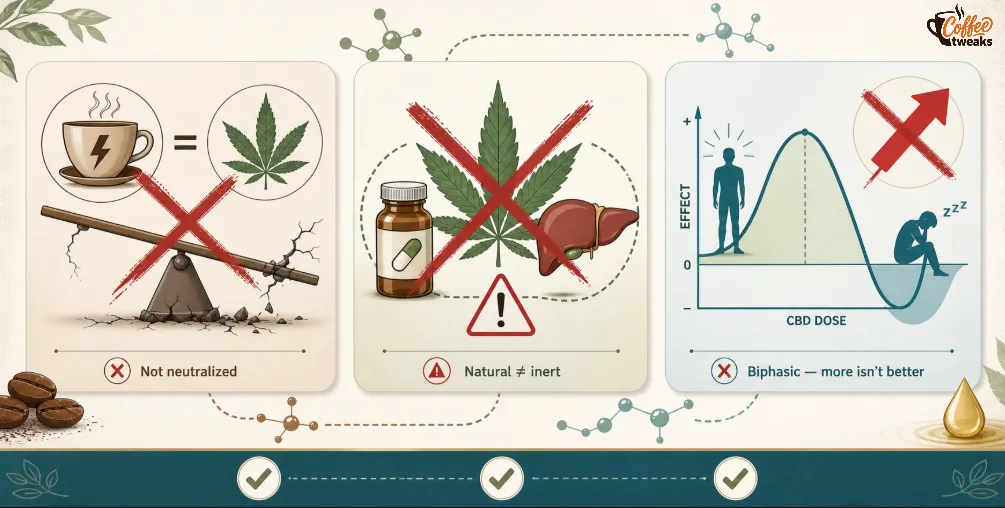
CBD appears to behave differently at different doses, a pattern researchers call a biphasic effect. Lower doses tend to be mildly alerting; higher doses tend to be sedating. This is one plausible explanation for why some people say CBD coffee helps them focus, while others say it makes them drowsy. It may come down to dose, individual body chemistry, or both.
Evidence level: Anecdotal for the coffee-specific pattern, with theoretical support from dose-response research.
CBD and ADHD Medication: What to Know Before Mixing
This is the part of the article that matters most if you're actually taking prescribed medication.
CBD and Adderall (amphetamine salts)
Adderall is partly metabolized by the liver enzyme CYP2D6. CBD has been shown to inhibit this same enzyme. In theory, that competition could raise Adderall's blood levels and intensify its effects, or, less predictably, alter how well it works.
Sources reviewing this interaction generally describe it as mild, but “mild” doesn't mean “ignore it,” especially since both substances independently can suppress appetite. Combining them doesn't cancel that side effect. It can compound it. Evidence level: Mechanistic/theoretical, based on enzyme pathways rather than large-scale clinical trials in ADHD patients specifically.
CBD and Vyvanse (lisdexamfetamine)
Vyvanse is a prodrug, meaning it needs to be converted in the body before it becomes active, and that conversion happens mostly through a different pathway than the liver's CYP enzymes.
That makes a direct CBD-Vyvanse metabolic interaction less clearly established than the CBD-Adderall one, but it's still not a combination with dedicated human trial data behind it. Evidence level: Limited data available.
CBD and Ritalin (methylphenidate)
Methylphenidate is broken down largely by an enzyme called CES1. CBD's interaction with CES1 is an active area of pharmacology research, including studies specifically designed to understand how CBD might affect drugs cleared through this pathway. As of now, there isn't a definitive answer on real-world clinical significance for people taking both. Evidence level: Emerging/inconclusive.
Common myth: “CBD smooths out my stimulant medication's side effects.” The available drug-interaction data doesn't support a clean smoothing effect. If anything, appetite suppression may stack rather than cancel. If you're on any ADHD medication, this conversation belongs with your prescriber, not a product review.
Beyond Focus: Anxiety, Sleep, and Blood Pressure
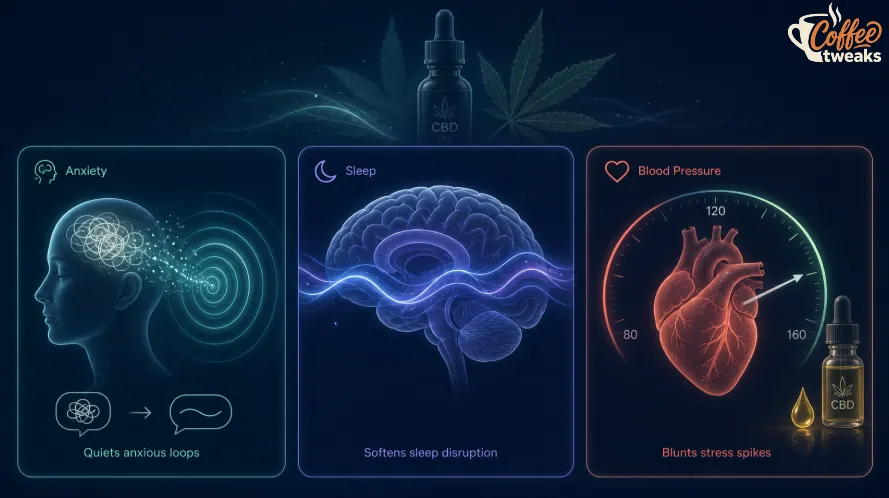
Anxiety
This is where CBD's evidence base is strongest, though still limited. Controlled studies using single doses of 300 to 600 mg have shown reduced anxiety in social anxiety disorder patients and healthy volunteers facing simulated public speaking.
A 2024 meta-analysis pooling eight randomized trials found a large effect size, but flagged the small combined sample size as a real limitation. A separate 2024 systematic review of anxiety trials from the past decade found inconsistent results across studies.
Evidence level: Moderate for high, pharmaceutical-grade doses. Weak for typical commercial CBD serving sizes, which are a fraction of what these trials used.
Since anxiety and ADHD symptoms can look similar and often co-occur, this is likely one honest reason some people feel their CBD coffee is “helping their ADHD.” It may be helping with anxiety instead, which is a real effect worth taking seriously on its own terms, just not the same thing as treating ADHD.
Sleep
Some CBD trials for anxiety have reported secondary improvements in sleep quality, but there isn't a dedicated, well-powered trial isolating CBD's effect on sleep in people with ADHD specifically. Evidence level: Limited, largely secondary findings.
Blood pressure
A meta-analysis pooling more than 20 studies found that CBD generally doesn't affect blood pressure or heart rate under resting conditions, but it can blunt the blood pressure spike that happens under acute stress.
Separate small human trials using high doses (600 mg and above) have shown modest reductions in resting blood pressure too. If you have a cardiovascular condition or take blood pressure medication, this is genuinely worth discussing with a doctor rather than assuming CBD is cardiovascularly neutral. Evidence level: Moderate, dose-dependent.
What Reddit Users Say
Anecdotal reports fall into a few recurring patterns. None of these are scientific evidence, but they're worth understanding because they explain the buzz around this product category.
Where these contradict the science: Framing CBD coffee as an ADHD treatment isn't supported. Framing it as something that might take the edge off caffeine-related jitters or general anxiety has more, if still thin, research behind it.
Common Myths, Worth Retiring
What the Research on CBD Coffee for ADHD Actually Shows
The honest summary: there is no dedicated clinical trial testing purified CBD, at realistic consumer doses, in adults specifically diagnosed with ADHD, measuring standardized ADHD symptom scores.
Almost everything available either studies THC-CBD combinations, studies CBD for anxiety or epilepsy and extrapolates, or relies on animal and preclinical data. Until that trial exists, anyone claiming certainty in either direction, for or against, is overstating what we know.
A Quick Word on Regulation
As of 2026, the FDA still hasn't approved CBD as a food additive or dietary supplement ingredient. The only FDA-approved CBD product remains a prescription epilepsy medication.
This doesn't make CBD coffee illegal to sell in most states, but it does mean there's no federal quality or dosing standard behind the CBD content listed on a bag of coffee or a can of cold brew. Potency claims are worth taking with real skepticism unless a brand publishes third-party lab testing.
Bottom Line
CBD coffee isn't a proven ADHD treatment. It isn't dangerous for most healthy adults at typical commercial doses, either. If you're not on ADHD medication and you're curious, the realistic best-case scenario is a milder jitter and a bit less caffeine-related anxiety, not sharper executive function.
If you are on stimulant medication, loop in your prescriber before adding CBD to your routine. And if focus is the actual problem you're trying to solve, the evidence still points toward stimulant medication, CBT, and good sleep habits, not your coffee order
Frequently Asked Questions
Does CBD coffee help ADHD focus?
There's no clinical evidence that CBD improves core ADHD symptoms. The one relevant randomized trial, using a THC-CBD combination, found no significant benefit for adult ADHD symptoms.
Can you take CBD with Adderall?
It's possible, but CBD and Adderall are both processed in part through the same liver enzyme (CYP2D6), and both can suppress appetite. Talk to your prescriber before combining them.
Does CBD cancel caffeine?
Not in a clean pharmacological sense. Some people report a “smoothing” effect on jitters, but there's no solid evidence that CBD neutralizes caffeine's stimulant effects at typical coffee doses.
Is CBD coffee safe every day?
For most healthy adults without other medications or conditions, moderate typical-dose CBD coffee appears low-risk based on available safety data. It's not FDA-regulated as a food additive, so potency accuracy varies by brand.
Can CBD reduce caffeine jitters?
This is plausible and commonly reported anecdotally, though it hasn't been rigorously tested at the doses found in commercial CBD coffee.
Can CBD improve executive function?
One small, open-label (not placebo-controlled) trial in anxiety patients found secondary improvements in executive function alongside anxiety reduction. That's not the same as a dedicated ADHD executive-function trial, and the result needs replication.
Can CBD worsen attention?
At higher doses, CBD's sedating, biphasic effect could plausibly make focus harder for some people, though this hasn't been specifically studied in ADHD populations.
Is CBD coffee the same as CBD oil?
No. Both contain CBD, but potency, absorption, and how consistently the CBD is mixed into the product can vary a lot between coffee and oil formats.
Does CBD interact with Vyvanse or Ritalin?
Possibly, through different metabolic pathways than the CBD-Adderall interaction. The data here is thinner and less conclusive. Discuss any combination with your doctor.
How much CBD is in a typical cup of CBD coffee?
Most commercial CBD coffee products contain somewhere around 5 to 25 mg of CBD per serving, far below the 300 to 750 mg doses used in most clinical CBD research.
Is caffeine actually good for ADHD?
It has a real, if modest and short-lived, mechanistic link to ADHD's dopamine system. But a large population study found no meaningful association between caffeine intake and ADHD symptom severity, and effects vary a lot between individuals.
Should I stop my ADHD medication and switch to CBD coffee?
No. There's no clinical evidence CBD treats ADHD, and stimulant medication remains the first-line, evidence-based treatment. Don't change or stop a prescribed medication without talking to your doctor.
Medical Disclaimer
This article is for informational purposes only and is not medical advice. It is not intended to diagnose, treat, cure, or prevent ADHD or any other condition. CBD and caffeine can interact with prescription medications, including stimulant and non-stimulant ADHD medications.
If you have ADHD, are pregnant or nursing, have a cardiovascular condition, or take any prescription medication, talk to a doctor or pharmacist before adding CBD products to your routine. Individual responses to CBD and caffeine vary significantly.