Coffee and Sleep: The 8-Hour Half-Life Nobody Talks About

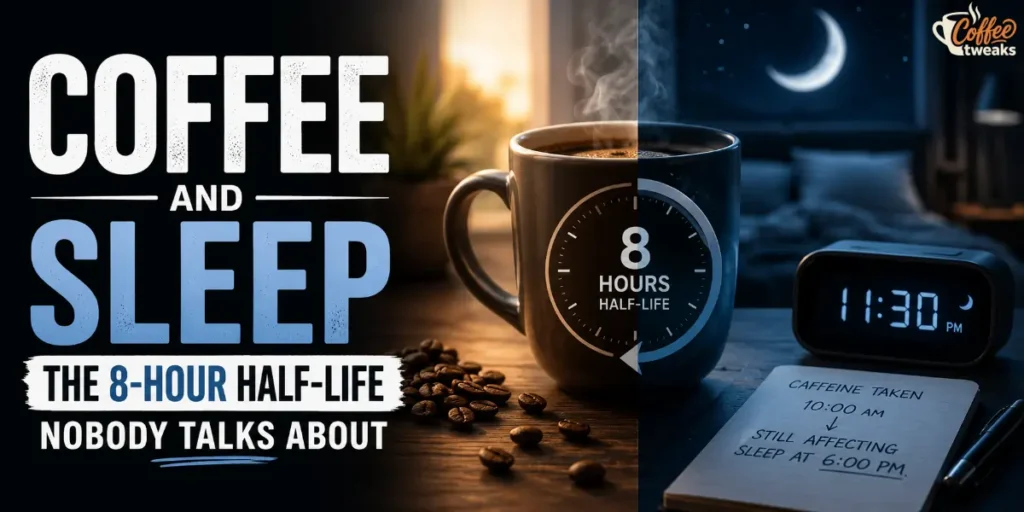
That 3 pm latte is still in your bloodstream at midnight. Not half of it. Depending on your genetics, most of it.
This is the part of the coffee and sleep conversation that barely anyone explains properly — and it's the reason you're lying awake wondering why you can't switch off even though you haven't had coffee since afternoon.
I've spent years studying coffee chemistry, pulling thousands of espresso shots, obsessing over extraction variables, and reading every piece of caffeine research I could get my hands on. And I'm telling you: the standard “caffeine lasts 4–6 hours” advice is wildly incomplete for most people.
Here's the thing. The real story about caffeine and sleep isn't about whether coffee is bad for you. Coffee is extraordinary. The story is about timing, genetics, and what actually happens inside your brain when caffeine meets adenosine — and why most people have the math completely wrong.
Let's fix that.
What Caffeine Actually Does to Your Brain
Before we get into timing, you need to understand the mechanism. Because once you do, the whole sleep disruption thing makes complete sense.
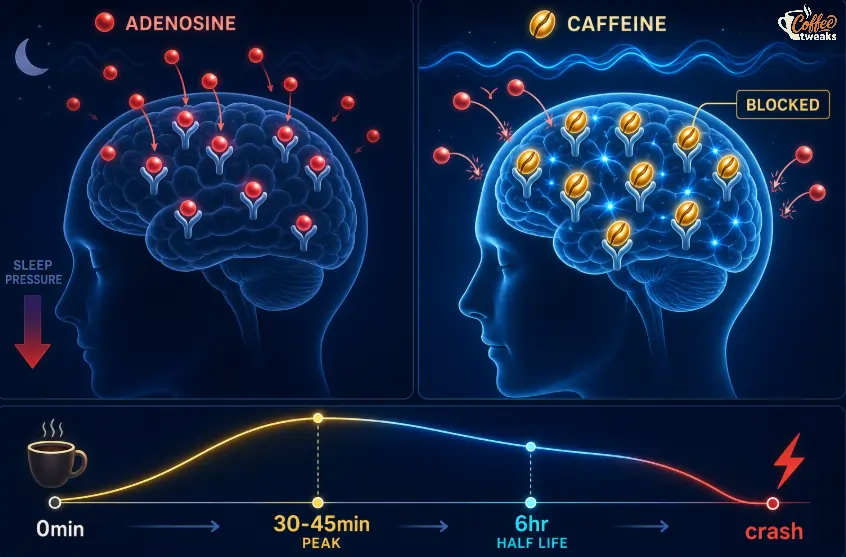
Your brain produces a molecule called adenosine throughout the day. Every hour you're awake, adenosine levels climb. The higher they get, the sleepier you feel. By the time you've been awake 15–16 hours, adenosine has built up enough to make you genuinely ready to sleep. This is called sleep pressure — and it's supposed to work exactly like that.
Caffeine is a structural impersonator. Its molecular shape is close enough to adenosine that it slots into the same receptors in your brain and blocks them. Adenosine can't bind. Sleep pressure doesn't register. You stay alert.
This is why caffeine works, and why it works fast, peak plasma levels hit within 30–45 minutes of your first sip.
But here's the critical part: caffeine isn't deleting adenosine. It's just blocking the receptors temporarily. While caffeine is in your system, adenosine keeps building up silently in the background, waiting. The moment caffeine clears those receptors, all that accumulated adenosine floods in at once.
That's the caffeine crash. That wave of sudden exhaustion. It's not fake tiredness, it's real, compounded sleep debt landing all at once. ☕🎯
The Half-Life Problem Nobody Explains Properly
Most articles tell you caffeine has a half-life of 4–6 hours. The FDA says the same. Some say 5 hours. And technically? None of them are lying.
But here's what they're not telling you.
A 5-hour half-life means that 5 hours after your coffee, half the caffeine is still active. Not a trace amount. Half. So if you had 200 mg of caffeine (roughly two standard espresso shots or one large drip coffee) at 2 pm:
You went to bed at 10 pm with 75 mg of active caffeine still running through your bloodstream. That's nearly the equivalent of a shot of espresso. And you're wondering why your sleep feels light and unrefreshing?
Real talk… this isn't about whether caffeine keeps you awake. It's about what it does to your sleep architecture even when you do fall asleep.
Studies using electroencephalography (EEG) show that caffeine, even taken 6 hours before bed, measurably reduces slow-wave sleep, the deepest, most restorative stage. You might fall asleep at your normal time. You might even sleep 7 hours. But the quality of that sleep is compromised in ways you won't feel until the next morning, and the morning after that.
This is the quiet damage. Less deep sleep means less physical recovery, less memory consolidation, blunted immune function, and elevated cortisol the following day, which, of course, makes you reach for another coffee. The cycle writes itself.
Your Genetics Are Running This Show ☕🎯
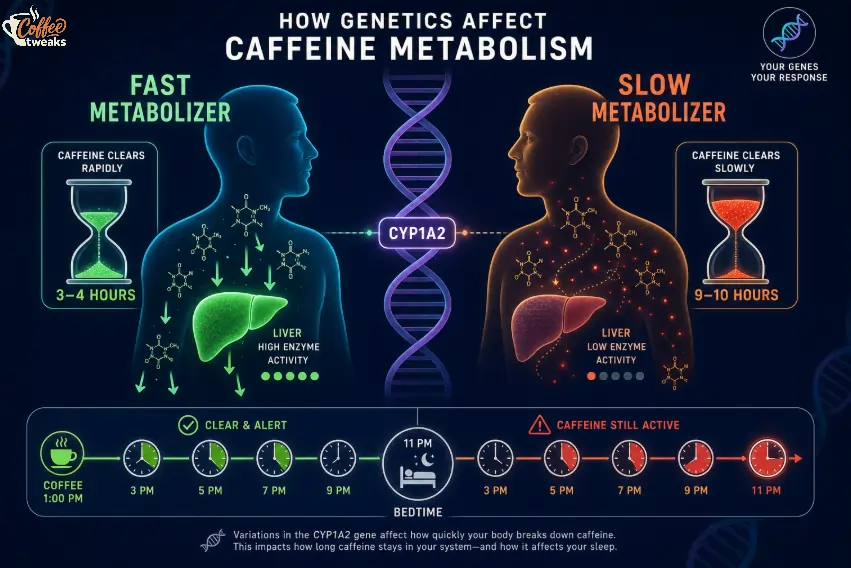
Here's where it gets genuinely fascinating, and explains why your colleague can knock back an espresso at 9 pm and sleep like a rock while you're still wired from a 2 pm flat white.
The primary enzyme responsible for breaking down caffeine in your liver is coded by a gene called CYP1A2. This gene controls how fast your body metabolizes caffeine. And the variation between people is not small.
Fast metabolizers, roughly 50% of the population, clear caffeine efficiently. Their half-life sits around 3–4 hours. An afternoon coffee is mostly gone by bedtime.
Slow metabolizers, the other 50%, have a variant of CYP1A2 that produces less of the metabolizing enzyme. Their caffeine half-life can stretch to 9–10 hours, sometimes longer.
Do the maths on that one. A slow metabolizer who drinks a coffee at 1 pm still has significant caffeine activity at 10 or 11 pm. They're not “just sensitive.” Their biology is working exactly as designed, just on a different timeline.
I've been wrong before. Not about this.
Several other factors stack on top of genetics:
So when someone says “caffeine doesn't affect my sleep,” they might genuinely be right. And when someone says “I cut off coffee at noon and still can't sleep,” they're also right. Both statements can be factually true at the same time.
What Caffeine Does to Your Sleep Stages
This part gets skipped in almost every mainstream article on coffee and sleep, and it's arguably the most important.
Sleep isn't a single state. It cycles through stages throughout the night, each serving specific biological functions. Caffeine disrupts this process in precise and measurable ways.
Slow-wave sleep (deep sleep/stages 3–4): Caffeine reduces the amount of time you spend here. This is where physical recovery happens, tissue repair, growth hormone release, and immune system strengthening. Less of this stage means you wake up feeling physically tired even after a full night in bed.
REM sleep: Caffeine shifts REM to earlier in the night and can reduce its total duration. REM is critical for emotional processing, memory consolidation, and cognitive function. This is why persistent caffeine-related sleep disruption eventually degrades mood, creativity, and problem-solving, not just alertness.
Sleep latency: Even when caffeine doesn't keep you fully awake, it increases how long it takes to fall asleep. Analysis using wearable sleep data found that participants who logged caffeine use scored 8+ points lower on sleep quality metrics, lost nearly 50 minutes of total sleep, and saw reductions across both REM and deep sleep stages.
You might think you slept. Your body knows the difference. ☕🎯
The 8-Hour Rule: When to Stop Drinking Coffee
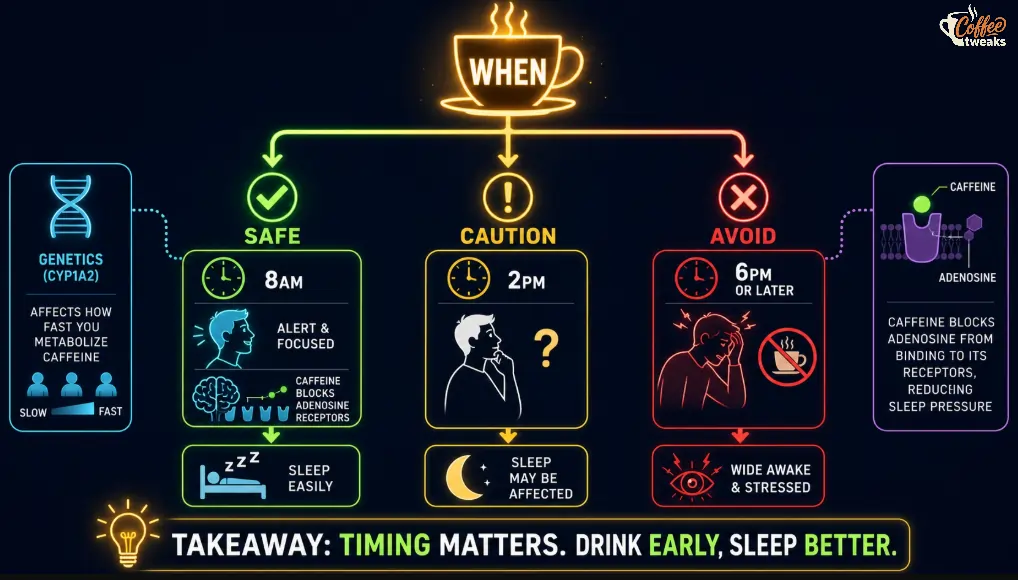
Every sleep researcher, every study worth reading, and every evidence-based guideline lands on the same number: cut caffeine at least 8 hours before your intended bedtime.
Not 4 hours. Not 6. Eight.
The 4–6 hour figure gets repeated because it's caffeine's average half-life, not a safety cutoff. By 8 hours, most average metabolizers have cleared enough caffeine for it to stop meaningfully interfering with sleep architecture.
For slow metabolizers? You're looking at 10 hours, potentially more.
Practical translation:
| Bedtime | Average Metabolizer Cutoff | Slow Metabolizer Cutoff |
|---|---|---|
| 10:00 pm | 2:00 pm | 12:00 pm (noon) |
| 11:00 pm | 3:00 pm | 1:00 pm |
| 12:00 am | 4:00 pm | 2:00 pm |
| 9:00 pm | 1:00 pm | 11:00 am |
Low-key obsessed with this table, honestly. Because most people see “don't drink coffee after 4 pm” and feel fine about their 3:45 pm latte. But if you're a slow metabolizer with a 10 pm bedtime, that 3:45 pm coffee is still 50% active when your head hits the pillow.
The 8-hour rule isn't arbitrary caution. It's basic pharmacokinetics applied to real human sleep schedules.
Hidden Sources of Late-Day Caffeine
Here's the thing. Coffee gets all the blame, but it's not the only source quietly sabotaging your sleep.
These are the ones people consistently overlook:
Real talk… if you're already managing your coffee cutoff and still struggling with sleep, track everything else too. The cumulative caffeine load across the day matters more than any single drink.
The Honest Verdict ☕🎯
I'm not here to tell you to quit coffee. That would be irresponsible, and I'm not apologizing for that. Coffee is genuinely extraordinary when you understand it and work with it instead of against it.
The Good
The Bad
The balance isn't complicated: coffee in the morning through early afternoon is genuinely beneficial for most people. Coffee stretching into the afternoon for slow metabolizers is a direct trade of sleep quality for a short-term alertness hit you'll pay for overnight.
Practical Rules From Someone Who Actually Loves Coffee
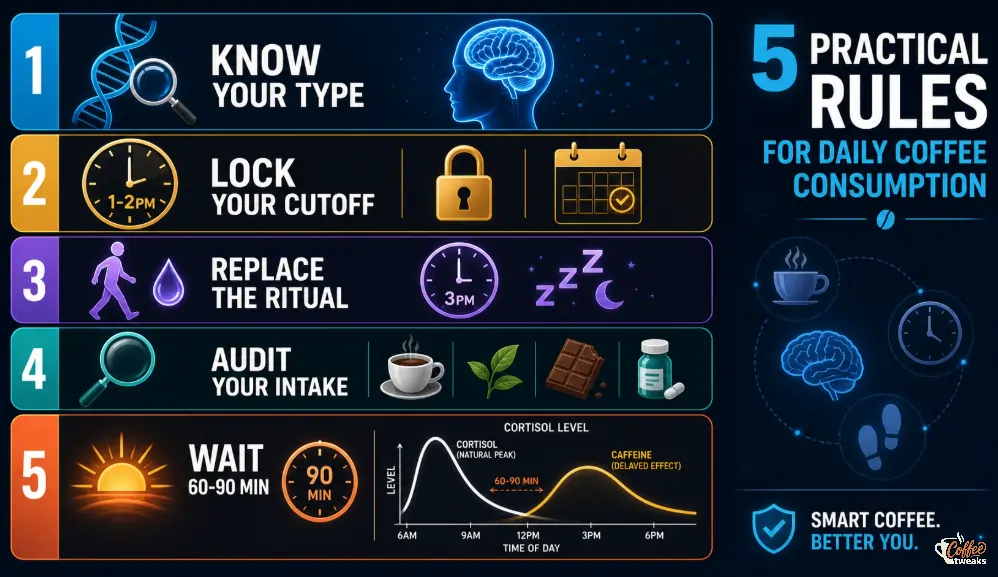
Know your metabolizer type. Consumer genetic tests report CYP1A2 variants. If you've never done one, pay attention to how you feel six hours after your last coffee. Still wired? You're probably a slow metabolizer.
Lock in your cutoff and keep it. For most people: nothing caffeinated after 1–2 pm. For slow metabolizers: move it to noon. Set a recurring reminder if you need the nudge.
Replace the ritual, not just the caffeine. The 3 pm slump isn't always a deficit — it's often a natural circadian dip that coffee temporarily masks. A 15-minute walk, cold water, or a brief rest does more for sustained afternoon alertness than a flat white that will be haunting your 1 am.
Audit before you adjust. Before deciding you “just don't sleep well,” track your total caffeine intake for a week — coffee plus tea plus chocolate plus supplements plus everything else. Most people are significantly underestimating their load.
Delay your first coffee by 60–90 minutes after waking. Cortisol peaks naturally in the first 30–60 minutes after you wake up. Drinking coffee during this window competes with your body's own alertness system. Delaying slightly allows your cortisol to do its job first, makes the caffeine hit more effective, and extends the window you have before your afternoon cutoff.
FAQ: Coffee and Sleep ☕🎯
Does coffee affect sleep quality even if I fall asleep normally?
Yes. Caffeine reduces slow-wave (deep) sleep and can fragment sleep architecture even when you fall asleep at your usual time. You may not notice consciously, but EEG studies and wearable data consistently show measurable differences in sleep quality.
What is the caffeine half-life?
Caffeine's half-life ranges from 2–10 hours depending on your genetics, age, hormonal status, and other factors. The commonly cited figure of 5 hours is an average — roughly 50% of the population metabolizes caffeine significantly more slowly.
When should I stop drinking coffee before bed?
The evidence-based recommendation is at least 8 hours before your planned bedtime for average metabolizers, and 10+ hours for slow metabolizers. For a 10 pm bedtime, that means no coffee after 2 pm if you're average, and after noon if you're a slow metabolizer.
What is the CYP1A2 gene and how does it affect caffeine?
CYP1A2 codes for the liver enzyme responsible for metabolizing approximately 95% of ingested caffeine. Variants that reduce enzyme activity extend caffeine's half-life to 9–10 hours or more. Around 50% of people carry a slower-metabolizing variant.
Can I build tolerance to caffeine's sleep effects?
You can build tolerance to the alertness effects of caffeine, but research suggests this tolerance does not fully extend to caffeine's ability to disrupt deep sleep. Sleep architecture remains vulnerable even as the subjective stimulant effect plateaus.
Does decaf coffee affect sleep?
Decaf contains 2–15 mg of caffeine per cup — not zero. For most people this is negligible, but slow metabolizers and people with high caffeine sensitivity may still experience effects, particularly across multiple evening cups.
The Bottom Line
Coffee and sleep aren't enemies. They're governed by timing and biology that most people are working around without a proper map.
You don't have to choose between great coffee and great sleep. You have to choose when you drink it, and that choice needs to be based on your actual metabolism, not generic advice that was never accurate for half the population.
Morning coffee is a genuine pleasure and a genuine performance tool. I'm not walking that back.
But the afternoon and evening stuff… that's where most people are quietly paying a sleep tax they don't even know they're accruing. Night after night, deep sleep gets eroded, recovery gets blunted, and the next morning they reach for more coffee to fix the problem their late coffee created.
Here's the thing. The 8-hour rule isn't a lifestyle restriction. It's how you keep drinking great coffee for the next 40 years without it slowly dismantling the quality of the rest that makes everything else work.
Get the timing right. Your sleep will thank you. And honestly, your morning coffee will taste even better when you're not half-dead from a compromised night's rest.