AeroPress Review: 17 Years & Still Best Travel Coffee Maker?

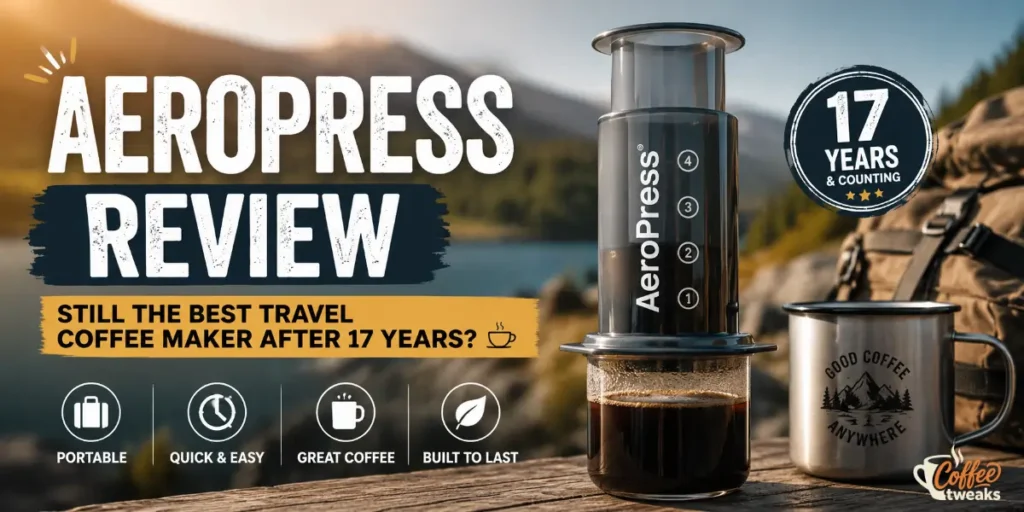
I still remember the first time I packed an AeroPress into my carry-on.
It was a red-eye from Buenos Aires to Barcelona, and I was determined not to start my new European life with bad airport coffee. The AeroPress sat tucked inside a rolled-up sweater, barely taking any space, next to my passport and a small bag of single-origin Ethiopian beans.
That was years ago. And I am still using it. ✨
That's the thing about the AeroPress: it doesn't demand your loyalty through flashy design or clever marketing. It earns it by just quietly working, every single time, if you're in a five-star hotel in Tokyo, a campsite in the Pyrenees, or a tiny Airbnb kitchen with one sad electric kettle.
But 2026 is a different world. The coffee equipment market has exploded. There are gorgeous travel pour-overs, sleek smart kettles, and compact espresso machines you can fit in a jacket pocket. So the question I keep getting asked, and the question I've been sitting with for weeks, is this:
Is the AeroPress still the best travel coffee maker after 17 years?
Let me give you my honest answer.
AeroPress Review: Quick Verdict (For Those in a Hurry) ☕
Yes, with important nuance.
The AeroPress Original remains the most versatile, durable, and forgiving travel coffee maker you can buy in 2026. It still makes exceptional coffee, cleans in seconds, and fits into any bag without complaint.
The AeroPress Go is the better choice for frequent travelers who prioritize compactness. The AeroPress Clear is for people who want that same performance with a premium aesthetic.
None of the alternatives I've tested, and I've tested a lot, match the complete package.
But it's not perfect. And I'll tell you exactly where it falls short.
What Is AeroPress, and Why Does It Still Matter?
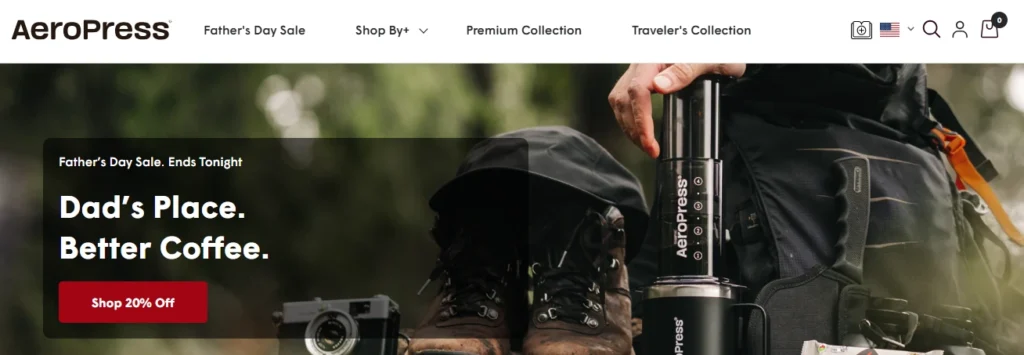
For anyone new here: the AeroPress was invented in 2005 by Alan Adler, a Stanford engineering lecturer who was frustrated by how long it took to brew a single cup of coffee. The result was a plastic cylinder that uses air pressure and immersion brewing to produce coffee in about one minute.
It sounds simple. It is simple. That's the genius. 🌿
Seventeen years later, the product has barely changed structurally, and that's a compliment. The core design that won over travelers, campers, and coffee nerds in 2005 is still fundamentally the same device you can buy today. What has changed is the lineup.
In 2026, AeroPress offers three main models:
Let's break down what actually separates them, because the differences matter more than the specs suggest.
AeroPress Original vs Go vs Clear: Which One Actually Suits You?
| Feature | AeroPress Original | AeroPress Go | AeroPress Clear |
|---|---|---|---|
| Best for | Home + travel | Dedicated travelers | Premium aesthetics + home use |
| Capacity | Up to 3 small cups | 1–2 cups | Up to 3 small cups |
| Included mug | No | Yes (doubles as carrying case) | No |
| Material | BPA-free plastic | BPA-free plastic | Tritan Renew (premium clarity) |
| Packability | Good | Excellent | Good |
| Price | Most affordable | Mid-range | Premium |
AeroPress Original
This is the one that started it all. It brews up to roughly three small espresso-style cups (or one large American-style cup), fits inside most backpacks with ease, and is shatterproof. It's the one I keep at home and also bring on longer trips where I know I'll want to brew multiple cups.
If you're shopping for your first AeroPress or you want a single brewer that works equally well at home and on the road, this is your pick. The price-to-performance ratio is unmatched.
AeroPress Go ✨
Okay but hear me out, the Go is genuinely underrated.
The entire brewer collapses into a travel mug that you can toss in your day bag. It's noticeably more compact than the Original, and the included mug means you don't need to hunt for a cup in your hotel room at 6 am. I used the Go on a 12-day trip through Portugal last year, backpack-only travel, and it never once felt like a burden.
The trade-off is capacity. The Go brews slightly smaller amounts than the Original. For solo travelers who brew one cup at a time, this is a non-issue. If you're camping with a partner and both want coffee, the Original is more practical.
AeroPress Clear 🌿
The Clear is the newest member of the family and the one that will look best on your kitchen counter. Made from Tritan Renew, a recycled, premium-grade plastic, it's crystal clear, sleek, and noticeably more refined looking than the classic opaque version.
Does it brew differently? Not meaningfully. The materials and brewing mechanics are the same. What you're paying for is aesthetics and the satisfaction of using something that feels more considered.
I didn't expect to love this but I genuinely do reach for the Clear on quiet mornings at home when I want the ritual to feel a bit more intentional. It's not for everyone, but for people who care about how their coffee setup looks on the shelf, it's worth the extra cost.
Who should skip the Clear? Campers, budget-conscious buyers, and anyone who's rough on their gear.
Brew Quality: What Does AeroPress Coffee Actually Taste Like? ☕
This is where I have to be honest rather than promotional.
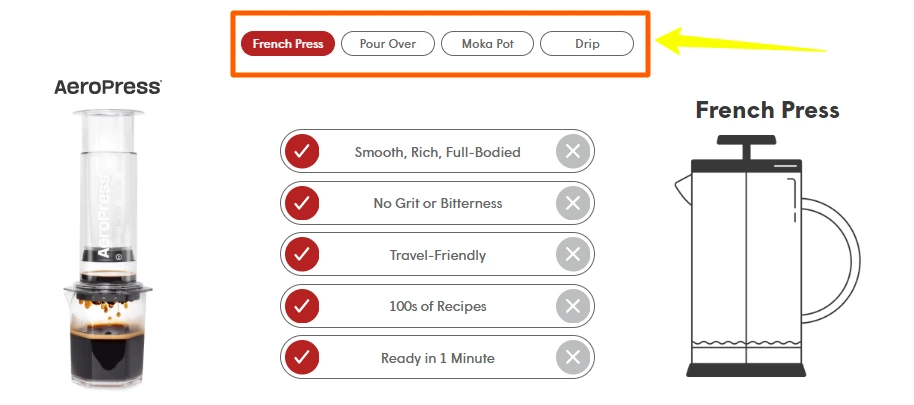
AeroPress coffee is smooth, relatively low-acid, and medium-to-full bodied. Because the brew time is short (1–2 minutes) and you press through a paper or metal filter, you get less bitterness than French press and more body than pour-over.
The flavour profile lands somewhere between immersion richness and filtered clarity, and that's actually a very pleasant place to be.
vs. French Press
AeroPress consistently produces less sediment and bitterness than French press. The paper filter captures oils and fine particles that French press leaves behind. The result is a cleaner cup. AeroPress claims “no grit or bitterness” and while I'd say that's slightly optimistic (grinds and technique still matter), it is genuinely true that a well-made AeroPress cup has noticeably less bitterness than a well-made French press cup. The French press has richer mouthfeel due to those oils, though. Neither is objectively better, they're different.
vs. Pour Over
Pour over at its best produces more clarity and brightness, particularly for light roasts with floral or fruity notes. An AeroPress cup is rounder and fuller. If you love tasting individual tasting notes in a delicate Ethiopian natural, pour over might show them off better. AeroPress will still taste good, just slightly less refined in that specific way.
vs. Moka Pot
Both can produce espresso-style concentrates. The moka pot runs hotter and produces more intense, sometimes more bitter extraction. AeroPress gives you more control over temperature and pressure, which usually means a more nuanced result. Also, you can't clean a moka pot in a hotel bathroom sink in 20 seconds. AeroPress can.
vs. Drip Coffee
Drip coffee is convenient, consistent, and often forgettable. AeroPress requires two minutes of attention but produces a noticeably better cup, more flavour, more control, less bitterness. No comparison, honestly.
vs. Espresso
AeroPress produces espresso-style concentrates, not true espresso. True espresso requires 9 bars of pressure. AeroPress generates roughly 0.5–0.75 bars. The result lacks the crema and intensity of real espresso, but it's rich enough to work in milk-based drinks and impressive for what it is. Anyone calling AeroPress an “espresso maker” is exaggerating, but anyone dismissing its concentrate as “not real espresso” is missing the point of what it can do.
The Bitterness Question
AeroPress's claim that it produces less bitterness than French press is largely accurate — but it's not magic. If you use water that's too hot, grind too fine, or steep too long, you will get bitterness. The AeroPress is more forgiving than other methods, not immune to user error. That distinction matters.
Travel Performance: Does It Deserve the Crown? ✨
This is the section I care most about. And yes, I'm speaking from real experience here.
Portability
The AeroPress Original fits into the pocket of most travel backpacks. The Go fits inside its own mug and takes up roughly the space of a water bottle. Neither requires special packing. You don't need to wrap it in bubble wrap or worry about TSA. It's plastic, it's light, it's shatterproof.
No exaggeration when I say, I've dropped the AeroPress Go on tile floors in three different countries. Still perfect.
Hotel Room Use ☕
This is where AeroPress quietly destroys every competitor.
Hotel room brewing requires: hot water from the kettle they provide, your brewer, your coffee, and a mug. That's it. The filter cap creates a seal so you can invert it without drips. You press into whatever mug you have. Cleanup takes under a minute at the bathroom sink, just pop out the puck, rinse the rubber plunger, done.
I've made coffee in hotel rooms in 11 countries with this thing. It never fails.
Camping Use 🌿
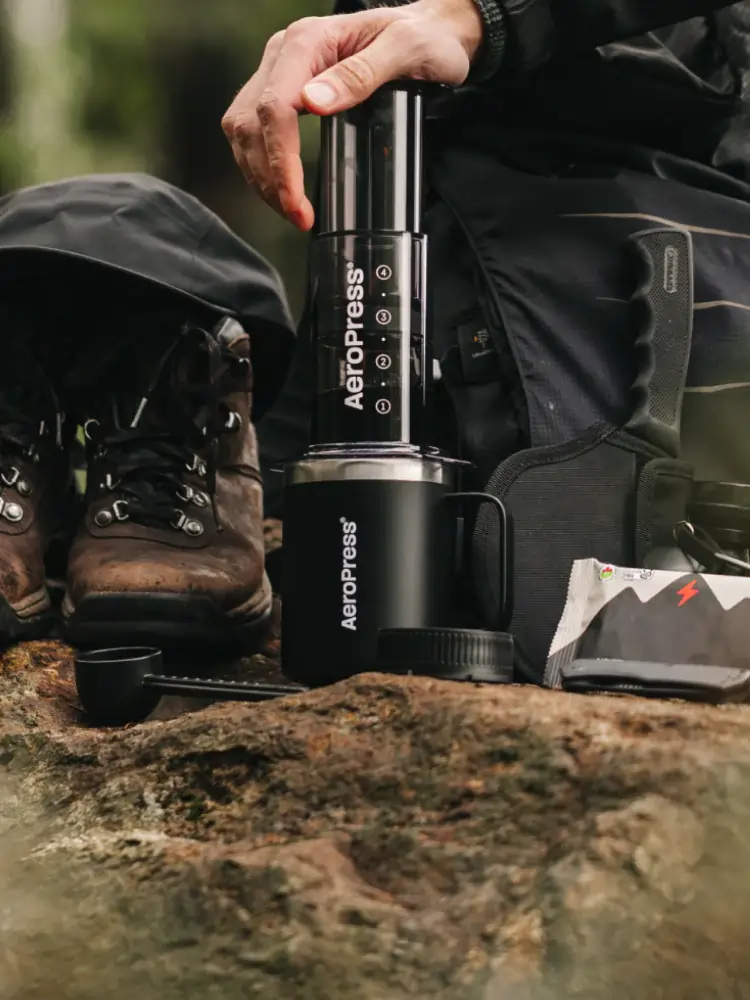
At camp, the AeroPress pairs beautifully with a small camping stove or JetBoil. It's completely manual, no electricity, no moving parts that can break. The fact that it works with a range of water temperatures is a genuine advantage when you're boiling water over a camp stove without a thermometer.
Airport and Train Travel
I've brewed AeroPress in airport lounges, on a picnic table outside a train station in Lisbon, and in the corridor of an overnight train because the dining car was closed. The stares are worth it. The coffee is always better than anything they're serving. ✨
Cleaning
Pop out the coffee puck. Rinse the chamber. Done. This takes literally 20–30 seconds. Anyone who has tried to clean a moka pot on a camping trip knows what a nightmare that experience is by comparison.
Does It Still Deserve the Title of Best Travel Brewer?
Yes. Here's why no competitor has genuinely overtaken it:
The AeroPress sits at the exact intersection of coffee quality, brewing simplicity, portability, and durability that no other single product has replicated.
My Go-To AeroPress Recipe ☕🌿

This isn't a championship recipe. It's the one I actually use, morning after morning, that consistently produces a delicious cup whether I'm in Barcelona or a campsite in Andalusia.
The Sofia Everyday Recipe
What you need:
Method:
- Place a rinsed paper filter in the cap and attach it to the chamber
- Stand the AeroPress upright on your mug (standard position)
- Add 17g of medium-fine ground coffee
- Start your timer and pour 230ml of water slowly, saturating all the grounds
- Stir gently 3–4 times
- Place the plunger on top and press slowly and steadily over 30–45 seconds
- Stop when you hear a soft hiss, that's air, not coffee, and over-pressing pulls bitterness
☕ Total brew time: About 90 seconds from first pour
✅ Why this works: The 85–90°C water temperature avoids over-extraction while still pulling sweetness and body from the beans. The medium-fine grind and short steep time keep bitterness in check. The slow, steady press gives you real control over the result. And rinsing the filter is a small step that makes a noticeable difference in cup clarity, don't skip it.
👉 Want something stronger? Use 20g coffee and reduce water to 180ml. Press into a mug of hot water and dilute to taste.
👉 Want cold brew fast? Use 20g coffee, 200ml room-temperature water, steep for 2–3 minutes, press, and pour over ice. Done in under five minutes. ✨
Accessories Worth Knowing About 🌿
AeroPress Manual Coffee Grinder ($199.95)
AeroPress launched their own manual grinder, and it's genuinely impressive. Italian-made titanium-coated conical burrs, 60+ grind settings from espresso-fine to coarse, and, the clever part, it fits inside an AeroPress plunger, handle and all. The whole kit becomes one compact unit you can drop into your bag without a second thought.
At $200, it sits in the mid-tier manual grinder range. For the quality of the burrs and the travel integration, it's competitive. Early user reviews rate it 4.9/5, with most people praising the construction quality and consistent grind. A few users noted the factory grind setting wasn't calibrated as described on arrival, and at least one reviewer mentioned difficulty reaching customer support for troubleshooting, worth knowing before you buy.
If you're building a complete travel coffee kit and want everything from AeroPress, the grinder completes the setup beautifully. If you already own a quality grinder like a Comandante, you don't need to switch. ☕
Filters
AeroPress paper filters are thin, affordable, and easy to find almost anywhere in the world. They produce a clean, clear cup by capturing oils and fine particles. Reusable metal filters are also available and produce a slightly fuller, oilier cup, closer to French press character. Both are valid. Paper is my everyday preference. Metal filters are the smarter travel option if you'd rather not pack a supply of disposables.
Honest Pros and Cons ✨
What AeroPress Gets Right
✅ Cleans faster than any other brewer I own: Pop out the puck, rinse the chamber, 20 seconds, done. When you're running for a 6am train and need your equipment packed in under a minute, this isn't a nice-to-have. It's essential.
✅ Forgiving of imperfect variables: Slightly too-hot water? Slightly uneven grind? AeroPress still delivers a good cup. Pour over under the same imperfect conditions would taste noticeably worse.
✅ Works at altitude: Water boils at lower temperatures at altitude, which affects extraction. Because AeroPress works well across a range of temperatures and short brew times, it handles altitude brewing better than most methods, genuinely useful for mountain hikers and anyone spending time in high-altitude cities.
✅ Virtually unbreakable: I've dropped mine, sat on the bag it was packed in, and left it in the rain. Still perfect. This durability isn't a minor selling point, it's a foundational travel advantage. 🌿
✅ Genuinely fast: Under two minutes from kettle to first sip. Including cleanup, the entire process takes about four minutes. No other quality brew method comes close to that.
✅ Enormous recipe flexibility: The AeroPress community has produced hundreds of recipes — hot, cold, concentrated, diluted, inverted, standard, optimized for light roasts and dark. You can spend years exploring without ever hitting a ceiling. ☕
Where AeroPress Falls Short
❌ It only brews one to three small cups at a time: If you regularly brew for a group, AeroPress is the wrong tool. Multiple batches become tedious fast. For that use case, a drip machine or large French press is more practical.
❌ The rubber plunger seal degrades over time: The rubber eventually hardens and loses its seal. Replacement seals are inexpensive and easy to install, but it's something long-term owners need to know about.
❌ Paper filter waste adds up: If you're environmentally conscious, the single-use filter consumption is worth thinking about. The metal filter option solves this, but produces a slightly different cup.
❌ It won't replace a proper espresso machine: If your primary goal is authentic espresso with real crema for lattes and cappuccinos, the AeroPress concentrate won't fully satisfy you. It's impressive for what it is — but it's not espresso.
❌ The manual effort isn't for everyone: If you genuinely need zero-effort, zero-thought coffee in the morning, a pod machine might suit your life better. No judgment. That's a real need for some people.
Is AeroPress Overhyped? 🌿
Somewhat, yes, in one specific way.
The coffee internet tends to present the AeroPress as a miracle device that will transform your mornings and make you a better human being. The reality is that it's a very good brewer that requires good beans and a decent grind to truly shine. If you buy an AeroPress and keep using pre-ground supermarket coffee, you won't have the revelation people describe.
The AeroPress amplifies good coffee. It doesn't fix bad coffee.
And those World AeroPress Championship recipes that circulate online? Many are fascinating but genuinely impractical for everyday brewing. They require gram-precise measurements, specific temperatures, and multiple steps most people won't follow at 7am. Ignore them for daily use.
The everyday AeroPress, with decent freshly ground beans and a simple recipe, is genuinely excellent. That version of the product fully lives up to its reputation.
Who Should Buy the AeroPress in 2026? ☕✨
Buy it if you are:
Skip it if you are:
FAQ
Is the AeroPress worth buying in 2026?
Yes. It remains the best combination of coffee quality, portability, and ease of use available at its price point. Nothing has replaced it.
AeroPress Original vs Go — which should I buy?
Buy the Go if travel is your primary use case. Buy the Original if you split time between home and travel, or want to brew more than one cup at a time.
What's the difference between AeroPress and AeroPress Clear?
The Clear is made from premium Tritan Renew material, giving it a transparent appearance and a more refined aesthetic. Brewing performance is essentially identical. You're paying for looks and material quality.
Is AeroPress better than French press?
For most people, yes. AeroPress produces a cleaner, less bitter cup, cleans in a fraction of the time, and is significantly more travel-friendly. French press has richer body due to oils passing through the mesh filter, but most people prefer the AeroPress results in a side-by-side comparison.
What is the best AeroPress recipe?
For everyday brewing: 17g medium-fine coffee, 230ml water at 85–90°C, stir 3–4 times, press slowly over 30–45 seconds. Total time under two minutes.
Is AeroPress good for camping?
Exceptionally so. It's shatterproof, works with water across a range of temperatures, requires no electricity, and cleans in seconds. It's arguably the best brewer made specifically for outdoor use.
Does AeroPress make real espresso?
No — it makes a strong, espresso-style concentrate. Real espresso requires 9 bars of pressure. AeroPress generates significantly less. The result is rich and enjoyable, but not technically espresso.
How long does an AeroPress last?
The main body lasts many years with normal use. The rubber plunger seal eventually degrades and may need replacing after a few years of heavy daily brewing. Replacement seals are inexpensive and easy to install.
Final Verdict: Is AeroPress Still the Best Travel Coffee Maker After 17 Years? ☕🌿✨
Yes. Full stop.
And I say this having genuinely tested the alternatives.
The reason the AeroPress has survived 17 years without being dethroned isn't nostalgia or inertia. It's because the product genuinely works, and nothing else at its price point and portability level produces comparable coffee with comparable ease.
I've made AeroPress coffee in hotel bathrooms before dawn, on picnic tables in the rain, in a mountain refuge without electricity, in a co-working space kitchen using a borrowed kettle, and in my own kitchen on hundreds of quiet mornings. The result is consistently good, occasionally great, and never a disaster.
This changed my whole morning, not because it's a magical device, but because it removed every friction point between me and a genuinely good cup of coffee, wherever I happen to be.
The AeroPress Go is the best dedicated travel version. The Original is the best all-rounder. The Clear is for people who want the same performance with more visual pleasure and a more intentional morning ritual.
None of the competitors I've tried, from Wacaco to portable pour-over setups, match the complete package of quality, portability, durability, and ease of use that AeroPress delivers. They win specific battles. AeroPress wins the war.
And honestly? After 17 years, that's the whole point. ✨