
Why Does Coffee Make You Poop? The Gastrocolic Reflex Explained

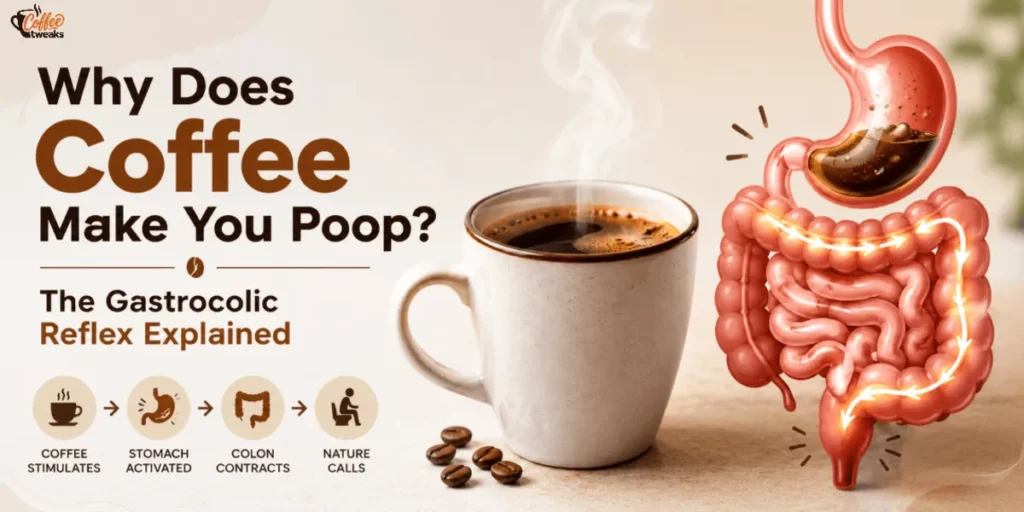
You wake up, brew your coffee, take a few sips… and suddenly your colon has opinions. 🚽
If that happens to you, you are not alone. Studies suggest around 29% of people feel the urge to have a bowel movement within about twenty minutes of drinking coffee.
So why does coffee make you poop so quickly? The answer comes down to the gastrocolic reflex, digestive hormones, gut contractions, and yes, caffeine too.
Coffee is not racing through your body. It is simply giving your colon a very effective signal to get moving.
Here is what is actually happening inside your gut.
The Gastrocolic Reflex: Your Body's Built-In “Go” Signal
💡 This is the big one. The piece of biology most people have never heard of, but that explains so much of what's happening.
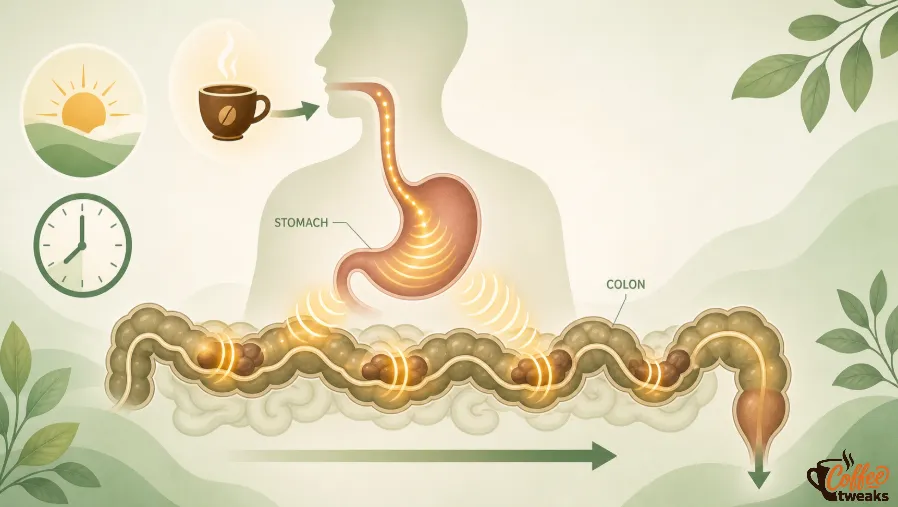
The gastrocolic reflex is your body's natural response to eating or drinking. When something enters your stomach, your colon gets a signal: Hey, new stuff is incoming. Time to make room. In response, the colon starts contracting, pushing older contents toward the rectum to clear the way.
It's not unique to coffee. This reflex triggers after any meal or drink. But coffee is unusually effective at setting it off, especially in the morning when the reflex is naturally at its most active. Your gut is basically primed and ready to go right after you wake up, and coffee is the spark that lights the whole thing.
Dr. Christine Lee, a gastroenterologist at Cleveland Clinic, describes the intestinal tract beautifully: it's a long, coordinated circuit, almost like a wave in the ocean. Each section contracts while the next one relaxes, squeezing things along. The whole mechanism is designed to keep things moving in one direction, and coffee happens to be one of the most effective things you can drink to get that wave started.
This changed my whole morning understanding of coffee. It's not a glitch. It's biology doing exactly what biology is supposed to do. ✨
Why Does Coffee Make You Poop So Quickly?
🤔 Here's the question that always makes people do a double-take: how can coffee affect your bowels so fast? It hasn't even been digested yet.
The answer is that what's moving isn't the coffee itself. It's the stool that was already in your colon, just waiting for a little push. When coffee triggers the gastrocolic reflex and digestive hormones, it sends a signal through your nervous system that tells the colon to start contracting. If you already have material in there ready to go, the result can happen in as little as four to twenty minutes.
If your colon is relatively empty, you'll feel very little effect. Think of it like a gun: if the chamber is loaded, one small trigger pull fires immediately. If it's empty, pulling the trigger does nothing. Your morning coffee is basically that trigger.
Caffeine's Role: Real, But Not the Whole Story ☕
Caffeine is a stimulant, and it doesn't just stimulate your mind. It stimulates smooth muscle contractions throughout your digestive tract. Research has shown that caffeinated coffee makes the colon approximately 60% more active than water and about 23% more active than decaf coffee. Those are not small numbers.
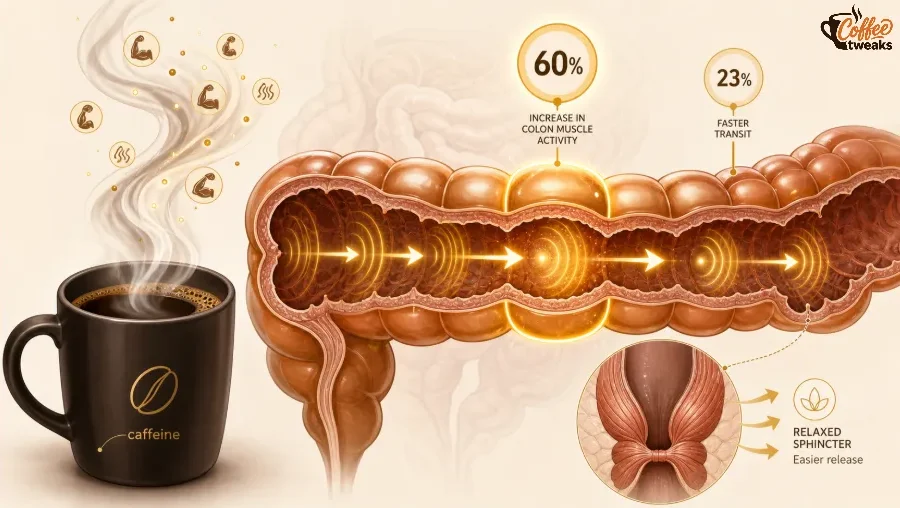
Caffeine also appears to relax the anal sphincter, the muscle responsible for keeping stool in place, which makes it physically easier for the body to release. Combined with increased colon motility (the speed at which contents move through), you get a very efficient system pointing in one direction.
But here's the twist that surprised researchers for years…
Why Decaf Coffee Does It Too ✨
This is genuinely one of the most interesting parts of coffee bowel movement science. When researchers first studied the phenomenon, they assumed caffeine was the main culprit. Then they tested decaf. And decaf also triggered bowel movements, just with a slightly less intense response.
So what's happening when the caffeine is removed?
Two compounds become important here. Chlorogenic acids are powerful antioxidants naturally found in coffee that stimulate the production of stomach acid. More stomach acid means faster digestion and quicker movement of contents through the gut. Additionally, compounds called N-alkanoyl-5-hydroxytryptamides also appear to increase stomach acid production and gut activity.
No exaggeration when I say this blew my mind a little. It means coffee's laxative effect is a team effort of dozens of compounds working together, not just one dramatic villain named caffeine.
The Hormone Connection: Gastrin and Cholecystokinin 💡
Coffee doesn't just affect your muscles. It talks to your hormones.
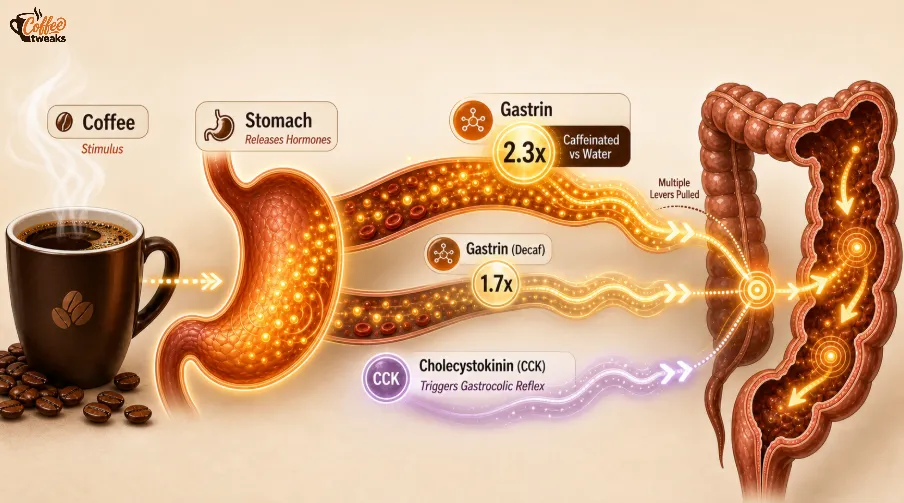
When you drink coffee, your stomach lining releases a hormone called gastrin. Gastrin's job is to stimulate digestion and increase colon activity. Studies have found that regular caffeinated coffee raises gastrin levels by about 2.3 times compared to drinking water. Decaf still raises them, just to about 1.7 times. This is a significant hormonal response to what is, chemically speaking, a relatively small volume of liquid.
Coffee also stimulates the release of cholecystokinin (CCK), a digestive hormone that not only increases the speed at which food moves through the colon but is also directly linked to triggering the gastrocolic reflex itself. So coffee is essentially pulling multiple levers at once: hormonal signals, muscle contractions, and acid production, all pointing toward the same outcome.
The coordination of all this happening within minutes of your first sip is honestly kind of remarkable when you think about it.
The Warmth Factor: One More Piece of the Puzzle 🌿
Dr. Christine Lee makes an observation that I haven't seen talked about enough: the warmth of coffee matters.
Hot liquids cause vasodilation, meaning blood vessels widen and smooth muscles relax. When the muscles throughout your digestive tract relax, there's less resistance to movement.
Contents flow more easily. This is part of why a hot cup of coffee in the morning creates such a pronounced effect compared to, say, an iced coffee, though cold brew and iced coffee can still trigger the reflex through the chemical pathways.
The warmth of the drink essentially lowers the physical barrier to movement at the same time that the chemical compounds are increasing the signals to move. It's a surprisingly elegant system.
Why Milk in Your Coffee Can Amplify Everything 😅
Here's something worth knowing if you make your coffee with milk, cream, or creamer.
Close to 65% of the world's adult population has some degree of lactose intolerance. This doesn't always mean severe symptoms. For many people it's mild: a little bloating, some urgency, slightly looser stools. But add that dairy response on top of an already-stimulated digestive system, and the combined effect can be noticeably stronger.
If your post-coffee bathroom experience feels a little too urgent for comfort, it might be worth testing your coffee black for a week, or switching to a non-dairy milk option like oat milk. You might be surprised by the difference. The coffee is still doing its thing, but without the dairy amplifier.
Why Some People Feel It and Others Never Do
This is one of the most common questions, and honestly it comes down to a mix of biology, habits, and individual sensitivity.
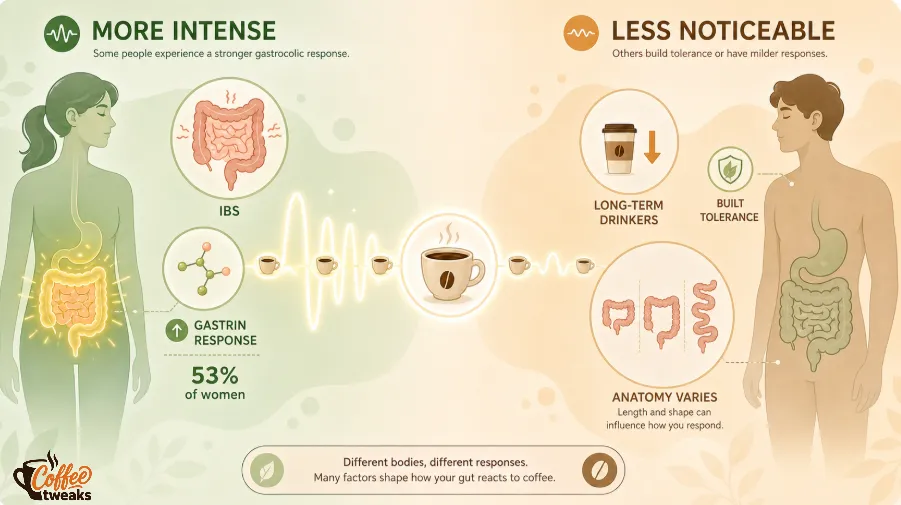
People who are more sensitive to hormones and neurotransmitters like gastrin will feel a more pronounced response. People with conditions like Irritable Bowel Syndrome (IBS) tend to have a heightened gut sensitivity overall, which means coffee's signals hit harder. Studies have noted that 53% of women in research cohorts experienced post-coffee urgency compared to lower rates in men, which may connect to the higher prevalence of IBS in women.
On the flip side, long-term heavy coffee drinkers can develop a degree of tolerance over time. Regular drinkers may find the effect diminishes, similar to how any repeated stimulation eventually becomes less dramatic. But tolerance isn't universal, and it's never complete. The gastrocolic reflex is a hard-wired biological process, not something that simply switches off.
Individual anatomy also plays a role. The length and diameter of a person's intestines, whether they tend to be straighter or more winding, and how much stool is already in the colon at the time of drinking all affect how fast and how strongly someone responds.
Is This Actually Healthy? 🌿
Short answer: for most people, yes. Completely.
Coffee poop is considered a normal physiological response when bowel movements are formed, not painful, not accompanied by blood, and feel relieving rather than distressing. If that describes your experience, your gut is functioning exactly the way it's supposed to.
In fact, for people who struggle with constipation, a morning cup of coffee can be genuinely therapeutic. Gastroenterologists have noted that the morning combination of coffee (especially warm), plus something high in fiber like oatmeal or bran cereal, can be a remarkably effective natural strategy for regular, complete bowel movements. And complete evacuation matters.
Incomplete elimination can contribute to bloating, cramping, and general discomfort throughout the day.
The gut is also most active in the morning, both because of your circadian rhythm and because bowel activity roughly doubles upon waking compared to during sleep. Coffee is essentially surfing a biological wave that's already in motion.
When to Talk to a Doctor 🤔
Most cases of coffee-induced bowel movements are just your body doing its job. But there are situations worth paying attention to.
Talk to a doctor if your coffee consistently causes:
These patterns don't automatically mean something serious, but they deserve professional evaluation. Coffee can sometimes unmask underlying digestive sensitivities like IBS, gastritis, or acid reflux rather than causing them. Catching and addressing these early is always better.
One important note: excessive coffee consumption, more than three or four cups daily for many people, can push things beyond a healthy reflex into genuine diarrhea, which carries its own risks like dehydration and electrolyte imbalance. Moderation matters here, as it does with most things.
Common Myths Worth Clearing Up
Myth: Coffee cleans out your intestines.
Not exactly. Coffee stimulates motility in the lower colon, but it doesn't flush or “detox” your digestive system. The effect is limited to pushing stool that's already in the colon toward the rectum.
Myth: Only strong, dark coffee does this.
Nope. The gastrocolic reflex and hormonal response happen regardless of roast level. Even decaf triggers it.
Myth: If coffee makes you poop, you must have a sensitive stomach.
Also not true. About one in three people experience this. It's common, well-documented, and entirely normal for a huge proportion of coffee drinkers.
Myth: The effect must fade if you drink coffee every day.
There's some tolerance that develops, but the core biological mechanisms don't disappear. Most regular coffee drinkers still experience the reflex; it may simply be less dramatic.
Practical Takeaways for Coffee Drinkers ☕
If the morning bathroom effect works well for you, great. Use it. Make it part of a healthy morning routine.

If it's uncomfortable or too urgent, here are a few things worth trying:
And if you love your coffee black, hot, and first thing in the morning like me? Just plan around the timing. Knowing your body's rhythm isn't embarrassing. It's just good information. ✨
FAQ: Your Coffee and Gut Questions, Answered
Why does coffee make me poop immediately?
It feels immediate because your colon is already loaded and waiting. Coffee triggers the gastrocolic reflex and releases hormones like gastrin, which signal the colon to contract. If stool is already in place, the response can happen within four to twenty minutes, long before the coffee itself has been digested.
Does coffee clean out your intestines?
Not in a true cleansing sense. Coffee stimulates the lower colon to push existing stool toward the rectum. It doesn't flush the entire digestive system or act as a detox. Think of it as a nudge in the right direction, not a pressure wash.
Why does decaf coffee make me poop?
Because caffeine is not the only compound in coffee that affects your gut. Decaf still contains chlorogenic acids, triggers gastrin release, and activates the gastrocolic reflex. The response is less intense than with caffeinated coffee, but it's real and well-documented.
Is it healthy if coffee helps me poop?
Yes, in most cases. If your bowel movements are formed, not painful, and feel relieving, your body is responding normally. For people who struggle with constipation, coffee can actually be a helpful daily tool for regularity.
Why does iced coffee make me poop too?
Even cold, coffee still contains chlorogenic acids, triggers gastrin release, and activates the gastrocolic reflex through its chemical compounds. You lose a little of the warmth-induced smooth muscle relaxation effect, but the hormonal and chemical pathways are still fully active.
Does coffee cause diarrhea?
It can, but it depends on amount and individual sensitivity. For most people, one to two cups produces normal, formed stools. More than two or three cups per day can speed gut transit to the point where water isn't properly absorbed, resulting in looser, more watery stools. If dairy in your coffee is involved and you're lactose intolerant, that can intensify the effect significantly.
Your Morning Routine Is Not Weird. It's Biology. ☕✨
I think what I love most about diving into this topic is how it reframes something that so many people feel a little sheepish about.
That morning bathroom trip after your coffee? It's not a quirk. It's not a digestive weakness. It's the result of a finely coordinated biological process involving hormones, nerve signals, muscle contractions, antioxidant compounds, and your body's internal clock all working in remarkable harmony.
Coffee wakes up a lot more than your brain. It wakes up your whole system, and your gut responds exactly the way a healthy gut is designed to respond.
And honestly? That's the whole point. 🌿
Your body knows what it's doing. You just needed a little science to back it up.
Now go enjoy that cup. You've earned it. ☕