
How to Make Vietnamese Iced Coffee (Ca Phe Sua Da) at Home


Most iced coffees are just regular coffee poured over ice and called a day. Ca Phe Sua Da is not that. It is a deeply concentrated, slow-dripped robusta coffee layered over sweetened condensed milk and crushed ice, and it hits differently than anything else in a glass.
If you have never made it at home, you are missing one of the most satisfying and genuinely simple coffee experiences available to any home brewer.
Here is the short answer. To make Vietnamese iced coffee, brew strong Vietnamese dark roast coffee through a phin filter using 14 to 16 grams of coffee and 90 to 100ml of water heated to around 200°F.
Add 2 to 3 tablespoons of sweetened condensed milk to a glass, pour the brewed coffee over it, stir, and pour over a full glass of ice. Done in under 10 minutes. But if you want it done right, keep reading.
Quick Answer: How to Make Vietnamese Iced Coffee
For anyone landing here from a quick search, here is the fast version before we go deep.
| Item | Detail |
|---|---|
| Coffee | Vietnamese dark roast, robusta-based (Trung Nguyen, Nguyen Coffee Supply) |
| Coffee dose | 14 to 16 grams (about 2 tablespoons) |
| Water | 90 to 100ml at 200°F (off the boil by 30 seconds) |
| Condensed milk | 2 to 3 tablespoons (30 to 45ml), to taste |
| Ice | 1 full glass, crushed or cubed |
| Brew method | Vietnamese phin filter |
| Total brew time | 5 to 7 minutes |
Place condensed milk in your glass first. Brew the coffee through the phin directly onto the condensed milk. Stir well. Pour over ice. That is Ca Phe Sua Da in its most honest form.
What Is Ca Phe Sua Da?
The name breaks down simply. “Ca phe” means coffee, “sua” means milk, and “da” means ice. Put it together and you get iced milk coffee, which is technically accurate but dramatically undersells what is actually in the glass.
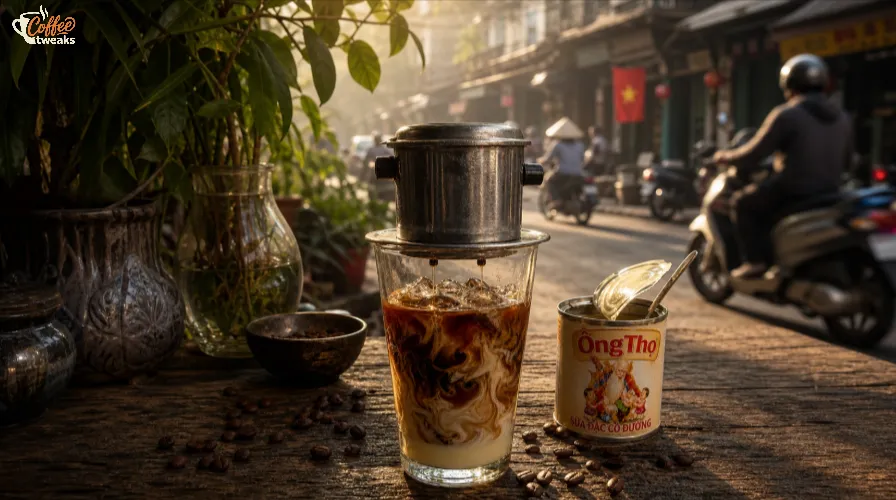
Ca Phe Sua Da was born out of French colonial influence in Vietnam during the mid-19th century. The French introduced coffee cultivation to Vietnam, but arabica struggled in the local climate.
Robusta, which is hardier, more bitter, and significantly higher in caffeine, took over and became the dominant bean in Vietnamese coffee culture. That transition fundamentally shaped the flavour profile of every cup of Ca Phe Sua Da ever made.
Fresh dairy milk was scarce and difficult to preserve in Vietnam’s tropical heat, so sweetened condensed milk became the natural substitute. Canned, shelf stable, sweet, and rich, it worked perfectly with the intensity of robusta. The combination was not a workaround. It became the standard, and for good reason.
Today, coffee culture in Vietnam is not just a morning habit. It is a social institution. Street-side coffee shops called ca phe open before dawn and stay full all day. The phin filter sits on the rim of the glass and drips slowly while you talk, read, and exist. There is no rushing a phin. That waiting is part of the ritual.
Ingredients You Need
You do not need much to make this properly. But what you choose matters enormously.
Vietnamese Ground Coffee
This is non-negotiable for authenticity. Standard supermarket arabica will give you a thin, acidic result that does not taste remotely close to the real thing. You want a dark-roasted, robusta-forward Vietnamese ground coffee.
Trung Nguyen is the classic go-to, widely available in Asian grocery stores and online. Their Gourmet Blend uses a mix of arabica, robusta, excelsa, and catimor.
Nguyen Coffee Supply is an excellent specialty option that sources single-origin Vietnamese robusta and arabica. Cafely also produces solid options. If you genuinely cannot find Vietnamese coffee, a dark French roast works as a backup, though the flavour depth will be noticeably different.
Sweetened Condensed Milk
Not evaporated milk. Not regular milk. Sweetened condensed milk. It needs to be the thick, sticky, sweet stuff from a can.
The traditional Vietnamese favourite is Longevity Brand (Ong Tho), which has a classic caramelised dairy richness that works beautifully with dark robusta. Carnation and Eagle Brand are solid Western options. Do not substitute coconut condensed milk unless you are intentionally making a variation.
Water
This matters more than most people think. Use filtered water if your tap water is heavily chlorinated. Temperature should be around 200°F, which is about 30 seconds off a full rolling boil. Too hot and you scorch the coffee. Too cool and you under-extract and get a flat, watery cup.
Ice
Use plenty of it. Ca Phe Sua Da is meant to be served cold in a glass packed with ice. The dilution from melting ice is part of the balance. If you use two cubes and wonder why it tastes thin, now you know.
Equipment Needed
The Vietnamese Phin Filter: The phin is a small stainless steel or aluminium single-serve drip filter consisting of four parts: a perforated base plate that sits on the rim of your glass, a brew chamber that holds the coffee grounds, an inner press plate or gravity filter insert that sits on top of the grounds, and a lid that covers the top during brewing to retain heat.
Phins are inexpensive. You can find a decent stainless steel phin for around five to ten dollars at an Asian grocery store or online. The most common sizes are 4oz and 6oz, which suits a standard single serve perfectly.
If You Do Not Have a Phin: Real talk, go buy one. They cost less than a coffee at a café and they last years. But if you genuinely cannot access one, you have options.
A French press works well with coarsely ground Vietnamese coffee using a short steep of about 4 minutes. An AeroPress with a fine grind and a short steep also produces a concentrated result.
A Moka pot brewed with a dark Vietnamese ground is another solid workaround. None of these will perfectly replicate the drip-brewed texture of a phin, but they will get you close enough to enjoy the flavour.
Everything In The Glass, Measured and Explained
| Ingredient | Amount | Purpose |
|---|---|---|
| Vietnamese dark roast ground coffee | 14 to 16g (about 2 tablespoons) | Provides the strong, bold coffee base |
| Sweetened condensed milk | 2 to 3 tablespoons (30 to 45ml) | Sweetness and creaminess |
| Hot water | 90 to 100ml at 200°F | Brewing the coffee through the phin |
| Ice | 1 full glass | Chilling and diluting to the right balance |
Step-by-Step Vietnamese Iced Coffee Recipe
Follow this method and you will get a proper Ca Phe Sua Da every single time.
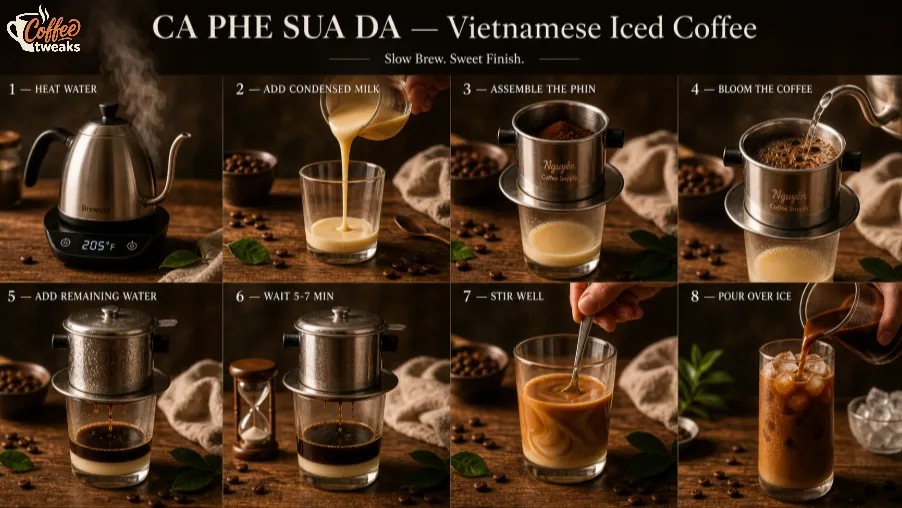
- Step 1: Heat your water. Bring water to a boil and then let it sit for 30 seconds. You are aiming for 200°F. If you have an electric kettle with temperature control, set it precisely.
- Step 2: Add condensed milk to your glass. Measure 2 to 3 tablespoons of sweetened condensed milk and pour it into the bottom of a heat-safe glass or mug. Start with 2 tablespoons if you prefer a less sweet drink, and adjust after tasting.
- Step 3: Assemble the phin. Place the perforated base plate over the rim of your glass. Set the brew chamber on top. Add 14 to 16 grams of ground Vietnamese coffee into the chamber. Shake gently to level the grounds. Place the inner press plate on top of the grounds. Do not press it down hard. Gravity will compact it during brewing.
- Step 4: Bloom the coffee. Pour just enough hot water to saturate the grounds, roughly 10 to 15ml. Wait 30 seconds. This allows the coffee to degas and prepares the grounds for an even extraction.
- Step 5: Add the remaining water. Slowly pour 80 to 90ml of hot water into the chamber. The water should fill the chamber close to the top. Put the lid on to retain heat.
- Step 6: Wait. Brewing will take 5 to 7 minutes. The coffee should drip steadily, roughly one drop per second. If it drips faster than that, your grind is too coarse. If it stops almost completely, the grind is too fine or the press plate is compressed too tightly.
- Step 7: Remove the phin. Once dripping stops, remove the entire phin assembly. Do not leave it sitting there and walk away, or the last concentrated drops will make the coffee bitter.
- Step 8: Stir. Mix the condensed milk and hot coffee together thoroughly in the glass. The condensed milk will be sitting at the bottom and needs to be fully incorporated.
- Step 9: Pour over ice. Fill a separate tall glass with ice and pour the coffee mixture over it. Alternatively, you can add the ice directly to the same glass if it is large enough.
- Step 10: Taste and adjust. If it is too sweet, less condensed milk next time. Too bitter, slightly coarser grind or a touch less coffee. Too weak, add more coffee or check your water temperature.
How to Use a Vietnamese Coffee Phin Filter
The phin filter is deceptively simple but it does have a learning curve. Most people mess up the first two or three brews because of grind size or press plate pressure. Here is a dedicated breakdown.
Assembly: The base plate has small holes and rests on the rim of your glass. The brew chamber sits on the base plate and holds the grounds. The press insert sits loosely on top of the coffee. The lid goes on last after you have added the water.
Coffee Dose: For a standard 4oz phin, use 14 to 16 grams or approximately 2 tablespoons. For a 6oz phin, scale up to 20 to 22 grams. Do not under-dose. The whole point of this brewing method is concentration.
Compression: This is where most beginners go wrong. The press plate should rest on the grounds with its own weight. You can give it one gentle twist to settle it, but do not press it down firmly with your hand. Over-compression restricts water flow and can lead to channelling, uneven extraction, or a brew that stalls completely.
Brewing Time: Ideal drip time is between 5 and 7 minutes for a full serving. If your brew finishes in 3 minutes or less, your grind is too coarse. If it is still going past 10 minutes or has practically stopped, your grind is too fine or you over-compressed the press plate.
Troubleshooting:
- Coffee drips too fast: Use a slightly finer grind. Vietnamese pre-ground coffee is already calibrated for a phin, so stick with it and just compress the press plate slightly more.
- Coffee barely drips or stops: Your grind is too fine, or the press plate was pushed down too hard. Lift the insert slightly with a chopstick or spoon handle to free up the flow.
- Bitter result: Water was too hot, brew ran too long, or the press plate sat on the grounds too long after brewing finished. Remove the phin as soon as dripping stops.
- Weak result: Under-dosing coffee, water not hot enough, or grind too coarse. Use more coffee or dial in the temperature.
Grind Size: A medium to medium-fine grind works best for most phin filters. If you are buying pre-ground Vietnamese coffee like Trung Nguyen, it is already ground to the right consistency for a standard phin. If you are grinding fresh at home, aim for a setting similar to table salt.
Expert Tips From Maya
I have made this drink more times than I care to count. Here is what actually matters.
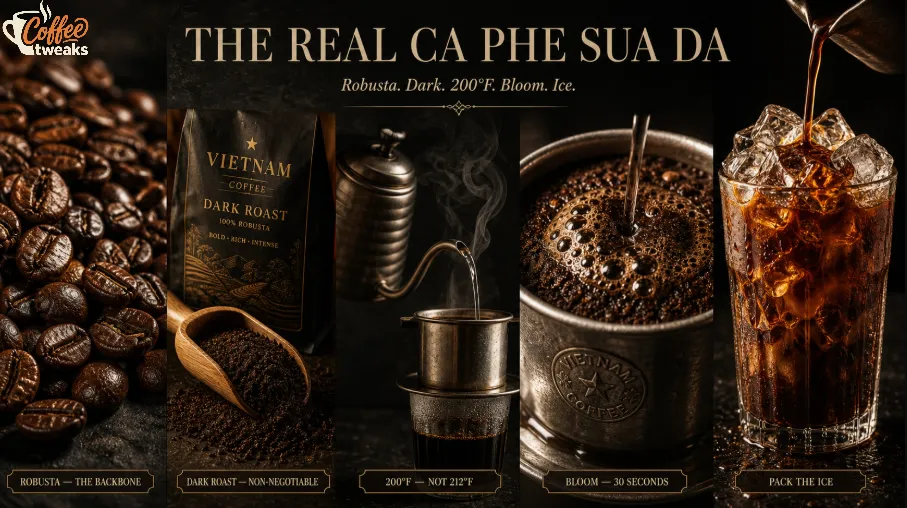
Use robusta. Full stop. I know the specialty coffee world has a complicated relationship with robusta. It is often dismissed as low-grade filler. But robusta is exactly what Ca Phe Sua Da needs.
It has nearly double the caffeine of arabica, a thicker body, lower acidity, and a distinctly earthy, dark chocolate, almost rubbery intensity that holds up against the sweetness of condensed milk. Arabica gets lost in this drink. You end up with a slightly sweet iced coffee that tastes like nothing in particular. Robusta gives it backbone.
Dark roast is mandatory. Not medium. Not medium-dark. Dark. The condensed milk is sweet and heavy. You need the bitterness and depth of a proper dark roast to create any kind of balance. Light roast Vietnamese iced coffee is a contradiction.
Get your water temperature right. I cannot stress this enough. Boiling water (212°F) will scorch the coffee and give you a harsh, acrid brew. Pull the kettle at 200°F and you will get a clean, deep extraction. That 12-degree difference is genuinely noticeable in the cup.
Bloom is not optional. Even if you are in a rush, take the 30 seconds to do a bloom. Vietnamese dark roasts still have enough trapped CO2 to benefit from degassing before full extraction. Skip it and you get uneven extraction and a muddier flavour.
Do not scrimp on ice. A properly made Ca Phe Sua Da hits a glass that is genuinely packed with ice. The gradual dilution as the ice melts brings the drink into balance. Start with too little ice and the drink is sweet, heavy, and slightly warm. That is not what this is supposed to be.
I have been wrong before. Not about this.
Common Mistakes to Avoid
Recipe Variations
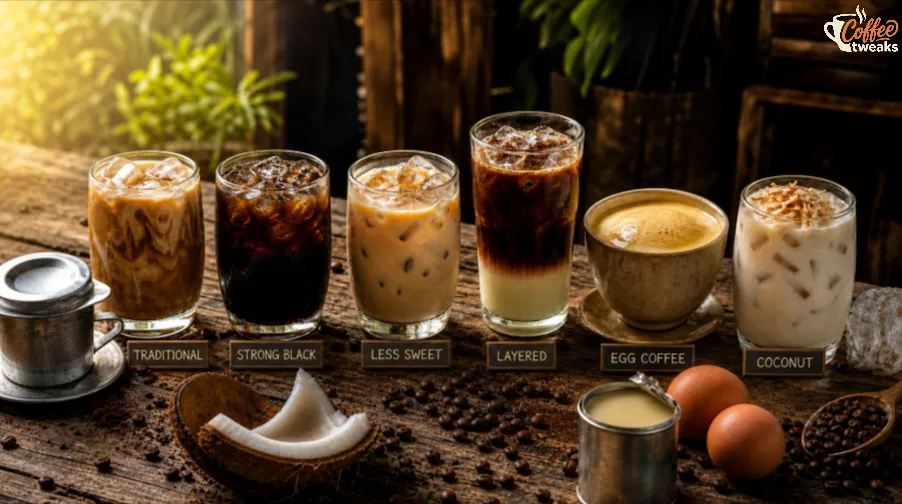
Vietnamese Iced Coffee Condensed Milk Guide
Here is the thing. Condensed milk is not an optional addition you can swap for oat milk and still call this drink authentic. It is the defining ingredient alongside the coffee itself.
The reason Vietnamese coffee culture landed on condensed milk is historical and practical. Fresh dairy was unavailable or unreliable in Vietnam’s climate, and sweetened condensed milk arrived in cans that lasted. Over time it became the ingredient, not a substitute.
The sweetness of condensed milk also does something that regular sugar cannot. Sugar dissolves and disappears. Condensed milk adds sweetness and a rich, creamy dairy fat that integrates into the coffee and thickens the overall texture of the drink. That is why Ca Phe Sua Da has a luscious, almost syrupy quality that no other iced coffee quite matches.
Best brands to use:
Sweetness Adjustments: Start with 2 tablespoons and taste before adding more. The standard ratio in Vietnam sits around 2 to 3 tablespoons per single serving, but personal preference varies. If you want less sweetness without sacrificing creaminess, mix 1 tablespoon of condensed milk with 1 tablespoon of whole milk or heavy cream.
Nutrition Information
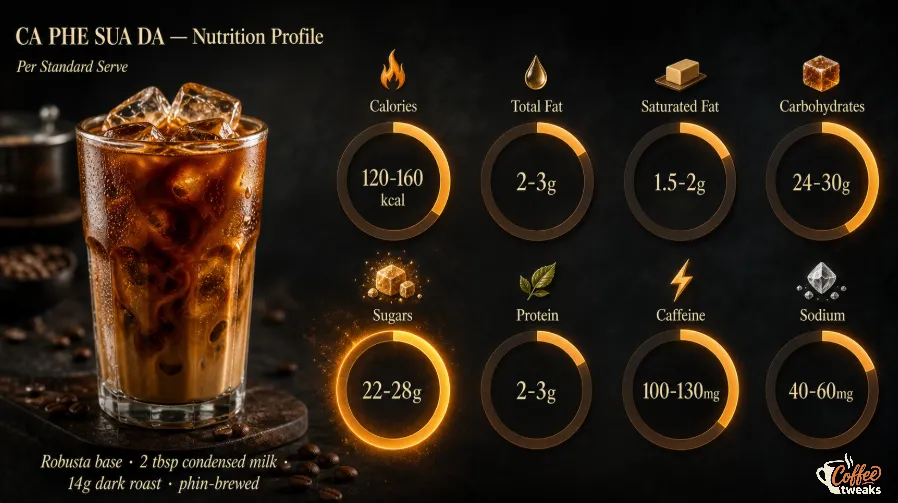
These figures are estimates based on a standard single-serve Ca Phe Sua Da using 2 tablespoons of sweetened condensed milk and 14 grams of Vietnamese dark roast coffee brewed through a phin filter.
| Nutrient | Approximate Amount |
|---|---|
| Calories | 120 to 160 kcal |
| Total Fat | 2 to 3g |
| Saturated Fat | 1.5 to 2g |
| Total Carbohydrates | 24 to 30g |
| Sugars | 22 to 28g |
| Protein | 2 to 3g |
| Caffeine | 100 to 130mg (robusta is higher than arabica) |
| Sodium | 40 to 60mg |
Note that using 3 tablespoons of condensed milk instead of 2 pushes calories closer to 180 to 200 kcal and increases the sugar content accordingly. The robusta base also means the caffeine content is meaningfully higher than a comparable arabica-based iced coffee of the same size.
FAQs
What coffee is best for Vietnamese iced coffee?
Use dark-roasted, robusta-based Vietnamese ground coffee. Trung Nguyen is the most authentic and widely available option.
Can I make Vietnamese iced coffee without a phin filter?
Yes, a French press or AeroPress works as a substitute. Results will differ slightly from the traditional phin-brewed version.
Why is Vietnamese coffee so strong?
Robusta beans contain nearly twice the caffeine of arabica. The phin also brews a small, highly concentrated serving.
Can I use regular coffee instead of Vietnamese coffee?
You can, but it will not taste authentic. Robusta provides the bold, earthy depth that arabica cannot replicate.
How much condensed milk should I use?
Start with 2 tablespoons per serving and adjust to taste. Most Vietnamese cafés use between 2 and 3 tablespoons.
What grind size works best for a phin filter?
Use a medium to medium-fine grind, similar to table salt. Pre-ground Vietnamese coffee is already calibrated correctly for most phin filters.
Can I make Ca Phe Sua Da ahead of time?
Yes, brew and refrigerate the coffee and condensed milk mixture for up to 3 days. Pour over fresh ice when ready to serve.
What is the difference between Ca Phe Sua Da and regular iced coffee?
Ca Phe Sua Da uses robusta beans and sweetened condensed milk. Regular iced coffee uses arabica and sugar syrup with dairy milk.
Conclusion
Ca Phe Sua Da is not complicated. It has three ingredients, one piece of simple equipment, and a method that you will have mastered by your second or third attempt. What makes it so good is the respect for those ingredients.
Authentic Vietnamese dark-roasted robusta, the right water temperature, a gentle press on the phin insert, and real sweetened condensed milk. No shortcuts and no substitutions that undermine the core of what the drink actually is.
Buy a phin filter. Find Vietnamese dark roast coffee at your local Asian grocery store or order it online. Grab a can of Longevity Brand or Eagle Brand condensed milk. Follow the ratios and brewing times in this guide. The 5 to 7 minute wait while the phin drips is genuinely part of the experience.
There is a reason this drink has been a daily ritual for millions of people in Vietnam for well over a century. Once you know how to make Vietnamese iced coffee properly at home, you will understand exactly why. ☕