Coffee and Longevity: The 2-Year Lifespan Paradox


Here’s the data point that should make you suspicious of every coffee headline… in the largest cohort ever assembled on this question — 402,260 Americans, over five million person-years — coffee drinkers died at higher rates than non-drinkers. The protective effect only appeared after researchers corrected for one variable: smoking. 📊
That reversal is the whole story of coffee and longevity in miniature. “Does coffee make you live longer” is really a question about confounders and hazard ratios.
We’ll get to the number everyone wants — roughly two extra years. But first, let’s walk through it the way I dial in a shot to 0.1g. Premise, measurement, conclusion. No hand-waving. ⚙️
Quick answer (TL;DR) ☕📊 Across cohorts totaling well over 1.5 million people, moderate coffee drinking (roughly 2–4 cups a day) is associated with a 10–17% lower risk of death from any cause compared with drinking none.
One life-table analysis estimates that translates to about 2 extra years of life expectancy at age 50 for people drinking 1–2 cups daily. The effect is real, replicated, and dose-limited — more is not better past ~3 cups. But every one of these studies is observational. None of them proves coffee causes longer life, and the honest confidence interval on “how much” is wide.
Key takeaways
The three big cohorts say the same thing ⚙️
When I evaluate any claim, I want independent measurements that converge. One study is a data point. Three large studies on three continents, using different populations and different coffee-brewing cultures, landing on the same number — that is a signal worth taking seriously.
NIH-AARP (Freedman et al., NEJM, 2012)
This is the foundational one. Researchers at the US National Cancer Institute followed 229,119 men and 173,141 women, all aged 50–71 at baseline, across 5,148,760 person-years between 1995 and 2008.
During follow-up, 33,731 men and 18,784 women died, more than 52,000 deaths, which gives the study enormous statistical power.
After adjusting for smoking and other confounders, people who drank three or more cups a day had roughly a 10% lower risk of death than non-drinkers. The inverse association showed up across most major causes: heart disease, respiratory disease, stroke, diabetes, infections, and even injuries and accidents.
Here's the thing nobody tells you about that study: in the unadjusted model, coffee looked deadly. Coffee drinkers were far more likely to smoke, and smoking is a longevity wrecking-ball. Strip smoking out and the sign flips from positive to protective. That is not a footnote. It is the reason to treat the whole field with humility — the confounders are that strong.
EPIC (Gunter et al., Annals of Internal Medicine, 2017)
The European replication, run through the WHO's cancer agency, followed 521,330 people across 10 countries — from espresso-drinking Italy to filter-coffee Scandinavia — for a mean of 16.4 years.
That is 41,693 deaths. People in the highest quartile of consumption had lower all-cause mortality: a hazard ratio of 0.88 (95% CI 0.82–0.95) in men and 0.93 (0.87–0.98) in women. Roughly 12% and 7% lower risk, respectively. The strongest single signal was digestive-disease mortality, where men in the top quartile had an HR of 0.41 — a 59% lower rate.
UK Biobank (Loftfield et al., JAMA Internal Medicine, 2018).
Nearly half a million again: 498,134 adults, mean age 57, 78% of them coffee drinkers, followed about 10 years for 14,225 deaths. This is the cleanest per-cup breakdown we have, so the numbers matter here:
Read that column top to bottom. The benefit is present by two cups, deepens a little, and does not disappear even in the people drinking eight-plus cups a day.
A separate UK Biobank analysis of 468,629 people (European Journal of Preventive Cardiology, 2022) put light-to-moderate drinking (0.5–3 cups) at an all-cause HR of 0.88 (0.83–0.92) and a cardiovascular-death HR of 0.83.
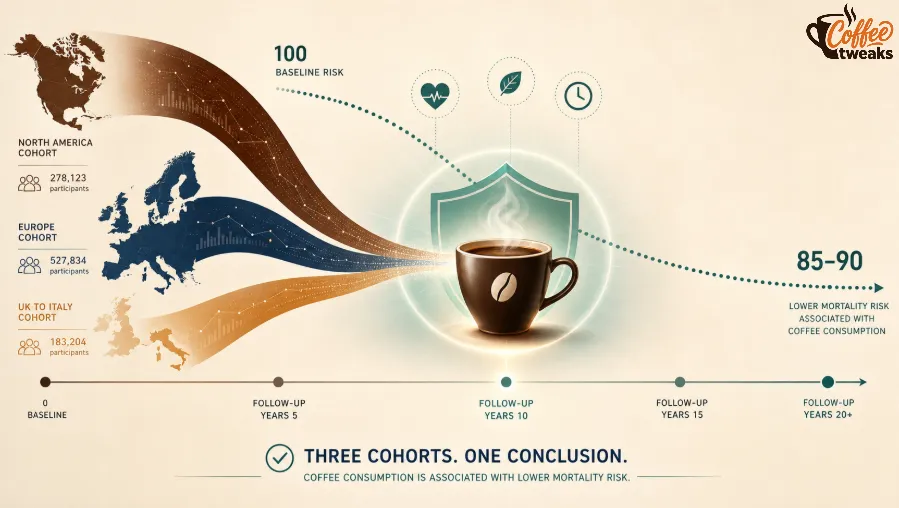
Three cohorts. Three continents. One conclusion: over roughly 1.5 million people, moderate coffee tracks with about a 10–15% lower death rate. That is the empirical backbone of every “coffee and longevity” article, including this one.
Life expectancy by cup count 📊
Hazard ratios are precise but abstract. “0.88” does not tell you how many birthday candles it buys. A 2025 analysis in Public Health Nutrition (Yan et al.) tried to convert the risk numbers into years, using U.S. life-table methods on 43,114 NHANES participants (2001–2018, 6,234 deaths). Here is what they estimated for life expectancy at age 50:
| Coffee intake (cups/day) | Estimated life expectancy at age 50 | Difference vs. non-drinkers |
|---|---|---|
| 0 (none) | 30.06 years | — (reference) |
| ≤ 1 | 30.82 years | +0.76 years |
| > 1 to 2 | 32.08 years | +2.02 years |
| > 2 to 3 | 31.24 years | +1.18 years |
| > 3 | 31.45 years | +1.39 years |
Look at the shape, not just the peak. The maximum is at 1–2 cups a day (+2.02 years, 95% CI 1.17–2.85), and then it falls back at higher intakes. This is the single most useful thing in the whole literature for a longevity-minded drinker, and it contradicts the instinct that if some is good, more is better.
Technically speaking — and this is a modeled estimate, not a measured lifespan, which I'll come back to — the data say the sweet spot is about two cups, and drinking your way up to six does not extend the curve. It bends it back down.
That “+2 years” figure is close to the number you may have seen in headlines. A 2024 review in Ageing Research Reviews (Cunha & Lopes) pooled 50-plus studies and landed on ~1.8 extra years of lifespan for regular drinkers around three cups a day.
I'll flag now, and again later, that this particular review was funded by a coffee-industry body — which does not make it wrong, but does mean it belongs in the “verify” column rather than the “settled” one.
Does coffee make you live longer? Correlation is not a coupon
This is the part most articles skip, and it is the part an engineer cannot skip. Every study above is observational. Nobody randomized 400,000 people to drink or abstain for 16 years. Researchers watched what people already did and looked at who died. That design has three failure modes, and all three are alive in this data.
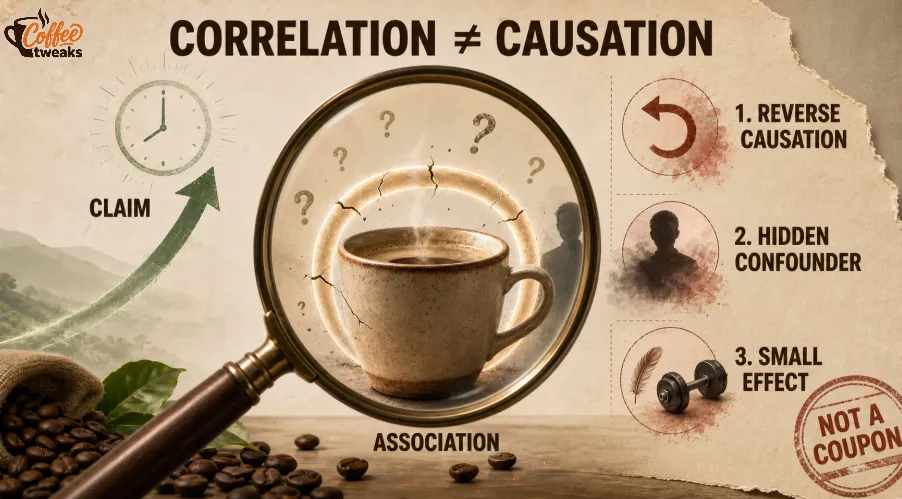
Reverse causation: Sick people cut back on coffee. Someone with early, undiagnosed heart disease or cancer often loses their taste for it, or is told to quit. If the sickest people are disproportionately in the “non-drinker” group because they were already declining, then coffee looks protective when really illness caused the abstention.
Good studies fight this by excluding people who died in the first few years of follow-up and by “lag analyses” — the UK Biobank team did exactly this — but you cannot fully eliminate it from watching-people data.
Residual confounding: Coffee drinkers differ from non-drinkers in a hundred ways the questionnaire never captured. The smoking reversal in NIH-AARP is the proof of concept: one uncontrolled variable was strong enough to flip the entire result.
How confident should we be that no other unmeasured variable is doing something similar? The EPIC authors ran the numbers on this. They calculated an E-value of about 1.5, meaning a single unmeasured confounder associated with both coffee and mortality at a hazard ratio of 1.5 could erase the entire benefit. A confounder that strong is not exotic.
Effect size: A hazard ratio of 0.88 is a modest effect. For comparison, not smoking, or moving from sedentary to active, moves your mortality risk far more than any coffee study reports. Coffee is a rounding error next to those levers. The reason it matters at all is scale: with 2 billion cups consumed daily worldwide, even a small per-person effect is a large public-health number.
So — does coffee make you live longer? The honest answer is: coffee drinking is consistently associated with living longer, the association is robust to a lot of poking, and there is a plausible biological story. But “associated with” is not “causes,” and the people who did this work say so out loud.
The NIH team stated flatly that they could not be sure the association meant coffee actually makes people live longer. The BMJ umbrella-review authors went further: they said doctors should not recommend coffee to prevent disease, and people should not start drinking it for their health.
When the researchers themselves refuse to make the causal leap, you should be suspicious of any blog that does.
Coffee mortality studies and the dose-response curve
The best summary of “how much” comes from the 2017 BMJ umbrella review (Poole et al.), which pooled 201 meta-analyses of observational research and 17 of randomized trials — a review of reviews. Its headline finding: the largest risk reduction sits at 3–4 cups a day versus none, at which point the associations were:
Two coffee mortality studies worth holding side by side on dose:
The BMJ review puts the floor of the curve at 3–4 cups. The 2025 life-expectancy model puts it at ~2. They disagree by a cup or two, which is exactly the resolution you should expect from this kind of data — nobody is measuring intake to 0.1 grams; they are asking people to recall cups per day on a questionnaire, once, years before anyone died.
What both agree on is the important part: the curve is U-shaped or J-shaped, benefit is real in the 2–4 cup band, and pushing past it does not add and may subtract.
One more study reframes the “how much” question as a “when” question, and it is worth its own section.
Personalization for the biohacker ⚙️
If you optimize your sleep, track your HRV, and have your genome on a hard drive somewhere, this is the section you actually came for.
The literature has two personalization levers with real primary-source backing: timing and genetics. Both are more interesting — and more limited — than the supplement-influencer version.
Timing: front-load your caffeine
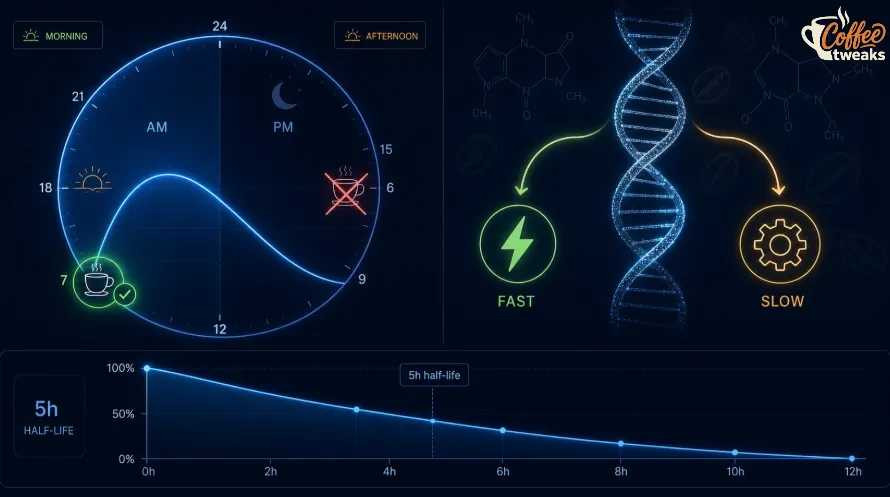
A 2025 study in the European Heart Journal (Wang et al., led by Tulane's Lu Qi) did something the older cohorts did not: it looked at when people drank, not just how much.
Using 40,725 NHANES adults (validated in a second cohort of 1,463), followed a median 9.8 years for 4,295 deaths, the researchers found two behavioral clusters — a morning-type pattern (36% of people) and an all-day pattern (14%).
Against non-drinkers, the morning-type pattern was associated with an all-cause mortality HR of 0.84 (0.74–0.95) and a cardiovascular-mortality HR of 0.69 (0.55–0.87). The all-day pattern? No statistically significant benefit. The interaction was significant (P = 0.031): higher intake lowered mortality risk only in morning drinkers.
The proposed mechanism is circadian. Caffeine's half-life is roughly 5 hours, so an afternoon cup keeps measurable caffeine in your blood at bedtime, blunting sleep quality and pushing against your natural evening dip in sympathetic-nervous-system activity.
This is one study, observational, and drinking-pattern is tangled up with lifestyle (all-day drinkers may be shift workers, poor sleepers, people self-medicating fatigue). But the biohacker takeaway is cheap and low-risk: get your cups in before noon. I moved my own cutoff to 2 p.m. years ago for sleep reasons; this study is a longevity argument for pulling it earlier still.
Genetics: the CYP1A2 story is real but narrower than sold
About 95% of caffeine is broken down by one liver enzyme, CYP1A2, and a common polymorphism (rs762551) sorts people into fast metabolizers (AA genotype, the *1A/*1A pattern) and slow metabolizers (AC/CC — the *1F carriers), who are roughly half the population. The direct-to-consumer genetics companies love this gene, so let me separate the solid findings from the marketing.
The solid findings are about specific cardiovascular outcomes, not lifespan:
Here's the thing nobody tells you when they sell you the genotype test: for the longevity endpoint itself, your CYP1A2 status appears not to matter.
The Loftfield UK Biobank study built a genetic caffeine-metabolism score from AHR, CYP1A2, CYP2A6, and POR variants and tested whether it changed the coffee-mortality link. It did not (P = 0.17 for heterogeneity). The mortality benefit held for slow metabolizers, fast metabolizers, and everyone in between.
That is a genuinely important, non-obvious result, so sit with it. It means two things at once.
First, if some genotypes get a hypertension penalty from caffeine but everyone still gets the mortality benefit, the benefit is probably driven by the non-caffeine compounds in coffee — the chlorogenic acids and other polyphenols — not the caffeine. The Loftfield authors said exactly this, and it is reinforced by the fact that decaffeinated coffee shows similar mortality associations.
Second, the personalization play for a slow metabolizer is not “quit coffee to live longer.” It is “watch your blood pressure, keep the dose moderate, and drink it early.” The gene tunes the how, not the whether.
What you put in the cup ☕
The most practically useful longevity study of the last two years is not about coffee at all. It is about what you add to it.
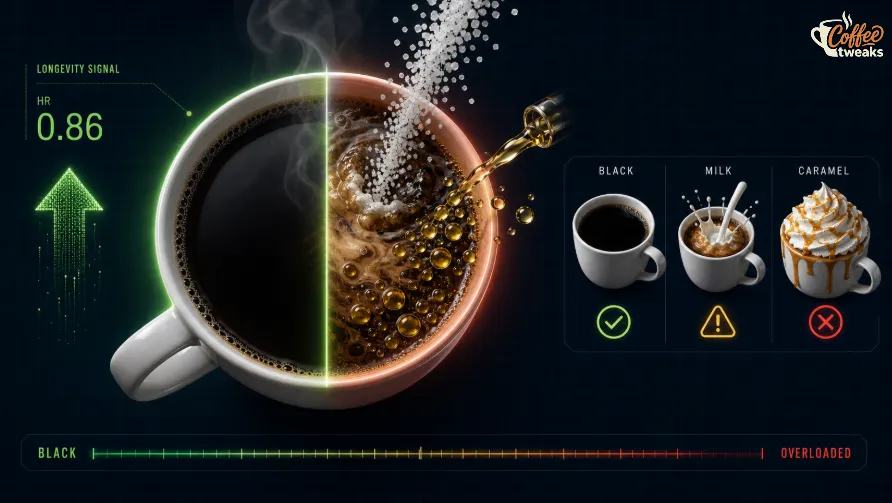
A 2025 analysis in The Journal of Nutrition (Zhou, Zhang et al., Tufts) tracked 46,222 U.S. adults through NHANES 1999–2018 (7,074 deaths) and did what almost no prior study bothered to do: it quantified the sugar and saturated fat people were adding. The all-cause associations were the familiar shape — HR 0.84 for 1 to under 2 cups, 0.83 for 2 to under 3, 0.85 for 3+.
But the benefit was concentrated in two groups: people drinking black coffee (HR 0.86) and people whose additives stayed low — defined as under 5% of the daily value, which works out to roughly half a teaspoon of sugar (under 2.5 g) and under 1 g of saturated fat per 8-ounce cup.
That fat ceiling is about five tablespoons of 2% milk, or one tablespoon of light cream. Cross those thresholds regularly and the association with lower mortality faded.
Read that as a dose limit, not a prohibition. A splash of milk is fine. A daily 300-calorie caramel drink with a saturated-fat load is a different beverage wearing coffee's reputation.
The bioactive compounds may be doing longevity work in the background; the sugar and fat are doing the opposite in the foreground, and at some ratio they cancel. If you are drinking coffee for the longevity association, the version the data actually supports is close to black.
Worth the money? Let's actually do the math 📊
I am an equipment person, so I cannot write a longevity article without asking whether the intervention is cost-effective. Most “biohacks” fail this test badly — hundreds of dollars a month for an effect size you could not detect in a trial. Coffee is the rare exception, and the numbers matter here.
Take a realistic home setup. A solid bag of specialty beans runs about $15–20 and yields ~30 cups, so call it $0.50–0.65 per cup, plus a few cents of electricity and a paper filter. Two cups a day is roughly $1.20/day, or about $440 a year.
Even a decent grinder and a $60–150 brewer amortized over a few years adds only pennies per cup. Against a modeled ~2-year life-expectancy association, that is — if you take the epidemiology at face value, which you should not do uncritically — one of the cheapest interventions in the entire longevity literature.
Compare it to the café path: a $5–6 daily drink is $1,800–2,200 a year, four to five times the home cost, and if it is loaded with sugar and cream you may be buying the additives that erase the benefit you were paying for.
So the cost-effectiveness verdict is lopsided in coffee's favor, with one honest asterisk: you were probably going to drink it anyway.
The right way to frame coffee and longevity is not “spend money to gain years.” It is “the thing you already enjoy is, on the available evidence, associated with a small benefit rather than a cost — provided you keep it mostly black and mostly before noon.” That is a much more defensible sentence than anything a supplement company will sell you.
The honest limitations
I promised premise, evidence, conclusion — and honesty about what the evidence does not support. Here is the full ledger.
None of this cancels the finding. It calibrates it. The responsible read is: moderate coffee is very likely safe and plausibly mildly beneficial for longevity, the evidence is strong for an observational field, and the correct posture is confident moderation rather than either fear or evangelism.
An actionable protocol ⚙️☕
If you want to align your habit with what the data actually supports — not what it hypes — here is the protocol I would defend on the numbers:
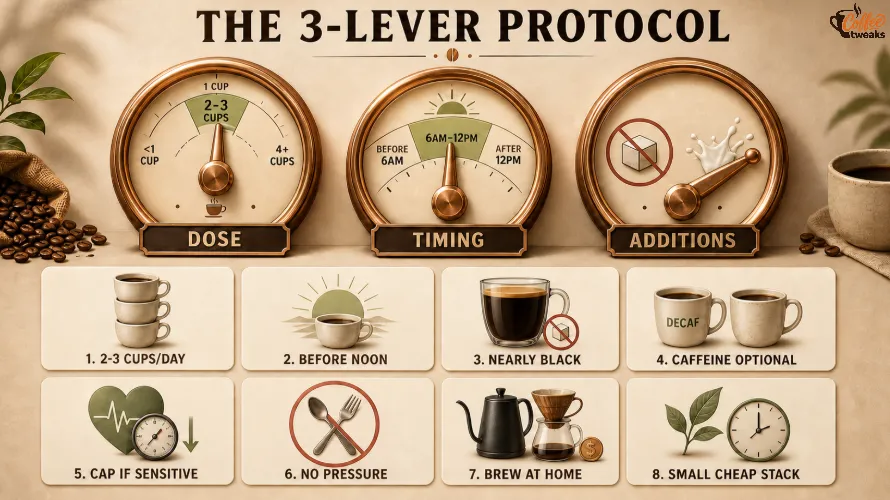
- Aim for 2–3 cups a day. This is the floor of the risk curve in the BMJ review and the peak of the life-expectancy model. It is the best-supported dose. There is no evidence-based reason to climb toward 6+ for longevity.
- Drink it in the morning, ideally before noon. The timing study's morning-type benefit plus caffeine's ~5-hour half-life both point the same way, and earlier caffeine protects the sleep that independently drives longevity.
- Keep it close to black. Under ~½ teaspoon of sugar and under ~1 g of saturated fat per cup is the threshold where the mortality association holds. A splash of milk is fine; a dessert is not.
- Caffeinated or decaf both count. Decaf shows similar mortality associations, and the genetics data suggest non-caffeine compounds drive the benefit. If caffeine disrupts you, decaf is a legitimate longevity choice, not a consolation prize.
- If you are a slow metabolizer or hypertensive, cap the dose and watch your blood pressure. Your longevity benefit likely survives (per UK Biobank), but your cardiovascular tuning is real (per Cornelis and Palatini). Moderate and monitor.
- Do not start drinking coffee for your health. The researchers who ran these studies say this explicitly. If you dislike it, there is no evidence strong enough to justify forcing it.
- Brew at home if cost matters. ~$440/year versus ~$2,000/year for the same beverage and the same association. That gap buys a lot of good beans.
The meta-point: coffee and longevity is a story about a modest, well-replicated, cheap association that you can optimize with three free levers — dose, timing, and what you add. That is a genuinely good position for a longevity intervention to be in.
It is also a position that requires you to hold “promising” and “unproven” in your head at the same time. Engineers do this every day. So can coffee drinkers.
Frequently asked questions
Does coffee actually make you live longer, or is it just correlation?
The evidence is correlational. Large studies consistently associate moderate coffee with 10–17% lower mortality, but because they are observational, they cannot prove coffee is the cause. Reverse causation and unmeasured confounders remain plausible alternative explanations, and the original researchers decline to make the causal claim.
How many cups a day is optimal for longevity?
The best-supported band is 2–4 cups. The BMJ umbrella review found peak benefit at 3–4 cups; a 2025 life-expectancy model peaked at ~1–2 cups and then declined. More than 4 cups does not add longevity benefit and may reduce it, though heavy drinking (8+ cups) was not associated with harm to lifespan in UK Biobank.
Is decaf as good as regular for longevity?
Broadly, yes. Decaffeinated coffee shows similar mortality associations, and the genetics data suggest the benefit comes largely from non-caffeine compounds like chlorogenic acids. If caffeine disrupts your sleep or heart rhythm, decaf is a reasonable choice.
Does it matter when I drink coffee?
A 2025 European Heart Journal study found morning drinkers had a clearer mortality and cardiovascular benefit than all-day drinkers, who showed no significant benefit. The likely reason is circadian rhythm and protecting nighttime sleep. Front-loading your cups before noon is a low-risk optimization.
I've heard I have a caffeine-metabolism gene. Should I quit?
Probably not, but moderate. Slow CYP1A2 metabolizers show higher risk of heart attack, hypertension, and kidney dysfunction with heavy intake in some studies. But the largest genetic-mortality analysis found the longevity benefit held regardless of genotype. Keep the dose moderate and monitor your blood pressure rather than abstaining.
Does adding sugar and cream cancel the benefit?
It weakens it. The mortality association was strongest for black coffee and coffee with under ½ teaspoon of sugar and under ~1 g of saturated fat per cup. A splash of milk is fine; sugar-and-cream-heavy drinks lose most of the association.
Who should be cautious about coffee?
Pregnant people (associations with low birth weight, preterm birth, and pregnancy loss), people at high fracture risk, and anyone who experiences palpitations, severe anxiety, reflux, or sleep disruption. Individual tolerance overrides population averages.