
Coffee and Bone Density: What Studies Actually Show (2026)

One cup of coffee makes you lose somewhere between 4 and 6 milligrams of calcium.
Your body needs about 1,000 to 1,200 mg of calcium a day.
So a single cup costs you roughly half of one per cent of your daily target… and a splash of milk puts back three to four times what the caffeine took out. 📊
That's the whole story in three sentences. But it's not the story most people carry around in their heads. The story in most people's heads is that coffee is quietly dissolving their skeleton, cup by cup, and that osteoporosis is the bill coming due.
Here's the thing nobody tells you: the fear around coffee and bone density is built almost entirely on studies of people who weren't getting enough calcium in the first place — and when you correct for that, the effect mostly disappears.
I went through the actual research for this one. The metabolic balance studies, the big meta-analyses, the famous cohort studies people keep citing without reading. I did the math on the calcium arithmetic myself. And the picture that emerges is a lot more reassuring than the headlines — with a few genuine exceptions worth knowing about.
Let's actually do the math.
The fear versus the finding
The fear is simple and mechanical, which is why it spreads. Caffeine makes you pee. Peeing flushes out calcium. Less calcium means weaker bones. Weaker bones means osteoporosis and fractures.
Every link in that chain is real. None of them is wrong, exactly.
The problem is the sizes. Each link is much, much smaller than the fear assumes, and by the time you multiply them all together you're left with an effect so small that for most people it rounds to zero.
The finding, stated plainly: in adults who get adequate calcium, moderate coffee consumption — call it up to about four cups a day — has no meaningful effect on bone mineral density or fracture risk. Some of the largest recent analyses actually find coffee drinkers have lower rates of osteoporosis, not higher.
The exceptions are specific and identifiable: postmenopausal women with genuinely low calcium intake, some elderly people whose bodies have lost the ability to compensate, and possibly heavy drinkers north of five cups a day. We'll get to each of them with numbers.
But let's start with the mechanism, because if you understand the machinery you'll never be fooled by a scary headline again.
Does coffee actually leach calcium from your bones?
Short version: coffee doesn't pull calcium out of your bones directly. It nudges your calcium balance — the difference between what you absorb and what you excrete — very slightly into the red.
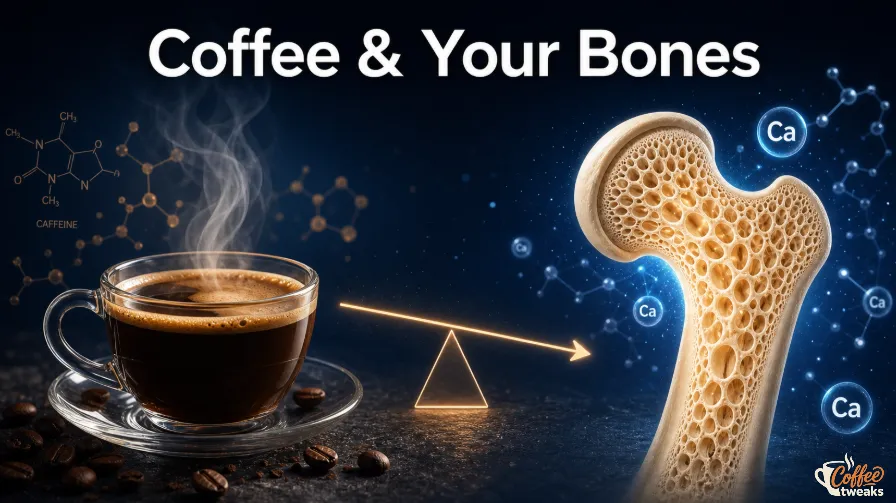
Here's how the machinery works. ⚙️
The two pathways
Caffeine affects your calcium economy through two separate doors.
Door one: absorption.
Caffeine slightly reduces how efficiently your intestines pull calcium out of the food you eat. The keyword is slightly. In the controlled human balance studies — the gold-standard kind where researchers measure everything going in and everything coming out — the depressant effect on intestinal calcium absorption is real but small.
Door two: excretion.
Caffeine acts on adenosine receptors in your kidneys. Normally your kidneys reabsorb a lot of the calcium that passes through them, sending it back into your blood. Caffeine turns that reabsorption down a notch, so a little more calcium leaves in your urine.
Both doors push the same direction: a bit less calcium in, a bit more calcium out. Negative balance.
Now, one nuance the popular articles skip. Robert Heaney — the researcher who did more careful work on this than anyone — pointed out in his 2002 review that while the absorption effect is measurable, the total 24-hour urinary calcium picture in controlled studies is less dramatic than the short-term spikes suggest.
Your body does some compensating over the full day. The scary “caffeine doubled calcium excretion” number you sometimes see comes from a high-dose study using 800 mg of caffeine — that's roughly eight cups of coffee slammed at once, measured over six hours. Not a normal morning.
How much calcium are we actually talking about?
The numbers matter here, so let's put real ones on the table.
The most-cited estimate comes from Heaney and Barger-Lux's balance work: about a 6 mg negative shift in calcium balance for every 175 mg of caffeine. That's roughly two cups of coffee. So call it about 3 mg of calcium per cup on the low end, 5 to 6 mg on the higher estimates that other groups have published. Some sources put it as low as 2 to 3 mg.
Let's be generous to the fear and use the higher figure: 5 mg of calcium lost per cup. ☕
A standard 8-ounce cup of brewed coffee has about 95 mg of caffeine, per USDA figures. A double-shot flat white has around 125 mg. A big travel mug is more.
Now stack it up:
Your daily calcium target is 1,000 mg if you're an adult under 51, or 1,200 mg if you're a woman over 50 or anyone over 70.
Twenty milligrams out of a thousand is two per cent. Five milligrams out of a thousand is half a per cent. This is, in the language of anyone who works with measurements, a rounding error.
Technically speaking, coffee does move your calcium balance. But also practically… it moves it by an amount you could erase without noticing.
Which brings us to the fix, but hold that thought — I want to show you the population data first, because the mechanism and the epidemiology tell the same story from two directions.
Does coffee cause osteoporosis?
This is the question people actually mean when they worry, so let's take it head-on. Does coffee and osteoporosis show up linked in the big studies?
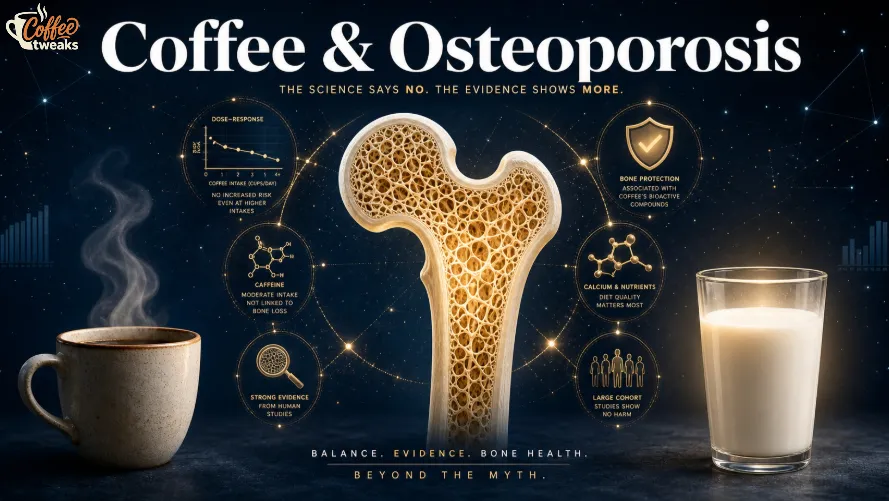
The honest answer: the evidence is mixed, mostly null, and — in the most recent and best-adjusted analyses — sometimes points the other way.
What the big meta-analyses show
A meta-analysis pools many studies together to get a bigger, more stable estimate than any single study can give. Here's what the major ones on coffee and fracture risk found.
Liu et al., 2012 (Archives of Medical Science) pooled 10 prospective studies — 214,059 participants, 9,597 fractures. They found an overall 3.5% higher fracture risk for each additional cup of coffee per day (relative risk 1.035, confidence interval 1.019–1.052). That sounds like a hit for coffee. Keep reading, because the sex breakdown flips the picture.
Sheng et al., 2013 (Osteoporosis International) looked specifically at hip fracture. Comparing the highest coffee drinkers to the lowest, they found a relative risk of 0.94 — with a confidence interval of 0.71 to 1.17. When a confidence interval straddles 1.0 like that, it means the result is statistically indistinguishable from “no effect.” Their conclusion was plain: no clear association between coffee and hip fracture.
A 2022 systematic review in Osteoporosis International went further. Across 13 studies covering 391,956 people for fracture and four studies for osteoporosis, high versus low coffee consumption was associated with a lower risk of osteoporosis — odds ratio 0.79, confidence interval 0.65–0.92. That's a statistically significant 21% reduction. For fracture, the association was non-significant.
Their dose-response numbers for hip fracture are worth seeing laid out, because they're not what the fear predicts:
Read that column top to bottom. From one cup up through four cups, the relative risk sits below 1.0 — meaning slightly protective, or at worst neutral. It only creeps above 1.0 at nine-plus cups a day, and even then the confidence interval is so wide it crosses 1.0 and means nothing statistically.
I'll say the quiet part out loud: if coffee were meaningfully dissolving skeletons, four cups a day would not keep showing up as neutral-to-protective in analyses of hundreds of thousands of people.
The men versus women split
Go back to that Liu 2012 meta-analysis, the one showing 3.5% higher fracture risk per cup. When they split it by sex, something interesting happened.
For women, the risk per cup was 1.049 — slightly elevated. For men, it was 0.910 — protective. Below 1.0.
And the female dose-response was non-linear. Two cups a day landed at RR 1.02 (barely above nothing). Eight cups a day jumped to RR 1.54.
So the harm signal in that analysis is real but it's concentrated in women drinking a lot of coffee, and it evaporates for men and for women at moderate intakes. That pattern — harm only at high doses, only in certain groups — is going to repeat everywhere we look.
The confounder nobody controls for
Here's the piece that reframes the whole debate, and it comes straight from Heaney.
People who drink a lot of coffee tend to drink less milk. Coffee is often a marker for a low-calcium diet, not the cause of the bone loss.
Think about it in daily terms. The person on their fifth black coffee at 3pm is frequently the same person who skipped breakfast, doesn't do dairy, and hasn't thought about calcium since a doctor mentioned it once. The coffee didn't wreck their bones. Their overall diet did, and the coffee is just the visible thing that correlates with it.
Heaney's conclusion after reviewing the balance studies was blunt: essentially all the observations implicating caffeine as an osteoporosis risk factor came from populations consuming substantially less than the recommended amount of calcium. In people hitting their calcium targets, he found no evidence of harm to bone at all.
This is why the epidemiology is so messy. Studies that carefully adjust for calcium intake, body weight, smoking, and estrogen tend to watch the coffee effect shrink or vanish. Studies that don't adjust well leave the confounder in and “find” a coffee effect that's really a calcium effect wearing a coffee costume.
The famous studies, decoded
A handful of specific studies get cited over and over, usually stripped of their context. Let's put the context back.
The Framingham Study (Kiel et al., 1990). This is the granddaddy of the coffee-fracture scare — 3,170 people followed for 12 years, 135 hip fractures. Higher caffeine intake tracked with higher hip fracture risk, and that's the line everyone quotes.
But look at the dose detail. They measured caffeine in “units,” where one cup of coffee equals one unit. For people drinking 1.5 to 2 units a day — call it a cup and a half to two cups — the adjusted relative risk of fracture was not significantly elevated compared to people drinking one unit or less. The risk showed up at the heavy end, not the moderate end. Two cups a day was fine.
The Rancho Bernardo Study (Barrett-Connor et al., 1994, JAMA). This one is the single most useful study in the entire literature, and I'll explain why in the milk section — because it's essentially a natural experiment on whether milk cancels the coffee effect. Spoiler: it does.
Rapuri et al., 2001 (American Journal of Clinical Nutrition). This is where the genuine risk lives. In elderly women, they found that 2 to 3 cups of brewed coffee a day accelerated bone loss — but specifically in nonsmoking postmenopausal women with low calcium intake (under 800 mg/day).
They also found the effect interacted with vitamin D receptor genotype, meaning some women are genetically more susceptible than others. Real finding. Note the conditions attached to it: postmenopausal, low calcium, and a particular genetic profile. Not “everyone who drinks coffee.”
See the pattern forming? Every study that finds real harm has the same fingerprints on it: older women, low calcium, high intake. Change any one of those variables and the effect tends to fade.
Does adding milk help? Here's the math
This is my favorite part, because it's where the arithmetic becomes genuinely satisfying. ☕📊
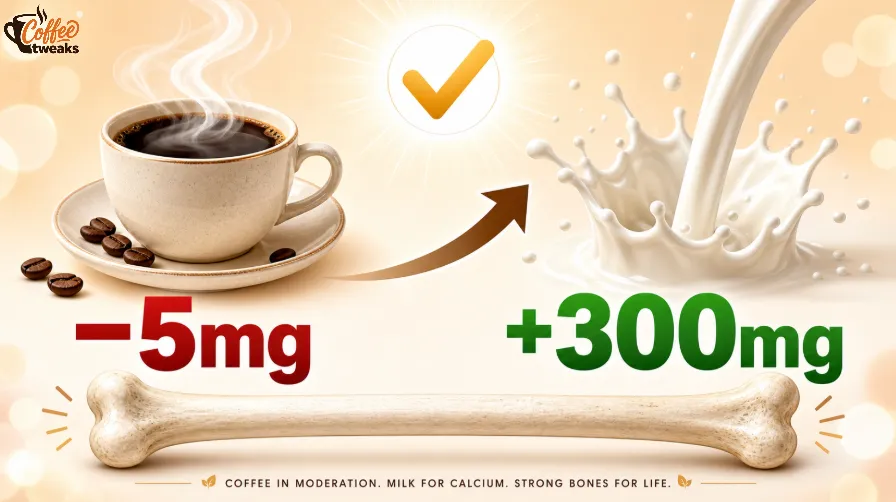
We established the loss: about 4 to 6 mg of calcium per cup of coffee. Let's keep using 5 mg to be safe.
Now the replacement. One cup (8 ounces) of milk contains about 300 mg of calcium. A tablespoon is one-sixteenth of a cup. So:
Set the two numbers next to each other.
You lose about 5 mg from the caffeine. A single tablespoon of milk gives you back 18 mg. That's not “offsetting” the loss — it's overshooting it by more than three to one. Two tablespoons overshoot it by seven to one.
Add a normal splash of milk to your coffee and you don't just neutralize the calcium hit, you come out ahead. Net positive. Your latte is a calcium delivery vehicle that happens to also contain caffeine.
I measured this against the literature and it lines up exactly with what Heaney concluded twenty years ago: the negative effect of caffeine on calcium absorption is small enough to be fully offset by as little as one to two tablespoons of milk.
And here's the beautiful part — the Rancho Bernardo Study proved it in actual humans, not just on paper.
Barrett-Connor's team measured lifetime coffee intake against bone density in 980 postmenopausal women, average age 72. They found a clean, graded relationship: more lifetime coffee, lower bone mineral density at both the hip and spine. Exactly what the fear predicts.
Then they split the women by whether they'd drunk at least one glass of milk a day through most of their adult lives.
In the daily-milk group, bone density did not vary by coffee intake at all. The entire coffee effect was present in the women who skipped milk, and entirely absent in the women who drank it. Their conclusion, in plain terms: coffee equivalent to two cups a day was linked to lower bone density only in older women who didn't drink milk daily.
That's the whole thing in one study. Coffee moves your calcium balance a little. Milk moves it back and then some. If your diet has enough calcium in it, the coffee never gets a foothold.
How much coffee is too much for bone density?
Let's put a number on it, with the caveat that “too much” depends heavily on who you are.
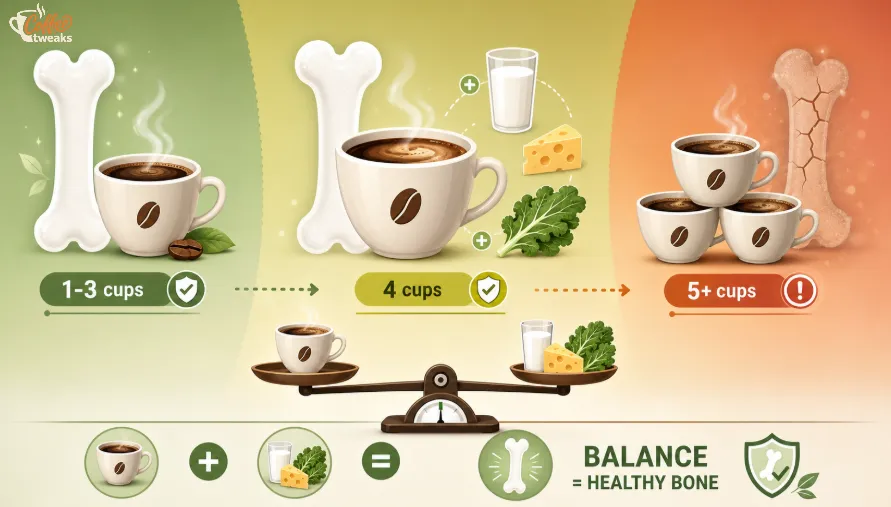
The general safety ceiling for caffeine in healthy adults is 400 mg a day — that's the figure health authorities use, and it works out to about four 8-ounce cups of brewed coffee. It's set mostly for heart and sleep reasons, but it's a sensible line for bones too.
For bone density specifically, the useful threshold comes from Nawrot and colleagues' 2003 review for Health Canada, which is one of the most cited caffeine-safety assessments in the literature. Their finding: bone mineral density was not meaningfully affected by a daily caffeine intake below 400 mg, provided calcium intake was at least 800 mg a day.
Read that as a conditional, because the condition is the whole point. Under 400 mg of caffeine plus at least 800 mg of calcium equals no measurable bone problem. The caffeine number and the calcium number work as a pair.
The newest data pushes the worry line even higher. A 2025 analysis of the Study of Osteoporotic Fractures — a 10-year look at older women with repeated measurements of both coffee and bone density — found that it took more than five cups a day before coffee showed a possible negative association with bone mineral density. Below that, nothing. (That same study, incidentally, found tea associated with higher hip bone density.)
So the rough map looks like this:
Who's actually at risk — and who isn't
Because the answer to “should you be worried?” genuinely depends on which group you're in, let me sort it out honestly.
At meaningfully higher risk:
Postmenopausal women with low calcium intake: This is the clearest at-risk group in the entire literature — Rapuri, Rancho Bernardo, and the female arm of the Liu meta-analysis all point here. After menopause, dropping estrogen already accelerates bone loss, and the body's ability to buffer a calcium deficit shrinks. Add low dietary calcium and a heavy coffee habit and the small per-cup effect stops being trivial.
The elderly with impaired calcium adaptation: Younger bodies compensate for a caffeine-induced calcium loss by absorbing more calcium from the gut. Massey and others have shown that older adults do this less effectively. The same cup of coffee costs an 80-year-old a little more than it costs a 30-year-old.
People with genuinely low calcium diets, at any age: If you're consistently under your calcium target — no dairy, no fortified foods, no leafy greens, no supplement — then you have no buffer, and the coffee effect has nothing to cancel it out.
Possibly, certain genotypes: The vitamin D receptor interaction Rapuri found, and separate work on CYP1A2 (the gene controlling how fast you metabolize caffeine), hint that some people are simply more susceptible. This science is still developing and isn't something you'd act on today, but it's why individual responses vary.
At little or no meaningful risk:
What the current consensus actually says
Pulling it all together, here's where the science sits as of the most recent data.
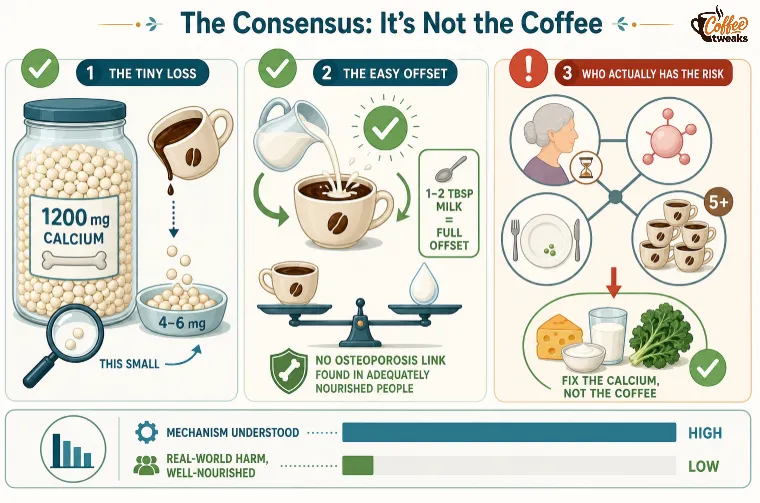
Caffeine has a real, measurable, but very small negative effect on calcium balance — through reduced intestinal absorption and increased urinary excretion. The size of that effect, around 4 to 6 mg of calcium per cup, is trivial next to a daily requirement of 1,000 to 1,200 mg.
That per-cup loss is fully and easily offset by 1 to 2 tablespoons of milk, which the Rancho Bernardo Study confirmed plays out in real women's bones over a lifetime, not just in a lab.
The population studies are inconsistent, and the inconsistency is largely explained by whether they adjusted for calcium intake. The best-adjusted recent meta-analyses find coffee neutral for fracture risk and possibly protective against osteoporosis.
The real risk is concentrated in a specific profile: older, postmenopausal, low calcium, high intake. For that profile, the fix isn't “quit coffee” — it's “fix the calcium.” And genetics may modulate individual susceptibility in ways we're still mapping.
There's still no consensus that coffee causes osteoporosis. Medical News Today's summary of the field captures it fairly: there isn't enough evidence to conclude that caffeine, in any quantity, causes osteoporosis. The mechanism is understood; the real-world consequence, in adequately-nourished people, is minimal.
The verdict: should you be worried?
For most people: no.
If you drink one to four cups of coffee a day, get a normal amount of calcium in your diet, and add a splash of milk — your bones are not the thing to worry about. The math doesn't support the fear. The population data doesn't support the fear. The one study that most directly tested the milk question found the entire coffee effect disappears when milk is in the picture.
If you're a postmenopausal woman, elderly, on a low-calcium diet, or drinking five-plus cups a day, the honest answer is: pay attention to your calcium, not your coffee. The coffee is at most a minor amplifier of a calcium problem, and the calcium problem is the one worth solving.
So here's what actually moves the needle on bone mineral density, in rough order of importance — none of which requires giving up coffee:
Coffee earned a reputation as a bone-thief on the strength of a mechanism that's real but tiny, amplified by studies that were really measuring low-calcium diets. When you do the arithmetic — and I did — the cup in your hand comes out looking almost entirely innocent. ☕📊
Worry about the calcium. Enjoy the coffee.
FAQ
Does drinking coffee cause osteoporosis?
There's no solid evidence that coffee causes osteoporosis in people who get adequate calcium. Caffeine slightly reduces calcium absorption and slightly increases calcium loss in urine, but the amount — roughly 4 to 6 mg per cup against a 1,000–1,200 mg daily need — is too small to matter for most people. Some of the largest recent meta-analyses actually found coffee drinkers had lower osteoporosis rates.
How many cups of coffee are safe for bone health?
Up to about four 8-ounce cups a day (roughly 400 mg of caffeine) shows no meaningful effect on bone mineral density in the research, as long as your calcium intake is at least 800 mg a day. A possible negative signal only starts to appear above five cups a day, and mainly in older women with low calcium intake.
Does adding milk to coffee protect your bones?
Yes, and the math is lopsided in your favor. A cup of coffee costs you about 5 mg of calcium; one tablespoon of milk gives back about 18 mg — more than three times as much. The Rancho Bernardo Study found that women who drank at least one glass of milk daily showed no coffee-related bone loss at all, while those who skipped milk did.
Is caffeine or coffee the real problem for calcium?
The measurable effect on calcium comes from caffeine specifically. But in population studies, coffee often acts as a marker for a low-calcium, low-milk diet — meaning the “coffee effect” frequently turns out to be a calcium-deficiency effect in disguise. Decaf drinkers get essentially none of the caffeine effect.
Who should actually be cautious about coffee and bone density?
Postmenopausal women with low calcium intake, elderly adults (whose bodies compensate less well for calcium loss), and anyone consistently below their calcium target. For these groups, the answer is usually to fix the calcium rather than quit the coffee. If you have osteoporosis or known risk factors, talk to your doctor.
Does coffee affect bone density in men or younger people?
The data is reassuring for both. In men, more coffee has been associated with slightly lower fracture risk, not higher. In children and adolescents, a genetics-based causal analysis found no relationship between caffeine and bone mineral density.
This article is general information, not medical advice. Bone health depends on many factors — age, sex, hormones, diet, genetics, medications, and existing conditions. If you have osteoporosis, a family history of it, or other risk factors for low bone mineral density, talk to your doctor or a registered dietitian about your specific situation before making changes.