
How to Make Coffee in the Microwave (No Kettle Needed) ☕🎯

Quick answer: Fill a microwave-safe mug with water and heat it in 30–45 second bursts, stirring between each one, until it's steaming hot — that's roughly 90 seconds on a strong 1,000–1,200W microwave, or up to 2.5 minutes on a weaker 700W one.
Stir in 1–2 teaspoons of instant coffee per 8 oz of water. No instant coffee? Stir 2 tablespoons of coarse ground coffee straight into the hot water, let it steep off-heat for 3–4 minutes, then pour slowly and leave the sludge behind. Never heat a plain, empty mug of water in one long continuous blast — that's the actual safety mistake almost every other guide skips.
Real talk… most microwave coffee guides will get you a cup of coffee. A few of them might also get you a face full of scalding water, and none of them explain why. Water heated in a microwave doesn't behave like water heated in a kettle. Nobody mentions that before telling you to blast a mug of plain water for two straight minutes.
I've pulled somewhere north of 10,000 espresso shots testing machines, grinders, and brew ratios. None of that matters here. This isn't espresso. This is triage. Here's the actual method — what to use, how long to heat it, and the one step that keeps this from going wrong.
What You Actually Need to Make Microwave Coffee ✅
Method 1: Instant Coffee (Fastest, Most Reliable)
This is the method. If you have instant coffee anywhere in your kitchen, use it.
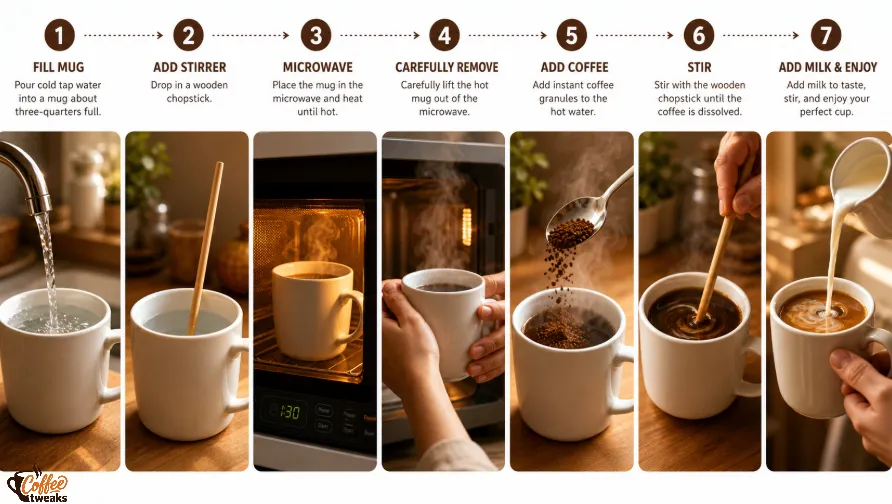
- Step 1: Fill a microwave-safe mug about three-quarters full with cold water. Leave headspace — a full-to-the-rim mug is how you get a boil-over.
- Step 2: Drop in your wooden stirrer or chopstick before you hit start.
- Step 3: Microwave in 30–45 second bursts, stirring briefly between each one, until the water is steaming and just short of a rolling boil. Total time is usually 1.5 to 2.5 minutes — your wattage decides where you land in that range.
- Step 4: Remove the mug carefully, using the sides, not gripping near the rim over the water.
- Step 5: Stir in 1–2 teaspoons of instant coffee per 8 oz of water. Start at 1 teaspoon if you're not sure — you can always add more, you can't take it out.
- Step 6: Stir until fully dissolved, add milk or sugar if you want them, and drink.
You do not need a full boil for instant coffee to dissolve. Steaming hot is enough, and it's the safer target anyway.
Method 2: Ground Coffee, No Filter
No instant coffee? Fine. You can still do this — you're just trading convenience for a bit of grit at the bottom of the mug.
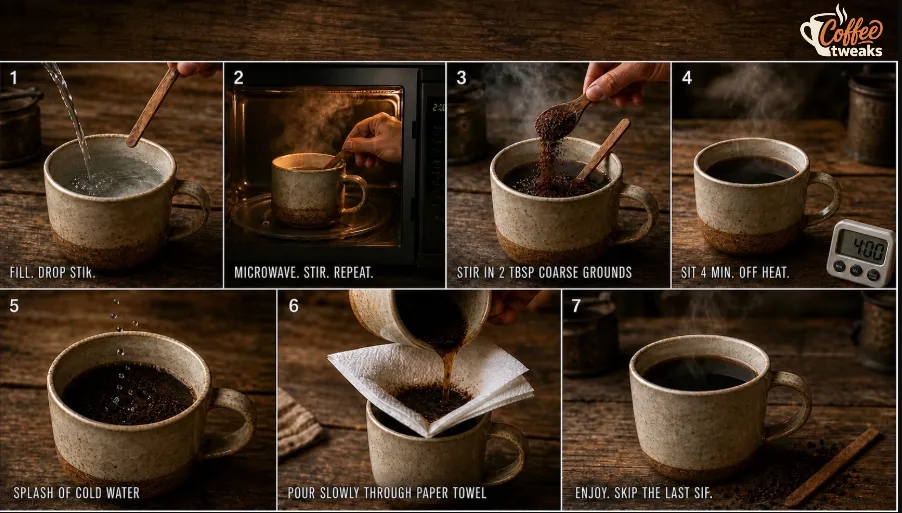
- Step 1: Fill your mug three-quarters full with cold water and drop in your wooden stirrer.
- Step 2: Microwave in 30–45 second bursts, stirring between, until steaming hot — same timing as above.
- Step 3: Remove the mug. Stir in 2 tablespoons of coarse ground coffee per 8 oz of water. Coarse matters here — fine grounds turn this into mud and oversteep fast.
- Step 4: Let it sit, off the heat, for 3–4 minutes. Do not put it back in the microwave with the grounds already in it — that's how you get scorched, bitter coffee.
- Step 5: Sprinkle in a small splash of cold water. This is the old campfire trick for getting grounds to sink to the bottom faster. Real talk — it works about half the time. If your grounds are still floating, patience does more than the water splash does.
- Step 6: Pour slowly into another mug through a paper towel or napkin if you want it clean, or just pour carefully and stop before you hit the sediment at the bottom. Either way, don't drink the last sip.
This tastes rougher than a pour-over. It's still real coffee, and it's better than instant if you actually like coffee flavor over convenience.
Here's the Thing: Superheated Water Is Real
This is the part every other “microwave coffee hack” article either skips entirely or buries in one vague sentence. It's the reason I built the whole method above around it instead of treating it as a footnote.
When you heat water on a stove or in a kettle, the heating element itself is rough and uneven, which gives water tiny surfaces to form bubbles on and boil normally. A microwave doesn't work that way. It heats the water directly and evenly, and a smooth, clean mug gives water almost no surface to form bubbles on.
The result: water can get hotter than its actual boiling point without ever visibly boiling. It just sits there, calm and still, holding way more energy than it looks like it is.
Then something disturbs it. Someone picks up the mug. Someone stirs it. Someone drops in a spoonful of instant coffee. And the water flashes into a violent boil all at once, sometimes hard enough to erupt out of the mug.
Washington State University‘s extension service has been warning about this for years, and physicists at the University of New South Wales describe the exact same mechanism — this isn't an urban legend, it's basic physics that Snopes has confirmed as accurate more than once.
I've been wrong before. Not about this. The fix isn't “be careful when you add the coffee.” The fix is not letting the water superheat in the first place — that's what the wooden stirrer and the short 30–45 second bursts are actually for. A rough wooden surface gives the water somewhere to form bubbles normally as it heats, so it never gets the chance to superheat quietly. Do that, and adding your coffee afterward is a non-event.
If you forgot the stirrer and just ran the microwave in one long blast, don't immediately grab the mug or dump coffee in. Let it sit untouched on the counter for a full minute first, then nudge it gently before you do anything else.
Mug Rules: What's Actually Microwave-Safe
Does Your Microwave's Wattage Actually Change the Timing? Yes.
This is the other thing generic articles get lazy about. They'll tell you “microwave for 90 seconds” like every microwave on earth is identical. It isn't. Wattage is the difference between a perfectly hot cup and either lukewarm coffee or an overheated mess.
| Microwave wattage | Roughly how long to heat 8 oz of water |
|---|---|
| 700W (compact, dorm, older models) | About 2 to 2.5 minutes |
| 900–1,000W (standard home microwave) | About 1.5 to 2 minutes |
| 1,200W+ (larger, newer, or commercial-style) | About 1.5 minutes |
Treat these as starting points, not gospel. Mug thickness, water volume, and how cold your tap water is all shift the number. The move isn't memorizing a time — it's heating in short bursts and watching for steam, not guessing a single number and walking away.
Milk, Sugar, and Cream: When to Add Them
Fixing Bad Microwave Coffee
| Problem | Why it's happening | Fix |
|---|---|---|
| Tastes weak or watery | Not enough coffee for the water | Bump up to 2 tsp instant, or 2.5 tbsp grounds |
| Tastes bitter or burnt | Over-steeped grounds, or water was too close to a hard boil | Pull grounds after 3–4 minutes, not longer; use steaming-not-boiling water |
| Gritty or muddy at the bottom | Normal with the grounds method | Strain through a paper towel, or just stop pouring before the sediment |
| Foamed up or nearly boiled over | Ran one long continuous blast instead of short bursts | Use 30–45 second increments with stirring, and leave headspace in the mug |
| Tastes flat and dull | This is just the ceiling of microwave coffee | A pinch of salt cuts perceived bitterness; a dash of cinnamon or cocoa powder adds richness without adding actual coffee |
Low-key obsessed with the salt trick, for what it's worth. A genuine pinch — not a spoonful — flattens the bitterness in a rough, over-extracted cup more than sugar does, and it doesn't make the coffee taste salty if you use a light hand.
Instant vs. Grounds: Quick Comparison
| Feature | Instant coffee method | Ground coffee method |
|---|---|---|
| Total time | About 2 minutes | About 5–6 minutes |
| Equipment needed | Just a mug | Mug + something to strain with |
| Taste | Milder, consistent | Stronger, more like real brewed coffee, but grittier |
| Best for | True no-time emergencies | When grounds are all you have on hand |
Does Microwaving Kill Caffeine or Antioxidants?

No, not caffeine. Caffeine is a heat-stable molecule that doesn't break down at the temperatures a microwave or kettle reaches — it survives boiling water brewing just fine, which is exactly how most coffee is made in the first place.
Antioxidants are murkier. Some coffee-industry sources claim reheating and microwaving barely touch antioxidant content; others claim a fast, significant drop.
The honest answer is that the evidence floating around online on this specific point is inconsistent and mostly comes from non-peer-reviewed coffee blogs rather than controlled studies, so I'm not going to hand you a confident number either way.
👉 What I will say: if you're drinking microwave coffee for the caffeine, you're getting it. If you're drinking it for antioxidants, coffee brewed and consumed fresh is still the safer bet.
FAQ
Can you put ground coffee directly in the microwave?
You can put ground coffee into water that's already been microwaved and removed from the microwave — stirred in and left to steep, not microwaved together with the water. Microwaving grounds and water together for an extended time tends to scorch the coffee and pull out excess bitterness.
Is it safe to microwave instant coffee?
Yes. Instant coffee is designed to dissolve in hot water, and there's nothing about the powder itself that reacts badly to microwave heat. The safety concern isn't the coffee — it's the water it's going into, if that water was allowed to superheat first.
Can you microwave a paper or styrofoam coffee cup?
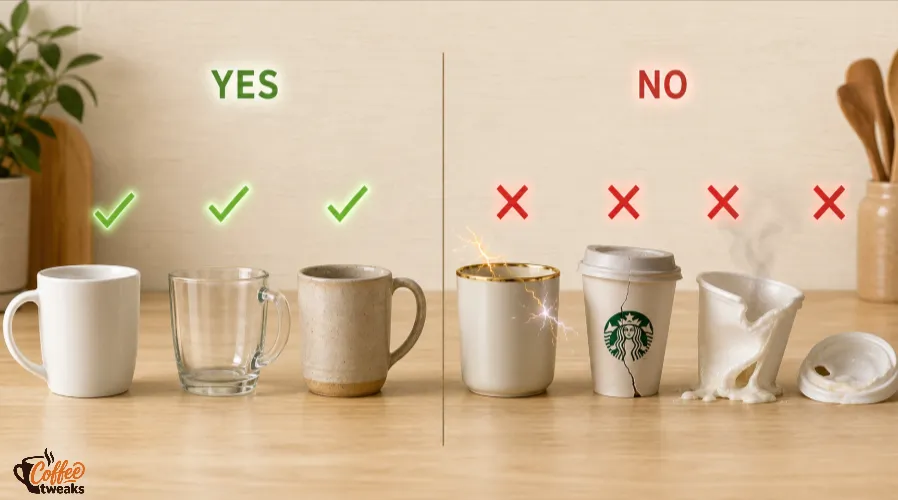
No to both. Paper cups are lined with plastic or wax that can warp or melt, and styrofoam can melt and release harmful compounds under microwave heat. Use a ceramic or glass mug instead.
How long should you microwave water for coffee?
Roughly 1.5 to 2.5 minutes for an 8 oz mug, depending on your microwave's wattage — weaker microwaves need more time, stronger ones need less. Heat in 30–45 second bursts and stir between them rather than running one long continuous cycle.
Can you microwave milk for coffee?
Yes, but watch it closely. Milk heats and boils over faster than plain water. Use shorter bursts — 20–30 seconds — and stop as soon as it's hot, not boiling.
Why does my microwave coffee taste burnt or bitter?
Almost always over-extraction: the grounds sat in the water too long, or the water was too close to a full boil when the coffee went in. Pull grounds at 3–4 minutes and aim for steaming-hot water, not a hard boil.
Is microwave coffee as good as brewed coffee?
No, and I'm not going to pretend otherwise. It's a fine emergency method, not a replacement for a real brewer. It'll wake you up and it won't taste offensive if you follow the ratios above — that's the actual bar it needs to clear.
The Honest Take
This will never be your best cup of coffee. And I'm not apologizing for that — it's not supposed to be. It's supposed to be a drinkable, safe cup when you have zero other options and zero time.
Get the ratio right, respect the superheating warning, and you'll have something you can actually drink without regret. That's the whole job here. ☕