
Does Coffee Dehydrate You? The Myth That Won’t Die


Here's the thing nobody tells you.
Coffee does increase urine production. That part is true. Your body really does make a little more pee after a strong cup.
What people leave out is the other half of the equation. Coffee itself is almost entirely water. So while a bit goes out, a lot more comes in. The math ends up in your favor.
I'm an engineer. I like it when the numbers actually balance. And when you put coffee's numbers on paper, the “coffee dehydrates you” story falls apart fast. 📊
I put my own morning cup on a kitchen scale once, out of curiosity. A regular mug of black coffee came in at around 240 grams. Roughly 235 of those grams were water. The caffeine? A rounding error by weight. That single measurement tells you most of what you need to know.
Let's do the rest properly.
⚡ Quick Answer
No, coffee does not dehydrate you in normal amounts. Caffeine has a mild diuretic effect, but a cup of coffee is about 95% water, and that water more than replaces the small extra loss. For most people, moderate coffee (up to around 400 mg of caffeine, or 3–4 cups) counts toward your daily fluids, not against them.
Key Takeaways
Does Coffee Dehydrate You?
Short version: no. Not at the amounts most people drink.
The best test anyone has run on this was published in 2014 in the journal PLOS ONE by Sophie Killer and colleagues at the University of Birmingham. They took 50 men who habitually drank 3 to 6 cups a day.
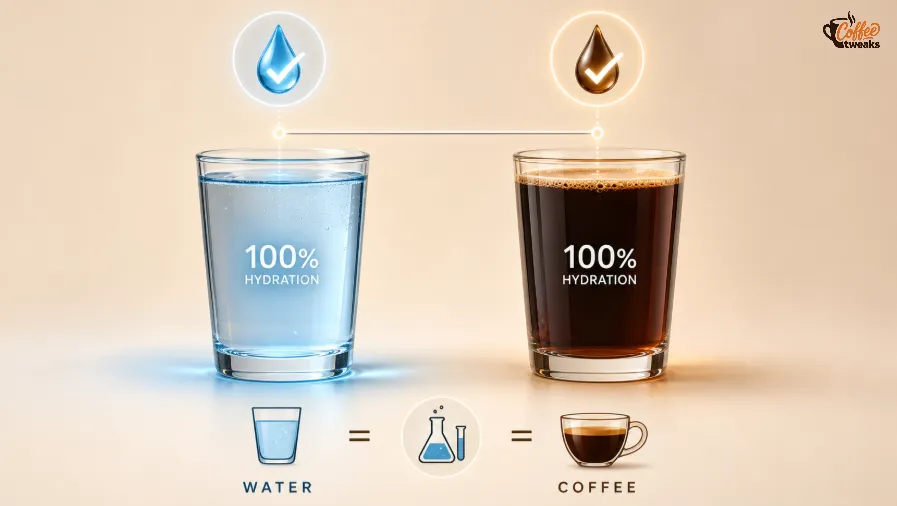
For three days each, the men drank either four cups of coffee daily or the same volume of plain water, under controlled diet and activity. Then the researchers measured total body water using a tracer method, plus a full panel of urine and blood hydration markers.
The result was clean. No difference. Coffee kept the men just as hydrated as water did.
Quick answer: Moderate coffee does not dehydrate you. A controlled 2014 study found that people drinking four cups of coffee a day were just as hydrated as when they drank the same amount of water, measured by total body water and urine and blood markers. Coffee counts toward your daily fluid.
I'll be straight with you about one detail, because most articles skip it. That Birmingham study was funded by the Institute for Scientific Information on Coffee, a body backed by the coffee industry. That's worth knowing. It's a reason to check whether independent research agrees.
It does. A separate line of work by Ronald Maughan's team at Loughborough, funded by a hydration research group, tested 13 different drinks and put coffee's hydrating power on par with water. And a meta-analysis pulling together 16 studies found only a minor diuretic effect that vanished during exercise. Different funders, different labs, same conclusion. When the results line up across sources that don't share an agenda, the finding holds.
So the honest answer isn't “trust the coffee study.” It's “several unrelated studies point the same way.” That's a sturdier place to stand.
Why People Believe Coffee Causes Dehydration
This myth has a birthday. It traces back to a 1928 study on a tiny group of people, and to later studies that shared one big design flaw.
Here's what those older studies did. They took people who had gone without caffeine for days or weeks. Then they gave them a hit of pure caffeine, often as a pill, and watched the urine pour out.
Two problems with that setup.
First, a caffeine-free person has no tolerance. Their body reacts hard to a dose that a daily drinker wouldn't blink at. That exaggerates the effect.
Second, a caffeine pill isn't coffee. Coffee arrives wrapped in 200-plus milliliters of water. A pill doesn't. Studying the pill tells you about caffeine in isolation, not about the drink in your hand.
So the science wasn't wrong, exactly. It was just answering a narrower question than people assumed. “Caffeine can be a mild diuretic in someone who never touches it” quietly turned into “coffee dries you out.” Those are very different claims.
The idea stuck because it sounds right. Coffee makes you pee, and peeing feels like losing water. The logic is intuitive. It's also incomplete, because it ignores everything that went into the cup in the first place.
Quick answer: The dehydration myth comes from early studies that gave caffeine pills to people who had avoided caffeine for days. Their bodies overreacted, and a pill has no water to offset the loss. That narrow finding got stretched into a claim about everyday coffee, which the drink's high water content disproves.
How Caffeine Actually Affects Hydration ⚙️
Let's open the hood. This is where the real mechanism lives, and it's simpler than it sounds.
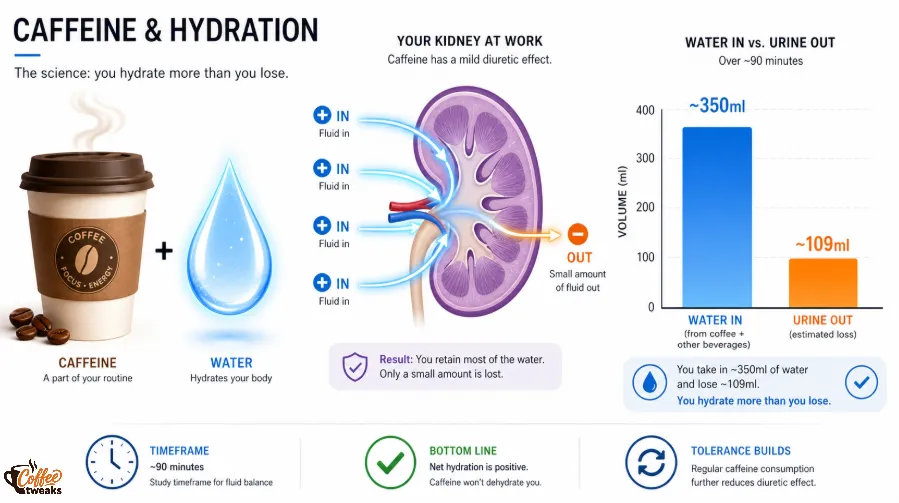
The diuretic effect
Caffeine is a mild diuretic, meaning it nudges your kidneys to release a bit more fluid. It does this partly by blocking a signal that normally tells your kidneys to hold onto water and sodium. Block that signal, and slightly more goes out.
Note the word slightly. The 2015 meta-analysis in the Journal of Science and Medicine in Sport crunched 28 measurements across 16 studies. The median caffeine dose was 300 mg, about three cups' worth. The average bump in urine output was 109 ml. 📊
That's less than half a cup of liquid. And you drank three cups to get there. The input dwarfs the output.
How your kidneys respond
Your kidneys are constant, careful accountants. Their entire job is keeping your fluid and salt levels steady. When a little extra fluid leaves after coffee, they simply adjust the ledger over the following hours. The diuretic effect peaks somewhere around 30 to 90 minutes after drinking and settles down within a couple of hours.
This is a small, temporary shift, not a leak.
Tolerance and adaptation
Here's the part that surprises people. The diuretic effect fades if you drink coffee regularly.
Your body adapts to caffeine within a matter of days. Once it does, the kidneys stop overreacting. This is why the Birmingham study saw no dehydration in habitual drinkers, and why you personally probably don't notice extra bathroom trips from your usual morning cup. You've adapted. The effect that shows up in a caffeine-naive test subject just isn't there for you.
So the diuretic response is strongest in exactly the people least likely to be drinking coffee: those who never do. For everyone with a daily habit, it's mostly a non-event.
Fluid balance, start to finish
Put the pieces together and the flow is easy to trace. Water and caffeine go in. Caffeine causes a small, short-lived rise in urine. Your kidneys rebalance. The water you drank stays in the system. Net effect on hydration in a regular drinker: essentially zero, and often slightly positive because of all that water.
Quick answer: Caffeine mildly blocks a kidney signal that conserves water, so you release a little more urine, about 109 ml on average per moderate dose. The effect is small, peaks within 90 minutes, and fades with regular use as your body builds tolerance. The water in coffee more than replaces it.
Coffee Is Mostly Water ☕
This is the fact that ends the argument, so let's give it real numbers.
Brewed black coffee is roughly 95% water. Some sources put it as high as 98%. The rest is a tiny fraction of dissolved solids: caffeine, oils, acids, and the aromatic compounds that make coffee taste like coffee. By weight, water is nearly the whole cup.
Worth the worry? Let's actually do the math. ⚙️
Say you drink a 240 ml mug of black coffee. About 228 ml of that is water. The caffeine's diuretic effect, using the meta-analysis average, pulls out something like 100 ml extra. So:
You came out ahead by more than half a cup. And that's using the average diuretic figure, which itself came from a 300 mg dose spread across three cups, not one. For a single mug, the real loss is smaller and the net gain is bigger.
Drink four cups over a morning and the arithmetic scales the same way. More water in than out, every time, until you get to genuinely large doses.
Black coffee is the clearest case because it's basically flavored water. Add milk and you're adding more fluid, plus electrolytes that help retention. A latte is even harder to spin as dehydrating than an espresso.
Quick answer: Coffee is about 95% water. A 240 ml cup delivers roughly 228 ml of water while caffeine pulls out only around 100 ml, leaving a net gain of over half a cup. Black coffee is essentially flavored water, so it hydrates you rather than drying you out.
How Much Coffee Is Too Much?
This is where the myth has a kernel of truth, and where most articles get vague. Let me give you the actual threshold. 📊
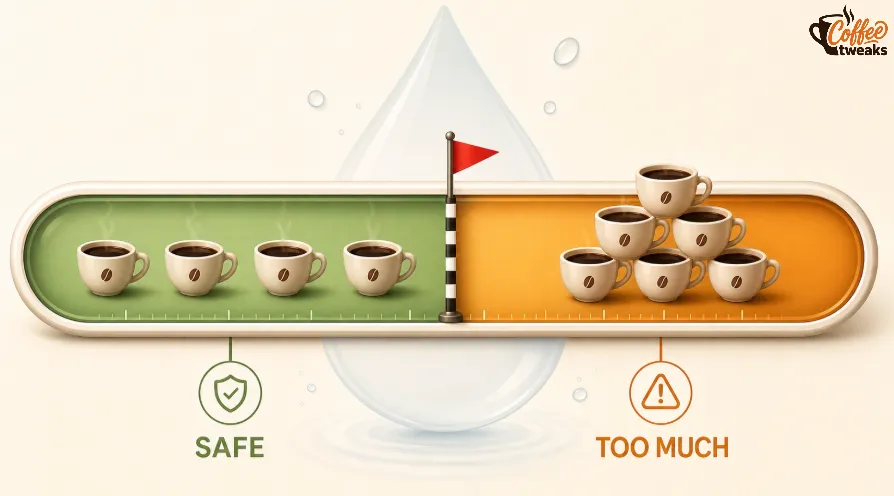
The dose that matters
A 2017 study in Frontiers in Nutrition by Adam Seal and colleagues tested the same coffee at two strengths in habitual drinkers.
So there is a line. It sits somewhere around 500 mg of caffeine taken all at once. Below the everyday range, coffee does nothing to your hydration. Slam five or six strong cups in a short window, and yes, you'll visit the bathroom more.
Notice that even the low dose in that study, ~250 mg, is more caffeine than most people get from a single cup. You have real headroom.
Safe daily limits
The two big food safety bodies agree closely.
That single-dose figure is useful. It sits comfortably below the ~500 mg point where the diuretic effect kicks in. Stay near normal serving sizes and you're nowhere near the threshold.
Coffee vs energy drinks
A quick word on the difference, because it matters for fluid and for safety.
Coffee delivers caffeine inside a large volume of water and nothing much else. Many energy drinks pack similar or higher caffeine into a smaller can, often alongside sugar and other stimulants that can amplify the effect. Same caffeine on the label doesn't mean the same drink. If you're tracking your intake, treat a can of energy drink as a more concentrated hit than a mug of coffee.
Quick answer: Coffee starts affecting fluid balance only at high single doses, around 500 mg of caffeine at once, per a 2017 trial. Everyday drinking stays far below that. Health authorities consider up to 400 mg a day, roughly 4 to 5 cups, safe for most healthy adults, with 200 mg a sensible single-serving ceiling.
👉 Read More: How Much Coffee Is Too Much?
Who Should Be More Careful?
The general answer is reassuring, but averages hide individuals. A few groups have good reason to pay closer attention.
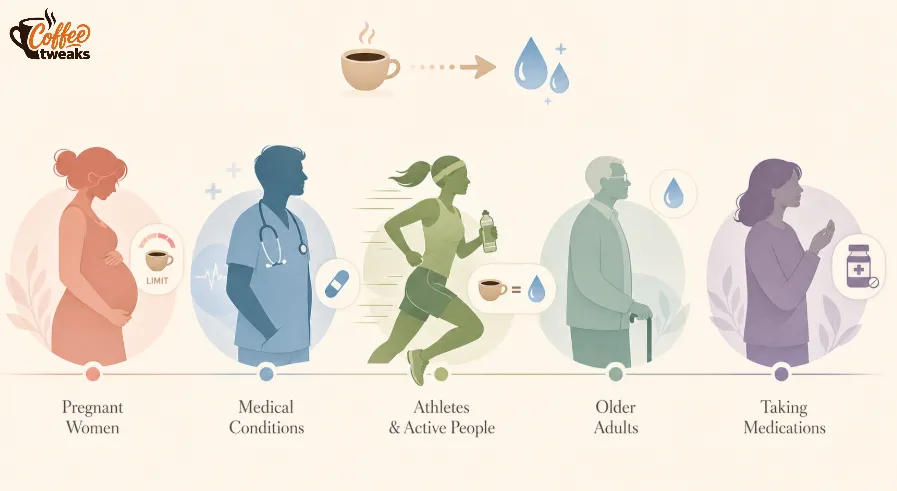
Quick answer: Most people need no special caution. Pregnant and breastfeeding people should stay under 200 mg of caffeine daily. Anyone with medical advice to limit fluids or caffeine should follow it. Athletes are fine, since exercise cancels the diuretic effect, and older adults should keep total fluids up regardless of coffee.
Coffee vs Water Intake 📊
Can coffee count toward your daily fluids? Yes. Let's put it in context with real numbers.
The U.S. National Academies estimate total daily water needs at about 2.7 liters for women and 3.7 liters for men. That's total water, and it includes the water in food, which supplies roughly 20% of it. So the amount you need to drink is lower than those headline figures suggest, and every fluid you drink helps hit it, coffee included.
Here's how coffee's caffeine stacks up against other everyday drinks, using figures from the Harvard Nutrition Source. 📊
| Drink | Serving | Caffeine | Roughly water | Counts toward fluids? |
|---|---|---|---|---|
| Brewed coffee | 240 ml (8 oz) | ~95 mg | ~95% | Yes |
| Instant coffee | 240 ml (8 oz) | ~60 mg | ~95% | Yes |
| Espresso | 45 ml (1.5 oz) | ~65 mg | ~95% | Yes |
| Decaf coffee | 240 ml (8 oz) | ~4 mg | ~95% | Yes |
| Black tea | 240 ml (8 oz) | ~47 mg | ~99% | Yes |
| Green tea | 240 ml (8 oz) | ~28 mg | ~99% | Yes |
| Cola | 355 ml (12 oz) | ~40 mg | ~89% | Yes |
| Energy drink | 250 ml | ~80 mg | ~90% | Yes, but watch sugar and stimulants |
| Plain water | 240 ml | 0 mg | 100% | Yes |
Now, “counts as fluid” doesn't mean “all equal.” Not every drink retains fluid the same way.
That Loughborough team built something called the Beverage Hydration Index, which ranks how well drinks keep fluid in the body over four hours, with still water set at 1.0.
Coffee landed right alongside water. Nothing about it scored below water. But a few drinks scored higher: full-fat milk, skim milk, and oral rehydration solution all beat plain water, thanks to their electrolytes.
| Drink | Hydration vs water | Why |
|---|---|---|
| Oral rehydration solution | Higher than water | Sodium and glucose drive retention |
| Skim milk | Higher than water | Electrolytes and protein |
| Full-fat milk | Higher than water | Electrolytes, protein, some fat |
| Water | Baseline (1.0) | The reference point |
| Coffee | About the same as water | Caffeine's effect is offset by fluid |
| Tea | About the same as water | Same story as coffee |
| Sports drink | About the same as water | Retention similar in a rested person |
The practical takeaway: coffee is a perfectly good contributor to your daily fluids. It just isn't your best tool when you're already dehydrated and need to catch up fast. For that job, milk or a proper rehydration drink does more, because the electrolytes help your body hold the fluid. For normal daily topping-up, your coffee is doing its part.
Quick answer: Coffee counts toward your daily fluid target, which is about 2.7 liters for women and 3.7 for men including water from food. On the Beverage Hydration Index, coffee retains fluid about as well as plain water. Milk and rehydration solutions rank higher, so they're better when you're already dehydrated.
Common Coffee Hydration Myths
Let's clear the shelf. Here are the ones that keep circulating.
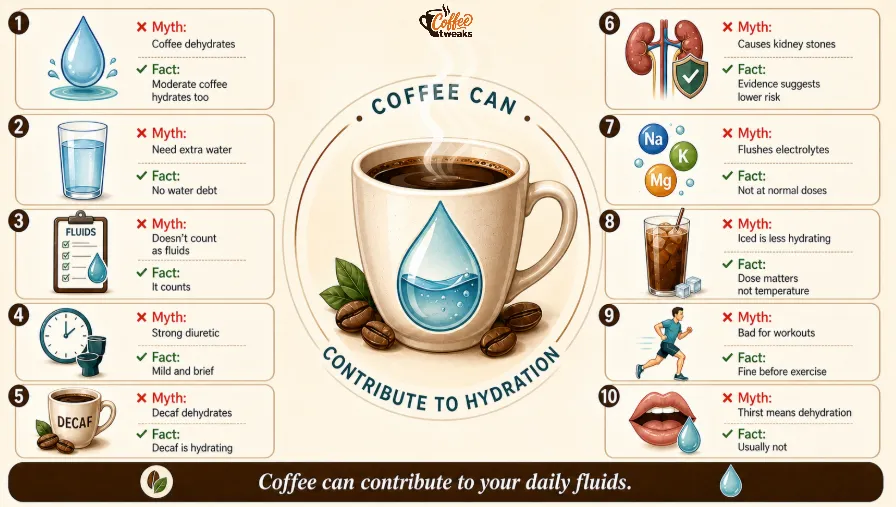
Coffee always dehydrates you
Fact: In normal amounts, moderate coffee contributes to hydration. Its water content more than offsets caffeine's mild diuretic effect, and controlled studies show no dehydration in regular drinkers.
You need an extra glass of water for every cup of coffee
Fact: You don't. The coffee already brought its own water. Drinking water alongside coffee is fine, but you're not paying off a debt. There is no debt.
Coffee doesn't count toward your daily fluid intake
Fact: It does. The Mayo Clinic and U.S. Dietary Guidelines both treat caffeinated drinks as part of your daily fluids.
The diuretic effect is powerful
Fact: It's mild and brief. A meta-analysis pegged the average extra loss at about 109 ml, less than half a cup, from a three-cup dose.
Decaf can still dehydrate you
Fact: Decaf has almost no caffeine, around 4 mg a cup, and is essentially hydrating water with flavor. If anything, it's a clean fluid source.
Coffee causes kidney stones
Fact: The evidence points the other way. A study of over 217,000 people found the highest caffeine intake was linked to a 26–31% lower risk of kidney stones, and decaf coffee was protective too. Anyone treating a specific stone type should still follow their doctor's advice, but the blanket “coffee causes stones” claim doesn't hold.
Coffee flushes out all your electrolytes
Fact: At normal doses, no meaningful electrolyte problem shows up in healthy people. Only high single doses, around 500 mg, produced a measurable rise in sodium and potassium loss, and even then it's modest.
Iced coffee or cold brew is less hydrating
Fact: Temperature has nothing to do with it. It's the same water and caffeine either way. Cold brew can actually be higher in caffeine depending on how it's made, so mind the dose, not the ice.
Coffee makes you dehydrated during a workout
Fact: Exercise cancels caffeine's mild diuretic effect. Research finds a coffee before training doesn't harm hydration, and caffeine can even help performance.
Feeling thirsty after coffee proves it dried you out
Fact: Thirst after coffee is usually about salt, sugar, or just habit, not net water loss. Black coffee left you with more fluid than you started with.
Frequently Asked Questions
Does coffee dehydrate you?
No, not in normal amounts. Coffee is about 95% water, and that fluid more than covers caffeine's small diuretic effect. Controlled research shows moderate coffee keeps you as hydrated as water. For most people it counts toward daily fluids rather than against them.
How much coffee can I drink before it dehydrates me?
You'd need a large single dose. Research shows about 250 mg of caffeine at once has no effect on fluid balance, while roughly 500 mg in one sitting produces a measurable rise in urine. Everyday drinking, even 3 to 4 cups spread out, stays well below that line.
Does coffee count as water intake?
Yes. The Mayo Clinic and U.S. Dietary Guidelines both count caffeinated drinks toward daily fluids. Coffee retains fluid about as well as plain water on the Beverage Hydration Index. It isn't the best choice when you're already dehydrated, but it contributes to your normal daily total.
Why does coffee make me pee so much?
Caffeine briefly blocks a kidney signal that conserves water, so you release a little more urine, mainly in the first 30 to 90 minutes. The effect is small, and it fades with regular drinking as your body builds tolerance. Occasional drinkers notice it more than daily ones.
Is decaf coffee hydrating?
Yes, very. Decaf has only about 4 mg of caffeine per cup, so there's almost no diuretic effect at all. It's close to drinking flavored water and contributes fully to your daily fluids.
Does coffee dehydrate your skin?
There's no good evidence that moderate coffee dehydrates your skin. Skin hydration depends on whole-body fluid and skin barrier health, not on your morning cup. Drinking coffee in normal amounts doesn't create the whole-body dehydration that would affect skin.
Does coffee cause kidney stones?
No, the opposite trend appears in large studies. Higher caffeine intake was linked to a 26–31% lower risk of kidney stones across more than 217,000 people, with decaf also protective. If you form a specific stone type, follow your doctor's personal advice.
Should I drink water after coffee?
You can, but you don't need to as a rule. Coffee already delivered water. Drink water when you're thirsty or your urine runs dark, not because you feel you owe a glass per cup. That trade-off is a myth.
Does coffee dehydrate you more than tea?
No meaningful difference for hydration. Tea has less caffeine per cup than coffee and slightly more water, but both land at about the same hydration level as plain water. Neither dries you out at normal intake.
Can coffee help me stay hydrated in hot weather?
It contributes fluid like any drink, so a coffee in the heat still adds to your total. In very hot conditions or heavy sweating, prioritize water and electrolytes, since you're losing salt too. Coffee is a fine part of the mix, not a substitute for replacing sweat losses.
Does coffee dehydrate you during a workout?
No. A meta-analysis found exercise cancels caffeine's mild diuretic effect. A coffee before training won't harm your hydration, and caffeine is a proven performance aid. You still need to replace fluids and electrolytes lost to sweat.
Is coffee dehydrating for older adults?
Coffee doesn't dehydrate older adults specifically. Aging does lower thirst sensitivity and water reserves, so older adults should keep total fluids up from all sources. A daily coffee still counts toward that total and isn't a special risk.
How much water is actually in a cup of coffee?
Roughly 95%, sometimes cited as high as 98%. A 240 ml cup holds about 228 ml of water. The caffeine and other dissolved solids make up only a tiny fraction of the weight, which is why coffee behaves so much like water for hydration.
Does cold brew dehydrate you more than hot coffee?
Temperature doesn't change the hydration math. Cold brew can carry more caffeine depending on the recipe, so watch the dose rather than the ice. Gram for gram of caffeine, cold and hot coffee affect fluid balance the same way.
What's the most hydrating way to drink coffee?
Add milk. A latte or a coffee with milk brings extra fluid plus electrolytes and protein, which help your body retain water. Black coffee is already hydrating, and milky coffee edges it up slightly. Either way, you finish ahead on fluid.
This article is for general information and isn't a substitute for personal medical advice. If you're pregnant, managing a health condition, or taking medication, talk to your doctor or pharmacist about what's right for you.