CBD Coffee Side Effects: What to Expect on Your First Cup (Safety Guide)

Here's the thing nobody tells you about CBD coffee.
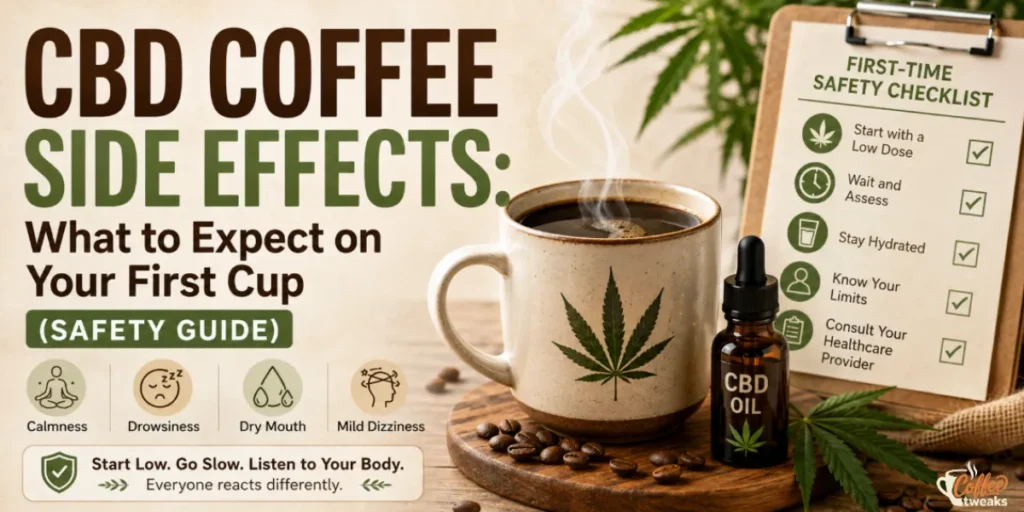
Most first-timers expect one of two extremes — either they're going to feel suddenly relaxed and zen, or the caffeine is going to hit them harder than ever. In reality, a significant number of first-time users feel almost nothing. Others notice mild dryness in the mouth, a subtle shift in how the caffeine lands, maybe a little dizziness if they drank it on an empty stomach.
The experience is rarely dramatic. And that's actually the honest answer most articles skip over.
What actually happens depends on your body weight, your liver enzyme activity, whether you've eaten, what medications you're on, and — crucially — how much actual CBD survived the brewing process. That last part is where things get interesting.
Let's go through all of it.
First Cup of CBD Coffee: What to Expect
CBD coffee side effects in most first-time users are mild. The most commonly reported effects include dry mouth, mild drowsiness, light dizziness, and occasional stomach upset. Some people notice that caffeine jitters are slightly reduced. A meaningful number of users notice nothing at all.
Serious effects are uncommon but possible — especially if you're on medications that use the same liver enzymes as CBD. Anyone on daily prescription medications should talk to a doctor before trying CBD coffee.
What Happens After Your First Cup?
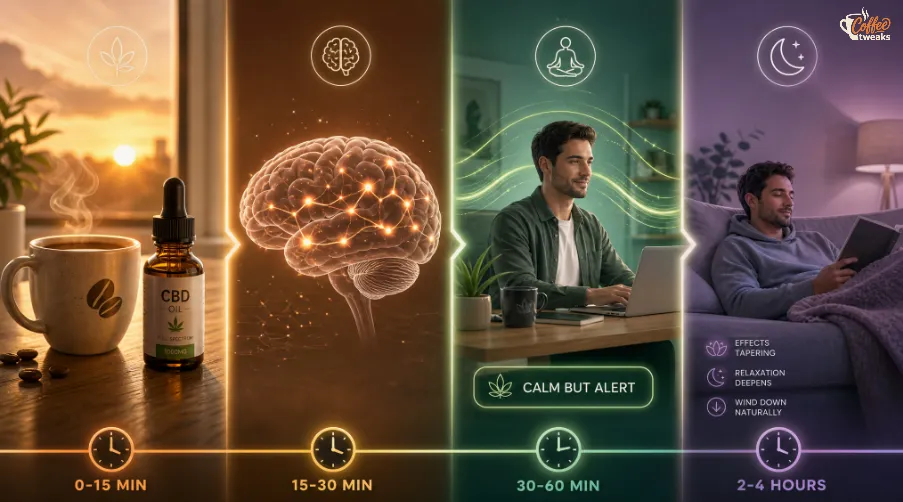
The timeline matters because CBD and caffeine work on different systems and at different speeds.
⌛ 0–15 Minutes
This is mostly just the caffeine beginning to act. Adenosine receptors in your brain start getting blocked, which is caffeine's main mechanism for keeping you alert. You may feel the warmth of the coffee, a slight uptick in heart rate, and the familiar early alertness of a morning cup.
CBD, at this point, has barely entered your bloodstream.
⌛ 15–30 Minutes
Caffeine is reaching peak absorption. If you're CBD-sensitive, this is when you may first notice something slightly different — a subtle smoothing of the caffeine edge. Some people describe it as less of a “spike” and more of a steady climb in energy. Others feel nothing different from a normal cup.
Any mild dry mouth typically starts here.
⌛ 30–60 Minutes
Both compounds are now active. This is the window where most first-time users either notice the combined effect or confirm to themselves that they feel nothing unusual. Possible experiences during this window:
⌛ 2–4 Hours
Effects from both compounds begin tapering. CBD has a half-life of roughly 18–32 hours in the body when taken regularly, but the perceptible effects of a single dose are much shorter-lived. Caffeine's half-life averages around 5 hours.
✅ What's normal: Mild fatigue as caffeine fades, feeling mostly back to baseline, slight thirst.
❌ What's not normal: Persistent heart palpitations past 2 hours, severe nausea, vomiting, extreme drowsiness, or confusion. If you experience any of these, contact a healthcare provider.
☕ The CBD Brewing Problem You Need to Know First
📊 Before discussing side effects in detail, there's a critical piece of research that completely changes how you interpret CBD coffee products.
A University of Connecticut study found that brewed CBD coffee contained 70–80% less CBD than the label claimed. The reason is basic chemistry: CBD oil is hydrophobic — it repels water. When hot water passes through CBD-infused grounds, it simply cannot extract the oil. The CBD stays bound to the grounds and goes down the drain.
What this means practically: if your bag claims 10 mg of CBD per serving, you may be consuming closer to 2–3 mg after brewing. This is why many first-time users feel nothing — they're simply not getting an effective dose. It also means that CBD-infused cold brew concentrates or CBD lattes where the oil is added directly to the finished liquid will deliver more actual CBD than dry-ground products.
⚙️ Ravi's Note: Always check the delivery format. Pods and pre-made lattes with CBD oil mixed into the liquid tend to be more effective than dry grounds with CBD coating. The label is often misleading. Read the small print carefully.
Most Common CBD Coffee Side Effects
Here's what the research and user experiences actually show, without the sales spin.
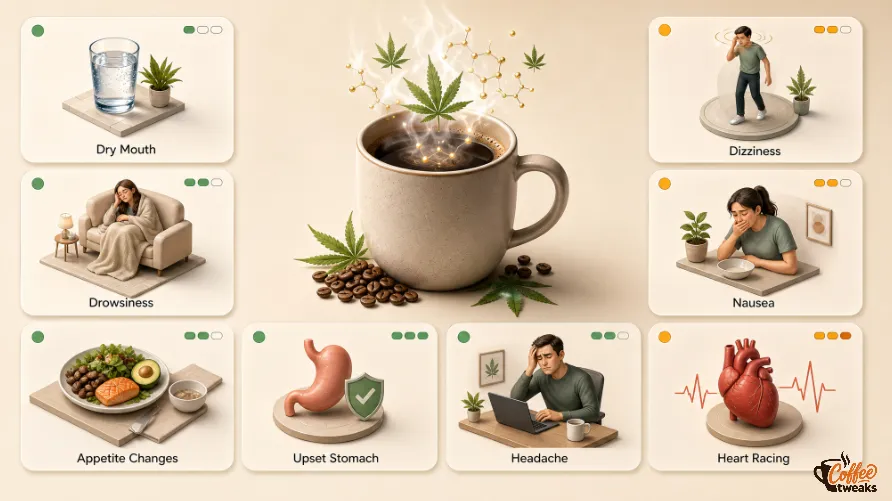
1. Dry Mouth
Likelihood: Moderate | Severity: Mild
This is CBD's most consistently reported side effect across clinical studies. CBD interacts with receptors in the salivary glands that regulate saliva production, temporarily reducing output. When you combine this with cafeine's mild diuretic effect, the dryness can be more noticeable than with either substance alone.
Fix: Drink water alongside your CBD coffee. Keep a glass nearby. It passes within an hour or two.
2. Drowsiness or Reduced Energy
Likelihood: Low to Moderate at typical doses | Severity: Mild
At low doses (under 10 mg), CBD is more commonly associated with alertness-support than sedation. At higher doses — particularly above 25 mg — sedative effects become more likely. The paradox is that caffeine in the same cup is actively working against drowsiness. The net effect for most people at typical CBD coffee doses is neutral to slightly calming.
If the brewed cup is delivering less CBD than the label claims (see above), drowsiness becomes even less likely.
When to be cautious: If you're also taking sleep medications, sedatives, or certain antidepressants, the drowsiness potential compounds significantly.
3. Dizziness or Light-Headedness
Likelihood: Low | Severity: Mild to Moderate
This typically happens for one of two reasons: you drank on an empty stomach, or the caffeine caused a temporary drop in blood pressure followed by rebound. CBD may contribute to mild blood pressure lowering in some individuals. The combination can occasionally cause a brief spell of light-headedness when you stand up quickly.
👉 Fix: Eat something first. If dizziness is persistent or severe, stop and sit down.
4. Nausea and Upset Stomach
Likelihood: Low to Moderate in sensitive individuals | Severity: Mild
Both caffeine and CBD independently can irritate the gastrointestinal tract in sensitive individuals. Coffee on an empty stomach already raises this risk. Adding CBD to the mix doesn't dramatically increase it, but for people who already find black coffee hard on their stomach, CBD coffee may be slightly worse.
Systematic reviews of oral CBD consistently list gastrointestinal upset among the more common reported adverse effects, alongside dry mouth and diarrhea.
5. Diarrhea
Likelihood: Low at typical doses | Severity: Mild
This side effect appears more frequently in higher-dose CBD studies — doses well above what most CBD coffee products claim to deliver. At the effective dose most people get from a brewed cup (likely 2–5 mg given the hydrophobic loss), diarrhea is unlikely unless you're individually sensitive.
6. Headache
Likelihood: Low | Severity: Mild
Counterintuitively, headaches from CBD coffee are usually caffeine-related, not CBD-related. If you're drinking CBD coffee in the afternoon and missing your usual morning caffeine dose, the headache is probably caffeine withdrawal. Dehydration (from the diuretic effects of coffee) is the other common trigger.
Pure CBD does not commonly cause headaches at low doses in clinical literature.
7. Changes in Appetite
Likelihood: Low | Severity: Mild
Unlike THC — which strongly stimulates appetite — CBD has a more complex and subtle effect on appetite regulation. Some users report slightly reduced appetite after CBD coffee. Others notice no change. The evidence on this is genuinely mixed and not robust enough to make a strong claim either way.
8. Feeling “Nothing”
Likelihood: High for first-time users | “Severity”: Not applicable
This deserves its own category because it's the most common first-time experience and the least discussed. Given the bioavailability issue with ground coffee products, a large proportion of first-time users simply won't feel any effect attributable to CBD. This is a completely normal outcome — not a sign something went wrong.
9. Anxiety from Caffeine
Likelihood: Moderate in caffeine-sensitive individuals | Severity: Mild to Moderate
Here's an important nuance: CBD on its own shows anxiolytic (anti-anxiety) potential in several clinical studies. However, if you're caffeine-sensitive, the stimulant effects of coffee can trigger anxiety, jitteriness, or a racing heart. No amount of CBD in the cup will fully counteract a dose of caffeine that your body doesn't tolerate well.
If you get anxious from regular coffee, CBD coffee is not a reliable solution. The caffeine is still caffeine.
10. Heart Racing
Likelihood: Low to Moderate depending on caffeine tolerance | Severity: Mild
In nearly all documented cases, elevated heart rate from CBD coffee is caused by caffeine, not CBD. CBD at standard doses does not typically increase heart rate. If your heart is racing after a cup, assess your caffeine intake first — one CBD coffee plus a pre-workout plus an energy drink is a caffeine stacking problem, not a CBD problem.
Why CBD and Coffee Feel Different Together
⚙️ This is the interesting part, and it's worth understanding clearly.
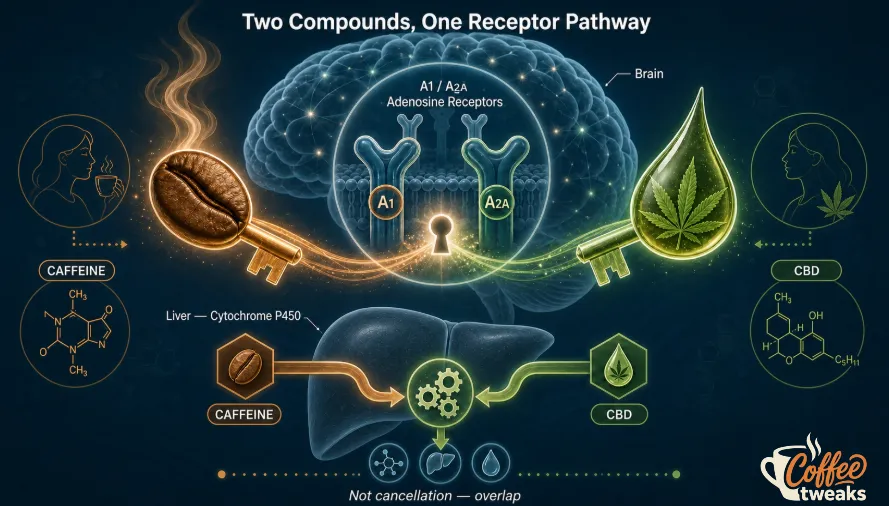
👉 Caffeine works primarily by blocking adenosine receptors in your brain. Adenosine is the compound that accumulates during waking hours and makes you feel progressively more tired. By blocking its receptors, caffeine keeps the sleepiness signal from landing — creating the familiar alertness effect.
👉 CBD interacts with the endocannabinoid system — a network of receptors (CB1 and CB2) throughout the brain and body that regulate mood, sleep, pain signaling, immune response, and more. CBD doesn't bind directly to these receptors the way THC does; it modulates them more indirectly. It also interacts with serotonin receptors (5-HT1A) which may partly explain its reported anxiolytic effects.
📊 There's an interesting intersection: animal research (in zebrafish models) suggests that CBD interacts with adenosine receptors — the exact same receptors caffeine targets. Specifically, CBD appears to have activity at A1 and A2A adenosine receptors.
This may be part of why some users report a smoother caffeine experience — not because CBD “cancels” caffeine, but because both compounds are operating on overlapping receptor pathways, potentially modulating how the caffeine signal is experienced.
The liver adds another layer. Both CBD and caffeine are metabolized through the liver's cytochrome P450 enzyme system. When you consume both simultaneously, they're competing for the same metabolic pathways. This can slow down how quickly caffeine is processed — which may extend its effects, reduce peak intensity, or do very little depending on your specific enzyme expression.
⚙️ Ravi's Note: This is also the core reason why CBD coffee can interact with medications. More on this in the interactions section.
Who Should Avoid CBD Coffee?
Some categories carry meaningful risk, not just theoretical caution.
CBD Coffee Medication Interactions
⚙️ This section is the most medically important part of this guide. Please read carefully.
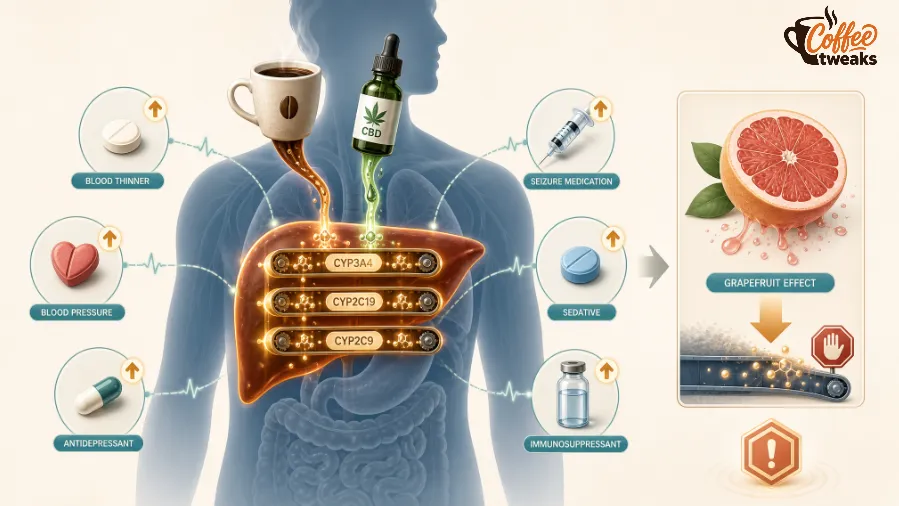
CBD is metabolized primarily through CYP3A4 and CYP2C19 liver enzymes, with additional involvement from CYP2C9. Research published as recently as 2026 confirms that CBD acts as a potent inhibitor of these enzymes — meaning it slows down the metabolism of other drugs that use the same pathways.
What this means in plain terms: if your medication is broken down by these liver enzymes, adding CBD slows that breakdown, causing higher drug levels in your blood than intended. This is the grapefruit juice effect — and it applies to a wide range of common medications.
Medications with Documented Interaction Risk
| Drug Category | Examples | Concern |
|---|---|---|
| Blood thinners | Warfarin, apixaban | CBD elevates warfarin levels — increases bleeding risk |
| Anti-epileptics | Valproate, clobazam | CBD + valproate: liver toxicity risk; used in Epidiolex trials, requires monitoring |
| Sedatives/sleep medications | Benzodiazepines, zolpidem | Additive sedation, potential over-sedation |
| Antidepressants | SSRIs, TCAs | Increased plasma levels; altered mood regulation |
| Blood pressure medications | Amlodipine, nifedipine | Additive BP lowering effect |
| Immunosuppressants | Tacrolimus, cyclosporine | Significantly increased drug levels — serious risk |
| Statins | Atorvastatin | Increased statin levels; muscle-related side effects |
📊 CYP3A4 is responsible for metabolizing approximately 50% of all pharmaceuticals. CYP2C9 and CYP2C19 handle another significant portion.
CBD's inhibition of all three is now confirmed across multiple peer-reviewed systematic reviews through 2026. The clinical magnitude of these interactions at low CBD coffee doses (2–5 mg effectively delivered after brewing) may be small, but for narrow therapeutic index drugs like warfarin, even small changes matter.
⚠️ Strong Medical Disclaimer: If you take any prescription medication, consult your prescribing physician or pharmacist before using CBD coffee. This is not optional caution — it's a genuine interaction risk with documented clinical consequences.
How Much CBD Coffee Should Beginners Drink?
📊 There are no official regulatory guidelines for CBD dosing in coffee. The FDA has not approved CBD in food and beverages (outside of prescription Epidiolex). Everything below is based on clinical research patterns and practical harm-reduction logic.
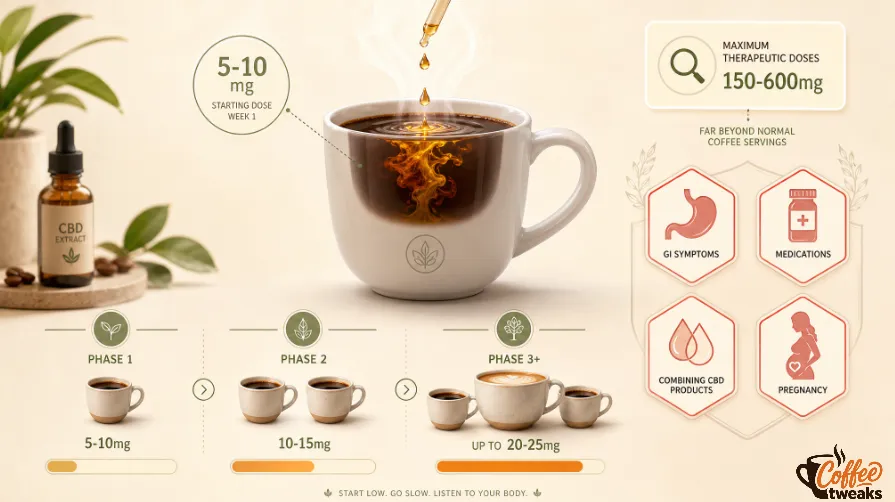
Starting point for beginners: 5–10 mg of CBD per cup (as labeled)
Given the 70–80% bioavailability loss in brewed ground coffee products, your effective dose from a labeled “10 mg” serving may be closer to 2–3 mg. For a CBD latte or cold brew with CBD oil directly added: the full labeled dose is more likely to be delivered.
| Phase | CBD Amount (as labeled) | Notes |
|---|---|---|
| Week 1 (first cup) | 5–10 mg | Drink one cup, wait 2 hours before assessing |
| Week 2 | 10–15 mg | Increase only if week 1 was well tolerated |
| Week 3+ | Up to 20–25 mg | General consumer ceiling for food products |
When NOT to increase:
Most clinical studies observing therapeutic effects in anxiety and sleep disorders use doses significantly higher (150–600 mg/day) than what any CBD coffee product delivers. The “relaxation effects” marketed to consumers are operating at doses where evidence is genuinely limited.
The numbers on the label are rarely what you're getting. Start low, not because of dramatic risks, but because it gives you a clean baseline for your own experience.
Signs You Took Too Much
Most CBD coffee products simply won't deliver a large enough dose to cause serious problems. But in cases where CBD oil is added directly to the drink (not brewed through grounds), or where you've stacked multiple CBD products, here's what to watch for.
Uncomfortable but not dangerous:
Potentially concerning — contact a healthcare provider:
CBD in isolation does not cause fatal overdose in humans. The WHO's 2019 Critical Review Report concluded that CBD has a “good safety profile” and “does not appear to have abuse potential.” However, the caffeine component, drug interactions, and individual liver sensitivity are genuine risk factors that shouldn't be minimized.
How to Reduce Side Effects
These are practical, evidence-adjacent strategies — not marketing-speak.
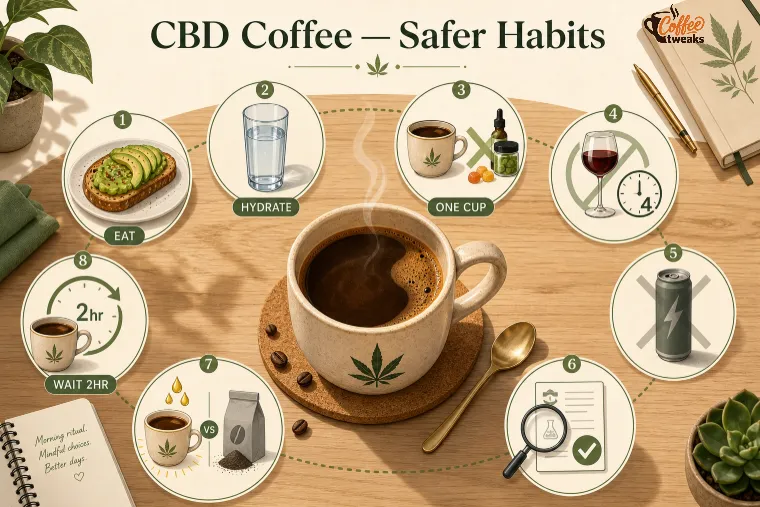
Does CBD Coffee Make You High?
No. CBD and THC are different molecules with very different effects.
THC (tetrahydrocannabinol) is the compound that causes the intoxicating “high” associated with cannabis. It activates CB1 receptors in the brain directly and potently. CBD does not do this. It interacts with the endocannabinoid system differently — modulating rather than directly activating CB1 receptors — and produces no intoxicating effect.
Hemp-derived CBD products sold legally in most markets must contain less than 0.3% THC by dry weight. At these concentrations, and at typical CBD coffee serving sizes, there is no THC dose sufficient to cause intoxication.
📊 Regarding drug testing: pure CBD isolate does not typically produce a positive THC test on standard roadside or workplace immunoassay tests. However, full-spectrum CBD products (which contain trace THC alongside other cannabinoids) carry a small risk of positive results, particularly with heavy daily use. Broad-spectrum CBD or isolate-based products are lower risk for this.
If drug testing matters for your job or safety, check whether your CBD coffee uses isolate, broad-spectrum, or full-spectrum CBD. The label or CoA should state this clearly.
Is CBD Coffee Safe?
The honest, balanced answer is: probably fine for most healthy adults at the doses typically delivered by commercial products, with some meaningful caveats.
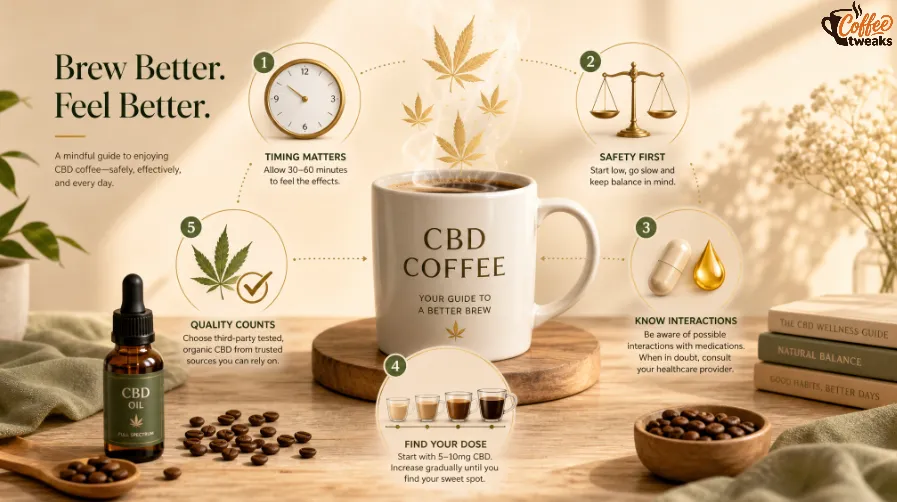
The WHO concluded that CBD “is generally well tolerated with a good safety profile” — but their review was based on studies where doses were far higher and more controlled than what any coffee product delivers.
The FDA has approved exactly one CBD product as a medication (Epidiolex for epilepsy) and does not currently approve CBD in food or beverages, citing insufficient safety data at population scale.
📊 The evidence picture in 2026:
The gap between what consumers experience and what clinical studies measure is enormous. Most CBD coffee delivers 2–5 mg of effective CBD. Most therapeutic studies use 150–600 mg. The wellness effects marketed to consumers haven't been demonstrated at the doses those consumers are actually receiving.
That doesn't make CBD coffee harmful. It makes the claimed benefits unproven at the doses involved — which is a meaningfully different thing.
⚙️ Ravi's Pre-Cup Safety Checklist
Before your first cup, go through this quickly:
Myth vs. Fact
| Myth | Fact |
|---|---|
| “CBD cancels out caffeine” | They interact at overlapping receptor systems, but neither fully cancels the other |
| “CBD coffee will definitely relax you” | Many users feel nothing; effect is individual and dose-dependent |
| “More CBD in the label = more CBD in your cup” | Brewing loses 70–80% of CBD from infused grounds |
| “CBD coffee is FDA approved” | No CBD food/beverage products are FDA approved |
| “CBD coffee can get you high” | CBD is non-intoxicating; hemp-derived products contain negligible THC |
| “Any side effects are CBD's fault” | Most side effects from CBD coffee (heart racing, anxiety, GI issues) are caffeine-driven |
| “CBD is completely safe for everyone” | It has real drug interactions and documented liver effects at higher doses |
Frequently Asked Questions
Can CBD coffee make you anxious?
The CBD component is unlikely to cause anxiety — it shows anxiolytic potential in clinical research. However, the caffeine in coffee absolutely can, particularly if you're caffeine-sensitive. If regular coffee makes you anxious, CBD coffee is unlikely to solve this. The caffeine dose isn't neutralized by CBD.
Can CBD coffee make you sleepy?
At typical CBD coffee doses (especially post-brewing loss), sedation is uncommon. At higher doses, CBD has sedative potential. If you're taking sedating medications alongside, the risk compounds. Most standard CBD coffee products are unlikely to cause significant sleepiness in healthy adults.
How long do CBD coffee side effects last?
The most common side effects — dry mouth, mild dizziness, and light GI discomfort — typically resolve within 1–3 hours. CBD's active presence in your system can last 4–6 hours from a single dose. Any caffeine-driven effects follow the caffeine timeline (half-life of approximately 5 hours).
Can I drive after CBD coffee?
For most people, one standard-dose CBD coffee won't impair driving ability. The caffeine may actually improve alertness. However, if you feel any dizziness, unusual drowsiness, or impairment, do not drive. In jurisdictions where cannabis testing is legal at roadside, pure CBD should not trigger a THC positive, but full-spectrum products with trace THC carry a small risk.
Can CBD coffee show up on a drug test?
Pure CBD (isolate or broad-spectrum) is very unlikely to cause a positive THC test at typical doses. Full-spectrum CBD products containing trace THC are a different story — cumulative daily use may cause THC metabolites to accumulate in the body and trigger a positive test. Check your product's CoA for THC content.
Can I drink CBD coffee every day?
Current evidence suggests low-dose CBD is tolerated daily by most healthy adults in the short term. Long-term safety data is limited. Daily use combined with daily medications is the scenario with the most caution warranted. The WHO's safety profile assessment and most clinical research covers weeks to months — not years.
Can I mix CBD coffee with medications?
This requires direct input from your pharmacist or prescribing doctor, not an article. CBD inhibits CYP3A4, CYP2C9, and CYP2C19 — enzymes that metabolize a wide range of medications. The interaction risk is real and drug-specific. Don't rely on generic guidance here.
Can CBD coffee upset my stomach?
Yes, particularly if you drink it on an empty stomach. Both caffeine and CBD independently carry GI upset risk. Eating first, staying hydrated, and starting with a lower-labeled-dose product all reduce this risk.
What happens if I drink too much CBD coffee?
Two or three cups of CBD coffee in a day is more likely to cause a caffeine problem (anxiety, heart racing, sleep disruption) than a CBD problem at typical commercial doses. Symptoms of genuine CBD excess — heavy sedation, GI distress, liver stress — require doses well above what brewed coffee delivers. Still, stacking multiple CBD products on top of CBD coffee can compound risk.
Does CBD cancel caffeine?
No. There's evidence of interaction at shared receptor systems (adenosine receptors in particular) and shared liver enzyme pathways, which may slightly moderate caffeine's peak intensity for some people. But caffeine is still active, still stimulating, and still capable of causing all its usual effects. CBD modulates; it doesn't cancel.
Does CBD coffee affect blood pressure?
Caffeine causes a temporary blood pressure increase. Some research suggests CBD may have mild blood pressure lowering properties. In healthy individuals, these may partially offset. In people on antihypertensive medications, the blood pressure effects of CBD may add to the drug's effect and cause it to drop too low.
Should I eat before CBD coffee?
Yes. Eating reduces GI irritation risk, lowers the chance of dizziness from blood pressure shifts, and — here's an interesting detail — fat-containing food significantly improves CBD bioavailability when CBD is directly consumed in liquid form (not brewed). If you're drinking a CBD latte with the oil mixed in, eating a meal with some fat actually helps.
Can beginners drink CBD coffee safely?
Most healthy adults with no significant medical conditions and no prescription medications can try CBD coffee with minimal risk. Following the checklist above substantially reduces the likelihood of side effects. Managing expectations matters: many first-timers feel nothing, and that's completely normal.
Can CBD coffee cause headaches?
Rarely. Headaches associated with CBD coffee are typically caused by caffeine (particularly afternoon consumption affecting sleep, or dehydration). CBD itself is not a consistent headache trigger at low doses. If you're regularly getting headaches after CBD coffee, examine caffeine timing and hydration before attributing it to the CBD.
Is CBD coffee stronger than CBD oil?
In most cases, no — significantly weaker. CBD oil drops taken sublingually bypass the brewing problem entirely and deliver full-dose CBD directly to the bloodstream. CBD coffee brewed through infused grounds delivers roughly 20–30% of the labeled dose after accounting for hydrophobic loss. CBD oil offers more precise, reliable dosing.
First-Time User Realistic Expectations
Here's the honest picture for someone about to try their first cup.
The wellness industry tends to either dramatically oversell CBD coffee as transformative or dramatize its risks for clicks. The evidence sits in a much quieter, less exciting middle ground: a low-dose, mildly interesting combination with some biologically plausible mechanisms, limited clinical proof of wellness effects at the doses delivered, and a reasonable safety profile for most healthy adults who aren't on medications.
That's the honest answer. Make your own call from there.
⚙️ Ravi Santos is an equipment and origins specialist with an engineering background from Goa. His work focuses on brewing science, equipment analysis, and evidence-based coffee education.