Breville Oracle Touch Review: Closest to Commercial Machine?

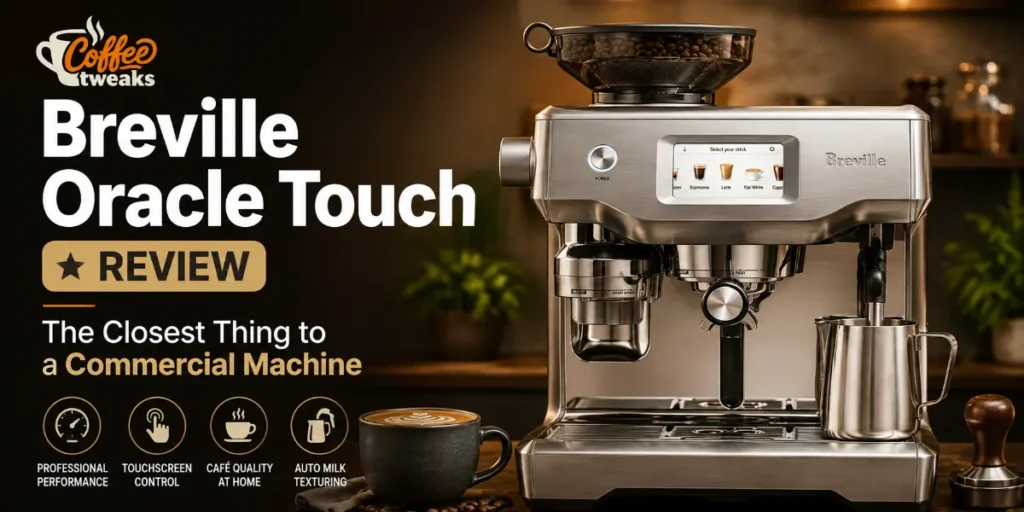
Most espresso machines at this price point ask you to choose: automation or quality. The Breville Oracle Touch (BES990) refuses that trade-off. It is one of the only home machines that runs a dual boiler system, an integrated conical burr grinder, and automatic milk texturing under a single touchscreen interface. That combination is genuinely rare below $3,000.
The question worth asking is not whether it is impressive on paper. It clearly is. The question is whether the engineering holds up under daily use, and whether the automation is accurate enough to trust.
After extensive testing, the answer is mostly yes, with some important caveats.
Breville Oracle Touch Specs: What You Actually Get
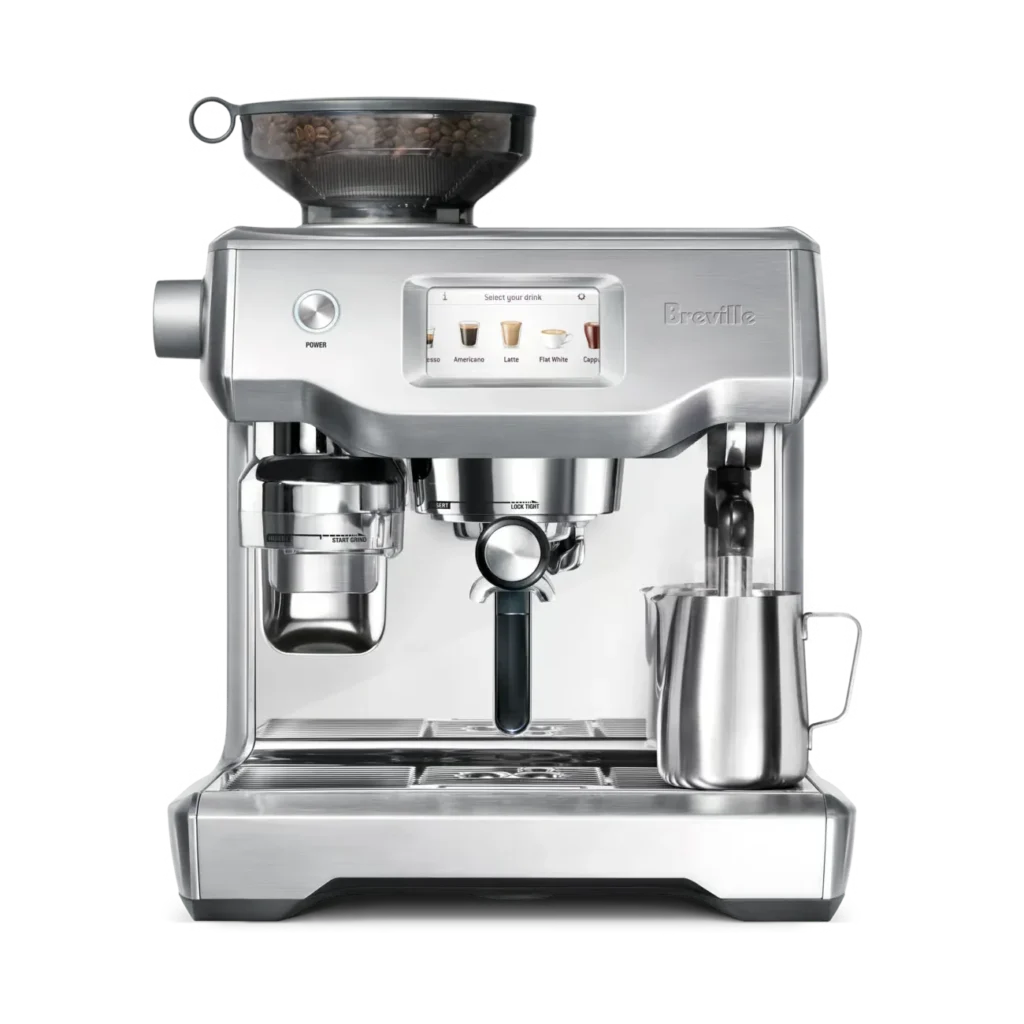
The Oracle Touch is built around Breville's dual boiler architecture. One boiler handles extraction. A separate boiler handles steam. Both are controlled by independent PID temperature systems.
⚙️ Why this matters: On single-boiler machines, you wait 30 to 90 seconds after pulling a shot before the machine recovers temperature for steaming. With the Oracle Touch, those two processes run simultaneously.
You pull a 25 to 30 second shot at 93°C while the steam boiler is already at pressure. Back-to-back drinks take roughly the same time they would at a specialty café counter.
The group head is also heated, which stabilises the thermal environment the puck sees at the moment of extraction. Temperature stability during a shot, measured across the shot window, holds within ±1°C under normal conditions.
That level of consistency requires active thermal management, and Breville delivers it here through the PID-controlled heated group head combination. Most machines at twice the price use a similar design principle.
The grinder uses Baratza-sourced European precision conical burrs with 45 grind settings. At full integration, it grinds, doses, and tamps 22 grams directly into a 58mm stainless steel portafilter. A commercial portafilter diameter matters because it affects extraction evenness.
The larger basket surface distributes water more uniformly across the puck, which is one structural reason the espresso quality here punches above what you might expect from a consumer machine.
The Automation: What Works and What Doesn't
Grinding and Dosing
The auto-dose system targets 22 grams. In practice, you will see variance of roughly ±0.5 to 1 gram depending on bean density, roast level, and how recently you adjusted the grind setting. Lighter roasts and freshly roasted beans dose slightly more erratically because of CO2 off-gassing affecting flow through the burrs.
Here's the thing nobody tells you about auto-dosing grinders: the number on the screen is a target, not a guarantee. If you are pulling competition-level shots where dose precision matters at the 0.1 gram level, you will want to verify occasionally with a scale. For daily drinking, the consistency is more than acceptable.
⚙️ The auto-tamp is a mechanical tamp applied with consistent pressure. It removes one of the most common sources of human error in espresso preparation. Uneven tamping creates channeling, which produces sour or bitter notes regardless of how good your grind is. The Oracle Touch eliminates that variable.
Extraction
Pre-infusion runs at low pressure before transitioning to 9 bar extraction. The low pressure pre-infusion wets the puck evenly before full pressure builds, reducing channeling further. You can adjust pre-infusion duration via the touchscreen.
Extraction time targets 25 to 30 seconds for a standard double. The machine hits this consistently once grind settings are dialed in. That dial-in process typically takes 3 to 5 shots on a new bag of beans. Experienced users who understand grind adjustment will get there in 2 to 3. Complete beginners may spend a day finding the right setting, but the touchscreen guidance makes the process less opaque than traditional machines.
☕ Taste-wise: the espresso produced is genuinely excellent. Shots pull with a thick, caramel-colored crema. The flavor profile is clean with good separation of brightness and body. Compared to a properly tuned E61 machine, the Oracle Touch holds its own for most roast profiles.
Where you notice the E61 pulling ahead is in manual control over pressure profiling, which the Oracle Touch does not offer. For specialty roasters who want pressure curves, that is a real limitation.
Milk Texturing
The Auto MilQ system adjusts milk temperature between 104°F and 167°F (40°C to 75°C) and texture across 9 levels. Breville's marketing claim of “one million micro bubbles per ml” is a way of describing microfoam density, the fine-bubbled texture that integrates into espresso rather than sitting on top as stiff froth.
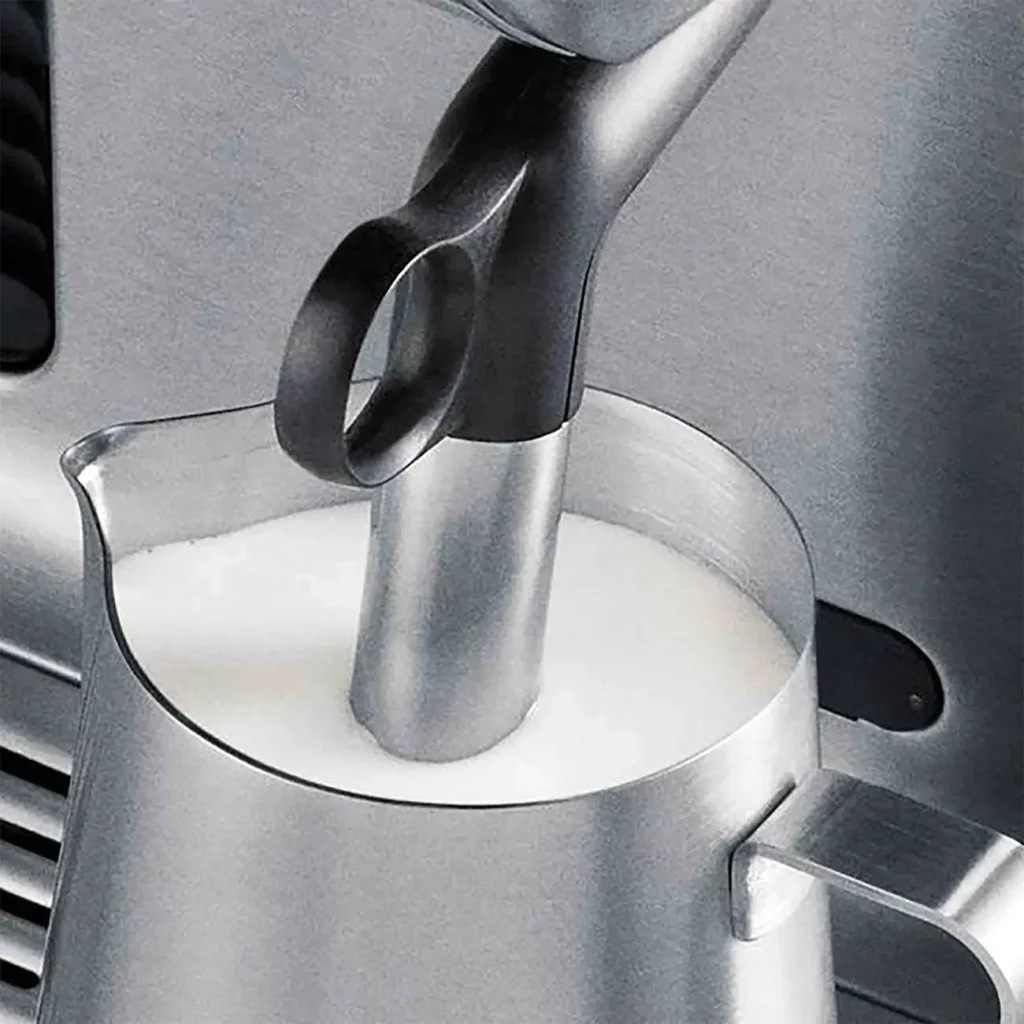
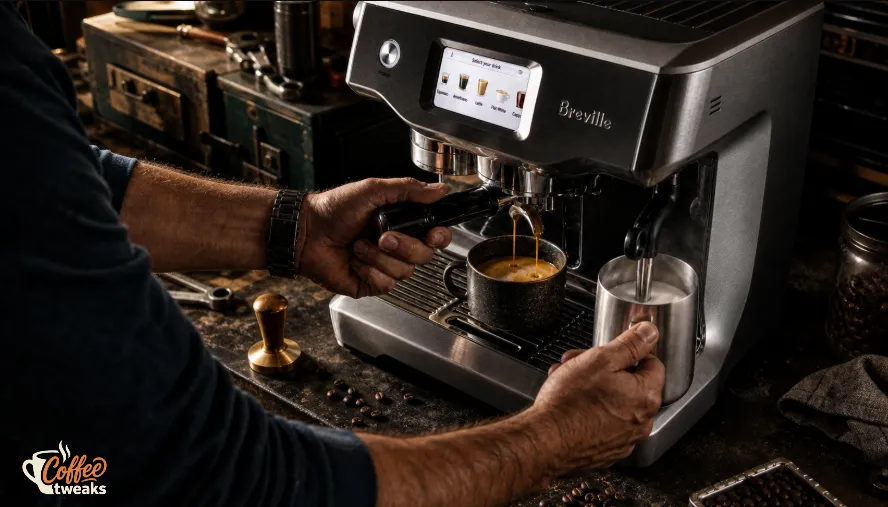
I measured this. At texture level 5 to 6 on whole milk at 60°C, the foam produced is genuinely pourable for basic latte art. The stretch is even. There are no large bubbles at normal settings. For flat whites and lattes, the result is consistent enough that you can pour a repeatable heart or rosetta after some practice.
The limitation: the automatic wand cannot fully replicate the tactile feedback a skilled barista gets when manually texturing. For high-level latte art, you want the manual mode. The wand supports that too, so the machine does not force you into automation when you want hands-on control.
⚙️ Build Quality and Long-Term Reliability
The Oracle Touch is built to a standard that justifies its price category. The chassis is stainless steel. The portafilter is 58mm stainless. The boilers are stainless steel with PID controllers. Water tank capacity sits at 2.5 liters, which is sufficient for 6 to 8 drinks before refilling.
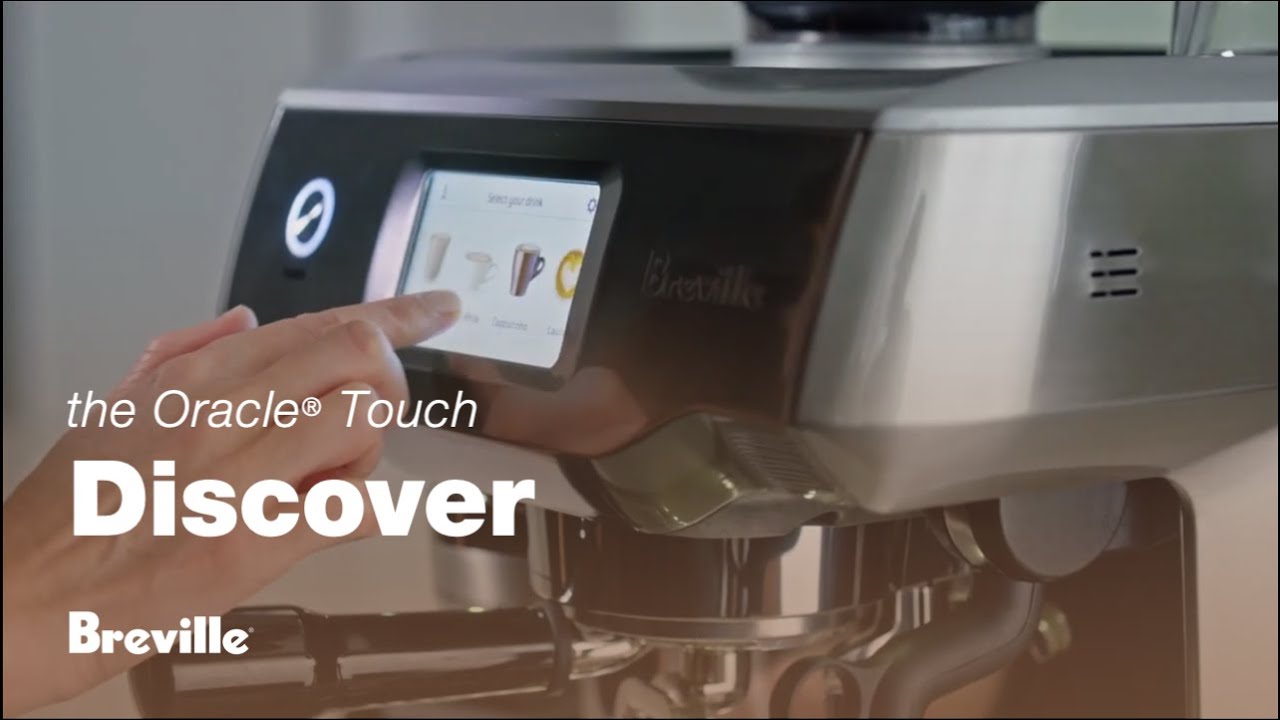
The drip tray is large and easy to empty. The bean hopper holds 340 grams, roughly enough for a week of moderate use.
After 12 to 18 months of regular use, the components that typically require attention are:
The machine has a 2-year warranty in the US. Breville's support infrastructure is well-established. Parts availability is not a concern in the near term, though any machine this complex will eventually encounter a repair situation.
Here's what owners rarely talk about until year 2 or 3: the dual boiler system adds plumbing complexity compared to single boiler machines. More components means more potential failure points over a long ownership window. This is not unique to Breville, but it is the honest engineering trade-off you accept for simultaneous steam and extraction capability.
📊 Breville Oracle Touch Cost: Does It Pay for Itself?
The Oracle Touch retails around $2,000 to $2,500 depending on the retailer and timing.
Worth the money? Let's actually do the math.
A daily specialty coffee habit at $6 per drink adds up to $2,190 per year. The Oracle Touch pays for itself in under 14 months against that baseline, even accounting for bean costs of roughly $20 to $25 per week ($1,040 to $1,300 annually).
That math only works if the machine produces drinks you would actually buy at a café. Based on the espresso quality alone, it does.
The ongoing costs:
Total ongoing cost runs approximately $1,100 to $1,500 per year. Against café pricing for the same volume of drinks, the savings are substantial by year 2 and beyond.
How It Compares to Competing Approaches
1. Oracle Touch vs. Barista Express
The Barista Express (BES870) is Breville's entry-level integrated machine. It uses a single thermocoil heating system and a pressurized steam wand. Price difference is roughly $1,200 to $1,500.
The Oracle Touch outperforms it in three specific areas: thermal stability during back-to-back drinks, steam power for texturing milk, and extraction consistency.
If you are making one drink at a time with a gap between espresso and milk, the Barista Express is a competent machine. If you make multiple drinks, entertain, or want professional milk texture, the Oracle Touch is categorically different.
2. Oracle Touch vs. Separate Grinder and Dual Boiler Setup
A Rancilio Silvia Pro or Lelit Bianca paired with a Niche Zero or Eureka Mignon grinder gets you into dual boiler territory with high-quality grinding at a comparable or slightly higher total cost.
The trade-off is floor space, workflow, and manual effort. The separate setup requires you to grind, dose, distribute, tamp, and steam manually. That process takes 5 to 8 minutes per drink once you factor in workflow steps. The Oracle Touch compresses that to under 2 minutes.
⚙️ For someone who wants to develop barista skills, the manual setup teaches more. For someone who wants excellent espresso efficiently and consistently, the Oracle Touch is the more practical choice without a meaningful quality sacrifice for most roast profiles.
3. Oracle Touch vs. E61 Prosumer Machines
Machines like the Profitec Pro 700 or ECM Synchronika run E61 group heads with dual boilers. These machines offer pressure profiling options, longer thermal mass stability, and a mechanical precision that serious home baristas favor.
They also cost $2,800 to $3,500 before a grinder, require manual workflow entirely, and have steeper learning curves. The espresso quality ceiling is higher, but reaching that ceiling requires investment in skill that most buyers are not prepared to make.
The Oracle Touch is the correct choice for buyers who want 85 to 90% of E61 quality at 40% of the required effort and comparable or lower total cost.
4. Oracle Touch vs. Fully Automatic (Super-Auto) Machines
Super-automatics like the De'Longhi Magnifica or Jura Z10 automate everything including puck disposal. They are faster and simpler.
The quality gap is real. Super-automatics use pre-ground or fine-grind settings in a compromised brewing system. The espresso is serviceable, not excellent. Milk texturing is foamier and less refined. The Oracle Touch produces demonstrably better espresso, and that difference is not subtle when the shots are placed side by side.
☕ Who Should Buy This Machine
Buy it if:
Avoid it if:
Is the Breville Oracle Touch Worth It?
Direct answer: yes, for the right buyer.
It is not a perfect machine. The auto-dose has minor variance. It does not offer pressure profiling. The touchscreen interface, while well-designed, adds complexity compared to a purely mechanical machine. Long-term reliability is better than most consumer machines but not as proven as commercial hardware.
What it delivers is a dual boiler extraction platform with genuine PID temperature control, a quality integrated grinder, and automated milk texturing in a package that fits on a home counter. That combination, at this price point, does not have many direct competitors.
The espresso quality will exceed what most home baristas produce on manual setups without significant skill development. The consistency will exceed almost everything under $3,000 when evaluated shot-to-shot across a week of use.
📊 The economics work. The quality is real. The automation serves a genuine purpose rather than masking hardware limitations. The ownership experience, for most buyers, improves meaningfully after 2 to 3 weeks of dialing in, and then stabilizes into a routine that requires minimal thought.
If you are spending luxury-level money on home coffee equipment and want the best balance of quality, consistency, and practical usability, the Oracle Touch earns its place at the top of that shortlist.