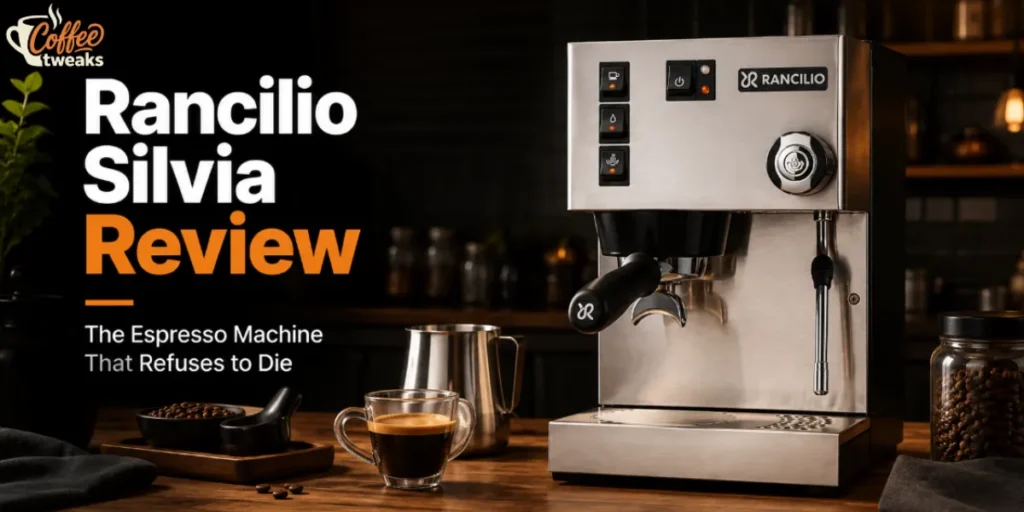
Rancilio Silvia Review: The Espresso Machine That Refuses to Die

Real talk.
Most espresso machines age out before they wear out. The software gets abandoned. The proprietary parts disappear. The company quietly discontinues the model and releases a “next generation” version that costs more and does less. Five years later, you're on a forum begging strangers for a replacement heating element that no longer exists.
The Rancilio Silvia launched in 1997. It is still in production. Still in essentially the same form factor. Twenty-year-old versions are selling used for $400 to $500 because buyers know exactly what they're getting. That is not brand loyalty. That is a track record.
Here's the thing. The Silvia has no PID. No touchscreen. No app. The thermostat is a two-point mechanical switch. The design is unapologetically boxy. It looks like a machine that was built to work, not to impress someone scrolling Instagram.
And it still outperforms the majority of “smart” machines under $1,000 on every metric that actually matters: shot quality ceiling, long-term reliability, repairability, and real-world cost over a decade of ownership.
I've been wrong before. Not about this.
Rancilio Silvia Specs That Actually Matter
Let me get the specs down so we can talk about what they mean in practice.
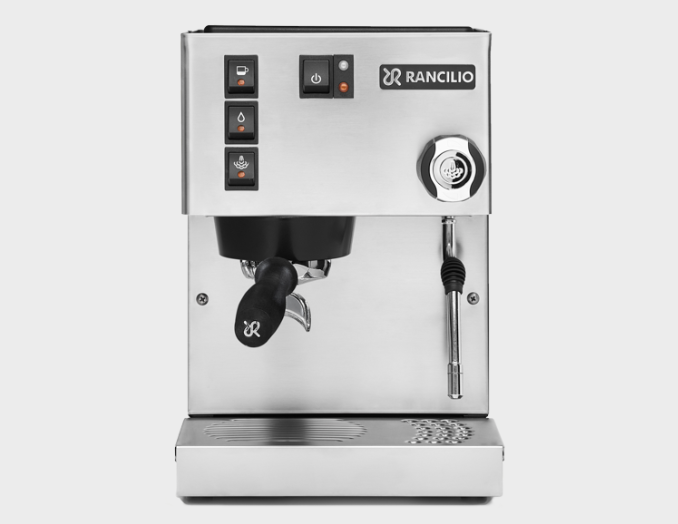
Single-group, single-boiler home espresso machine. 235mm wide, 340mm tall, 290mm deep. Weighs 14kg. That weight matters, I'll explain why in a moment. The 2-litre water reservoir feeds a 0.3-litre brass boiler. Single vibration pump.
Manual temperature regulation via thermostat. Chrome-plated brass portafilter supporting baskets up to 21g. Stainless steel steam wand and steam knob. Available in stainless steel, black, white, and sage green.
On paper, nothing spectacular. In practice, the materials behind those numbers are the whole story.
Why This Machine Is Still Alive After 30 Years
Rancilio built the Silvia to work. Not to sell. Those are different priorities and they produce different machines.
The brass brewing group is the foundation. Brass has exceptional thermal mass. Once it's at operating temperature, it holds heat with a consistency that aluminum components cannot match. Aluminum heats faster, which looks impressive in a spec sheet. But it sheds heat faster too, which means every shot is pulled at a slightly different temperature unless there's active temperature control compensating.
The Silvia's brass group acts as a thermal buffer. It absorbs and redistributes heat across the extraction cycle in a way that produces measurably more stable shots once you understand the warm-up requirements.
The 0.3-litre brass boiler works on the same principle. When cold brew water enters, the temperature drop is smaller and recovery is more predictable than smaller, higher-wattage aluminum alternatives. Experienced owners who have run both report that the Silvia produces more repeatable shots in real daily use once they've internalised the workflow. That's not a coincidence. That's thermodynamics.
The 58mm chrome-plated brass portafilter is a commercial-standard size. Every third-party precision basket, every distribution tool, essentially every aftermarket component designed for professional machines fits this grouphead.
The accessory and parts ecosystem is enormous. When Rancilio eventually stops manufacturing the Silvia, and that day will come, the 58mm commercial supply chain will still be producing compatible components for another twenty years.
The 14kg weight. Some buyers see that as a negative. It is not. That weight is metal. You can lock the portafilter in one-handed without bracing the machine. You can slam the portafilter home at 6am half-awake and the machine does not move. Small thing. Real thing.
The vibration pump is where the commercial parallel ends. Commercial machines run rotary pumps because they're quieter, more consistent, and rated for volume. Silvia's vibration pump is standard for this category and performs adequately. It's louder than rotary alternatives and pressure varies slightly across pulls. Not a dealbreaker. Just worth knowing.
Espresso Quality: What You Can Realistically Expect
The Silvia can produce exceptional espresso. I mean that without qualification. But “can” is doing serious work in that sentence.
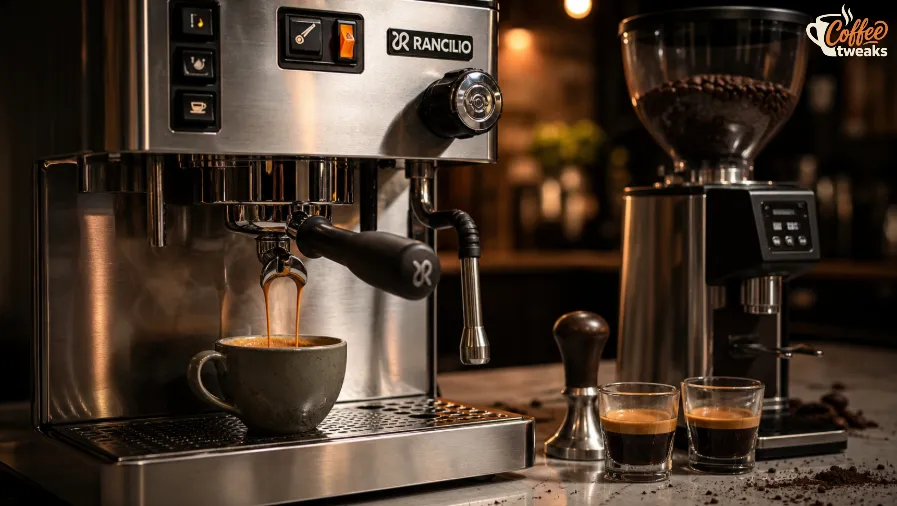
What actually comes out of the portafilter depends almost entirely on two things: your grinder and your skill. The machine is not the limiting factor at this price point. It has enough thermal stability, enough pressure consistency, and enough extraction potential to produce shots that would embarrass machines costing twice as much, assuming everything upstream is dialed in.
A properly dosed, properly distributed, properly ground shot through a quality basket on the Silvia produces espresso with defined body, clean sweetness at the finish, and crema that actually holds.
The flavor clarity, where you can taste the fruit or chocolate character of a well-developed bean rather than just a generic “coffee” note, is present in a way that pressurised-basket beginner machines completely mask. That separation is the point. That's what you're buying this machine for.
Temperature behavior is where beginners hit their first wall. The two-point thermostat cycles on and off across a temperature range. Where in that cycle you pull determines your extraction temperature. Too hot: bitter, hollow finish. Too cool: sour, underdeveloped, no sweetness. This is real and it requires learning.
Temperature surfing, timing your pull to catch the thermostat at the right point in its cycle, sounds complicated. It takes a few weeks to internalise. Once you have it, you stop thinking about it. But the first few weeks can produce inconsistent results that make some beginners question the machine before they've actually given it a fair run. I've seen that happen. It's frustrating to watch because the machine isn't the problem.
If thermostat management genuinely bothers you, a PID kit is a well-documented and widely available modification for the Silvia. It brings temperature precision in line with machines at significantly higher price points. Not required. But available.
Pressure at the puck runs at the standard 9 bars. You won't get pressure profiling. You won't get the nuanced pre-infusion ramps of a La Marzocco. You will get honest, predictable extraction that responds directly to your dose, grind, distribution, and technique choices. For most home baristas, that's everything they need.
Rancilio Silvia Build Quality Is Its Biggest Advantage
Can the Silvia last 15 to 20 years?
Yes. And there's a documented record to prove it.
Silvia V1 and V2 machines from the early 2000s are still in daily operation. Not displayed on shelves. Daily drivers. That lifespan is nearly unheard of for any consumer kitchen appliance in 2026. It is specifically because the construction is metal throughout, stainless steel housing, brass boiler, brass group, rather than plastic shells over cheap frames.
Repairability is the Silvia's most underrated quality and it gets almost no attention in standard reviews. Every component is user-serviceable. The boiler, heating element, thermostat, pump, solenoid, steam valve, all accessible with basic hand tools. Replacement parts are available from multiple suppliers.
The service documentation has been shared so thoroughly in the home barista community it's effectively public. You do not need a repair technician. You need fifteen minutes and a screwdriver.
That matters enormously when you're thinking past the purchase. The average modern “smart” espresso machine has a real-world lifespan of four to seven years before parts support disappears and the manufacturer's support line stops returning calls. The Silvia V2 from 2003 still has parts available in 2026. That gap in long-term ownership cost is not small.
The V6, which is the current production model, addressed a handful of genuine weak points from earlier versions. The steam wand is now full stainless steel replacing the chrome-over-brass version that peeled with age. The group head cover was updated.
The included tamper is now solid metal rather than the plastic unit that every previous owner immediately discarded. None of these changes touch core espresso performance. They do address components that were the known failure points of older versions. Refinements, not reinvention.
Steam Performance: Honest Numbers
The steam wand is strong for a single-boiler machine. The 0.3-litre brass boiler at full pressure produces meaningful, sustained steam that can stretch milk properly once you have technique.
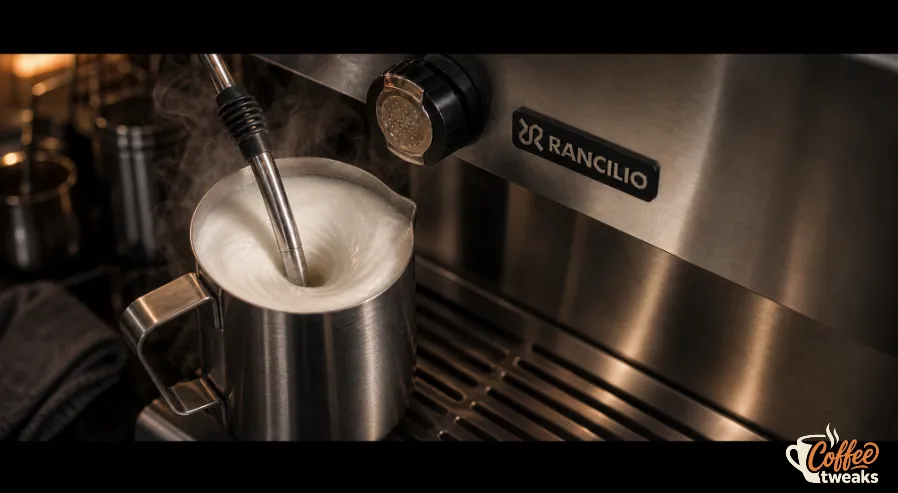
The honest limitation is transition time. Brew temperature to full steam pressure takes approximately 90 seconds to 2 minutes. That wait is part of the workflow. It is not negotiable. It is physics. If you are making a double espresso immediately followed by a latte, you are waiting between those two steps.
At full steam pressure, microfoam quality is genuinely good. The single-hole tip requires more wand movement than multi-hole commercial tips, which means it demands more technique.
Low-key obsessed with this one feature, actually, because that single hole forces you to develop the wrist movement and pitcher positioning that produces proper stretched milk rather than the aerated froth that beginners mistake for microfoam. It's a steeper learning curve but a better outcome.
The wand produces milk suitable for proper latte art with practice. Not café-competition-level, but clean, glossy, rolled microfoam that pours well. For one or two milk drinks per session, it delivers. For a household running five consecutive cappuccinos, a dual-boiler machine is the honest recommendation. The Silvia is not that.
Daily Workflow: The Full Picture
Warm-up time is 15 to 25 minutes for a properly stabilised brass group. Some owners run a 30-minute warm-up. Many use the machine's power-on timer to pre-heat before getting out of bed. If you need an espresso four minutes after entering the kitchen, this machine will make your morning difficult.
Once the group is up to temperature, the workflow is manual and deliberate. Dose, distribute, tamp, lock, brew. Every variable is yours to set. Every outcome is yours to own. For a certain type of person, that process is genuinely satisfying. For another type, it becomes exhausting within a few months.
The shot-to-shot routine requires a small amount of attention to thermostat cycle timing. After steaming, a short purge helps cool the group before pulling a follow-up espresso. These aren't complicated steps but they do require presence. You cannot be on your phone managing four things and also pulling a dialed-in shot on this machine. That is not a flaw. That is a design philosophy.
What Beginners Need To Know
The Silvia is not a beginner machine in the sense of “requires no skill.” It is absolutely a machine a beginner can and should consider; those are different things.
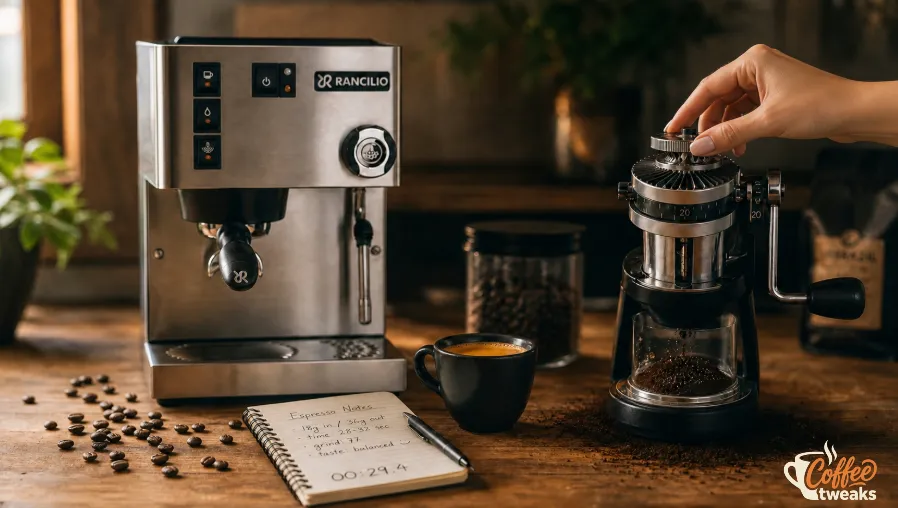
Some beginners buy the Silvia and stay with it for fifteen years. These people tend to enjoy learning processes, appreciate craft over convenience, and are pulled toward the technical side of things generally. The Silvia rewards that orientation. Those owners develop real extraction technique, dial in their workflow, and end up with a machine they genuinely know how to use at a high level.
Other beginners buy the Silvia expecting consistent café-quality shots from week one. They hit the temperature surfing learning curve, produce bitter or sour shots for two months, and list the machine on Facebook Marketplace at a $300 loss. Those people weren't wrong for wanting espresso. They were just mismatched to this workflow.
The deciding question is not about the budget. It's: do you want to learn espresso, or do you want espresso?
Neither answer is wrong. But one of them is wrong for this machine.
One more thing, and I say this with full sincerity: if you do not have a quality burr grinder, stop reading this review and go solve that problem first. The Silvia paired with a mediocre grinder will produce mediocre espresso. The machine is not the limiting factor. Budget $200 to $400 for a grinder as part of this purchase. That combination will produce results that a $2,000 machine with a bad grinder cannot match.
Rancilio Silvia M vs. Older Versions
The “M” designation on current Rancilio listings indicates a version without the auto-off timer. The “E” version includes auto-off for EU compliance. For buyers outside the EU, M is the standard current model. The distinction is regulatory, not performance-related.
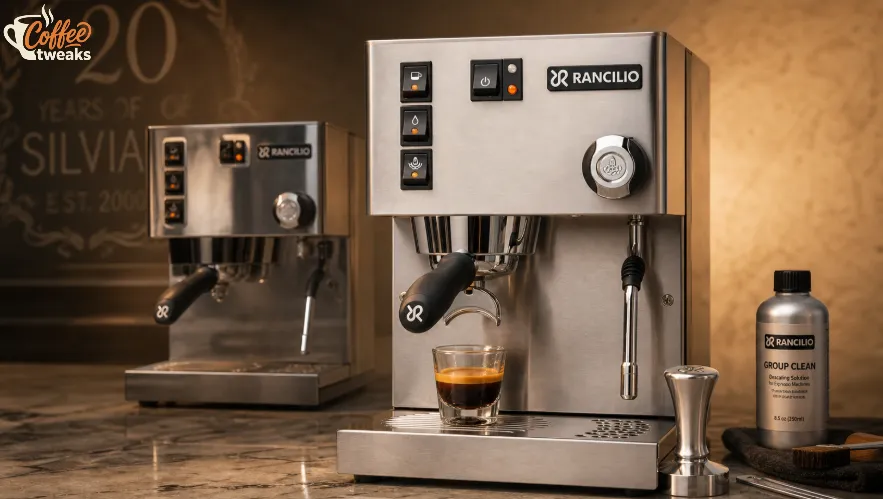
The version history matters primarily if you're considering a used machine.
Buy used with conditions. Verify regular descaling history. Inspect the steam wand and grouphead cover for peeling on older versions. Run test shots if possible. A clean V3 for $300 is a genuine bargain. A neglected V6 for $650 is not.
Rancilio Silvia vs. Gaggia Classic Pro
Both machines are Italian, both use 58mm commercial portafilters, both sit in the entry-level serious segment, and this comparison comes up on every espresso forum on the internet. It deserves a direct answer.
| Feature | Rancilio Silvia | Gaggia Classic Pro |
|---|---|---|
| Price (2026 approx.) | ~$800 to $995 | ~$450 |
| Boiler Material | Brass | Aluminum |
| Boiler Volume | 300ml | ~100ml |
| Grouphead Material | Brass | Steel |
| Machine Weight | 14kg | ~9kg |
| Brew-to-Steam Transition | ~90 to 120 seconds | ~35 seconds |
| Steam Power | Stronger, more sustained | Faster recovery |
| Build Quality | Exceptional | Good |
| Long-Term Durability | Outstanding | Good |
| Repairability | Excellent | Good |
| Espresso Quality Ceiling | Slightly higher | Very close |
| PID Standard | No (aftermarket available) | No (aftermarket available) |
Here's the thing about that transition time difference. The Gaggia's smaller, higher-wattage aluminum boiler heats and cools faster. If your workflow is espresso, milk drink, espresso, milk drink back to back, the Gaggia's 35-second brew-to-steam cycle matters. If you're pulling espressos or making one latte per session, the Silvia's 90-second transition is irrelevant.
Build quality: the Silvia wins clearly. Fifty per cent more weight because there's fifty percent more metal. The portafilter handle, the steam knob, the steam wand, every surface contact point feels meaningfully more substantial. Over ten years of daily use, that material difference compounds.
Espresso quality: both are excellent. The Silvia's larger brass group produces marginally more stable extraction temperatures in real conditions. The difference in the cup between two equally skilled operators with equally dialed grinders is real but not transformative. You're not buying the Silvia over the Gaggia Classic Pro for dramatically better espresso. You're buying it for the build, the steam power, and the long-term ownership story.
The honest recommendation: If your combined machine-plus-grinder budget is $700, buy the Gaggia Classic Pro and a better grinder. The grinder matters more than the machine at this level.
If your total budget is $1,200 or more, the Silvia plus a quality grinder is the correct long-term investment. The price difference between the machines buys you a brass boiler, a heavier grouphead, and fifteen to twenty years of documented reliability. That's a reasonable trade.
How Much Does the Rancilio Silvia Cost to Own?
Owning a Silvia is cheap once you're past the purchase price. That is not marketing copy. That is the documented experience of owners who have kept these machines for fifteen or twenty years.
Total parts cost across ten years of properly maintained ownership is typically under $200. Compare that to a proprietary control board replacement at $300 out of warranty on a “smart” machine, and the economics of repairable construction become very clear very fast.
Who Should Buy the Silvia in 2026
Buy it if you:
Skip it if you:
Rancilio Silvia Review:: Final Verdict
☕🎯 The Rancilio Silvia is still worth buying in 2026. Not conditionally. Not “for certain types of users.” Worth buying.
Not because it has the most features. It doesn't. Not because it's the easiest machine to use. It isn't. Because it is one of the most honest pieces of espresso equipment you can bring into a home kitchen, and the record of people who bought one fifteen years ago and still use it every morning is the most convincing review any machine can have.
Is it the best long-term investment in its category? For the right person, yes. The right person owns a grinder, has patience for a learning curve, drinks primarily espresso, and intends to own the same machine when their current car is already gone.
Would I personally spend my own money on it today?
I already have. Twice. The first one I gave to my sister when she moved. It's been running for eleven years. She's never had it serviced. She descales it every four months and replaces the gasket every two years. That machine will outlive the kitchen it's sitting in.
The design is old. The thermostat is manual. The warm-up time requires planning.
None of that matters when you pull a shot that's clean, sweet, and exactly what you dialed for. Silvia earns that shot every time you put in the work.
And I'm not apologising for that.