What Happens to Your Body When You Drink Coffee Every Day for a Year?

Here's the thing nobody tells you: your body does not react to coffee the same way on Day 1 as it does on Day 365.
The first cup you drink and the cup you have after a year of daily coffee hit very different bodies. Same drink. Same caffeine. Different response. Your receptors adapt, your liver adjusts, and your brain gradually builds tolerance.
That is what makes the daily coffee effects on the body so interesting. So instead of repeating coffee myths, I went through the research to see what actually changes from your first cup to a full year of drinking it every day.
Let's do the maths honestly.
First, how caffeine actually works ⚙️
You can't understand the year-long story without understanding one molecule and one enzyme. Stick with me for two minutes — this is the whole foundation.
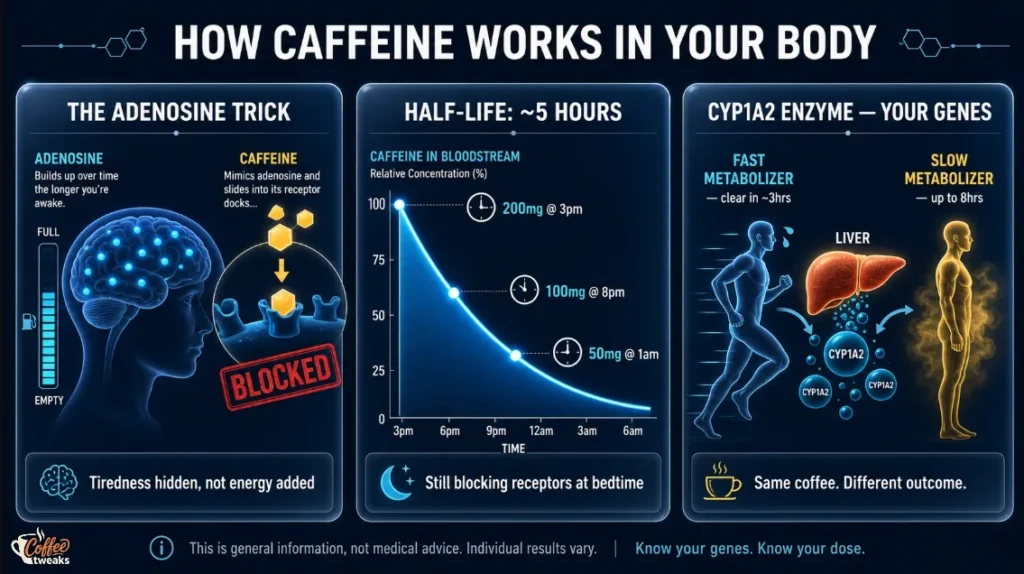
The adenosine trick. From the moment you wake up, a chemical called adenosine starts building up in your brain. It's a by-product of your brain using energy. As it accumulates through the day, it slots into little docking points called adenosine receptors, and each time it docks, you feel a bit more tired.
By evening, enough has built up that you want to sleep. Adenosine is basically your brain's fuel gauge running towards empty.
Caffeine works by a simple bit of chemical mimicry. Its shape is close enough to adenosine that it slides into those same docking points — but it doesn't switch them on. It just blocks them. Adenosine keeps building up in the background, but your brain can't read the signal. So you don't feel the tiredness that's actually there.
That's the buzz. Caffeine doesn't give you energy. It hides your tiredness by jamming the sensor. This detail matters enormously for the year-long story, because your brain does not sit still while its sensors are being blocked.
Half-life: why 3 pm coffee ruins 11 pm sleep. Caffeine has a half-life of around five hours in a typical adult. Half-life means the time your body takes to clear half of a dose. So if you drink a coffee with 200 mg of caffeine at 3 pm, you've still got roughly 100 mg floating around at 8 pm, and about 50 mg at 1 am.
That leftover 50 mg is enough to keep some of those adenosine receptors blocked while you're trying to sleep. This is why afternoon coffee is the single biggest hidden cause of poor sleep in daily drinkers. The numbers matter here: the caffeine is still working long after you've stopped noticing it.
CYP1A2: the enzyme that makes you fast or slow. Your liver breaks caffeine down using an enzyme called CYP1A2. And how much of it you produce is largely genetic.
Roughly speaking, people fall into two camps:
This is why blanket advice like “coffee doesn't affect my sleep” is useless — it depends entirely on which body you've got. A few things shift this too: smoking speeds caffeine clearance up, while pregnancy and certain medications (including some antidepressants and the contraceptive pill) slow it dramatically, sometimes doubling the half-life.
So when I give timings later, treat them as a starting point. You'll need to calibrate for your own machinery. I measured this on myself for weeks with a simple sleep tracker and a cut-off time, and my sweet spot turned out to be very different from my brother's. Same genes, roughly. Different livers, apparently.
Right. Now the timeline.
Daily Coffee Effects on the Body: Day 1 to Year 1
The daily coffee effects on the body change as tolerance builds and your system adapts to regular caffeine. Here’s how that progression typically looks from your very first cup through a full year of daily coffee.
Day 1: your first ever cup, hour by hour ☕
Let's say you've never had caffeine and you drink one strong coffee this morning. Here's what actually unfolds.
On Day 1, the effect is at its strongest. You have zero tolerance. Your receptors are fully sensitive. Enjoy it, because it never feels quite this punchy again.
The first week: tolerance begins ⚙️📊
This is where the interesting biology kicks in, and where most articles stop paying attention.
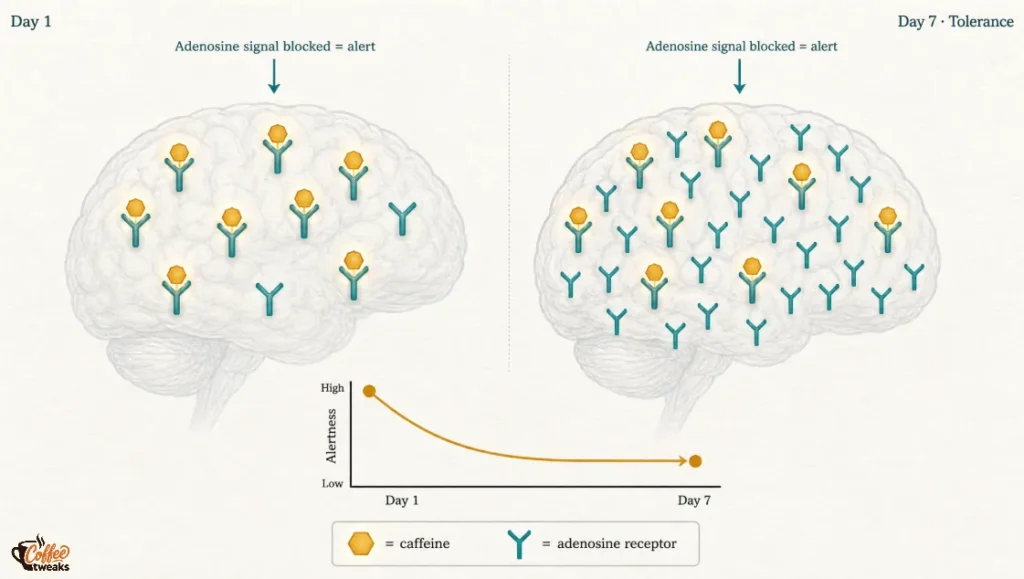
When you block adenosine receptors day after day, your brain notices. It responds the way any good control system responds to interference: it compensates. Over the first week or two of daily coffee, your brain starts building more adenosine receptors.
Think about what that means. You've been blocking the sensors, so your brain installs extra sensors. Now the same dose of caffeine blocks a smaller proportion of them. The buzz gets quieter. This is caffeine tolerance, and it's mechanical, not psychological.
By the end of week one, most daily drinkers notice the “wow” feeling has softened. You're not imagining it. There are physically more docking points to block, so your morning cup is doing more work just to reach the same place.
A few other things happen this week:
Strength of evidence here: strong. Receptor upregulation and tolerance are well established in both animal and human research. This isn't a maybe.
The first month: this is now a habit ☕
By the end of a month, daily coffee has stopped being an event and become part of your baseline. And this is where a subtle, important shift happens — one that trips a lot of people up.
Once you're fully tolerant, coffee mostly restores you to normal rather than lifting you above it.
Here's what I mean. After weeks of daily caffeine, your brain has extra adenosine receptors. Skip your morning coffee, and all those unblocked receptors get flooded with adenosine — more sensors than you started with, all switched on at once. You feel foggy, tired, maybe headachy. Drink the coffee, and you snap back to feeling normal.
So the morning cup you now describe as “waking you up” is partly just clearing a mild overnight withdrawal. Technically speaking, but also taste-wise, that first cup still feels essential — but a chunk of its magic is now maintenance rather than genuine enhancement.
That's not a reason to quit. It just reframes what the habit is doing. Around the one-month mark you'll also notice:
Evidence on withdrawal: strong and well documented. It's recognised as a genuine clinical syndrome.
Three months: the steady state ⚙️📊
Three months of daily coffee and your body has reached a fairly stable relationship with the drink. The dramatic adaptation is done. Now the slower, quieter, long-term effects start to matter more than the daily buzz.
At this stage, the story stops being about the caffeine hit and starts being about everything else in coffee — and there's a lot else.
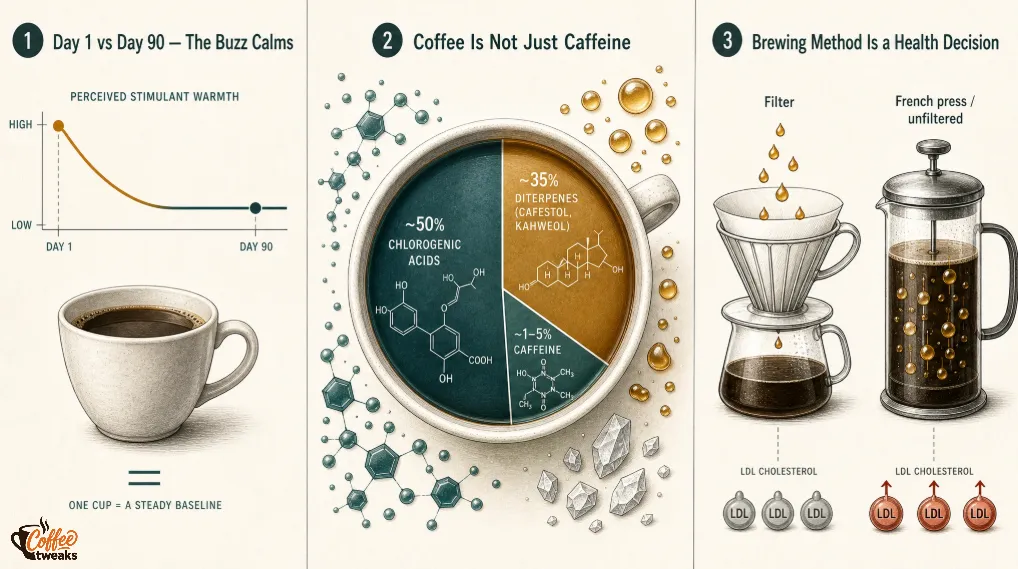
Coffee is not just caffeine dissolved in water. It's one of the most chemically complex drinks people consume, carrying hundreds of compounds. The two groups worth knowing about are:
Chlorogenic acids. These are polyphenols — plant antioxidants. Coffee is one of the biggest sources of them in a typical Western diet, often more than fruit and vegetables simply because people drink so much of it. Chlorogenic acids are thought to influence how your body handles blood sugar and may have mild anti-inflammatory effects. Roasting destroys some of them, so lighter roasts keep more.
Diterpenes (cafestol and kahweol). These are oily compounds that raise LDL — the “bad” cholesterol. And this is where your brewing method suddenly becomes a health decision, not just a taste one. More on that shortly, because it's one of the few genuinely actionable findings in all of coffee science.
By three months, if you're a moderate drinker with sensible timing, your body has basically normalised. Sleep is fine if your cut-off is right. Blood pressure is adapted. Your gut is regular. You have a stable tolerance. Nothing alarming is happening. You've simply become a coffee person.
Six months: the compounds start doing quiet work 📊
Half a year in, and any short-term effects are old news. What matters now is cumulative exposure to those non-caffeine compounds, and this is where the big population studies come in.
I need to be honest about the type of evidence here, because it changes what we can claim.
Almost all the “coffee is good for you” findings come from observational cohort studies. These follow large groups of people — sometimes hundreds of thousands — for years, and compare coffee drinkers with non-drinkers. The UK Biobank, the big European EPIC studies and large American cohorts all do this.
The strength of these studies is their size and length. Half a million people followed for a decade is a lot of data. The weakness is that they can only show association, not cause. Coffee drinkers might differ from non-drinkers in other ways — habits, income, health behaviour — and researchers can only adjust for so much. So when I say coffee is “linked to” lower risk of something, I mean exactly that. Linked. Not proven to cause.
With that caveat firmly in place, by six months your steady daily exposure is what those studies were measuring. Any protective association they found applies to a habit like yours. The effects are gradual and statistical — you won't feel them. They show up as slightly better odds across a population, not as a sensation in your body.
Let me lay out what those odds actually look like.
One year: the full picture 📊☕
A full year of daily coffee. Here's the honest summary of where the evidence stands on the things people care about most. I've graded each one by how strong the science is.
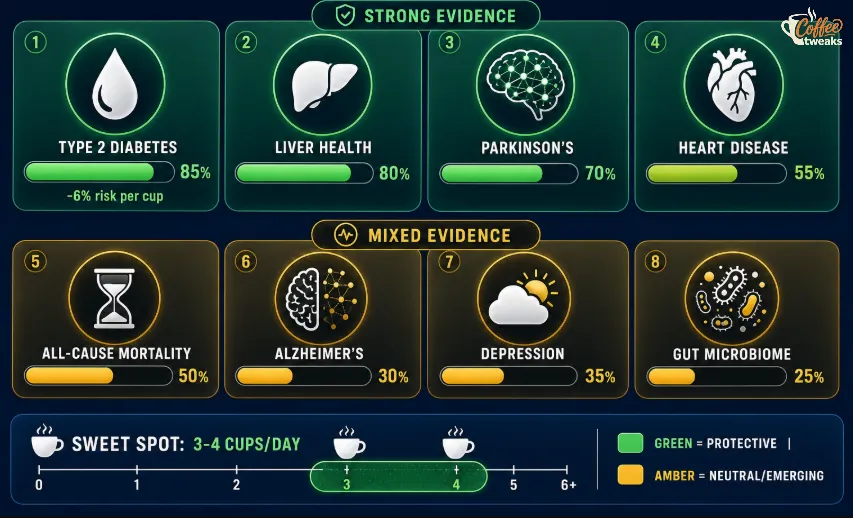
👉 Type 2 diabetes — protective link, strong and consistent: This is one of coffee's most reliable findings. Meta-analyses pooling many studies find that each daily cup is associated with roughly a 6% lower risk of developing type 2 diabetes, with the biggest benefit around 3–4 cups.
Here's the clever bit: decaf shows a similar benefit. That tells us it's probably the chlorogenic acids and other compounds, not the caffeine, doing the work. Evidence: strong association.
👉 Liver health — protective link, strong: Coffee drinkers consistently show lower rates of liver scarring, cirrhosis and liver cancer, plus healthier liver enzyme readings. The effect appears across different liver conditions, which makes it more convincing.
This is one of the areas where researchers are most confident coffee is genuinely helpful. Evidence: strong association, biologically plausible.
👉 Parkinson's disease — protective link, moderate to strong: Caffeine specifically is associated with lower Parkinson's risk, and here the mechanism makes sense — caffeine acts on the same adenosine system involved in the disease. Decaf doesn't show the same effect, which points to caffeine as the active ingredient. Evidence: reasonably consistent.
👉 Heart disease — reassuring, mostly neutral to mildly protective: For decades people feared coffee was bad for the heart. Large modern studies mostly clear it. Moderate intake is not linked to increased heart disease, and some studies suggest a small protective association at 3–4 cups.
The big exception is cholesterol from unfiltered coffee — covered below. Very high intake may cause palpitations in sensitive people. Evidence: moderate, reassuring overall.
👉 All-cause mortality — modest protective link, moderate: Several large cohorts find moderate coffee drinkers have a slightly lower risk of dying during the study period than non-drinkers, often with a sweet spot around 3–4 cups. The reduction is modest and, again, observational.
Coffee is not a longevity drug — but it's clearly not shortening moderate drinkers' lives either. Evidence: moderate.
👉 Alzheimer's and cognitive decline — possible link, limited: Some studies hint that coffee drinkers have a slightly lower risk of cognitive decline, but the evidence is weaker and less consistent than for diabetes or liver. Promising, not established. Evidence: limited to emerging.
👉 Depression — possible link, moderate to limited: A few large cohorts associate moderate coffee with slightly lower rates of depression. The effect is small and the direction of cause is unclear — feeling well might make people more likely to enjoy coffee, not the other way round. Evidence: moderate at best.
👉 Gut microbiome — emerging: Newer research links coffee drinking with greater diversity in gut bacteria and higher levels of certain beneficial microbes. This is genuinely interesting but early. Evidence: emerging, don't over-read it.
So after a year, the fair conclusion is this: if you drink moderate, sensibly-timed, ideally filtered coffee, the balance of evidence is mildly positive. Not miraculous. Mildly, reassuringly positive.
The brewing method decision that actually matters ⚙️
If you take one practical thing from this whole article, take this one. It's the rare piece of coffee health advice that's both well-supported and easy to act on.
Those diterpenes I mentioned — cafestol and kahweol — raise LDL cholesterol. But they're oily, and a paper filter traps them almost completely.
So the health difference between brewing methods is real and measurable:
The numbers matter here. Studies on unfiltered coffee show it can raise LDL cholesterol noticeably in people who drink a lot of it daily. For someone already watching their cholesterol, switching a daily cafetière habit to a paper-filtered method is a genuinely sensible move — no caffeine change, no taste sacrifice you can't adjust to, real biological benefit.
Espresso sits in an interesting middle spot: it retains diterpenes but the serving is small, so the total dose is lower than a big mug of French press. If you're an espresso-only drinker, this is less of a worry than if you're on three cafetières a day.
Technically speaking, but also taste-wise, unfiltered coffee often tastes richer and heavier because those same oils carry body and flavour. So it's a genuine trade-off, not a free win. Just know it exists.
Roast level matters less than people claim for health. Darker roasts have slightly fewer chlorogenic acids (roasting breaks them down) but the difference isn't dramatic, and roast choice is really about flavour. Don't lose sleep over it.
Metabolism, appetite and the insulin puzzle ⚙️📊
A few body systems don't fit neatly into the timeline, so let me handle them together — because there's a genuine puzzle here worth understanding.
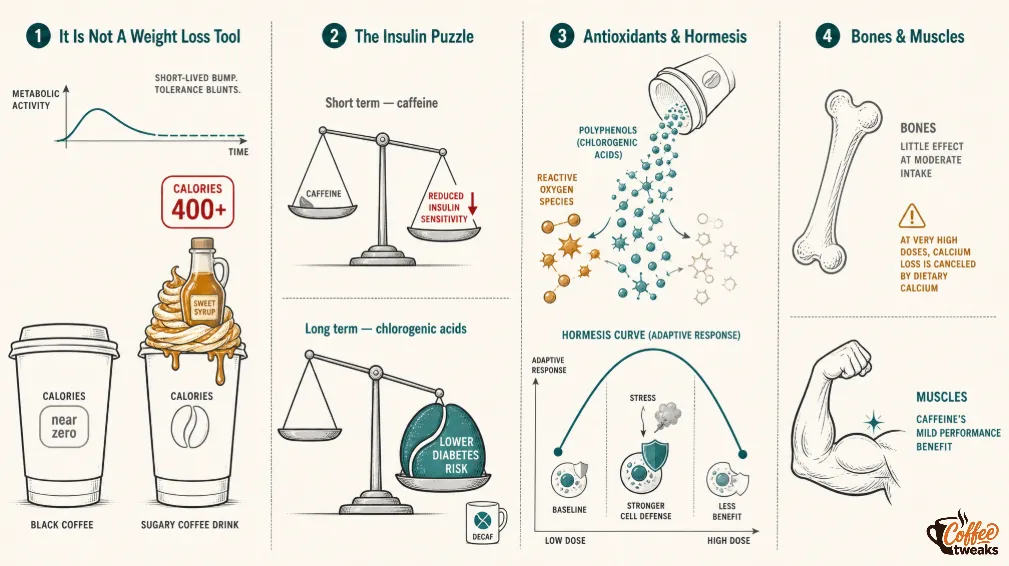
Metabolism and weight. Caffeine gives a small, short-lived bump to your metabolic rate and gently suppresses appetite. New drinkers feel this most. But — and this is the important part — tolerance blunts both effects within weeks.
So coffee is not a weight-loss tool in any meaningful long-term sense. Black coffee is nearly calorie-free and can help you feel fuller before a meal, which is mildly useful. The moment you add sugar and syrup, though, you've turned a zero-calorie drink into a pudding. That's where daily coffee quietly adds weight for a lot of people — not the coffee, the extras.
The insulin puzzle. Here's something that looks contradictory until you understand it. In the short term, caffeine can slightly reduce insulin sensitivity — meaning it makes your body a touch worse at handling blood sugar right after a dose. Yet the long-term studies clearly link regular coffee with lower type 2 diabetes risk. How can both be true?
The answer is two different timescales and two different ingredients. The short-term insulin effect is caffeine's doing, and tolerance softens it over time. The long-term protection appears to come from the chlorogenic acids and other compounds, which is exactly why decaffeinated coffee shows the same diabetes benefit.
So the caffeine gives a minor short-term nudge in the wrong direction, while the rest of the coffee gives a larger long-term nudge in the right one. The net effect over a year favours the good side.
Antioxidants and hormesis. Coffee's polyphenols act as antioxidants, mopping up some of the reactive molecules your body produces as normal waste. There's also a theory called hormesis — the idea that small doses of mild stress from plant compounds prompt your cells to strengthen their own defences, a bit like how exercise stresses muscles to make them grow back stronger.
It's a plausible part of why polyphenol-rich foods and drinks tend to look good in the data. But treat it as a reasonable idea rather than settled fact. Evidence: emerging.
Bones and muscles. For most people at moderate intake, coffee has little meaningful effect on either. Very high caffeine can increase calcium loss slightly, but adequate dietary calcium cancels it out. Caffeine's help with exercise performance is the more relevant muscle story, and I've covered that below.
Practical advice: how to do daily coffee well ☕
Here's how to get the upside and dodge most of the downside. This is the part you can actually act on.
How much is moderate? Health authorities generally consider up to about 400 mg of caffeine a day safe for healthy adults — very roughly four cups of brewed coffee, though real cups vary hugely. Pregnant women are advised to stay under 200 mg. A single dose over 200 mg at once is where jitteriness tends to start for many people.
Best time to drink it. Mid-to-late morning is a sensible default for most people. There's a popular idea that you should delay coffee for 90 minutes after waking to avoid clashing with your natural cortisol rise. Be careful with this one — the science behind it is thin. If delaying suits you, fine, but don't treat it as proven. It isn't.
Worst time to drink it. Too close to bed. Because of that five-hour-plus half-life, caffeine within 8–10 hours of sleep can measurably reduce your sleep quality even if you drop off fine. For most people, an early-afternoon cut-off is the highest-value habit change available. Slow metabolisers should cut off earlier still.
Coffee before exercise. This is one of caffeine's best-proven effects. It's a genuine performance aid — it improves endurance and makes hard effort feel easier. A cup 30–60 minutes before training works well. Tolerance blunts this a little, so it hits hardest if you don't over-rely on it daily.
Coffee and fasting. Black coffee has almost no calories and won't meaningfully break a fast. Add milk, sugar or syrup and that changes. Coffee on a completely empty stomach bothers some people's digestion — if it does, have it with or after food.
Coffee and anxiety. If you're prone to anxiety or panic, caffeine can genuinely make it worse — it amplifies the same alertness and heart-rate signals your body uses for anxiety. Slow metabolisers feel this more. Cutting back is a reasonable experiment if you're struggling. This is one case where less really can be better.
Coffee and medications. Caffeine interacts with a fair few drugs. Some medicines slow its breakdown (leaving you wired for longer), and caffeine can affect how some drugs work. If you take regular medication, it's worth a quick check with a pharmacist or doctor.
Who should be cautious or ask a doctor: anyone pregnant or breastfeeding, people with heart rhythm problems, poorly controlled high blood pressure, severe anxiety or panic disorder, certain sleep disorders, or anyone on medication that interacts with caffeine. If you're in any of these groups, get personalised advice rather than trusting a general article — including this one.
Myth busting: what the evidence actually says 📊
A lot of coffee “facts” are decades-old scares that never held up. Let me clear the big ones.
“Coffee dehydrates you.” No. Caffeine is a mild diuretic in people who aren't used to it, but regular drinkers develop tolerance within days, and the fluid in the coffee more than makes up for any extra loss. At normal intake, coffee contributes to your daily hydration. Myth busted.
“Coffee stunts your growth.” No evidence for this at all. It seems to have grown out of an old, flawed worry about coffee and bones, which itself didn't hold up. Coffee has no effect on height. Myth busted.
“Coffee damages your kidneys.” In healthy people, no. Moderate coffee doesn't harm normal kidneys, and some studies even link it with slightly lower risk of kidney disease. People with existing kidney conditions should follow their doctor's advice, but the blanket claim is wrong. Myth busted.
“Coffee causes heart attacks.” Not at moderate intake. Modern large studies clear moderate coffee of raising heart disease risk, and some suggest a small benefit. The old fear came from early studies that didn't separate coffee drinkers from smokers. Myth busted, with the caveat that very high intake can trigger palpitations in sensitive people.
“Coffee causes osteoporosis.” Overblown. High caffeine intake slightly increases how much calcium you lose, but the effect is small and easily offset by getting enough calcium in your diet. Moderate coffee is not a meaningful osteoporosis risk for most people. Myth largely busted.
“Coffee permanently raises your blood pressure.” No. There's a short-term rise, especially in new drinkers, but regular drinkers develop tolerance to it. Moderate habitual coffee is not a major driver of chronic high blood pressure. Myth busted, though people with uncontrolled hypertension should still be sensible.
“Coffee is addictive like a hard drug.” Not in the same league. Caffeine creates genuine physical dependence — real tolerance, real withdrawal — but it doesn't drive the compulsive, life-wrecking behaviour of serious addictive drugs. It's better described as a dependence-forming habit than an addiction in the dangerous sense. Fair to say your body relies on it. Not fair to compare it to hard drugs.
Original extras competitors skip ⚙️☕
Here are the bits I wish more coffee articles included.

Your year-long adaptation, in one glance
Tolerance progression, explained simply
Tolerance isn't “coffee stops working”. It's “coffee works from a lower starting point”. Because you build extra receptors, skipping coffee now drops you below your old baseline — that's withdrawal. Coffee lifts you back up. So a tolerant drinker gets less of a peak but pays a bigger penalty for missing it. That's the trade you sign up for with a daily habit.
Coffee vs caffeine pills vs energy drinks
Worth the money? Let's actually do the math: plain coffee gives you the most benefit per penny and per calorie. Everything else is paying more for less.
Common mistakes daily drinkers make
Signs your routine is healthy
You sleep well, you're not anxious or shaky, you drink it for enjoyment as much as function, you can skip a day without misery, and you're under roughly 400 mg a day. That's a good, sustainable coffee habit.
Signs you're drinking too much
Trouble sleeping, a racing or fluttering heart, ongoing jitteriness or anxiety, an upset stomach, needing more and more just to feel normal, or a bad headache and low mood every time you're late for a cup. If several of these ring true, ease back gradually — a slow taper avoids the worst of the withdrawal.
FAQs
Is coffee healthy to drink every day?
For most healthy adults, yes — moderate daily coffee (about 3–4 cups) is linked to lower risk of several diseases and is considered safe. The benefits are modest and come from observational studies, so they're associations rather than guarantees. Timing, dose and brewing method decide whether your habit leans healthy or not.
Can I drink coffee every day?
Almost certainly, if you're a healthy adult and keep it moderate. The main things to watch are total caffeine (aim under 400 mg a day), timing (not too close to bed), and added sugar. Pregnant women and people with certain heart, anxiety or sleep conditions should be more cautious.
Is coffee bad for you in the long term?
The long-term evidence is mostly reassuring or mildly positive for moderate drinkers. The clearest long-term downside is raised cholesterol from unfiltered coffee, which a paper filter fixes. Very high intake can cause sleep and anxiety problems. It's about dose and method, not coffee being inherently harmful.
Can coffee damage your liver?
The opposite, on current evidence. Coffee is consistently linked with better liver health — lower rates of scarring, cirrhosis and liver cancer, and healthier enzyme readings. It's one of the strongest findings in coffee research.
Does coffee increase your lifespan?
Large studies link moderate coffee with a modestly lower risk of early death, often with a sweet spot around 3–4 cups. But these are observational, so coffee isn't proven to cause longer life. It's fairer to say moderate coffee is associated with slightly better odds, not that it extends your life.
Can coffee improve memory and focus?
Short term, yes — caffeine reliably sharpens alertness, reaction time and focus. But tolerance means a daily habit mostly restores your normal rather than boosting you above it. Long-term memory protection is possible but the evidence is limited, not proven.
Does coffee affect your hormones?
Caffeine can raise stress hormones like cortisol and adrenaline in the short term, but regular drinkers develop tolerance to much of this. The popular claim that morning coffee badly clashes with your cortisol rhythm is not well supported. For most people at moderate intake, the hormonal effect is minor.
What happens if you suddenly stop drinking coffee?
If you're a daily drinker, expect withdrawal: headache, tiredness, irritability, low mood and poor focus. It usually starts 12–24 hours after your last cup, peaks around 24–48 hours, and clears within a few days to a week. Tapering down gradually avoids most of it.
Can you become immune to caffeine?
Not fully immune, but you do build strong tolerance, so the noticeable buzz fades. The underlying effects still happen — caffeine still blocks adenosine and still disrupts late-day sleep — you just stop feeling the lift as much. So “immune” isn't quite right; “tolerant” is.
Does coffee dehydrate you?
No. At normal intake it counts towards your fluid for the day. Any mild diuretic effect fades with regular drinking. That old warning is a myth.
Final Verdict
A year of daily coffee doesn't transform you. Nothing dramatic happens on any single day. What actually occurs is a slow, mostly gentle set of adjustments: your brain builds tolerance in the first fortnight, your body normalises over the first few months, and your long-term disease odds shift very slightly in a favourable direction — provided you keep it moderate, time it away from bedtime, watch the sugar, and preferably filter it.
The downsides are real but they're almost all fixable. Poor sleep is a timing problem. High cholesterol is a filter problem. Jitters and anxiety are a dose problem. Withdrawal is a “quit gradually” problem. None of them are reasons to fear the coffee itself.
So drink it because you enjoy it. Treat the modest health links as a pleasant bonus, not a health strategy. And calibrate the details to your own body, because your liver and your genes have the final say, not any article, including mine.
Right. My cup's gone cold. Worth it. ☕
This article is for general information and isn't medical advice. If you have a health condition, are pregnant, or take regular medication, check with a doctor or pharmacist before changing your caffeine habits.