Is Black Coffee Healthy? The Definitive Evidence Summary

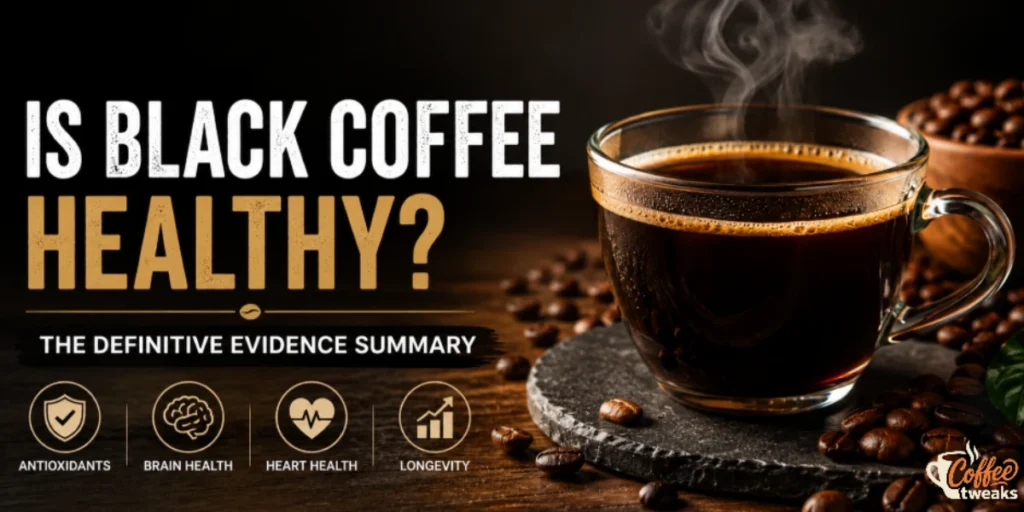
Is Black Coffee Healthy? For most adults, yes, especially when it replaces sugary coffee drinks. An 8oz cup contains just 1–3 calories, while adding sugar and whole milk can push the same drink close to 100 calories.
The biggest benefit comes from what black coffee removes: added sugar, cream and unnoticed liquid calories. It also provides caffeine and chlorogenic acid, compounds linked in observational research to better metabolic health, lower fatty liver risk and reduced inflammation.
Still, black coffee is not a miracle drink. Too much caffeine can harm sleep, worsen anxiety and trigger digestive issues. For most healthy adults, staying below 400mg per day keeps the balance sensible. The real win is simple: keep the coffee, lose the extras.
The calorie question is the whole game 📊
Here's the thing nobody tells you when they hand you the “go black” advice: the health benefit they're describing is almost entirely a subtraction, not an addition.
Let me lay out the numbers, because the numbers matter here.
| What's in the cup | Approximate calories (per 8oz) |
|---|---|
| Plain black coffee | 1–3 |
| + 1 tsp sugar | ~16 |
| + 2 tsp sugar | ~32 |
| + 1 tbsp whole milk | ~9 |
| + 2 tbsp half-and-half | ~40 |
| + 1 pump flavored syrup | ~20 |
| A large café “coffee” drink (caramel, whole milk, whip) | 350–500+ |
Look at the top row and the bottom row. That is the entire spectrum of “coffee,” and it spans from a rounding error to a meal. When someone says black coffee is a health drink, what they've really discovered is that they were drinking 300 to 500 liquid calories a day and calling it coffee.
I measured this against my own habit a few years back. Two flat whites and an afternoon oat-milk latte came out to roughly 400 calories before I'd eaten a single bite of food. Switch those to black and the daily total drops to under 10.
Over a year, assuming nothing else changes, that's a difference of well over 100,000 calories. Whether that turns into meaningful fat loss depends on a hundred other variables, but the arithmetic is not subtle.
The calories you remove are real and immediate. The benefits you add are smaller and slower. Keep that ratio in mind for the rest of this article, because it's the honest frame the health-influencer version skips.
This is the core of the black coffee no sugar health conversation. “No sugar” is doing more work than “coffee.” Once you internalise that, everything else in this article becomes easier to weigh correctly.
What's actually in a cup of black coffee ☕
A cup of black coffee is about 98% water. The remaining 2% is where all the interesting chemistry lives, and it's more crowded than you'd expect for something that costs pennies to make.
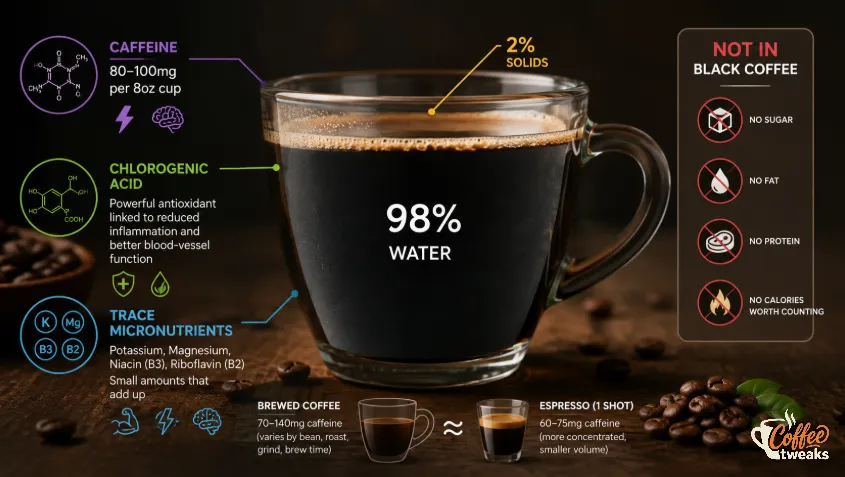
The three things that matter for your health:
Caffeine. An 8oz cup of brewed coffee typically carries 80–100mg of caffeine, though the real-world range runs wider, anywhere from about 70mg to 140mg depending on the beans, the roast, the grind, and how long the water sat in contact with the grounds.
Espresso is more concentrated per ounce but smaller in volume, so a single shot lands around 60–75mg. This variability is why “how much caffeine is in coffee” never has a clean answer… it's a range, not a number.
Chlorogenic acid. This is the antioxidant compound that does a lot of the quiet heavy lifting in coffee-health research. It's a family of polyphenols associated with reduced inflammation and improved blood-vessel function.
Coffee is one of the largest single sources of these compounds in the average Western diet, not because coffee is uniquely rich in them, but because people drink so much of it.
Lighter roasts retain more chlorogenic acid than darker ones, since roasting degrades it. Technically speaking, but also taste-wise, this is one more reason to explore lighter roasts.
Trace micronutrients. A cup contains small but non-trivial amounts of potassium, magnesium, niacin (B3), and riboflavin (B2). Individually modest. But when you're drinking two to four cups a day, “modest amounts, four times over” starts to add up to a measurable contribution.
What's not in a cup of black coffee is the point I keep returning to: no sugar, no fat, no meaningful protein, no calories worth counting. It's a near-zero-cost delivery vehicle for a stimulant and a bag of antioxidants.
That combination is unusual, and it's most of why the research keeps finding associations worth talking about.
The alertness isn't “energy” — here's the actual mechanism ⚙️
People describe coffee as giving them “energy,” which is chemically wrong in a way worth correcting, because understanding the real mechanism changes how you use it.
Caffeine contains zero calories. It cannot give you energy in the physics sense, because energy is calories and caffeine has none. What it actually does is block a signal.
Your brain produces a molecule called adenosine throughout the day. Adenosine accumulates the longer you're awake, and it binds to receptors that essentially tell your nervous system, “we're getting tired now.” Caffeine's molecular shape is close enough to adenosine that it slots into those same receptors, without activating them.
It sits in the parking spot so adenosine can't. The tiredness signal is still being produced; it just can't be received.
The knock-on effect: with the “slow down” signal blocked, your natural stimulants — dopamine and norepinephrine, operate with less resistance. That's the alertness. That's the mood lift. That's the reason a cup at the right time feels like a switch flipping rather than a slow warm-up.
Two practical consequences fall out of this mechanism.
👉 First, caffeine doesn't erase your sleep debt — it hides it. The adenosine is still accumulating behind the blockade. When the caffeine clears, it all lands at once, which is the afternoon crash. You didn't create energy; you deferred a bill.
👉 Second, timing matters more than dose. Caffeine's half-life is around 5 to 6 hours in a typical adult, meaning a 2pm cup can leave a quarter of its caffeine still circulating at midnight. If you sleep badly and drink coffee to compensate, you can build a genuine loop. The coffee isn't the villain there — the timing is.
Black coffee benefits, one mechanism at a time
This is where the internet gets loose with the truth, so I'm going to be deliberately careful. Most of what we know about coffee and long-term health comes from observational cohort studies — researchers follow large groups of people for years and note who drinks coffee and who develops what.

That design can show strong, consistent associations. It cannot, on its own, prove that coffee caused the outcome. I'll flag which is which as we go, because that distinction is the entire difference between a trustworthy article and a listicle.
1. Metabolism and fat: real, but small 📊
Caffeine is a genuine thermogenic, it raises your metabolic rate temporarily and promotes lipolysis, the breakdown of stored fat into free fatty acids the body can burn. This part is solid; it's been measured in controlled settings.
The honest problem is the magnitude. The metabolic bump from a dose of caffeine is on the order of a few percent, and it's temporary — hours, not days. Realistically we're talking about a few dozen extra calories burned across the window it's active, and your body adapts to regular intake, which blunts the effect further over time.
Worth it? Let's actually do the math. If black coffee “boosts your metabolism,” the boost is real but roughly the caloric equivalent of a short walk to the kitchen. The far larger metabolic win from switching to black coffee is the 300–500 calories of sugar and milk you stopped drinking.
Anyone selling black coffee as a fat-burner is pointing at the small lever while standing next to the large one. The small lever exists. It's just small.
2. Insulin sensitivity and type 2 diabetes: the sugar is the variable
This is one of the more robust findings in the whole field: regular coffee drinkers show a consistently lower risk of developing type 2 diabetes across many large cohorts, and the association tends to strengthen with more cups per day (up to a point).
But read the fine print. These associations hold for coffee consumed without large amounts of added sugar. If you're spooning sugar into every cup, you're adding the exact input — repeated glucose spikes and the insulin response they demand, that erodes insulin sensitivity over years. You can't out-antioxidant a sugar habit.
So the diabetes story is really the same story as the calorie story wearing different clothes. Black coffee sits alongside lower diabetes risk. Sweetened coffee pushes the other way.
The compound that appears protective is chlorogenic acid, plausibly by influencing glucose absorption and insulin signaling — but “appears protective” is the correct caution, because this is observational data, not a controlled trial where they assigned people to coffee.
3. Liver health: one of the strongest associations we've got
If I had to name coffee's most impressive health signal, it's the liver. Multiple large studies link regular coffee consumption to a lower risk of non-alcoholic fatty liver disease, reduced progression of liver scarring, and lower levels of the enzyme markers that indicate liver stress.
The pattern shows up across different populations and holds even after researchers adjust for the obvious confounders.
The mechanism isn't fully nailed down — likely a combination of chlorogenic acid, caffeine, and other compounds acting on inflammation and fat accumulation in liver tissue. And again: association, mostly observational.
But of all the health claims made about coffee, the liver data is the one I'd bet on holding up. It's consistent, it's large, and it's biologically plausible.
4. Inflammation, blood vessels, and the long game
Chlorogenic acid and the broader antioxidant load in coffee are associated with reduced markers of inflammation and improved endothelial function — the health of the lining of your blood vessels, which matters enormously for cardiovascular risk over decades.
The realistic framing: this isn't a dramatic, feel-it-today effect. It's a small nudge in the right direction, repeated daily, over years. That's how most diet-and-longevity effects work.
Nobody's blood vessels transform because of a Tuesday cup of coffee. But consistent, sugar-free coffee consumption is plausibly one small input on the good side of the ledger, and the population-level data broadly supports that read.
Add it all up and the black coffee benefits picture is genuinely positive — but it's a portfolio of small, mostly-observed associations plus one large, unambiguous win (removing the sugar). Not a miracle.
A good, cheap, low-risk habit with a favorable evidence base. That's a more useful thing to know than “superfood,” because it tells you how much to actually rely on it.
Does black coffee break a fast? ⚙️📊
If you've gone black on a doctor's or trainer's advice, there's a good chance intermittent fasting is somewhere in the picture, and this is the question that generates the most confusion.
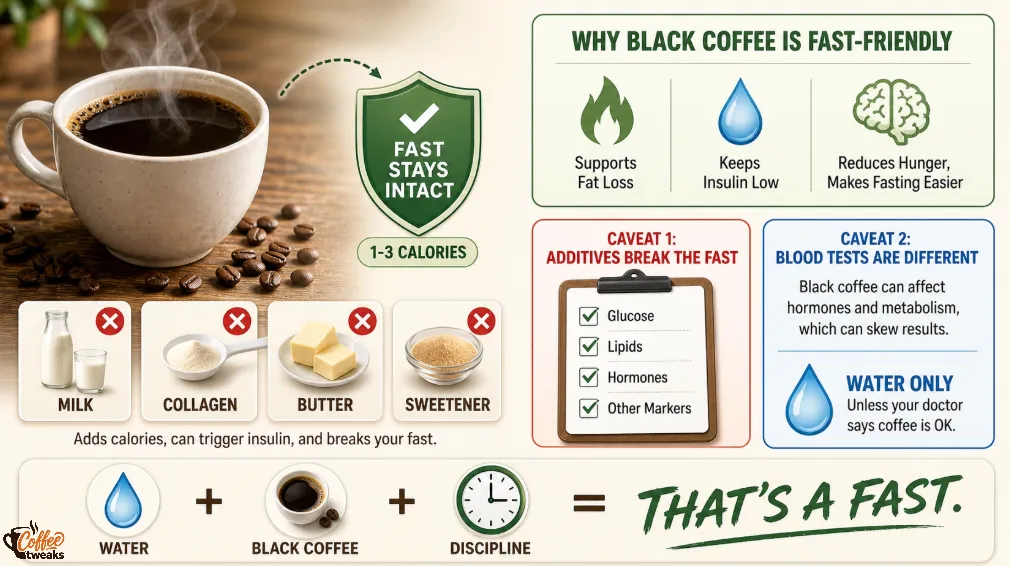
For the goals most people fast for — fat loss, metabolic health, giving insulin a long break — black coffee does not break your fast. The reason ties directly back to the number at the top of this article.
A fast, in the practical metabolic sense, is broken when you consume enough calories (especially from carbohydrates or protein) to trigger a meaningful insulin response and pull your body out of the fasted state. Plain black coffee at 1–3 calories doesn't come close to that threshold.
The general rule of thumb people use is that anything under about 5 calories won't meaningfully disturb a fast, and black coffee clears that bar with room to spare.
There's a bonus for fasters, too: the appetite-suppressing and mild thermogenic effects of caffeine can make the fasting window genuinely easier to hold. A lot of people who fast aren't drinking black coffee for the antioxidants — they're drinking it because it turns a hard 16-hour window into a manageable one.
Two honest caveats on black coffee fasting, because the internet oversimplifies this:
The moment you add anything — a splash of milk, a scoop of collagen, a pat of butter, a sweetener your body responds to — you're no longer in the clean case. Even “just a little milk” adds calories and can nudge insulin. If your fast is strict, black means black. Water and coffee, nothing else.
And separately: if you're fasting specifically for a blood test — fasting glucose, a lipid panel, certain hormone panels — that's a different kind of fast with different rules.
Black coffee can subtly affect some of those readings by influencing hormones and metabolism, so it can skew results even though it's not “breaking” a fast in the weight-loss sense. When the fast is for bloodwork, the safe move is water only unless your doctor explicitly says coffee is fine. Ask. Don't guess.
The sugar-quitter's real worries (the questions you didn't ask out loud)
The mechanisms are the easy part. The hard part — the part that actually determines whether you stick with this — is that black coffee has to survive contact with your tongue every single morning. Let's deal with the worries people are too self-conscious to say out loud.
“Will it taste unbearable?”
At first, honestly? If you're coming off sweetened, milky coffee, the first few black cups may taste harsh, bitter, and a little punishing. That reaction is real and it's not a character flaw. Your palate has been calibrated to a sweet, creamy signal, and you just removed it. Bitterness is going to feel loud.
But here's the thing nobody tells you: most of the bitterness people blame on “black coffee” is actually bad coffee, brewed badly.
Over-extracted, stale, cheap, burnt-dark beans made with water that's too hot will taste like punishment no matter what you add. The sugar was hiding the flaws, not fixing them. Take that same crutch away from a mediocre brew and of course it's rough.
“How long until it actually tastes normal?”
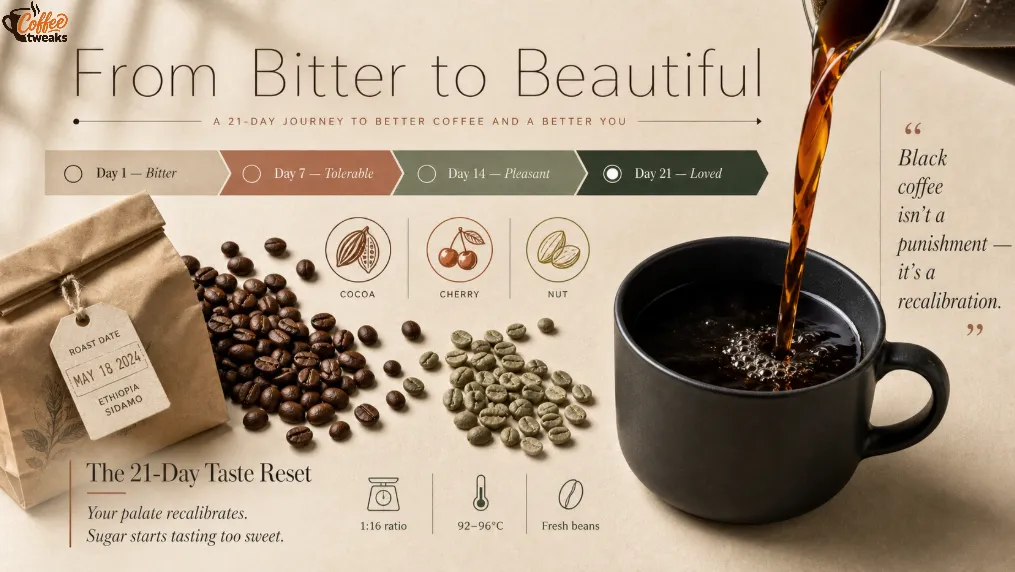
This is a real, measurable adaptation, and the timeline is more encouraging than people fear. For most people, the shift takes somewhere in the range of two to three weeks of daily black coffee before the bitterness stops registering as unpleasant and starts registering as… flavor.
Your taste receptors genuinely recalibrate. Around the one-month mark, a surprising number of people find they've flipped entirely — sweetened coffee starts tasting cloying, and they can suddenly notice things in the black cup they never could before: acidity, fruit, chocolate, nuttiness.
I've watched this happen with dozens of people I've nudged into better coffee. The three-week wall is real, and almost everyone who pushes through it stops wanting to go back. The trick is not white-knuckling through bad coffee for three weeks — it's making the coffee good enough that the transition is pleasant instead of grim. Which brings me to the practical part.
The transition that actually works ⚙️☕
Going black is far easier if you upgrade the coffee at the same time you strip out the sugar. A few specifics that do the heavy lifting:
👉 Start with a medium roast, not a dark one. Dark roasts are the bitter, ashy, “burnt” flavor most people associate with black coffee. A medium roast is more forgiving, less bitter, and has more of the sweetness and acidity that make black coffee pleasant on its own. Lighter roasts also retain more chlorogenic acid, so you get a small health bonus for choosing them.
👉 Buy beans with a roast date, and use them within a few weeks. Stale coffee is flat and bitter. Fresh coffee is sweeter and more aromatic on its own — which means it needs help from sugar far less. This one change does more for the taste of black coffee than almost anything else.
👉 Dial in your ratio. A solid starting point is about 1:16 — 15g of coffee to 250g of water — and adjust from there. Too strong and bitter, add water or use less coffee. Too weak and sour, do the reverse. Precision here isn't nerdery for its own sake; the difference between a bitter cup and a sweet one is often a few grams of coffee and a slightly cooler water temperature (around 92–96°C / 198–205°F rather than fresh-off-the-boil).
👉 Taper if you need to. You don't have to go cold turkey on sweetness. Halve your sugar each week — two teaspoons to one, one to a half, a half to none — over a month. Your palate adjusts to gradual change more comfortably than to a cliff, and you'll barely notice each step.
“Will I get withdrawal?”
Two different withdrawals are worth separating here, because people conflate them.
Sugar reduction rarely causes true physical withdrawal at the levels found in coffee — you might notice cravings or feel a bit off for a few days as your routine changes, but it's usually mild and short.
Caffeine is the one to watch, and it only matters if you're also cutting your coffee quantity, not just the sugar. If you keep drinking the same number of cups and just remove the additives, your caffeine intake is unchanged and there's nothing to withdraw from.
If you cut back on cups at the same time, abrupt caffeine withdrawal can bring headaches, fatigue, irritability, and low mood for a few days to a week. The fix is simple: taper the number of cups gradually rather than quitting overnight, and the withdrawal mostly disappears.
“Is it actually better for me, or just different?”
Better — but be precise about why, because this is the honest core of the whole question.
Switching from sweetened, milky coffee to black is meaningfully better for you, and the primary reason is the elimination of the sugar and the liquid calories, not some transformation in the coffee. You're removing a real negative.
On top of that, you keep all the plausible upsides of the coffee itself — the antioxidants, the caffeine, the associations with lower diabetes and liver-disease risk. So it's not just different.
It's a genuine net improvement. But the honesty that builds trust is admitting that most of the “better” is a subtraction you made, and the coffee is along for the ride with a favorable evidence base of its own.
Limits, risks, and who should actually be cautious
An article that only sells you the upside isn't a health article — it's a pitch. So here's the other side of the ledger, because black coffee is genuinely not for everyone in every amount, and pretending otherwise would undermine everything above it.
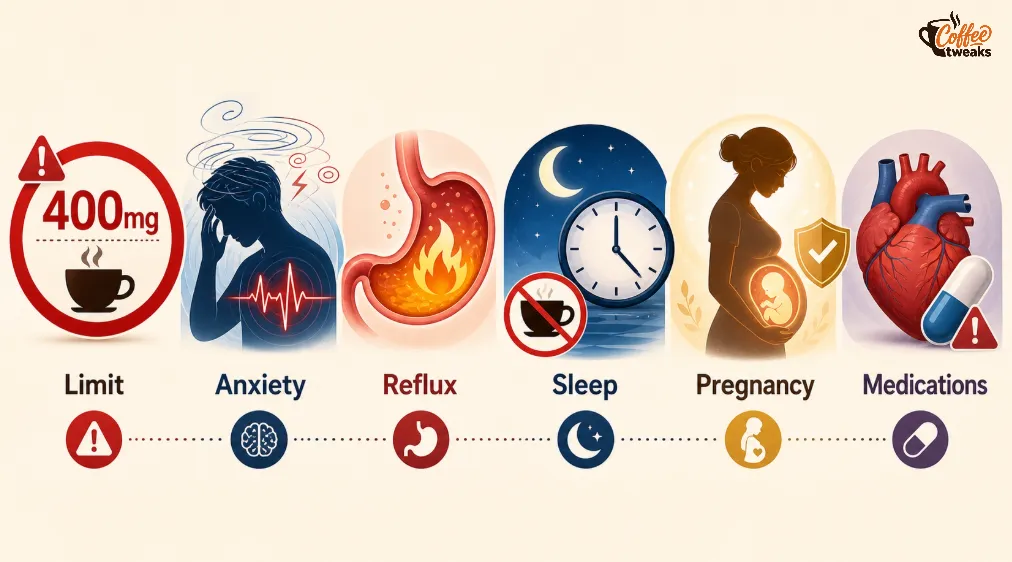
The dose ceiling. For most healthy adults, the sensible upper limit is around 400mg of caffeine a day, roughly four 8oz cups of brewed coffee. Push past that and the benefits invert into insomnia, jitteriness, a racing heart, anxiety, and digestive upset.
There's no antioxidant argument strong enough to justify caffeinating yourself into a bad night's sleep. More is not better here; there's a sweet spot and a wall past it.
Anxiety and panic disorders. Caffeine is a stimulant, and for people prone to anxiety it can directly amplify the physical symptoms — elevated heart rate, restlessness, that wired feeling — that fuel and mimic anxiety and panic.
If coffee reliably makes your anxiety worse, that's real, it's chemical, and no health benefit is worth overriding it. Consider cutting back or switching to decaf, which keeps most of the antioxidants.
Acid reflux and sensitive stomachs. Coffee can relax the lower esophageal sphincter and stimulate stomach acid, both of which aggravate reflux (GERD) and heartburn. If you're a reflux sufferer, black coffee on an empty stomach is often the worst-case scenario.
Some people tolerate it better with food, or find that a lower-acid brewing method or a darker (lower-acid) roast helps, but if it consistently hurts, listen to that.
Sleep problems. Circle back to that 5–6 hour half-life. If you struggle with sleep, an afternoon or evening cup is very likely part of the problem, even if you feel like you can fall asleep fine — caffeine measurably degrades sleep quality even when it doesn't stop you dropping off.
A simple, high-value rule: no caffeine after early afternoon. For many people that single change does more for their health than any benefit in the sections above.
Pregnancy. This one deserves extra care and I won't hand-wave it. Guidance during pregnancy generally recommends limiting caffeine substantially — commonly to around 200mg a day or less, roughly two cups — because caffeine crosses the placenta and the developing fetus can't metabolize it efficiently.
If you're pregnant or trying to become pregnant, this is a conversation to have with your doctor rather than a number to take from an article. Your specifics matter more than a general rule.
Certain medications and conditions. Caffeine interacts with some medications and can aggravate certain heart-rhythm and blood-pressure conditions. If you're managing a cardiac condition or taking regular medication, check with your doctor rather than assuming coffee is neutral.
For most people it is. For some it genuinely isn't, and the only way to know which group you're in is to ask someone who can see your full picture.
A note on how sure we can actually be
One more thing, because it's what separates a summary you can trust from one you can't.
Most of the long-term health claims about coffee — the diabetes link, the liver link, the inflammation and cardiovascular associations — come from observational research. Large, careful, repeated, consistent… but observational.
That means researchers watched what happened; they didn't randomly assign people to drink coffee or not for twenty years and compare outcomes. The consistency across many studies and populations makes the associations genuinely compelling, and researchers do their best to statistically control for the obvious confounders.
But “strongly associated with” is not the same sentence as “proven to cause,” and anyone who tells you coffee guarantees any of these outcomes is overselling the evidence.
The one claim that doesn't need that caveat is the calorie math. That's not observational or associational, it's arithmetic. Black coffee is 1–3 calories. Sweetened, milky coffee is 100 to 500. That part is simply, provably true, and it happens to be the single biggest lever in the entire discussion.
The takeaway that's actually worth acting on
If you remember one thing, don't make it a health claim. Make it this: the person who told you to go black was right, but for a reason they probably got half-wrong.
Black coffee is a near-zero-calorie drink that carries a real, favorable — if mostly observational — health profile, and switching to it removes the single most harmful thing in most people's coffee: the sugar. That's the win. Not a metabolism miracle, not a fat-burner, not a cure for anything.
A cheap, low-risk daily habit with the evidence leaning gently in its favor, and one large, unarguable benefit baked in from the moment you stop sweetening it.
So here's what I'd actually do with that, in order:
Buy fresher, medium-roast beans than you're using now — that alone makes black coffee taste like something you'd choose rather than endure. Taper the sugar over three to four weeks instead of quitting cold, and give your palate the full three weeks to recalibrate before you decide whether you like it.
Keep your daily caffeine under roughly 400mg and cut it off by early afternoon. And if you're pregnant, prone to anxiety, or wrestling with reflux, treat the cautions above as the actual point, not the fine print.
Do that, and in a month you won't be white-knuckling a bitter cup for your health. You'll have a drink you look forward to, that costs you almost nothing on the calorie sheet, and that quietly does you a small favor every morning. That's not a hack. That's just a good cup of coffee, finally tasted for what it is. ☕