Best Time to Drink Coffee for Energy: Cortisol Explained

Here's the thing nobody tells you.
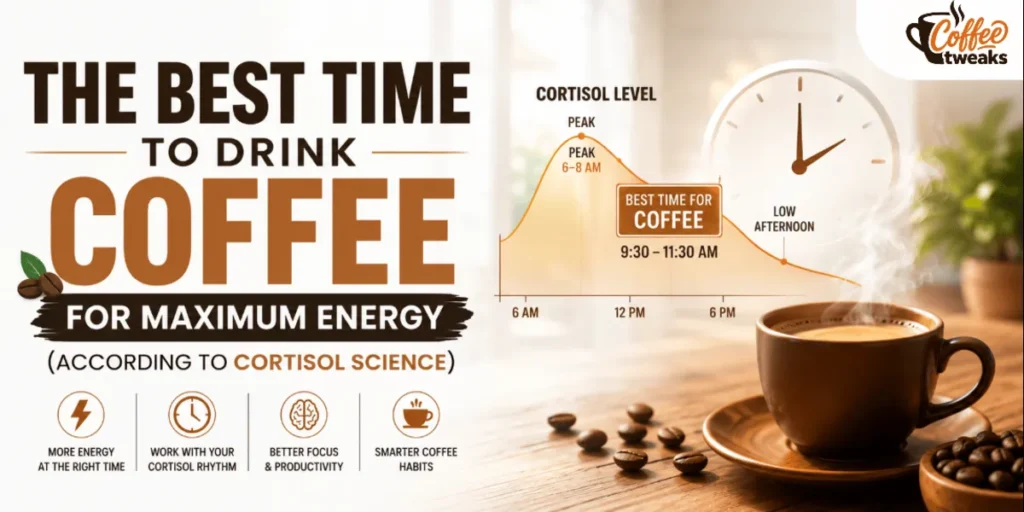
The best time to drink coffee isn't necessarily when you wake up.
The goal is to drink coffee when caffeine can do the most work.
Those are not the same thing.
Most people are drinking their first cup at 6:47 AM, half-asleep, and wondering why it barely works. Then they're reaching for a second cup. Then a third. Then they wonder why their sleep is falling apart.
This is a timing problem. Not a caffeine problem.
Here's what the biology actually says, and how to fix it.
What Happens In Your Brain When You Wake Up
Before you hit that brew button, your brain is already running a full wake-up sequence.

In the final hour of sleep and immediately after waking, your body initiates a cascade of hormonal activity that is specifically designed to get you alert, oriented, and cognitively functional, without any caffeine involved.
This is not a coincidence of evolution. This is a precisely timed biological system.
The two key players: cortisol and adenosine clearance.
⚙️ The Biology In 60 Seconds
What's happening at wake-up:
Net result: You become alert, naturally. No caffeine required.
Adenosine is worth understanding here. Throughout your waking day, adenosine accumulates in your brain. The longer you've been awake, the more adenosine builds up, and the more sleep pressure you feel. When you sleep, that adenosine clears. When you wake, you're at your lowest adenosine load of the entire day.
Caffeine works by blocking adenosine receptors, not by creating energy. It masks the tiredness signal. But when you wake up, that signal is already at its lowest point. So the first cup of coffee is working against your own biology, not with it.
That's the core insight. Let's go deeper.
The Cortisol Awakening Response Explained
The Cortisol Awakening Response (CAR) is one of the most well-documented and well-replicated phenomena in circadian biology.
Within the first 30–45 minutes of waking, cortisol levels spike by approximately 50–100% above baseline. This is not stress-related cortisol. This is programmed, circadian cortisol, your body's built-in alertness mechanism tied directly to your sleep-wake cycle.
Key CAR data points:
What affects individual CAR timing:
| Factor | Effect on Cortisol Peak |
|---|---|
| Chronotype (night owl vs. morning person) | Shifts peak 1–2 hours earlier or later |
| Sleep deprivation | Can blunt CAR magnitude |
| Chronic stress | Dysregulates normal CAR pattern |
| Age | Older adults show flatter CAR curves |
| Light exposure at wake | Amplifies CAR strength |
The critical thing to understand: cortisol itself is a performance enhancer. It sharpens focus. It improves reaction time. It mobilizes glucose for brain use. You are already running on it for 30–60 minutes after waking.
Adding caffeine on top of peak cortisol is like stepping on a gas pedal that's already fully pressed.
Should You Drink Coffee Immediately After Waking?
Let's address the claim directly.
The popular recommendation, most prominently associated with neuroscientist Andrew Huberman and cited across wellness media, is:
“Wait 90–120 minutes after waking before drinking your first coffee.”
Here's a fair, evidence-based breakdown of where that advice stands.
What Science Actually Says
What is established:
- Cortisol peaks 30–45 minutes after waking, this is solid, peer-reviewed science
- Caffeine stimulates additional cortisol production via ACTH stimulation at the pituitary gland
- In habitual caffeine users, morning cortisol response is partially (not fully) blunted due to tolerance
- Caffeine consumed during peak cortisol may compound stimulatory effects, contributing to jitteriness and a sharper energy crash
What is still debated:
The nuanced verdict:
The 90-minute rule is a reasonable heuristic, not a proven law. The logic behind it is sound. If your body is already at peak cortisol, waiting until cortisol begins declining before adding caffeine allows the caffeine to “fill the gap” rather than stack on top.
For most people, aiming for 60–90 minutes post-wake is a practical, biology-informed starting point, with flexibility based on your individual schedule and wake time.
The Best Time To Have Your First Coffee
This is where scheduling meets biology.
The goal is simple: drink your first coffee after your cortisol peak has begun declining, but before adenosine starts accumulating enough to cause a mid-morning fog.
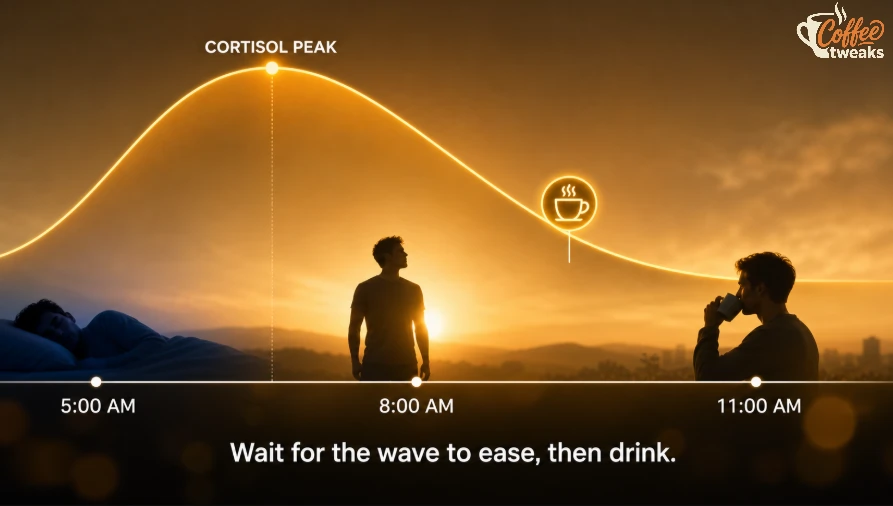
Here are realistic targets based on wake time:
For Early Risers (Wake 5:00–6:00 AM)
For Standard Schedule (Wake 7:00–8:00 AM)
For Shifted Schedules / Late Risers (Wake 9:00–10:00 AM+)
📊 The Numbers Matter Here
| Wake Time | Cortisol Peak Window | Suggested First Coffee | Reason |
|---|---|---|---|
| 5:00 AM | 5:30–6:00 AM | 7:00 AM | Post-peak cortisol drop; adenosine still low |
| 6:00 AM | 6:30–7:00 AM | 7:30–8:00 AM | CAR declining; caffeine enters cleanly |
| 7:00 AM | 7:30–8:30 AM | 9:00–9:30 AM | Classic optimal window |
| 8:00 AM | 8:30–9:00 AM | 9:30–10:00 AM | Aligned with cortisol decline |
| 9:00 AM | 9:30–10:00 AM | 10:30–11:00 AM | Shifted schedule, same principle |
| 10:00 AM+ | 10:30–11:00 AM | 11:30 AM–12:00 PM | Late chronotype window |
Coffee Timing vs Energy Levels Throughout The Day
Your energy across a day isn't random. It follows a predictable architecture driven by two overlapping systems: cortisol's diurnal curve and adenosine accumulation.
Understanding where those two systems are at any given hour tells you exactly when caffeine is most useful, and when it's wasted.
The Energy Architecture
Morning (7:00–10:00 AM): Cortisol is high. Adenosine is low. This is your natural cognitive peak. You don't need caffeine here as much as you think. If you drink coffee in this window, the benefit is smaller, cortisol is already doing the work.
The Afternoon Coffee Problem
The afternoon cup is where most people unknowingly destroy their sleep quality, and don't even connect the two.
Caffeine's Half-Life: The Real Numbers
Caffeine has an average half-life of 5–6 hours in healthy adults. That number shifts significantly based on individual genetics, particularly the CYP1A2 gene.
| Metabolizer Type | Caffeine Half-Life | Afternoon Cut-Off |
|---|---|---|
| Fast (CYP1A2 variant) | 2.5–4 hours | 4:00–5:00 PM |
| Average | 5–6 hours | 2:00–3:00 PM |
| Slow | 7–10 hours | 12:00–1:00 PM |
What this means in practice:
A 200 mg cup of coffee consumed at 3:00 PM leaves approximately 100 mg of caffeine in your system at 9:00 PM (for average metabolizers). That's the equivalent of a full cup of coffee in your bloodstream at bedtime.
Research published in the Journal of Clinical Sleep Medicine demonstrated that caffeine consumed 6 hours before bedtime reduced total sleep time by over one hour, even when subjects reported no difficulty falling asleep. The sleep architecture was disrupted below their perceptual threshold.
This is the dangerous part: you don't always feel it, but the data shows it's happening.
The slow-wave sleep (the deep, physically restorative phase) is particularly vulnerable to caffeine interference. This is the sleep phase that governs muscle recovery, immune function, and metabolic regulation.
Why Some People Sleep Fine After Evening Coffee
They're not special. They're fast metabolizers. The CYP1A2 gene in its fast-acting variant allows caffeine clearance in 2.5–4 hours instead of 5–6. For a 10:00 PM bedtime, this means a 6:00 PM espresso clears before sleep. This is a genetically determined trait, not a trained tolerance.
How Late Is Too Late For Coffee?
Use this table as a calibration tool, adjusting based on your metabolizer type.
| Bedtime | Average Metabolizer (Cut-Off) | Fast Metabolizer (Cut-Off) | Slow Metabolizer (Cut-Off) |
|---|---|---|---|
| 9:00 PM | 1:00–2:00 PM | 4:00 PM | 11:00 AM |
| 10:00 PM | 2:00–3:00 PM | 5:00 PM | 12:00 PM |
| 11:00 PM | 3:00–4:00 PM | 6:00 PM | 1:00 PM |
| 12:00 AM | 4:00–5:00 PM | 7:00 PM | 2:00 PM |
General rule of thumb: For average metabolizers, stop caffeine intake at least 6 hours before your intended bedtime.
Optimal Coffee Timing For Different Goals
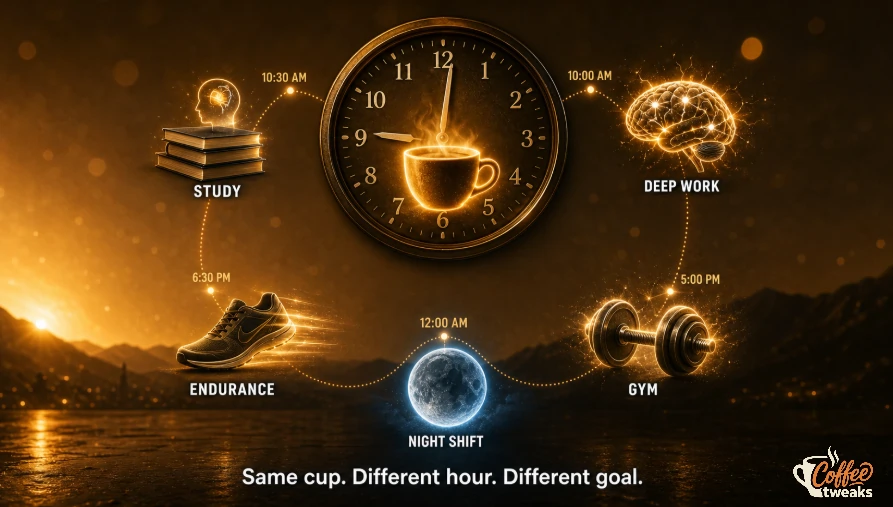
☕ Maximum Productivity & Deep Work
👍 Best window: 9:00–11:00 AM (post-cortisol peak, pre-adenosine accumulation)
This is your cognitive sweet spot. Cortisol is declining but still elevated enough to support alertness. Caffeine enters cleanly and extends the focus window. Adenosine is low, so caffeine has receptors available to block.
Protocol: One cup 60–90 minutes after waking. Pair with a clear task list. No email. No distractions. Use the focus window.
🏋️ Gym Performance
👍 Best window: 30–60 minutes pre-workout
Caffeine peaks in plasma within 30–60 minutes of ingestion. For strength training and high-intensity work, this timing window maximizes power output, reduces perceived exertion, and increases time-to-fatigue.
For morning training sessions (6:00–8:00 AM), this creates a conflict with cortisol timing. In this case, pragmatic pre-workout timing takes priority, consume caffeine 30–45 minutes before training, and adjust your post-workout coffee window.
Effective dose: 3–6 mg of caffeine per kilogram of body weight. For a 75 kg person, that's 225–450 mg, approximately 2–4 cups of coffee.
🏃 Endurance Sports
👍 Best window: 45–60 minutes pre-event
Caffeine improves endurance performance by reducing perceived effort, increasing fatty acid oxidation, and delaying glycogen depletion. A meta-analysis across multiple endurance studies shows meaningful performance improvements at doses of 3–6 mg/kg bodyweight.
For races or long training runs, time your coffee to peak exactly as you start, not before the warm-up.
📚 Students and Exam Performance
👍 Best window: 9:30–11:00 AM for morning sessions; 1:30–2:30 PM for afternoon revision
Students often over-caffeinate to compensate for poor sleep. This is counterproductive — caffeine cannot replace the memory consolidation that occurs during deep sleep. Better sleep + strategic timing outperforms chronic overconsumption.
🌙 Night Shift Workers
👍 Best window: Beginning of shift + 4 hours in (no caffeine within 6 hours of your sleep window)
Circadian disruption means cortisol rhythms are shifted and inconsistent. Night shift workers should treat the start of their shift as their “morning” — and apply the same 60–90 minute delay principle relative to wake time.
The Biohacker Coffee Timing Framework
The 3-Cup Optimization Model
This is a practical framework for the person who drinks 2–3 cups per day and wants to extract maximum cognitive benefit from each one.
☕ Cup 1 — The Cortisol Bridge
☕ Cup 2 — The Focus Lock
☕ Cup 3 (Optional) — The Afternoon Bridge
Quick rule: Total daily caffeine ≤ 400 mg. Space cups by at least 2 hours. Never use Cup 3 to compensate for not sleeping.
Common Coffee Timing Mistakes
These are the errors that turn a precision tool into a liability.
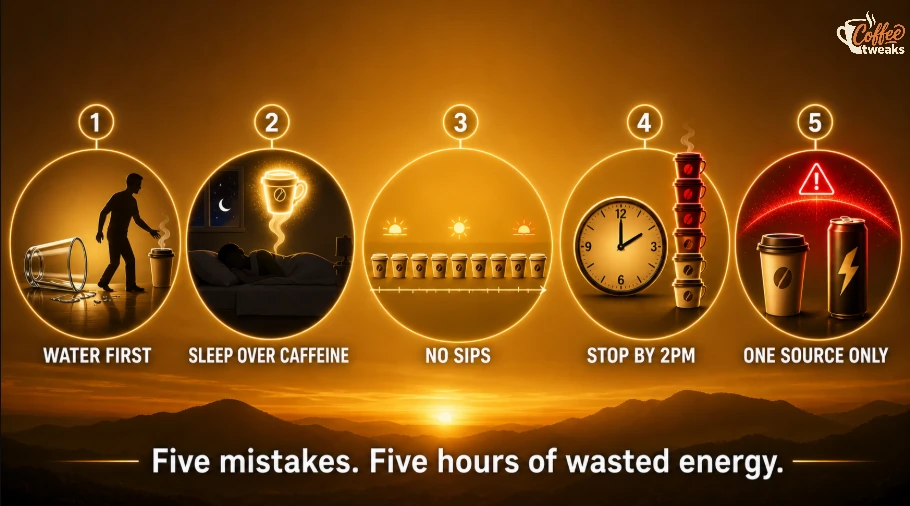
1. Drinking coffee before hydrating
You wake up after 7–8 hours with measurable dehydration — roughly 0.5–1% of body weight lost through respiration and perspiration. Caffeine is a mild diuretic. Reaching for coffee before water compounds this deficit, blunting cognitive function before the caffeine even kicks in. Water first. Always.
2. Using caffeine to compensate for poor sleep
This is the most common and most damaging pattern. Adenosine accumulates normally during sleep deprivation — it doesn't stop building because you're tired. Caffeine blocks it temporarily, but the debt remains. When caffeine clears, the accumulated adenosine crash is severe. And the caffeine required to function keeps increasing. Fix the sleep first.
3. Continuous low-dose caffeine throughout the day
Sipping coffee from 7 AM to 5 PM keeps adenosine partially blocked across the entire day. This prevents natural adenosine buildup from completing its role — signaling when you actually need rest. It also builds significant tolerance fast. Discrete, timed doses are more effective than constant low-level intake.
4. Late afternoon caffeine stacking
One coffee at 2:00 PM. One at 3:30 PM. An energy drink at 4:30 PM. Each with overlapping half-lives. By 11:00 PM you have a cumulative caffeine load that would shock most people — and wonder why you can't fall asleep. Track your total and your last dose.
5. Energy drinks plus coffee
Energy drinks frequently contain 150–300 mg of caffeine plus stimulant compounds like taurine and guarana. Stacking these with coffee pushes total caffeine well above the 400 mg threshold — and the cortisol response is amplified. The crash is proportional.
FAQ
Is it bad to drink coffee immediately after waking?
Not necessarily, but it may be less effective because cortisol is already rising. Waiting 60–90 minutes can reduce jitters and improve caffeine’s impact.
Should I wait 90 minutes before coffee?
For most people, waiting 60–90 minutes is a useful guideline. The goal is to drink coffee after your natural cortisol peak begins to decline.
What is the Cortisol Awakening Response?
It is the natural rise in cortisol that occurs within 30–45 minutes of waking. This response helps increase alertness, blood pressure, and energy.
Does coffee raise cortisol?
Yes, caffeine can temporarily increase cortisol levels. The effect is usually smaller in regular coffee drinkers because they develop partial tolerance.
What's the best time to drink coffee for focus?
The best window is usually 60–90 minutes after waking. For standard schedules, this often falls between 9:00 AM and 11:00 AM.
How late can I drink coffee without affecting sleep?
Most people should stop drinking coffee at least six hours before bedtime. Slow caffeine metabolizers may need an even earlier cut-off.
Is afternoon coffee always bad?
No. A moderate coffee in the early afternoon may be fine if it is consumed at least six hours before sleep.
Does coffee timing matter more than coffee quantity?
Both matter. Timing affects energy and sleep quality, while quantity determines your total caffeine exposure and risk of side effects.
The Final Logic
The science on this is clear enough to act on, but not so rigid that it demands exactness to the minute.
Your cortisol peaks 30–45 minutes after waking. It declines through mid-morning. Caffeine is most effective when it fills the declining alertness window, not when it stacks on the peak. Caffeine has a 5–6 hour half-life, which means afternoon timing directly determines sleep quality, whether or not you can feel it. And sleep quality directly determines whether you actually need three cups of coffee tomorrow, or two.
The best time to drink coffee isn't a universal clock time.
It's the moment when your biology, schedule, and caffeine strategy align.
That alignment looks different for a 5 AM riser versus a 9 AM riser. It looks different for a slow caffeine metabolizer versus a fast one. It looks different before a gym session versus a three-hour deep work block.
But the framework is the same for everyone:
Wait. Time it. Track it. Sleep well. Repeat.
That's not biohacking mysticism. That's just using the tool correctly.