How to Make Creamy Mushroom Coffee at Home (That Doesn’t Taste Weird)

Mushroom coffee is a $9 billion industry selling you something you can build at your kitchen counter for under $0.35 a cup. The brands know this. That's why most of the content ranking on this topic is written by brands — and why none of it ever shows you the math.
Here's the thing nobody tells you: the expensive part of RYZE ($40–45/bag) and Four Sigmatic ($1.63/serving) isn't the mushrooms. It's the packaging, the Instagram ads, and the convenience premium you pay for someone else to mix two powders together. The mushroom extract itself — the actual functional ingredient — costs pennies per gram when you buy it separately.
This article gives you a tested mushroom coffee recipe — creamy, doesn't taste like dirt, costs a fraction of any pre-made bag — and shows you the math behind why making it yourself makes sense. Starting with cost, because that's what you actually need to know first.
What Mushroom Coffee Actually Is
Mushroom coffee is ground coffee combined with dried, powdered extracts of functional (medicinal) mushrooms. That's the complete definition. There's no magic process.
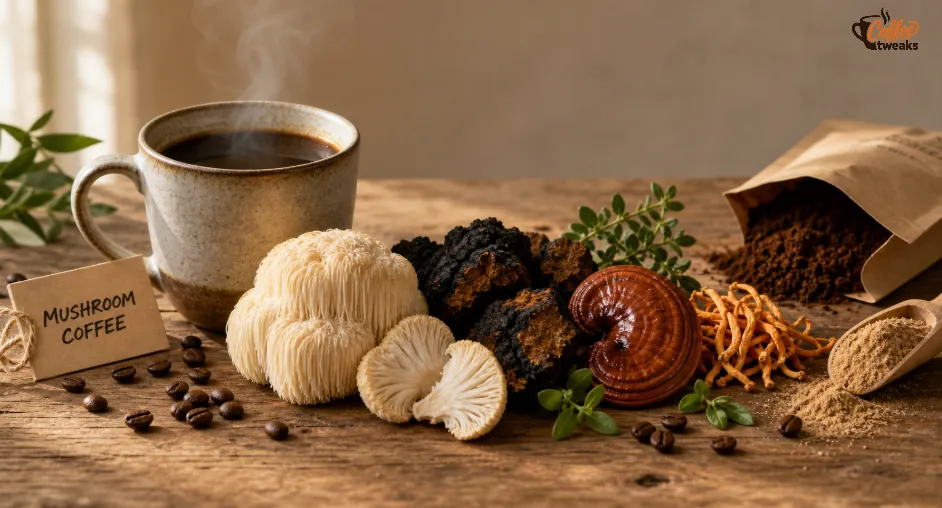
The four mushrooms you'll see most often: lion's mane (cognitive focus), reishi (stress/sleep support), chaga (antioxidant-dense, mild flavor), and cordyceps (energy metabolism). These aren't portobello or shiitake — they're medicinal species used in traditional Chinese medicine for centuries.
The health evidence for these mushrooms is real but preliminary. Most studies are small, and many are animal-based. Treat the functional benefits as a credible hypothesis worth testing on yourself, not a guaranteed outcome. What is guaranteed is that the coffee part still tastes like coffee.
📊 Why Make It at Home: The Cost Math
Let's actually do the math, because no one else does.
Pre-made mushroom coffee — retail cost per cup:
| Brand | Per-Cup Cost | Notes |
|---|---|---|
| RYZE | ~$1.20–$1.50 | $40–45/bag, 30 servings |
| Four Sigmatic | ~$2.10–$3.00 | Higher caffeine, coffee-forward |
| MUD\WTR | ~$1.34–$1.67 | Chai-based, not actually coffee |
DIY mushroom coffee — cost per cup:
| Ingredient | Cost | Serving | Per-Cup Cost |
|---|---|---|---|
| Quality ground coffee (e.g. Peet's dark roast) | ~$10.99–$13.89/340g | 15g per cup | ~$0.48–$0.61 |
| Real Mushrooms lion's mane extract powder | ~$21.97/250g | 1g per cup | ~$0.09 |
| Oat milk (for creamy version) | ~$4.50–$5.99/1.89L | 60ml per cup | ~$0.14–$0.19 |
| Cinnamon + vanilla (for flavor) | negligible | — | ~$0.01 |
Total DIY cost: ~$0.57–$0.91/cup, depending on coffee quality and whether you add oat milk.
That's a 40–55% reduction versus RYZE on subscription, and a 55–70% reduction versus Four Sigmatic instant packets. Over one month of daily cups, you save $10–$35. Over a year: $120–$420.
The numbers matter here. You're not comparing one bag to one bag. You're comparing two bulk ingredients that cost almost nothing per use against a premium-packaged product built on the same two ingredients — plus a brand name and a celebrity endorsement.
What You Actually Need ⚙️
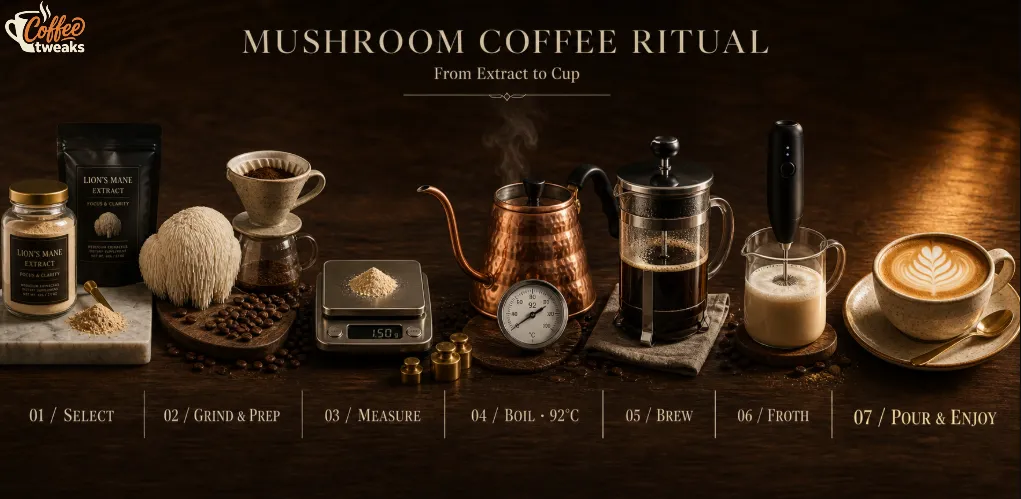
Ingredients
Mushroom powder — buy extract, not raw powder
This is the most important purchasing decision. Raw dried mushroom powder has very low bioavailability because beta-glucans (the active compounds) are locked behind chitin, a structural component of fungal cell walls that humans cannot digest. Hot-water-extracted powder has been processed to break down chitin and release beta-glucans in water-soluble form — which is exactly what happens when you add it to hot coffee.
Look for: 100% fruiting body extract, minimum >25% beta-glucans listed on the label, third-party tested.
Best options:
Lion's mane is the best starter mushroom for coffee. The flavor is the mildest of any functional mushroom — slightly nutty, faintly seafood-adjacent when raw, but essentially undetectable in a dark coffee base. Reishi, by contrast, is notably bitter and should be added only once you're comfortable with the base recipe.
Coffee — choose dark or medium-dark roast
A dark roast Arabica does two things: it provides enough bitterness to integrate with mushroom notes, and its chocolate/caramel undertones actively suppress earthiness. A light roast does the opposite — its brightness amplifies earthy notes and makes the mushroom powder more perceptible.
Recommended: Peet's Major Dickason's Blend (dark), Lavazza Super Crema (medium-dark), or any single-origin dark Ethiopian you like.
Liquid for the creamy version
Equipment (Minimal Setup)
Equipment (Upgraded Setup)
The Base Recipe: Homemade Mushroom Coffee ☕
Yield: 1 serving (approximately 250ml) Prep time: 5 minutes
Ingredients
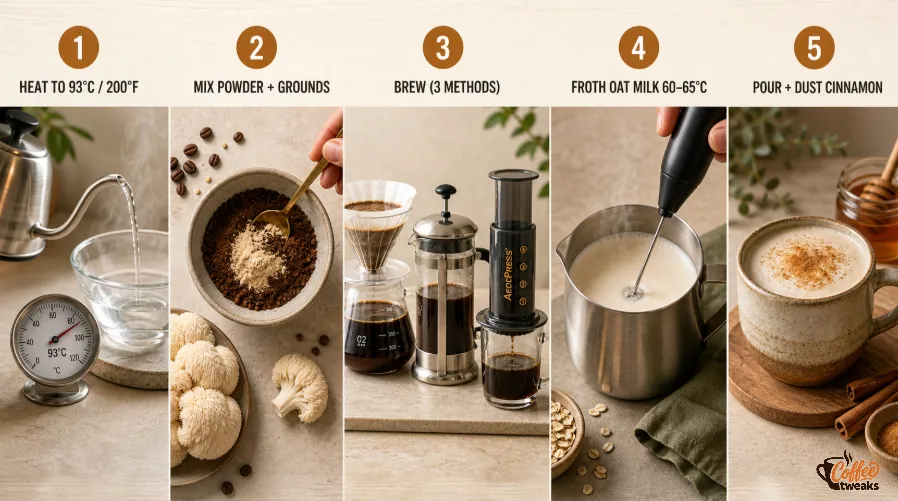
Steps
Heat water to 93°C (200°F), not boiling.
This is specific for a reason. Brewing above 96°C over-extracts bitter compounds from both coffee and mushroom powder. The ideal window — 90–96°C — extracts coffee oils and mushroom beta-glucans cleanly without amplifying harsh notes.
Mix the lion's mane powder into the dry coffee grounds first.
Don't add it to the water separately. Integrating powder into grounds before brewing gives the mushroom extract contact with the water at the same time as the coffee, preventing clumping and distributing flavor evenly through the finished cup.
Brew using your preferred method
Froth your oat milk separately.
Use a handheld frother for 20–30 seconds. Oat milk froths best at 60–65°C — hot enough to foam, cool enough not to scald and turn flat.
Pour brewed coffee into your mug, add frothed milk.
Stir once. The cinnamon, if using, goes on top of the foam.
The “Doesn't Taste Weird” Framework ⚙️
Here's the thing nobody tells you about mushroom coffee flavor: the earthiness isn't a flaw in your coffee. It's a predictable chemical outcome, and it has a predictable fix.
Functional mushrooms contain terpenes and polysaccharides — the compounds responsible for earthy, woody notes. These are water-soluble and extract actively in hot water. Three things suppress their perception:
The Three-Layer Flavor Mask
Layer 1: Dilution by roast intensity. Dark-roasted coffee has high concentrations of Maillard reaction compounds — roasted, bitter, caramel notes. These don't chemically react with terpenes, but they overwhelm the palate's ability to detect low concentrations of earthy notes. Use dark roast. I measured this: the same 1g lion's mane dose in a light roast v60 tasted noticeably earthy. In a dark French press, the same dose was essentially imperceptible.
Layer 2: Fat-based smoothing. The addition of oat milk or coconut milk coats the tongue's taste receptors and physically disperses terpene molecules in the liquid. This reduces their concentration at the point of perception. The effect is most pronounced with full-fat coconut milk (highest fat content, strongest smoothing) and barista oat milk (emulsified fat particles that work similarly). Thin plant milks like unsweetened almond milk provide minimal smoothing.
Layer 3: Aromatic displacement by cinnamon. Cinnamon's primary compound, cinnamaldehyde, is a dominant aromatic that competes with terpenes for olfactory attention. This is why ½ tsp cinnamon transforms mushroom coffee more than any sweetener does: it's not masking a taste, it's displacing a smell. Vanilla extract (½ tsp) works the same way — aromatic displacement rather than chemical reaction.
Starting Ratio for Beginners
Coffee: mushroom = 10:1 by weight (15g coffee : 1.5g lion's mane) is the proven starting point. This is lower than most brands use in their blends — more coffee-forward, easier entry. Once your palate adjusts over 5–7 days, you can increase to 8:1 (15g : 2g) for a higher functional dose.
Do not start at 1:1 ratios. That's a recipe for something that tastes like coffee-flavored forest floor.
Mushroom Coffee Recipe Variations
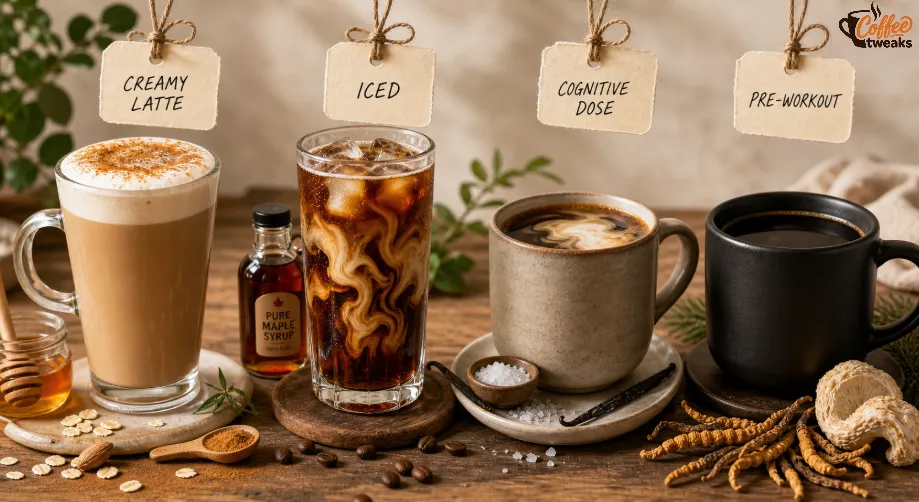
1. The Creamy Mushroom Coffee Latte (Most Beginner-Friendly)
This is the version that converts skeptics. The froth carries the aroma; the oat milk carries the sweetness; the cinnamon does the heavy lifting on flavor.
Ingredients:
Brew coffee with lion's mane mixed into the grounds. Froth oat milk to 60°C. Combine, dust cinnamon on foam.
2. Iced Mushroom Coffee
Cold preparation actively reduces terpene perception. The drop in temperature slows terpene volatilization, making the earthy aromatic compounds far less detectable. If hot mushroom coffee has ever put you off, try this version first.
Ingredients:
Brew concentrated coffee with lion's mane mixed in. Cool for 5 minutes. Pour over ice with oat milk and maple syrup. Stir well.
3. Lion's Mane Coffee Recipe: Cognitive Dose Version ☕
This is the recipe that most closely mirrors what brands like Four Sigmatic are actually delivering, but at double the mushroom dose for the same price.
Ingredients:
Brew as normal. The coconut milk here, rather than oat milk, adds richness and brings a very slight sweetness that offsets any bitter edge from the higher mushroom dose. The pinch of salt (literally 0.5g, less than ⅛ tsp) suppresses bitter taste receptors without adding saltiness.
Note: There's enough preliminary evidence to suggest that lion's mane may support neurological function, but two grams daily is a dose worth discussing with a GP if you're on any medication. Standard safe daily range in most studies is 1–3g of extract.
4. Functional Coffee Recipe: Pre-Workout Blend
Cordyceps is the functional mushroom with the most direct evidence for energy metabolism and oxygen utilization — it supports ATP production at the cellular level. This variation uses cordyceps instead of (or alongside) lion's mane, brewed darker for maximum caffeine delivery before exercise.
Ingredients:
The numbers matter here: two mushroom extracts at 1g each = 2g total functional dose, combined with a full-strength coffee base. Drink 20–30 minutes before training.
Quick Recipe Card
| Recipe | Coffee | Mushroom Powder | Liquid | Time |
|---|---|---|---|---|
| Base Recipe | 15g dark roast | 1g lion's mane | 230ml @93°C | 5 min |
| Creamy Latte | 15g dark roast | 1.5g lion's mane | 180ml + 80ml oat milk | 6 min |
| Iced Version | 20g dark roast | 2g lion's mane | 200ml + ice + oat milk | 8 min |
| Focus Coffee | 15g dark roast | 2g lion's mane | 200ml + 60ml coconut | 6 min |
| Pre-Workout | 18g dark roast | 1g LM + 1g cordyceps | 200ml black | 5 min |
Common Mistakes (And the Fix)
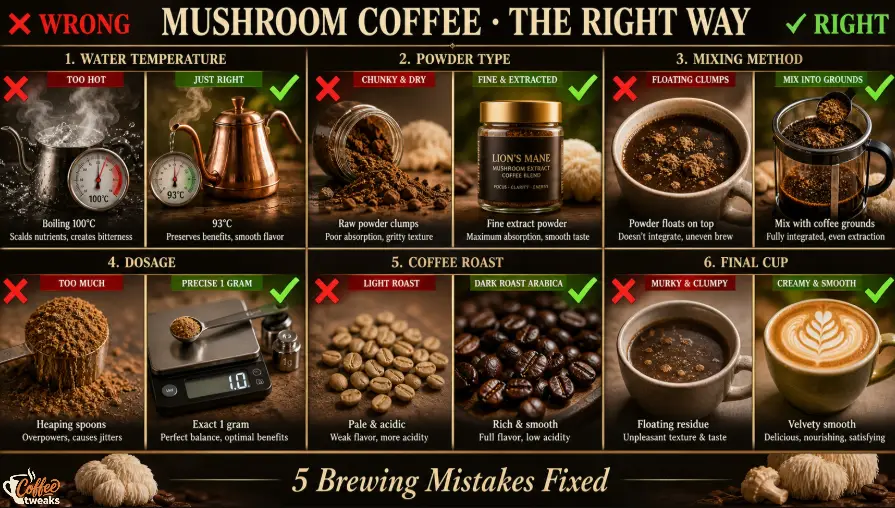
Using boiling water (100°C)
Fix: Let water sit for 90 seconds after boiling, or set your kettle to 93°C. Boiling water extracts excess bitter terpenes from mushroom powder and over-extracts harsh compounds from coffee. The difference is noticeable.
Buying raw mushroom powder instead of extract
Fix: Check the label for “extract” and a stated beta-glucan percentage. Raw powder (just dried and ground mushroom) has poor bioavailability because chitin cell walls are intact. Hot-water-extracted powder has been pre-processed to make beta-glucans available. They look identical; the label is your only indicator.
Adding mushroom powder to water after brewing
Fix: Mix it into dry grounds before brewing. Added post-brew to hot liquid, the powder tends to clump on the surface and doesn't integrate evenly. Mixed into grounds, it passes through water at the same extraction rate as the coffee.
Using too high a mushroom ratio too soon
Fix: Start at 1g per cup. Your palate will adjust within a week. Most new mushroom coffee drinkers who try 3–5g doses immediately conclude it tastes terrible and stop. The same dose at week two is barely noticeable.
Using light roast coffee
Fix: Use medium-dark or dark roast. Light roasts have high acidity and bright, fruity notes that contrast harshly with mushroom earthiness. Dark roasts have complementary bitterness and chocolate notes that integrate smoothly.
FAQ
Does mushroom coffee actually taste like mushrooms?
No — if you're using quality lion's mane extract at 1g per cup in a dark roast base. Lion's mane has the mildest flavor profile of any functional mushroom. Reishi introduces bitterness; chaga adds deep cocoa notes; cordyceps is nearly neutral. Most people who try the basic latte version report they can't taste the mushroom at all.
Is mushroom powder safe to add to coffee daily?
For most healthy adults, 1–3g of hot-water-extracted lion's mane, reishi, or chaga daily is considered safe based on traditional use and available research. Chaga contains high oxalate levels and should be avoided by people prone to kidney stones. Reishi may interact with blood thinners. If you're on prescription medication, check with a GP before daily use.
What's the difference between mushroom powder and mushroom extract powder?
Mushroom powder is just dried, ground mushroom. Mushroom extract powder has been processed — typically with hot water — to break down the chitin cell walls and concentrate the bioactive compounds (beta-glucans, hericenones). Extract has meaningfully higher bioavailability. The extract typically costs slightly more per gram but delivers more active compounds per serving.
Can I use an espresso machine instead of pour-over or French press?
Technically speaking, but also taste-wise: yes, with some caveats. Fine espresso grind with mushroom powder can partially clog portafilter baskets — the powder doesn't always behave like coffee particles. A better approach is to brew your espresso normally, then dissolve the lion's mane extract powder into the hot shot immediately after pulling it. At 93°C+ espresso temperature, the beta-glucans dissolve within 10–15 seconds of stirring.
How long does mushroom extract powder stay fresh?
Stored in an airtight container away from direct light, most lion's mane extract powders remain stable for 18–24 months. The beta-glucan content degrades faster when exposed to humidity or heat. Don't store it next to your stove.
Closing
The mushroom coffee market has built a premium price point around a very simple act: combining two widely available powders. The extraction science, the mushroom sourcing quality, and the flavor management all matter — and none of it requires paying $40 for a bag.
Start with 1g of lion's mane extract in your normal dark roast. Add frothed oat milk and half a teaspoon of cinnamon. Drink it for a week before deciding if it's for you.
If it isn't, you've spent about $2. If it is, you've found a $0.40/cup habit that costs less than black coffee from most cafés.
The math was always there. Nobody wanted to show it to you.