
Coffee and ADHD: Does Caffeine Actually Help Focus?

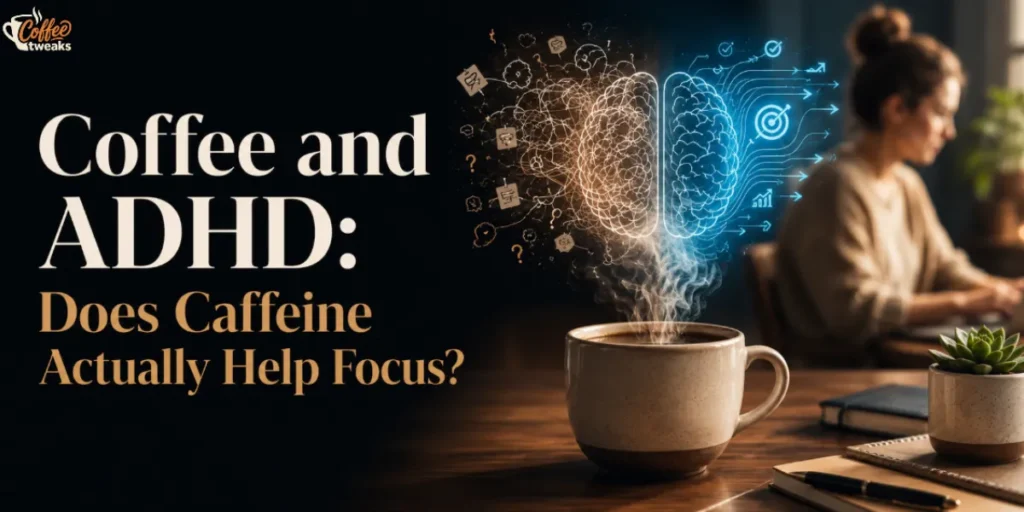
Most people assume caffeine makes everyone more alert, more wired, more restless.
Yet many adults with ADHD describe the opposite effect.
They drink coffee and feel calmer.
Less scattered.
More able to finish one task before starting three others.
That reaction isn't imaginary. The relationship between coffee and ADHD has a plausible neurochemical explanation, one that sits at the intersection of dopamine signaling, adenosine receptor pharmacology, and the way attention is regulated in the ADHD brain.
Here's the thing nobody tells you: the question isn't really “does caffeine help focus?” The real question is “does caffeine help this specific brain focus, and under what conditions?” Those are entirely different questions. And the answers are a lot more interesting than most wellness articles let on.
Why the ADHD Brain Is Different ⚙️
To understand why coffee affects people with ADHD differently, you need to understand what ADHD actually is at a neurological level.
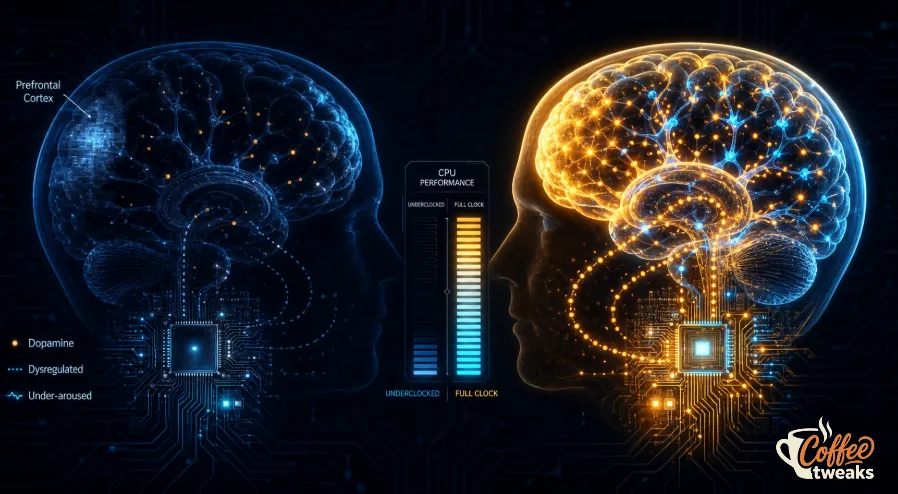
ADHD is not fundamentally a hyperactivity disorder. It is a dopamine regulation disorder.
The prefrontal cortex, the brain's executive command center, responsible for planning, decision-making, working memory, and impulse control, relies heavily on dopamine signaling to function optimally.
In ADHD brains, this dopamine system is dysregulated. Dopamine transporters clear dopamine from synapses too quickly, receptors are often less responsive, and the reward circuitry fires inconsistently. The result is a brain that struggles not because it lacks intelligence or effort, but because its chemical infrastructure for sustained, directed attention is operating below baseline.
Think of it this way: the prefrontal cortex in an ADHD brain is like a computer running on an underpowered processor. The software is fine. The processor keeps dropping clock speed at the exact moment you need it most.
This creates the core ADHD experience:
The ADHD brain is not overstimulated. In most cases, particularly in the circuits that govern focus and executive function, it is chronically under-aroused.
That distinction matters enormously when we talk about what caffeine does.
The Pharmacology of Caffeine ⚙️
Technically speaking, caffeine is a methylxanthine compound. It is the world's most widely consumed psychoactive substance. And its primary mechanism is surprisingly elegant.
Adenosine is a neurotransmitter that accumulates in your brain throughout the day as a byproduct of neural activity. The longer you've been awake, the more adenosine has built up. When adenosine binds to its receptors, primarily A1 and A2A receptors, it tells the brain to slow down. You feel tired, mentally sluggish, less motivated. That's adenosine working as intended.
Caffeine is structurally similar enough to adenosine that it competes for the same receptor sites. It slots into adenosine receptors but doesn't activate them. It blocks them. By doing so, it prevents the brain from receiving the “slow down” signal, and the result is a state of sustained wakefulness.
But here's where it gets more relevant to ADHD.
The A2A adenosine receptor shares a co-localized relationship with the dopamine D2 receptor. When caffeine blocks A2A receptors, it indirectly potentiates dopamine receptor signaling. Dopamine, which was being partially suppressed by adenosine, is now able to act more freely. Caffeine also promotes norepinephrine release, which further enhances alertness and attention.
So caffeine's path to improving focus is:
- Block adenosine → remove the brain's fatigue signal
- Potentiate dopamine signaling → increase drive, motivation, and attention
- Increase norepinephrine → boost alertness and arousal
For a neurotypical brain that's already reasonably dopamine-balanced, this mainly produces the familiar effect: alertness, slightly elevated heart rate, reduced tiredness, sometimes jitteriness.
For an ADHD brain that's chronically dopamine-deficient in key circuits, introducing a substance that potentiates dopamine signaling doesn't create overstimulation. It moves the system closer to baseline.
That's why the ADHD brain responds differently. Caffeine is nudging an under-aroused system toward optimal function, rather than pushing an already-optimized system into overdrive.
Why Coffee Makes Some ADHD Adults Feel Calmer ⚙️
This is the question most people with ADHD actually want answered, because it feels paradoxical and slightly strange to admit.
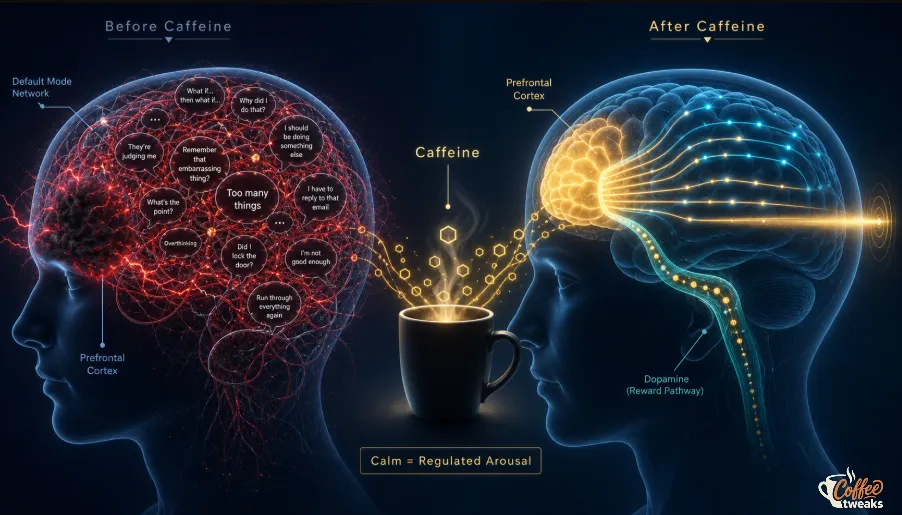
“I drink coffee, and I feel… calm. Less noisy. More like myself.”
The clinical term for this is the paradoxical effect of stimulants in ADHD. It is well-documented and mechanistically sound.
Here's what's happening at the neurological level.
The ADHD brain in a low-stimulation state is not quiet, it is chaotic. The default mode network (the brain's background processing system, active during rest and mind-wandering) tends to remain highly active in ADHD even when the person is trying to focus on a task.
Intrusive thoughts, daydreaming, task-switching, restlessness, these are not laziness or distraction. They are the symptom of a brain struggling to downregulate irrelevant neural chatter and upregulate task-relevant circuits.
When caffeine provides mild stimulation through adenosine blockade and dopamine potentiation, it gives the prefrontal cortex just enough of a boost to:
The subjective experience of all this is: calm. Not sedation. Not fatigue. But a reduction in mental noise and an increase in purposeful mental engagement.
Importantly, “calm” in this context means regulated arousal, not lowered arousal. The person isn't sedated, they are operating at a more efficient, less chaotic frequency.
Does Coffee Actually Help ADHD Symptoms?
Let's go symptom by symptom and be honest about what the evidence actually shows.
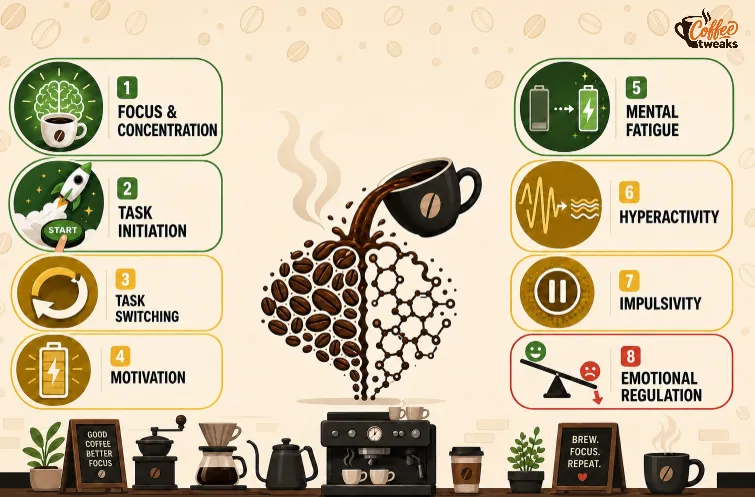
1. Focus and concentration: Some evidence of benefit, particularly for tasks requiring sustained attention with moderate cognitive demand. Research published in Nutrients found that caffeine improved attention and concentration in ADHD animal models.
However, a 2024 meta-analysis of human studies found the reduction in ADHD symptoms to be present but not statistically significant compared to placebo. The effect exists; it is just inconsistent and considerably milder than prescription medication.
2. Task initiation (executive dysfunction): This is where many ADHD adults report the most subjective benefit. Coffee can lower the activation energy needed to begin a task, partly through dopamine's role in initiating reward-directed behaviour. The research base here is thinner in humans, but the mechanistic logic is sound, and the anecdotal evidence is consistent.
3. Task switching: Limited evidence. Caffeine may improve the ability to disengage from one task and shift to another under high-demand conditions, but this effect is inconsistent across individuals.
4. Motivation: Modest benefit. Dopamine potentiation through adenosine blockade can increase goal-directed behaviour, but the effect is dose-dependent and tolerance-limited.
5. Mental fatigue: Caffeine's primary strength. It reliably reduces perception of mental fatigue by blocking adenosine. For ADHD adults who routinely burn through cognitive resources compensating for executive dysfunction, this is genuinely useful.
6. Hyperactivity: Unclear, but theoretically beneficial at the right dose. If hyperactivity is partially a behavioural symptom of under-arousal and dopamine-seeking, then improving dopamine tone through caffeine may reduce the drive to seek stimulation through movement. This is the same mechanism that makes stimulant medications paradoxically calming for hyperactive ADHD presentations.
7. Impulsivity: Weak evidence. Caffeine does not consistently improve impulse control.
8. Emotional regulation: Often worsened by caffeine, particularly at higher doses. This is a counterintuitive but important finding, and we'll explore it in detail shortly.
Caffeine vs. ADHD Medication: An Honest Comparison ⚙️📊
This is the section most people with ADHD are actually looking for when they search “caffeine vs Adderall.” Let's be thorough, accurate, and medically responsible.
First, the mechanisms:
| Category | Caffeine | Amphetamine (Adderall) | Methylphenidate (Ritalin/Concerta) |
|---|---|---|---|
| Primary mechanism | Adenosine receptor antagonism | Dopamine/norepinephrine release + reuptake inhibition | Dopamine/norepinephrine reuptake inhibition |
| Dopamine effect | Indirect, potentiates signaling | Direct, floods synapses | Direct, prevents clearance |
| Norepinephrine effect | Indirect increase | Strong direct increase | Strong direct increase |
| Prefrontal cortex targeting | Non-specific | Highly targeted | Highly targeted |
| Clinical evidence for ADHD | Weak to moderate (mostly animal studies) | Very strong | Very strong |
| Onset | 30–60 minutes | 30–60 minutes | 30–60 minutes |
| Duration | 3–7 hours (variable) | 4–6 hours (IR), 10–12 hours (XR) | 4–8 hours (IR), 10–12 hours (XR) |
| Predictability | Low, varies with tolerance, sleep, food, timing | High, consistent dosing | High, consistent dosing |
| Controlled substance | No | Yes (Schedule II) | Yes (Schedule II) |
| Cardiovascular effects | Moderate, raises heart rate, BP | Significant, heart rate, BP increase | Significant, heart rate, BP increase |
The fundamental distinction is this: caffeine works indirectly through adenosine receptors and nudges dopamine activity. Prescription stimulants work directly on dopamine and norepinephrine transporters in the exact brain circuits that govern executive function in ADHD.
Caffeine is a general-purpose wakefulness promoter that happens to secondarily benefit some ADHD symptoms. Prescription ADHD medication is specifically engineered to correct the dopaminergic deficit underlying the condition.
The numbers matter here. Clinical trials show that amphetamine-based medications reduce ADHD symptoms in roughly 70–80% of patients. The evidence base for caffeine as a therapeutic agent in human ADHD is far smaller, far less consistent, and has never demonstrated the same magnitude of effect.
✅ What caffeine can do: Provide mild, temporary improvement in alertness, motivation, and task initiation for some ADHD adults, particularly at low-to-moderate doses in well-rested individuals.
❌ What caffeine cannot do: Replace medication. Reliably treat core ADHD symptoms. Improve working memory to clinical significance. Provide consistent, predictable symptom management. Substitute for evidence-based treatment, behavioural therapy, structured interventions, or pharmacotherapy under clinical supervision.
Never stop or adjust prescribed medication based on caffeine response without speaking to your prescribing clinician.
The Dosage Question ☕📊
The numbers matter here enormously, and most ADHD articles skip this part.
Typical caffeine content in common drinks:
| Drink | Caffeine (approximate) |
|---|---|
| Espresso (single shot, 30ml) | 63–75 mg |
| Drip coffee (240ml / 8oz) | 95–150 mg |
| Cold brew (240ml) | 150–250 mg (higher extraction) |
| Instant coffee (240ml) | 60–90 mg |
| Energy drink (250ml) | 80–160 mg |
| Pre-workout (single serving) | 150–300+ mg |
In terms of functional effect on attention and cognition:
Here's the thing nobody tells you: more caffeine does not mean more focus for ADHD adults. It often means hitting a ceiling, and then crossing into territory where anxiety worsens and attention actually deteriorates.
The Yerkes-Dodson law applies here directly. Cognitive performance follows an inverted-U curve with arousal level. ADHD brains start from a lower baseline arousal, meaning the optimal zone shifts slightly, but the peak still exists, and high caffeine doses push past it into over-arousal.
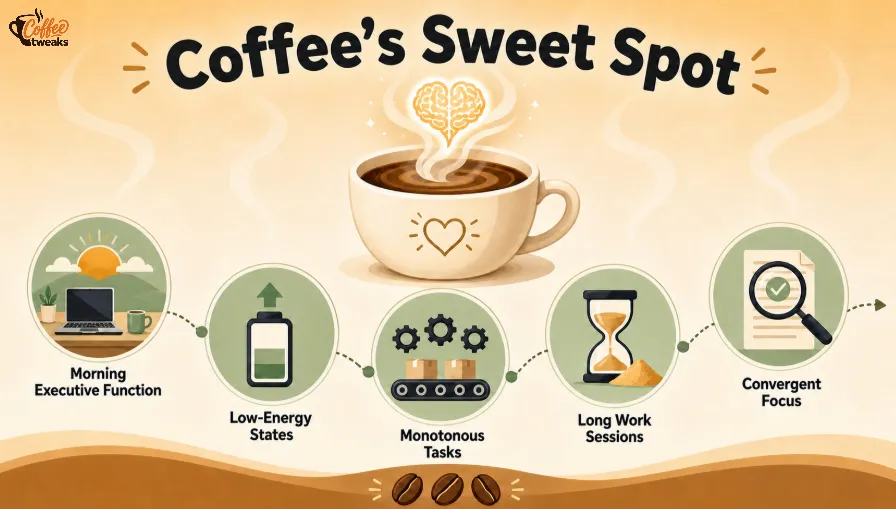
When Coffee Helps ☕
There are specific contexts where caffeine genuinely supports ADHD function:
When Coffee Makes ADHD Worse ☕⚙️
This is the section most coffee-loving ADHD adults would rather skip, but it's possibly the most important.
The Sleep Connection — The Most Important Section ⚙️
Here's an insight that changes how you should think about caffeine and ADHD entirely.
Poor sleep and ADHD are bidirectionally linked. ADHD disrupts sleep through racing thoughts, delayed sleep phase, difficulty transitioning to bed, and overnight restlessness. Poor sleep, in turn, mimics and amplifies ADHD symptoms, degrading working memory, executive function, impulse control, and emotional regulation in ways that are clinically indistinguishable from ADHD's core deficits.
Now here's where caffeine creates a trap.
A poorly-rested ADHD adult reaches for coffee in the morning to combat fatigue, reasonable enough. Caffeine improves morning function. They feel better. Then they drink more in the afternoon to get through the day.
The caffeine they consume at 2 PM still has measurable concentration in their bloodstream at 8 PM, thanks to that 3–7 hour half-life. Sleep onset is delayed. Sleep quality deteriorates. The next morning, they feel worse than yesterday. They need more coffee to function. The cycle deepens.
What makes this particularly insidious for ADHD adults is that adenosine, the molecule caffeine blocks, is partly responsible for deep, restorative slow-wave sleep. Chronically blocking adenosine with late-day caffeine doesn't just delay sleep onset; it may reduce the quality of sleep that does occur, including the stages most critical for memory consolidation and cognitive restoration.
The result: an ADHD adult who genuinely cannot tell whether they're experiencing ADHD symptoms or sleep-deprivation symptoms, because they have both, each making the other worse, with caffeine sitting at the center of the cycle.
The practical implication is simple but hard: caffeine timing matters more than caffeine quantity. Setting a firm caffeine cutoff, typically no later than early-to-mid afternoon for most people, is one of the highest-leverage interventions available to ADHD adults who drink coffee.
Why Caffeine Works One Day and Fails the Next ⚙️
You've probably noticed this. Monday: coffee produces clean focus, you're productive, the day flows. Tuesday: same coffee, same amount, you feel vaguely anxious, scattered, slightly worse than before.
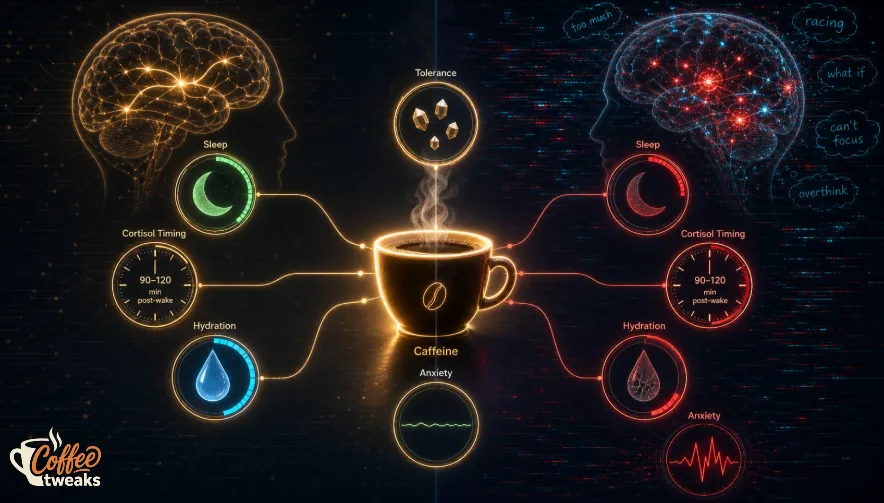
This inconsistency is real and not imaginary. Several factors explain it:
Sleep quality. Caffeine's effectiveness is significantly modulated by how well-rested you are. On a well-slept day, caffeine clears a low adenosine load and fine-tunes a functional system. On a sleep-deprived day, adenosine load is massive, caffeine is fighting a much larger buildup, and the cortisol response it triggers adds anxiety on top of an already-stressed nervous system.
Cortisol timing. Cortisol peaks naturally in the first 90 minutes after waking. Drinking coffee during this window essentially stacks stimulation on top of the body's natural alertness peak, providing little benefit while accelerating tolerance development. Many chronobiologists now suggest delaying first coffee consumption 90–120 minutes after waking, when cortisol is naturally declining and caffeine's adenosine-blocking effect is most useful.
Tolerance. The ADHD brain builds caffeine tolerance like any other. Regular caffeine consumption leads to upregulation of adenosine receptors, the brain builds more receptor sites to compensate for the blockade. You eventually need more caffeine to achieve the same effect. Daily heavy coffee drinkers with ADHD are often no longer getting meaningful focus benefits, they are simply preventing withdrawal (which, ironically, creates ADHD-like cognitive fog of its own).
Hydration and food intake. Caffeine is a mild diuretic. Cognitive performance deteriorates with even mild dehydration, and ADHD adults, who often forget to eat and drink regularly, are frequently operating in a dehydrated state when they expect caffeine to perform.
Comorbid anxiety states. On days when the anxiety load is already high, a stressful meeting, a conflict, a deadline, caffeine's cortisol and norepinephrine boost can tip the balance from focused to overwhelmed.
Why Some ADHD Adults Get Sleepy After Coffee ⚙️
This deserves its own moment because it confuses a lot of people.
For an ADHD brain that is severely under-aroused, operating significantly below the optimal arousal threshold, caffeine provides a mild upward nudge. If that nudge brings the brain closer to its baseline optimal functioning level, the nervous system interprets this as a cue to relax. The constant, exhausting effort of trying to focus through cognitive chaos eases. The default mode network quiets somewhat. The subjective result is not alertness, it is relief.
Think of it like a muscle that's been held in constant tension. When that tension finally releases, the response is relaxation, sometimes almost drowsiness.
Additionally, there's an important interaction here: if an ADHD adult is sleep-deprived (very common in this population), the caffeine may normalise enough function to allow the body's sleep drive to surface. The fatigue was always there. The stimulant was masking it. When the stimulant also provides some focus benefit, the system settles enough to actually register how tired it is.
This is not a sign that caffeine “doesn't work.” It can be a sign that it worked too well in the short term, bringing the brain to a state where rest becomes the natural, appropriate response.
What the Research Actually Says 📊
Let me be direct about the state of the science, because it's more nuanced than most articles admit.
Final Verdict: Does Coffee Actually Help ADHD? ☕📊
Here is the honest, evidence-based answer.
For some ADHD adults, in the right dose, at the right time, under the right conditions: yes. Caffeine can provide real, if modest, improvements in alertness, task initiation, motivation, and the subjective experience of mental noise reduction. The mechanistic pathway through adenosine blockade and dopamine potentiation is scientifically sound. The paradoxical calming effect experienced by many ADHD adults has a coherent neurological explanation. These are not imaginary effects.
But coffee is not an ADHD treatment. The evidence base is nowhere near the level required to call it therapeutic. Its effects are inconsistent, dose-sensitive, tolerance-limited, and highly dependent on sleep, timing, anxiety state, and individual neurobiology. It does not reliably address the core executive function deficits of ADHD. It can worsen emotional regulation. And if it's disrupting your sleep, it is almost certainly making your ADHD symptoms worse over the medium term, even while it appears to help in the short term.
The practical picture that emerges from the research:
The reason many ADHD adults feel better after coffee is real. The chemistry is real. The dopamine story is real. But coffee is a blunt tool applied to a precise problem, and understanding its limits is just as important as understanding why it sometimes works.
The ADHD brain deserves better than just a lifetime of coffee and hope. But for a morning cup that takes the edge off the chaos? The science says: there's something genuinely there.