Coffee Addiction: Is It Real, and How Do You Break It?

So here's what happened.
I was in my kitchen last winter, staring at the coffee machine at 7 a.m., and I had this weird thought: I don't actually want this right now. I wasn't tired. I wasn't cold. I wasn't even particularly in the mood for coffee.
But I made it anyway. Because not making it felt… wrong. Like something would be off about the whole day.
That tiny moment nagged at me for weeks. Was this coffee addiction, or did I genuinely love the smell, the ritual, and the warmth? Or was I just running from a headache I hadn't gotten yet?
I went deep into the research. I read through Johns Hopkins studies, NIH papers, sleep research, and psychiatry journals. I talked to people who'd quit. I tried cutting back myself.
Here's everything I found, honestly, without the scare tactics.
First: Is Coffee Actually Addictive?
This is the question, right? And the answer is… it depends on what you mean by addictive.
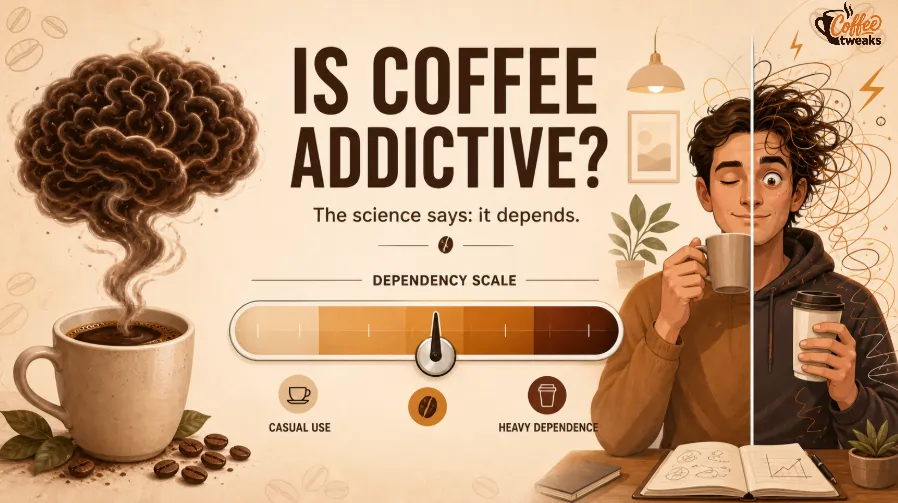
The short version: Caffeine produces physical dependence in regular users. But it's not the same kind of addiction as cocaine, alcohol, or nicotine, and that distinction genuinely matters.
Here's where the science lands:
Researchers at Johns Hopkins University School of Medicine have been studying this for decades. Their conclusion? A condition called Caffeine Use Disorder is real, real enough that the Diagnostic and Statistical Manual of Mental Disorders (DSM-5) includes it as a condition for further study. The World Health Organization's ICD-10 already formally recognizes Caffeine Dependence Syndrome.
But here's the important nuance: most daily coffee drinkers don't meet clinical criteria for addiction. Studies suggest fewer than 9% of the general caffeine-using population would qualify for a full Caffeine Use Disorder diagnosis. The DSM-5's diagnostic threshold for caffeine is intentionally more restrictive than for other substances, precisely because nonproblematic daily coffee use is so common.
So yes, caffeine is a psychoactive drug. Yes, it can create dependence. But your morning latte is not cocaine. Not even close.
What Actually Happens in Your Brain
To understand why coffee feels so necessary, you need to understand one molecule: adenosine.
Adenosine is a neurotransmitter that accumulates in your brain throughout the day. The more it builds up, the sleepier you feel, it's basically your body's natural sleep-pressure system. Caffeine works by blocking adenosine receptors, preventing that sleepy signal from getting through.
Here's where it gets interesting:
By blocking adenosine, caffeine also indirectly boosts dopamine activity, the brain chemical associated with motivation, reward, and pleasure. This is why coffee can make you feel not just awake, but genuinely good. Research from Johns Hopkins confirms that caffeine stimulates dopaminergic activity by removing adenosine's inhibitory effect at dopamine receptors. Dopamine release in the brain's reward center (nucleus accumbens) is also triggered by harder drugs like cocaine and amphetamines, but the scale is completely different.
The key difference:
That's why you get dependent on caffeine but don't get addicted the way you would to hard drugs.
Tolerance develops for a different reason: when you drink caffeine every day, your brain compensates by growing more adenosine receptors. Now you need more caffeine to block them all. This is why two cups eventually feels like one cup used to.
The Real Difference: Habit vs. Dependence vs. Addiction
These three words get jumbled together constantly. Let's untangle them.
| Category | Habit | Dependence | Addiction |
|---|---|---|---|
| What it is | A routine behavior, often comforting | Physical reliance on a substance to feel normal | Compulsive use despite significant harm |
| Example with coffee | Morning coffee as part of your wake-up ritual | Getting headaches or fog when you skip a day | Drinking 8+ cups knowing it's wrecking your sleep and anxiety |
| Can you skip it? | Yes, with minor discomfort | Difficult, withdrawal symptoms appear | Extremely hard; attempts repeatedly fail |
| Brain chemistry | Behavioral conditioning | Adenosine receptor upregulation | Dopamine system disruption |
| Clinical concern? | None | Sometimes, especially if it's interfering with health goals | Yes |
| What it feels like | “I love my morning coffee” | “I need coffee or I get a headache” | “I can't stop even though I know it's hurting me” |
Most daily coffee drinkers fall somewhere between habit and dependence. True clinical addiction to caffeine, where use causes significant life impairment and repeated failed quit attempts, is far less common, though it does exist.
Signs You Might Be Caffeine-Dependent (Not Just a Fan)
Here's where things get relatable.
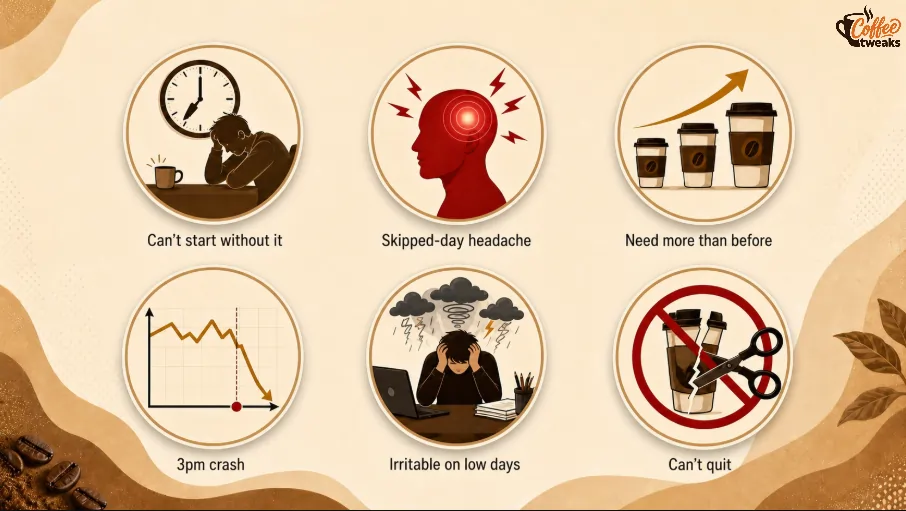
Be honest with yourself as you read these. I know I winced at a few.
1. You can't start your morning without it
Not because you love the ritual, but because you feel genuinely unwell, foggy, or like a different person without it. You're not choosing coffee; you're avoiding the absence of it.
2. Skipping a day gives you a headache
This is the most telling sign. Headaches from caffeine absence happen because your newly-grown adenosine receptors are now flooded with adenosine all at once, causing blood vessels in the brain to dilate. It's a real physiological event, not imagination.
3. You need more than you used to
Started with one cup and now need three to feel the same level of alert? That's classic tolerance. Your brain has adapted to caffeine's presence and raised the baseline.
4. The afternoon crash is brutal
When caffeine wears off and adenosine floods in all at once, energy can drop sharply. If your 3 p.m. is consistently miserable without another cup, your caffeine timing may be creating a feedback loop.
5. You're irritable, anxious, or low-grade headachey on “low coffee” days
These are mild withdrawal symptoms, even if they don't feel dramatic.
6. You've tried to cut back and couldn't
This one is the most clinically significant. A persistent desire to cut down, combined with unsuccessful attempts, is one of the DSM-5's primary diagnostic criteria for Caffeine Use Disorder.
Quick gut check: If coffee feels like a choice, you probably have a habit. If skipping it feels like a health event, you're likely dependent.
What Happens When You Actually Stop
Whether you're quitting forever or just doing a reset, your body will react, and it helps to know what's coming.
Caffeine withdrawal has a recognized clinical syndrome. The symptoms are real, they're documented, and they follow a predictable timeline.
The Withdrawal Timeline
🕐 Day 1 (12–24 hours after your last cup)
This is when symptoms typically begin. Most people notice:
What's happening: Adenosine is flooding the receptors that caffeine used to block. Blood vessels are dilating.
🕑 Days 2–3 (Peak Withdrawal)
This is the hardest window. Symptoms peak between 20 and 51 hours after the last dose:
What's happening: Your brain is recalibrating. It's trying to figure out its new normal without caffeine's constant interference.
🕒 Days 4–7 (Gradual Improvement)
The headaches typically subside. Energy starts to stabilize. Brain fog begins to lift. Many people are surprised to feel more naturally alert by the end of the first week, especially if their sleep quality improves without late caffeine in the system.
What's happening: Adenosine receptor density is beginning to normalize. Your brain is reclaiming its natural chemistry.
🕓 Week 2 and Beyond
For most people, withdrawal is fully resolved. Research shows caffeine withdrawal typically lasts 2 to 9 days in total. After that, many people report:
⚠️ Important reminder: These symptoms are dose-dependent. Someone who drinks one cup a day will have a much easier withdrawal experience than someone drinking 600mg+ daily.
Coffee, Anxiety, and Mental Health: The Honest Conversation
This is the part I wish someone had explained to me years ago when I was in a stressful Barcelona winter, drinking four espressos a day and wondering why I felt wired and exhausted simultaneously.
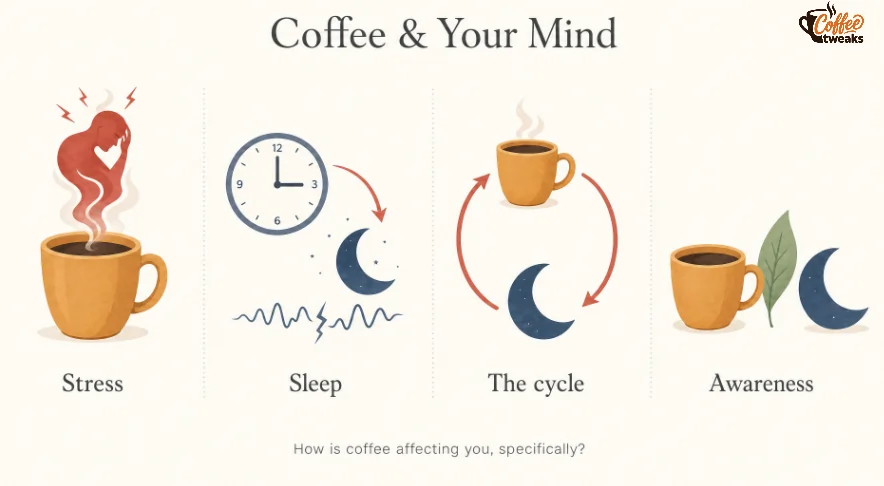
Caffeine and cortisol
Caffeine stimulates your adrenal glands to release cortisol, your body's primary stress hormone. Morning coffee on an empty stomach, or coffee consumed during an already stressful period, can amplify feelings of anxiety, racing thoughts, and physical tension. This isn't a character flaw. It's chemistry.
Caffeine and anxiety sensitivity
Not everyone responds to caffeine the same way. Genetic variations, specifically in the ADORA2A gene (adenosine A2A receptor), determine how sensitive you are to caffeine's anxiety-producing effects. Some people can drink espresso at midnight and sleep fine. Others feel their heart race from half a cup. Both are valid. Neither is wrong.
Caffeine and sleep, the silent disruptor
This is the sneaky one. Caffeine has a half-life of roughly 5 to 6 hours, meaning that 3 p.m. cup still has half its caffeine circulating in your system at 9 p.m. Poor sleep then drives you to drink more caffeine the next morning. Which disrupts the next night's sleep. And around it goes.
The Sleep Foundation consistently flags caffeine timing as one of the most impactful variables in sleep quality, not just quantity, but depth of sleep, particularly the restorative slow-wave stages.
But here's the important balance:
Most people tolerate moderate caffeine intake (up to 400mg daily per FDA guidelines) without significant mental health impact. If you're not anxious, sleeping well, and feel good, there's no science demanding you quit. The research on coffee also shows real benefits: improved focus, cognitive performance, and even long-term associations with reduced risk of certain diseases.
The goal isn't fear. It's awareness.
The question isn't “is coffee bad?” It's “how is coffee affecting you, specifically?”
How to Quit (or Cut Back) Without Feeling Miserable
Let's say you've decided something needs to change. Maybe you want to reset your tolerance. Maybe the anxiety is real and you want to test life without caffeine. Maybe you just want to prove to yourself that you can go a week without it.
Here's what actually works, backed by both research and real-world experience.
The Step-by-Step Reduction Plan
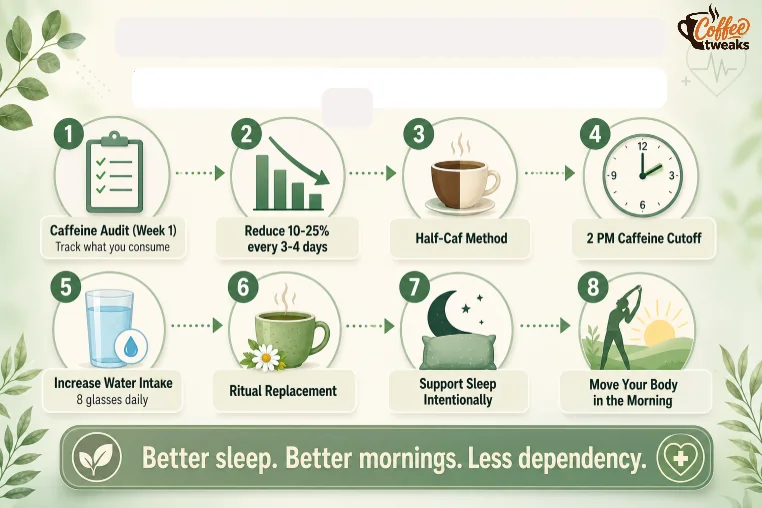
Step 1: Do a caffeine audit (Week 1)
Before cutting anything, track what you're actually consuming. Most people underestimate this significantly. Remember: coffee, tea, pre-workout, chocolate, certain medications, and energy drinks all count.
Step 2: Reduce by 10–25% every 3–4 days
The Cleveland Clinic specifically advises against quitting cold turkey, it dramatically increases withdrawal severity and paradoxically deepens dependency (because reaching for something to relieve the headache creates a new reinforcement cycle). Slow reduction prevents withdrawal from becoming dramatic.
Step 3: Use the half-caf method
If you're on espresso or strong drip coffee, start mixing 50% decaf with your regular beans. Your taste buds won't notice much. Your adenosine receptors will thank you.
Step 4: Set a hard caffeine cutoff time
Medical professionals recommend stopping caffeine by 2 p.m. to protect sleep. Better sleep means less morning fatigue, which means less need for caffeine, which starts breaking the feedback loop.
Step 5: Increase water intake significantly
Dehydration masquerades as fatigue constantly. Cleveland Clinic's registered dietitian Beth Czerwony notes that people often drink caffeine because they feel they can't stay awake, but dehydration is frequently the actual cause of low energy. Eight glasses a day sounds boring, but it genuinely shifts energy levels.
Step 6: Find a ritual replacement
Research shows that much of caffeine's behavioral pull is tied to the ritual, not just the molecule. The morning warmth. The smell. The pause before the day begins. Replacing espresso with a good herbal tea or even a warm mug of lemon water preserves the ritual while removing the dependency.
Step 7: Support sleep intentionally
Better sleep reduces morning caffeine need dramatically. During your reduction period: keep a consistent sleep schedule, reduce screens 30 minutes before bed, and consider magnesium glycinate or chamomile, both have evidence behind them for improving sleep quality.
Step 8: Move your body in the morning
Even 10 minutes of movement increases natural dopamine and cortisol in a healthy, sustainable way. This partially replaces what caffeine was doing without the dependency side effects.
What About Tea As a Transition?
Yes, this works beautifully. Green tea contains L-theanine, an amino acid that promotes calm focus and actually moderates caffeine's more anxious effects. Many people find switching from coffee to green or white tea reduces withdrawal discomfort significantly while preserving the ritual and delivering a gentler, more sustained energy lift.
Do You Actually Need to Quit?
Here's my honest answer: probably not, unless coffee is genuinely causing problems.
If you:
…then you likely have a habit, possibly mild dependence, and no pressing health reason to quit entirely.
What might genuinely help you is:
There's solid, peer-reviewed research on coffee's health benefits too. Harvard Health, the American Heart Association, and multiple large-scale studies have linked moderate coffee consumption to reduced risk of type 2 diabetes, Parkinson's disease, and certain liver conditions. Quitting coffee is not inherently healthier for everyone.
FAQ: Your Questions, Answered Honestly
Is coffee addictive?
It can create physical dependence in regular users, but it's not classified as an addiction the same way as alcohol, nicotine, or illegal drugs. The DSM-5 includes “Caffeine Use Disorder” as a condition for further study, but genuine clinical addiction to caffeine is less common than simple dependence.
How much caffeine is too much?
The FDA recommends no more than 400mg per day for healthy adults, roughly 4–5 standard cups of drip coffee. The American Medical Association is slightly more conservative at 250mg (about 3 cups). Pregnant individuals should stay under 200mg daily. Individual sensitivity varies significantly based on genetics.
How long does caffeine withdrawal last?
Most people experience symptoms for 2 to 9 days. The peak intensity usually hits at 20–51 hours after the last dose. After day 7, the majority of withdrawal discomfort is resolved for moderate users.
Can caffeine cause anxiety?
Yes, for some people, particularly those with genetic sensitivity to caffeine (variations in the ADORA2A gene). Caffeine stimulates cortisol release and can amplify pre-existing anxiety. However, many people tolerate caffeine well without any anxiety impact. It's highly individual.
Is decaf better for mental health?
For anxiety-sensitive individuals, possibly yes. Decaf still contains a small amount of caffeine (~12mg per mug) but substantially less than regular coffee. Switching to decaf can reduce cortisol stimulation and sleep disruption without fully eliminating the ritual.
What's the safest way to quit coffee?
Gradually, reducing intake by 10–25% every few days rather than stopping abruptly. Staying hydrated, substituting with lower-caffeine options like green tea, and supporting sleep quality all make the process significantly easier.
Can you be dependent on coffee without realizing it?
Absolutely. Many people don't recognize dependence until they skip a day and get a splitting headache or feel unusually foggy. If your energy and mood are noticeably worse on days you skip caffeine, you're likely dependent to some degree, even if the word “addiction” feels too strong.
Will energy levels actually improve after quitting?
For most people, yes, eventually. The first week is rough. But after the withdrawal period, many former heavy coffee drinkers report more stable, consistent energy throughout the day, better sleep quality, and less dramatic afternoon fatigue. The highs are lower, but so are the crashes.
A Final Word From Me
I still drink coffee. I want to be honest about that.
But something shifted after all that research. I moved my last cup to noon. I started drinking water before I reached for the machine. I took a 10-day break in January just to see how I felt, and honestly, days 2 and 3 were rough, but by day 6 I was sleeping better than I had in months.
Now when I drink coffee, it feels different. More intentional. Less automatic. Like I'm choosing it, not just reaching for it out of reflex.
That's the real goal here, not quitting, not restriction, not turning your morning ritual into a guilt exercise.
The goal is to have a relationship with coffee that feels intentional instead of automatic.
Whether that means cutting back, resetting your tolerance, switching to half-caf, or simply being more curious about when and why you reach for the cup, any of that counts as progress.
Your coffee habit is yours. You get to decide what it looks like.