
Coffee and Gut Health: What the Microbiome Research Shows

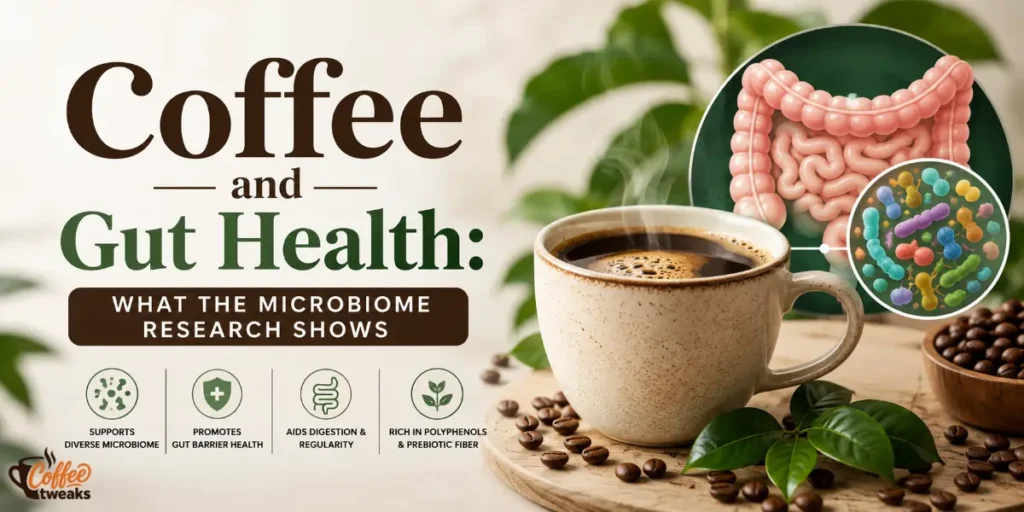
Coffee is, for most people, genuinely good for gut health. It feeds beneficial bacteria, improves microbial diversity, stimulates digestion, and has a measurable prebiotic-like effect. The bathroom sprint after your morning cup is not a warning sign. It is your digestive system working exactly the way it should. That said, individual responses vary, and if you have IBS, there are nuances worth understanding.
Here’s the thing. Coffee has spent decades being accused of wrecking digestion. Research tells a very different story.
What Happens in Your Gut After You Drink Coffee?
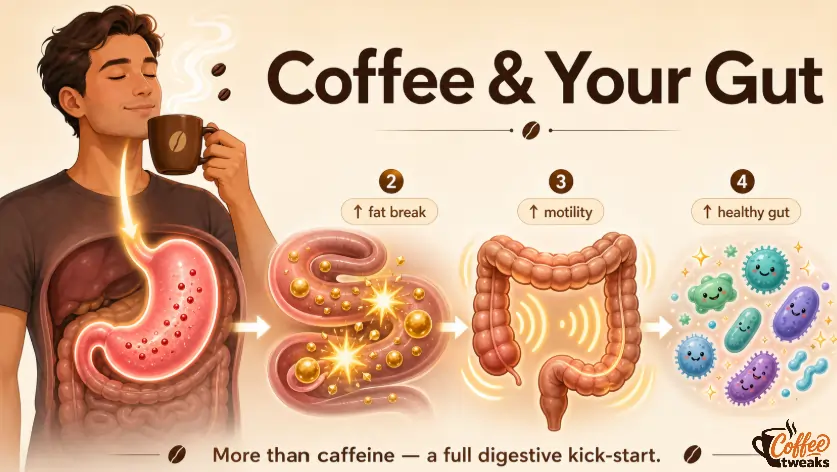
The moment coffee hits your stomach, your body starts responding. And it responds fast. Within minutes, coffee triggers the secretion of gastrin, a digestive hormone that stimulates stomach contractions and promotes the release of gastric acid (hydrochloric acid). This is not a malfunction. This is your gut doing its job.
Coffee also prompts the release of cholecystokinin, commonly abbreviated as CCK. CCK is a hormone that increases bile production, which your body uses to break down dietary fats in the small intestine. So every time you drink your morning flat white alongside eggs or avocado toast, coffee is literally helping you process that fat more efficiently.
Beyond the stomach, coffee accelerates movement through the large intestine. Research shows that regular coffee can stimulate colon motility roughly 23% more than decaffeinated coffee and up to 60% more than a glass of water. This effect is known as increased gut motility, and it is one of the primary reasons coffee is associated with a reduced risk of chronic constipation.
All of this happens regardless of whether you are drinking a light roast pour-over or a dark roast espresso. The digestive response is fundamentally tied to coffee’s bioactive compounds, many of which are not caffeine.
Coffee and the Gut Microbiome
This is where things get genuinely fascinating, and where the science has moved far beyond what most people realize.
Your gut microbiome is a community of trillions of microorganisms living primarily in your large intestine. The composition of that community, which species thrive and which ones don’t, is directly shaped by what you eat and drink. Coffee is one of the most powerful dietary influencers of that microbial community ever identified in research.
The reason comes down to coffee’s chemical complexity. From a brewing perspective, I think about coffee as a solution of hundreds of bioactive compounds, not just caffeine. You have chlorogenic acids (the major polyphenols), melanoidins formed during roasting, trigonelline, soluble fiber, diterpenes like cafestol and kahweol, and more. When those compounds reach your colon largely unabsorbed, your gut bacteria get to work on them.
Chlorogenic acids, which are the dominant polyphenols in coffee, are not well-absorbed in the small intestine. About two-thirds of them reach the colon intact, where they become food for your microbiome. Bacteria ferment these compounds and produce metabolites including quinic acid and hippuric acid, both of which appear beneficial to metabolic and gut health. Quinic acid in particular has demonstrated antioxidant, antimicrobial, and antiviral properties. Hippuric acid is considered a marker of healthy polyphenol metabolism.
Melanoidins, which are those brown polymers formed during the Maillard reaction in roasting, function similarly to dietary fiber in the gut. They promote the growth of short-chain fatty acid (SCFA) producing bacteria. SCFAs, especially butyrate, are critical for maintaining colon cell health, reducing inflammation, and regulating the gut-brain axis. This matters more than most people appreciate.
Real talk: if you are a coffee drinker, your gut is doing chemistry with your espresso right now. That chemistry is largely working in your favor.
What Research Says About Coffee and Gut Bacteria
The evidence here has become increasingly compelling, particularly from large-scale human studies.
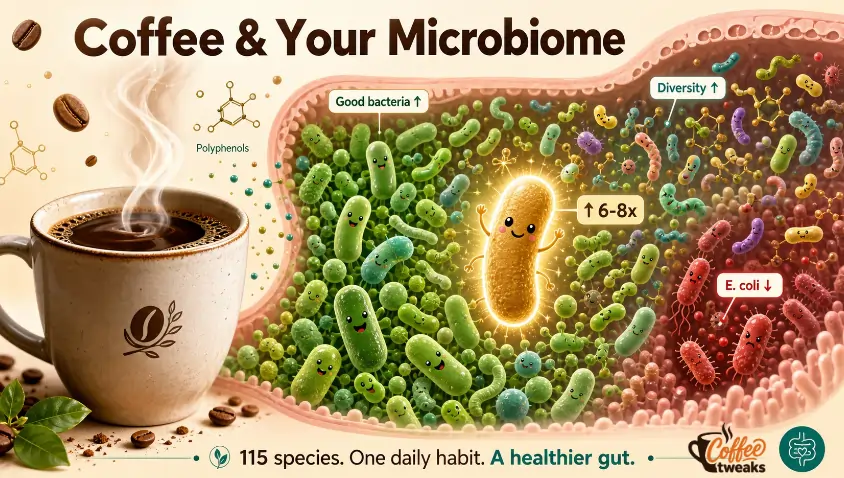
A landmark study analyzing data from more than 1,000 deeply phenotyped individuals found that coffee consumption was the most strongly correlated dietary item with gut microbiome composition, across all 150-plus foods and drinks examined. It showed a dose-dependent relationship, meaning more coffee correlated with more pronounced microbiome changes. This finding was subsequently validated in a second independent cohort.
Building on that, ZOE scientists published research in Nature Microbiology analyzing gut microbiome data from over 22,000 people across 25 countries. They identified 115 bacterial species linked to coffee consumption. The standout finding was the identification of a specific microbe, Lawsonibacter asaccharolyticus, which was on average 6 to 8 times more abundant in coffee drinkers compared to non-drinkers. The researchers described this as the strongest link ever found between a single food and a single gut bacterium. That is not a small finding.
Critically, the top ten bacteria most associated with coffee consumption were equally associated with decaffeinated coffee consumption. This tells us that the microbiome effects of coffee are driven primarily by its non-caffeine compounds, particularly its polyphenols. Caffeine matters for some things, but for the microbiome, it appears to be mostly a passenger.
Research also consistently shows that coffee consumption is associated with increased levels of Bifidobacterium and Lactobacillus species, both of which are widely regarded as beneficial probiotic genera. At the same time, certain potentially harmful bacteria, including Clostridium species and Escherichia coli, appear in lower concentrations in habitual coffee drinkers.
The overall picture is one of greater microbial diversity and a more favorable microbiome composition in people who drink coffee regularly. Microbial diversity is considered one of the strongest indicators of a healthy gut.
A 2026 Nature Communications study went further by examining coffee’s influence on the entire microbiota-gut-brain axis, comparing habitual coffee drinkers with non-coffee drinkers and tracking what happened when coffee drinkers quit for two weeks and then reintroduced either caffeinated or decaffeinated coffee.
The microbiome changes tracked alongside changes in inflammatory markers, cognitive performance, and mood, providing some of the most direct evidence yet that coffee’s influence on gut bacteria may have downstream effects on brain function.
I am not overstating that. I’ve been wrong before. Not about this.
Does Coffee Help Digestion?
Yes, with specificity. Let me break down what the evidence actually supports.
Coffee directly stimulates gastrin and hydrochloric acid secretion, both of which are involved in breaking down food in the stomach. Coffee also stimulates cholecystokinin release, which drives bile production and fat digestion. These are not theoretical mechanisms. These are measured physiological responses documented in human studies.
Coffee accelerates transit through the gastrointestinal tract, particularly in the colon. This can feel like discomfort if you are sensitive, but for most people it represents a functional digestive benefit. Sluggish gut motility is associated with constipation, bloating, and fermentation build-up. Coffee counteracts that.
What coffee does not reliably do, despite decades of folk wisdom to the contrary, is cause heartburn or aggravate acid reflux in the general population. Multiple large studies and systematic reviews have found no significant association between coffee consumption and gastroesophageal reflux disease (GERD), peptic ulcers, or chronic heartburn at the population level. Individual sensitivity exists, but blaming coffee as a blanket trigger for reflux is not supported by the weight of evidence.
The myth that coffee is “acidic and therefore bad for the stomach” is worth addressing directly. Coffee does stimulate acid production, but that is how digestion works. Stimulating acid in the context of eating is appropriate physiology. The problems arise when you drink coffee on an empty stomach and already have acid sensitivity, a situation I will address in the practical tips section.
Why Coffee Makes You Poop
Most people blame caffeine for the bathroom sprint. That is only part of the story, and honestly, not even the most interesting part.
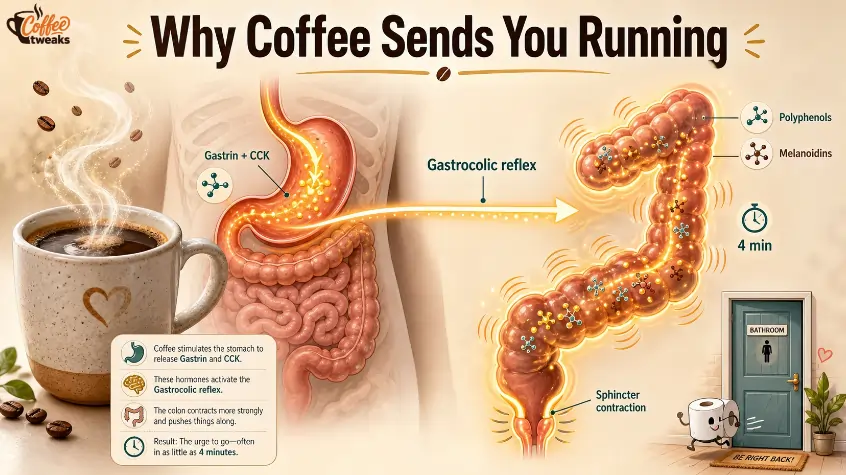
When coffee reaches your stomach and small intestine, it triggers gastrin and cholecystokinin release. These two hormones activate what is called the gastrocolic reflex, a physiological response where your colon contracts in preparation for incoming food. This reflex is a normal digestive mechanism. Coffee essentially short-circuits it into action before you have even finished your cup.
Research confirms that caffeine also stimulates stronger contraction of the anal sphincter and increases the urge to defecate. Studies using manometry, which measures pressure inside the gastrointestinal tract, have directly observed that coffee induces colon contractions within four minutes of consumption in some individuals. Four minutes. That is not incidental.
Here is where the decaf question matters. Decaffeinated coffee also triggers bowel movements, just somewhat less powerfully than caffeinated coffee. Studies show that decaf stimulates colon activity meaningfully, roughly 23% less than regular coffee. This confirms that caffeine contributes to the laxative effect, but is not the sole mechanism. The polyphenols, melanoidins, and other compounds in coffee independently affect colon motility.
For people with constipation, this is a feature, not a bug. Coffee’s motility effects can be genuinely beneficial. A regular cup in the morning supports the natural rhythm of your digestive system, which is already primed to activate after overnight fasting.
Coffee and IBS
This is where blanket advice breaks down entirely. IBS is a spectrum condition, and individual responses to coffee vary significantly depending on the subtype and the person.
The research is genuinely mixed. A large prospective cohort study found that higher intake of coffee, including ground and instant varieties, was actually associated with a lower risk of developing IBS, with a dose-response relationship. That is the long-term population picture. On the other hand, cross-sectional research has found that habitual coffee drinking is associated with greater odds of having IBS in certain populations, particularly among women and overweight individuals.
The discrepancy makes more sense when you look at IBS subtypes.
For IBS with constipation (IBS-C), coffee’s motility-stimulating effects can be genuinely helpful. Research has found that coffee drinkers actually have higher odds of IBS-C specifically, which may sound counterintuitive. The interpretation is that people with constipation often turn to coffee to help manage it, rather than coffee causing the condition. The motility benefit is real.
For IBS with diarrhea (IBS-D), coffee is a more complicated proposition. The gastrocolic reflex effect, the accelerated colon motility, the stimulation of gastric secretions: all of these can exacerbate loose stools and urgency in someone whose colon is already hypersensitive. Coffee is consistently identified as one of the top food triggers for dyspepsia, pain, and loose stools in IBS patients.
Low-key obsessed with this nuance because it explains why two people with IBS can have completely opposite experiences with the same cup of coffee.
Beyond subtype, caffeine sensitivity itself varies based on genetics. Variants in the ADORA2A gene, which encodes the adenosine A2A receptor, influence how strongly people respond to caffeine’s stimulating effects. People who metabolize caffeine slowly tend to experience stronger gut responses at lower doses. If coffee consistently makes your IBS worse, genetic caffeine sensitivity may be a factor, and switching to decaf is a legitimate evidence-based option that preserves the microbiome benefits.
Practical IBS guidance:
Coffee Type Matters More Than Most People Think
I spend a lot of time thinking about extraction variables, roast profiles, and brewing chemistry. From a gut health standpoint, these variables actually matter.
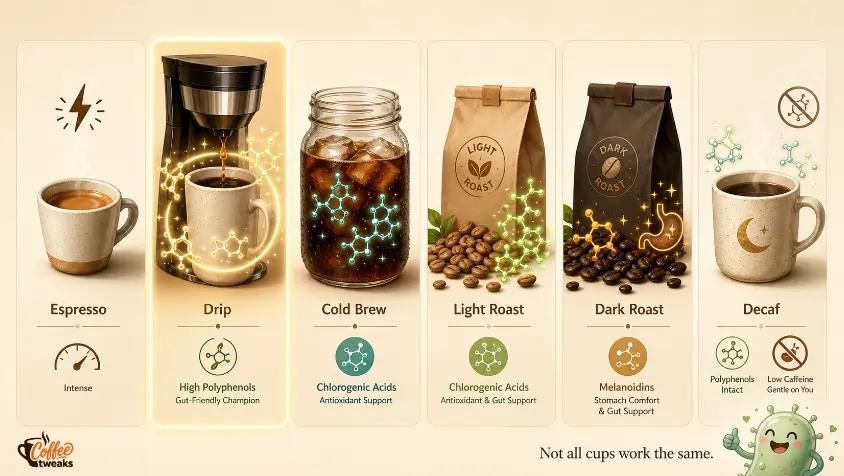
1. Espresso is concentrated, low-volume, and typically pulled from finely ground coffee at high pressure. Espresso has lower total polyphenol content per serving compared to drip coffee simply because the serving size is much smaller. However, it contains higher concentrations of certain compounds including caffeine per milliliter. For gut sensitivity, espresso can be intense but manageable in small amounts.
2. Filter or drip coffee delivers a larger volume of polyphenols per cup and is generally considered the most gut-friendly brewing method in terms of overall microbiome benefit. It is also filtered, which removes most of the diterpenes cafestol and kahweol, compounds relevant for cholesterol but largely irrelevant for gut microbiome effects.
3. Cold brew uses cold water extraction over many hours, typically 12 to 24. Cold brew retains very high levels of chlorogenic acids because it does not expose them to heat-induced degradation. Interestingly, cold brew delivers significantly more chlorogenic acids per serving than hot-brewed coffee, which is relevant for gut bacteria that ferment these compounds. Cold brew tends to be gentler on the stomach for acid-sensitive individuals because it lacks some of the irritating compounds produced during hot extraction.
4. Dark roasts have lower chlorogenic acid content than light roasts because prolonged, high-temperature roasting degrades these polyphenols. However, dark roasts are higher in melanoidins, which have their own fiber-like prebiotic effects on the gut microbiome. For acid sensitivity specifically, darker roasts tend to be better tolerated because the roasting process also creates compounds like N-methylpyridinium that have been shown to inhibit stomach acid production.
5. Light roasts contain the highest chlorogenic acid content and are the richest source of polyphenols for your gut bacteria. If microbiome optimization is your goal, light to medium roast filter coffee is the highest-value option.
6. Decaf preserves nearly all the microbiome benefits of regular coffee. The ZOE research found that the top bacterial associations with regular coffee were equally strong with decaf. Decaf removes most caffeine through chemical, water, or CO2 processes, and while the flavor profile changes, the polyphenol content remains largely intact. For anyone who wants the gut health benefits without the motility acceleration, decaf is a completely legitimate choice.
Potential Downsides for Gut Health
No serious discussion of coffee and gut health omits the downsides. Here they are, without the fearmongering.
Coffee stimulates gastric acid production. For people with existing gastric ulcers, acid hypersensitivity, or inflamed esophageal tissue, this can cause discomfort. This is not true for most people, but it is real for some. Drinking coffee with food and choosing dark roast or cold brew can significantly reduce this effect.
Excess caffeine, typically above 400 mg per day or about four to five strong cups, can cause loose stools, urgency, and digestive discomfort in many people. This is not a microbiome effect. It is a direct stimulant effect on gut motility. Caffeine’s acceleration of the gastrocolic reflex becomes inconvenient when overdone. Moderation here means three to five cups per day for most people.
Coffee can exacerbate anxiety, and anxiety directly affects gut function through the gut-brain axis. If your coffee habit drives cortisol dysregulation, poor sleep, or chronic anxiety, the downstream effects on gut health are real even if the coffee itself is not directly harming your microbiome. The gut-brain axis runs in both directions.
Coffee on a completely empty stomach first thing in the morning, before any food, is the scenario most likely to cause acid discomfort or cramping. Having something to eat alongside your first cup, even something small, typically resolves this.
How to Drink Coffee for Better Gut Health
These are evidence-informed, practical suggestions. Not a prescription. Not medical advice. Just what the research suggests works.

Timing your first cup. Waiting 60 to 90 minutes after waking to drink your first coffee allows your cortisol awakening response to complete naturally. This is more relevant for mood and energy regulation than gut health specifically, but it reduces the likelihood that you are combining peak cortisol with strong gastric stimulation on an empty stomach.
Drinking coffee with or after food. This single habit change makes coffee significantly more tolerable for people with acid sensitivity, IBS-D, or morning cramping. The presence of food in the stomach buffers the acid response and softens the gastrocolic reflex.
Quantity. The sweet spot supported by most research is two to four cups per day. Harvard’s nutrition research found significant microbiome benefits in both moderate (three cups per month to three per day) and heavy (more than three cups per day) drinkers, but adverse effects including elevated blood pressure and sleep disruption become more likely above three to four daily cups.
Roast selection for sensitivity. If you experience acid reflux, stomach discomfort, or IBS flares after coffee, try dark roast or cold brew before abandoning coffee entirely. The chemistry genuinely differs in ways that affect tolerance.
Switching to decaf for IBS-D. Not a compromise. Not a lesser option. Decaf delivers the full microbiome benefit, minus the motility acceleration that triggers urgency. This is supported by the ZOE microbiome research.
Adding fiber-rich foods alongside coffee. Coffee acts as a prebiotic for certain bacteria. Pairing it with fiber-rich foods amplifies that effect. Whole grain toast, fruit, oats: all good partners for your morning cup.
Avoiding heavy dairy additions if lactose sensitive. This seems obvious, but it is frequently overlooked. Many people attribute their post-coffee gut discomfort to the coffee itself when it is actually the two tablespoons of milk that contain enough lactose to cause symptoms.
Myth vs. Fact: Quick Checks
| Claim | Verdict |
|---|---|
| Coffee causes heartburn in most people | False. No significant population-level association with GERD |
| Decaf has no gut health benefits | False. Decaf shares most microbiome benefits of regular coffee |
| Caffeine is the sole reason coffee makes you poop | Partially false. Gastrin, CCK, and gastrocolic reflex also play major roles |
| Coffee damages your gut bacteria | False. Coffee increases beneficial bacteria and microbial diversity |
| IBS sufferers should always avoid coffee | Oversimplified. Depends entirely on IBS subtype and individual sensitivity |
| Light roasts are weaker than dark roasts | Generally false for gut health. Light roasts are higher in polyphenols |
Key Takeaways
Coffee is one of the most researched dietary influencers of the gut microbiome identified to date. The evidence consistently points in a favorable direction for moderate consumers. Across large-scale human studies, metagenomics research, and controlled intervention trials, coffee has been shown to increase beneficial bacterial species including Lawsonibacter asaccharolyticus, Bifidobacterium, and Lactobacillus genera; promote microbial diversity; stimulate production of short-chain fatty acids; and support the gut-brain axis through both direct and microbiome-mediated pathways.
The mechanism is primarily driven by polyphenols and fiber-like compounds, not caffeine. This is why decaf coffee preserves the gut benefits. It is also why brewing method and roast level affect the character of those benefits, with light roast filter coffee delivering the highest polyphenol payload and dark roast or cold brew being the gentler choices for acid-sensitive individuals.
For IBS, the picture is individual. IBS-C may actually benefit from coffee’s motility effects. IBS-D warrants caution around caffeinated coffee specifically, while decaf remains a high-value option.
The bathroom effect is not a side effect to worry about. It is a well-understood physiological response driven by hormonal and reflex mechanisms that are part of healthy digestive function.
Drink quality coffee, in amounts that feel good for your body, and appreciate the fact that every cup is doing quiet work inside your microbiome.
And I am not apologizing for that.
Frequently Asked Questions
Is coffee good for gut health?
For most people, yes. Research consistently shows that moderate coffee consumption increases beneficial gut bacteria, improves microbial diversity, and supports digestive motility. The polyphenols and fiber-like compounds in coffee act as prebiotics, selectively feeding bacteria associated with better metabolic and gut health.
Does coffee improve the microbiome?
Evidence from multiple large human studies and metagenomics analyses suggests it does. Coffee is the food item most strongly correlated with gut microbiome composition across all dietary items studied. Regular coffee drinkers show higher levels of beneficial bacteria, greater microbial diversity, and more favorable metabolite profiles.
Why does coffee make me poop immediately?
Coffee stimulates gastrin and cholecystokinin release, triggering the gastrocolic reflex, a hormonal and neurological signal that activates colon contractions. Caffeine also directly increases anal sphincter activity and urgency. Both caffeinated and decaffeinated coffee produce this effect, though regular coffee produces it more strongly. This response can occur within minutes of drinking.
Is coffee bad for IBS?
It depends on the type of IBS. For IBS-C, coffee may improve symptoms by supporting colon motility. For IBS-D, caffeinated coffee can worsen urgency and diarrhea. Decaffeinated coffee is generally better tolerated by IBS-D sufferers while preserving the microbiome benefits. Individual caffeine sensitivity also plays a significant role.
Does decaf affect digestion?
Yes. Decaffeinated coffee still triggers gastrin and cholecystokinin secretion, still activates the gastrocolic reflex to a moderate degree, and still provides polyphenols and fiber-like compounds that feed gut bacteria. The gut health effects of decaf and regular coffee are far more similar than different.
Which coffee is easiest on the stomach?
Dark roast coffee and cold brew are the most stomach-friendly options for acid-sensitive individuals. Dark roasting creates compounds that partially inhibit stomach acid production, and cold brew’s low-heat extraction produces a smoother acidity profile. Both are significantly gentler than light roast hot-brewed coffee for those with acid sensitivity.
The information in this article is for educational purposes and reflects current research findings. It is not a substitute for individualized medical advice. If you have a diagnosed gastrointestinal condition, speak with a registered dietitian or gastroenterologist before making significant dietary changes.