Coffee and Heart Health: New Research Changes the Story 🌿☕


My uncle came home from his check-up one afternoon looking like someone had cancelled Christmas.
He was 54. Healthy. Active. Loved his morning cortado more than almost anything. His doctor, well-meaning, working from advice that hadn't caught up to the evidence, told him to cut the coffee. For his heart.
He did it. For six miserable weeks. And then the research started catching up with what many of us suspected all along.
Coffee and heart health tell a very different story now.
Why Coffee Was Blamed for Heart Disease
The reason coffee got labelled a heart villain goes back to the 1960s. A study flagged it as a possible coronary risk factor, and that association quietly embedded itself into medical culture for decades. Every generation of doctors inherited a slightly watered-down version of the same concern.

It was never the whole picture. But it stuck anyway.
What's changed is scale. The research that's emerged over the last decade doesn't come from small studies with shaky methodology. It comes from millions of people, tracked over years, across continents. And when you look at that data honestly, the story shifts.
What the Newer Research Actually Shows
Okay but hear me out, because this part genuinely surprised me.
A 2023 review published in the Ochsner Journal pulled together studies from 2000 to 2021 covering hundreds of thousands of adults. The conclusion? Moderate, regular coffee consumption was associated with decreased risk of hypertension, heart failure, and atrial fibrillation. Not neutral. Decreased.
A separate meta-analysis of 40 studies covering 3.85 million participants found that coffee drinkers had a lower all-cause mortality risk than non-drinkers, with the optimal range sitting around 3.5 cups per day for all-cause mortality and around 2.5 cups for cardiovascular mortality specifically.
That is not a fringe finding buried in an obscure journal. That is 3.85 million people pointing in the same direction.
The Morning Coffee Study That Changed Everything
No exaggeration when I say this one genuinely shifted how cardiologists are talking about coffee.
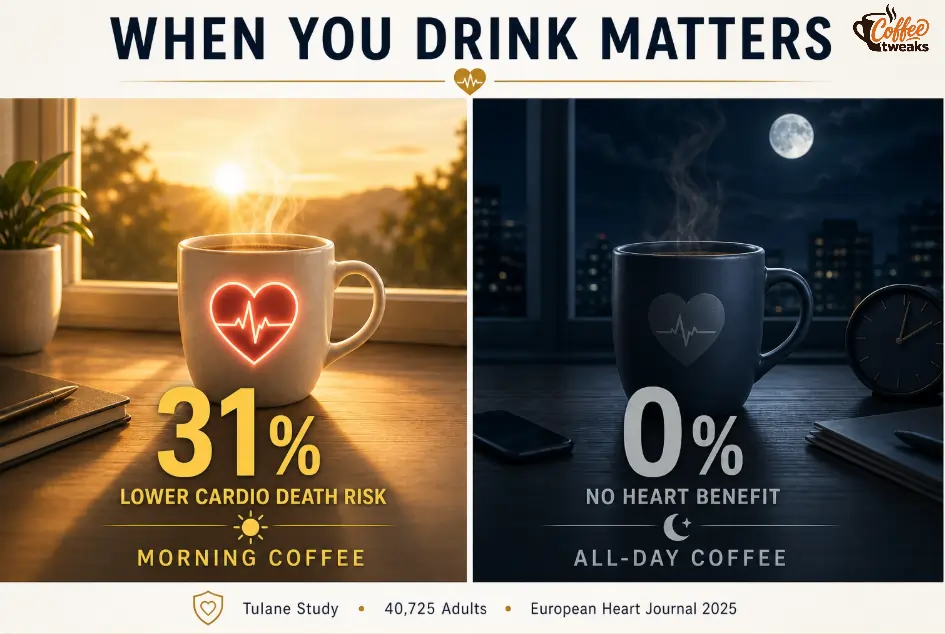
In 2025, researchers at Tulane University published a study in the European Heart Journal using data from 40,725 US adults tracked through NHANES over nine to ten years. They didn't just ask how much coffee people drank. They asked when.
Morning coffee drinkers, people who kept their cups to before midday, were 16% less likely to die from any cause and 31% less likely to die from cardiovascular disease compared to non-coffee drinkers.
All-day coffee drinkers? No cardiovascular mortality benefit. None.
This changed my whole morning. Not because I was going to stop drinking coffee, but because I understood why the timing matters now. Coffee in the morning works with your body's natural rhythms. Afternoon and evening coffee may disrupt your circadian biology, suppress melatonin, and quietly increase inflammation, which chips away at the cardiovascular protection coffee would otherwise offer.
Professor Thomas Lüscher, writing an editorial alongside the study, said it simply: “Drink your coffee, but do so in the morning.”
That's the kind of advice I can actually use.
Coffee and Blood Pressure: The Part That's Actually Complicated
I'm not going to pretend this section is all reassuring news. It's more nuanced than that.
Caffeine does raise blood pressure temporarily, anywhere from 3 to 15 points systolic, sometimes more. That's real. For most healthy adults, the effect is short-lived and the body adapts with regular consumption. A review of 13 studies covering 315,000 people found no long-term association between moderate coffee drinking and hypertension development.
But here's the exception that matters: if your blood pressure is already severely elevated, consistently at 160 mmHg systolic or above, a long-term Japanese study following over 18,000 adults found that drinking two or more cups per day was associated with roughly double the cardiovascular mortality risk compared to non-drinkers in that group.
For people with well-managed or mild hypertension, this effect wasn't observed. For most healthy adults, neither.
The takeaway isn't that coffee is dangerous. It's that severe, uncontrolled hypertension is its own risk category, and if that's your situation, the conversation belongs with your cardiologist, not a wellness article.
Coffee and AFib: How the Old Advice Got It Backwards
For years, people with atrial fibrillation were told to avoid coffee completely. The reasoning seemed logical: caffeine stimulates the heart, irregular heartbeat is already a problem, why add fuel?
The actual research disagrees.
A study from the Physicians' Health Study published in the Journal of the American Heart Association found that 1 to 3 cups per day was associated with lower rates of AFib. A separate meta-analysis showed an 11% reduction in AFib risk at moderate coffee consumption, rising to 16% at higher caffeine intakes.
Why? Coffee is loaded with antioxidant compounds, chlorogenic acids, polyphenols, cafestol, and trigonelline — that appear to have meaningful anti-inflammatory effects. Since inflammation is deeply tied to atrial fibrillation development, those compounds may actually be protective.
I didn't expect to love this finding, but here we are. The thing that was supposed to trigger the arrhythmia may actually be helping prevent it.
Coffee and Heart Failure: The Most Consistent Finding of All
If you want the area of coffee and cardiovascular research where the evidence is the most reliable and the most repeated, it's heart failure.
Three of the most respected long-term cardiovascular studies in the US, the Framingham Heart Study, the Cardiovascular Health Study, and the Atherosclerosis Risk in Communities study, all found the same thing independently: higher coffee consumption was associated with lower long-term risk of developing heart failure.
A dose-response meta-analysis published in Circulation: Heart Failure mapped a clear J-shaped curve. Up to 4 cups per day showed a strong inverse relationship with heart failure risk. The CARDIA cohort study added something even more striking, moderate coffee consumption from early adulthood through middle age was associated with better left ventricular function in later life.
That means the coffee you're drinking in your 40s might be doing something good for the heart you'll have in your 60s.
Filtered vs. Unfiltered: The Detail Most Articles Skip
This one genuinely matters and almost nobody talks about it.
Unfiltered coffee, French press, boiled coffee, Turkish coffee — contains two compounds called cafestol and kahweol. They're natural diterpenes found in coffee oils, and they suppress bile acid synthesis in a way that raises LDL cholesterol levels over time. A single cup of boiled coffee contains around 7.2 mg of each.
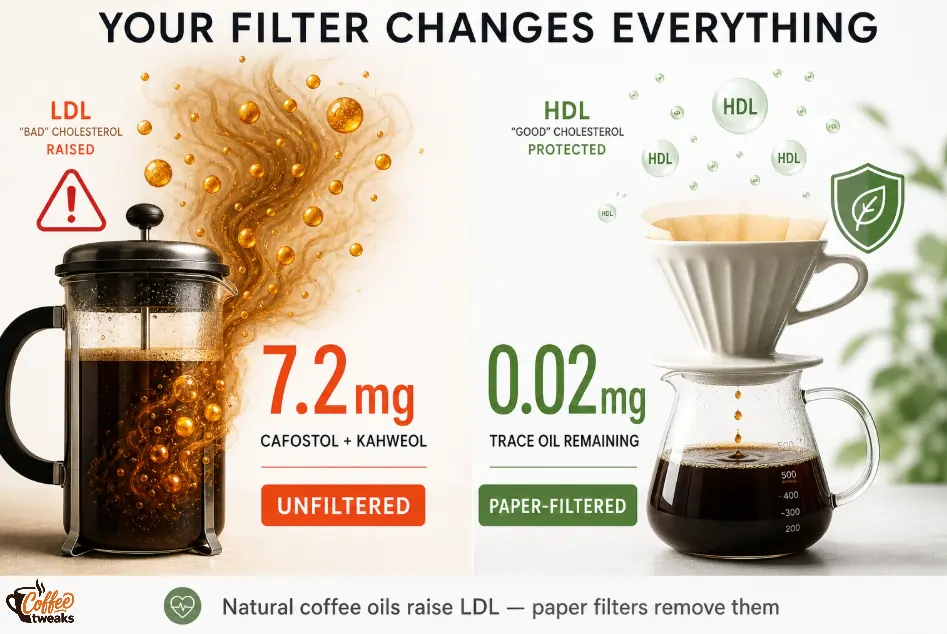
Paper-filtered coffee, your drip machine, your pour-over, your standard filter brew, removes almost all of those oils. The filtered cup retains only trace amounts, around 0.02 mg. And it doesn't just neutralize the risk: filtered coffee may actually be antiatherogenic, supporting healthy cholesterol transport through phenolic acids that improve HDL function.
This doesn't mean you need to retire your French press forever. But if you're drinking 3 to 4 cups a day and your LDL has been creeping upward, switching to a filtered method is one of the simplest and most underrated changes you can make.
Why Your Body Processes Coffee Differently Than Mine
Here's the piece that makes sense of all the contradictory headlines.
Your body metabolises caffeine through an enzyme called CYP1A2, and a common variant (CYP1A2*1F) slows it down. People who carry that variant are “slow” metabolizers — caffeine lingers in their system, so the effects on blood pressure and heart rate last longer too. People with the “rapid” version clear caffeine quickly and may actually see a neutral or even protective cardiovascular effect from regular coffee.
A landmark study in JAMA (Cornelis et al., 2006) showed exactly this split: the increased risk of nonfatal heart attack from coffee was concentrated in slow metabolizers, not rapid ones. Among slow metabolizers, 2–3 cups a day was associated with a 36% higher risk, and 4+ cups with a 64% higher risk — while rapid metabolizers saw no such increase. When you pool both groups together in one study, the effects cancel out and the results look inconsistent. That's a big part of why the headlines seem to flip-flop.
There's no easy way to know your type without genetic testing. But if coffee makes you feel jittery, anxious, or keeps you wired for four hours after a single cup — your body is telling you something. One or two cups in the morning is your lane. That's not a limitation, that's just information.
What “Moderate” Actually Means
Studies define it differently, which is part of the confusion. But across the strongest research, a working pattern emerges:
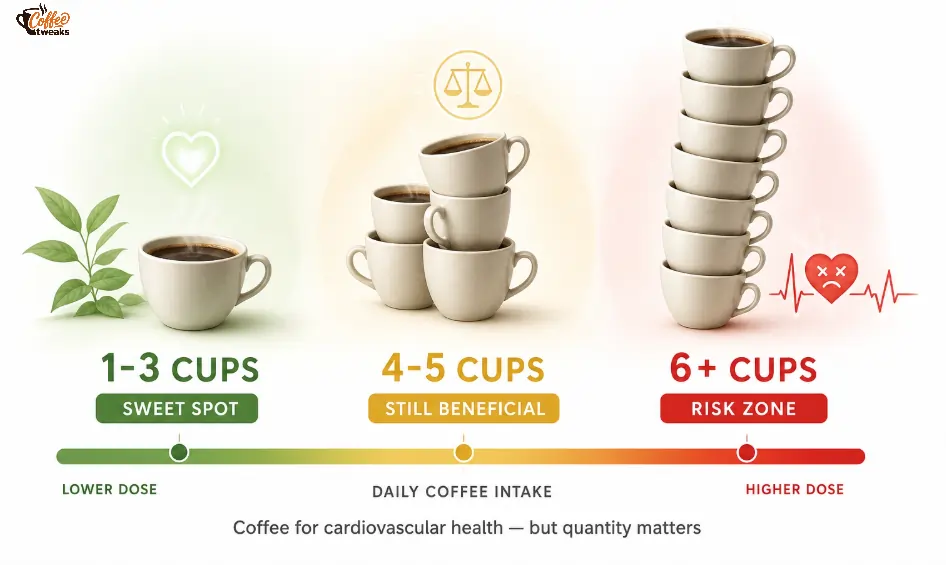
And again — timing shapes the whole thing. Morning coffee is doing different things to your cardiovascular system than evening coffee. That's not intuition anymore. That's what the data says.
The Honest Limitations Worth Knowing
Good research is honest about what it doesn't know yet. This should be too.
Most of these studies are observational, which means they can identify patterns across populations but can't definitively prove causation. Coffee drinkers may differ from non-drinkers in other lifestyle ways that are hard to fully control for. The mechanisms behind many of coffee's cardiovascular effects are still being mapped.
The evidence is strongest for heart failure risk reduction, cardiovascular mortality in morning drinkers, and the inverse relationship with atrial fibrillation. It's more mixed for blood pressure, real in the short term, largely neutral in the long term for most people, genuinely concerning for those with severe uncontrolled hypertension.
No one is claiming coffee is medicine. But the evidence that it's a cardiovascular villain, for most healthy adults drinking it moderately in the morning, is largely gone.
This Is What Changed
For years, coffee was the guilty pleasure people tolerated. The drink you'd mention apologetically at a health check. The habit that came with a quiet asterisk.
The newer research, from NHANES, from the Framingham Heart Study, from the European Heart Journal, from NIH-funded cohorts spanning millions of people, tells a different story.
For most healthy adults drinking 1 to 3 cups in the morning, that coffee isn't working against your heart. The evidence increasingly suggests it may be working with it, quietly reducing inflammation, supporting heart function, and fitting naturally into the kind of morning ritual that makes a good life feel like a good life.
My uncle went back to his cortado. Not out of stubbornness. Because the research caught up.
And honestly? That's the whole point. ☕🌿✨

This article is for informational purposes only and does not substitute for professional medical advice. If you have a diagnosed cardiovascular condition, hypertension, or related risk factors, please speak with your cardiologist before changing your coffee habits.