
Coffee and Health: What 50 Years of Research Actually Shows

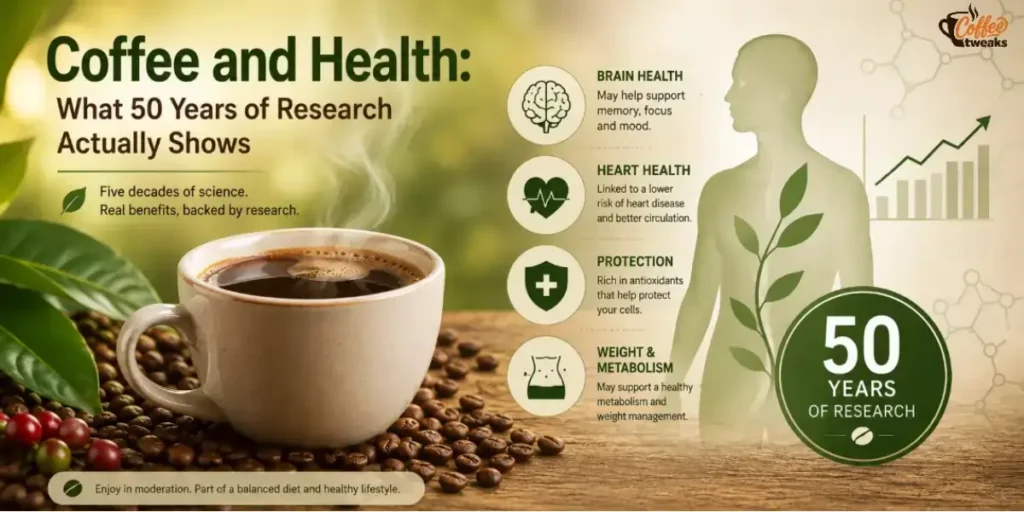
Here's the thing nobody tells you about coffee and health research…
The headlines lie in both directions. One week coffee causes cancer. The next week it adds years to your life. Neither is what the data actually says.
So I went and read the actual coffee and health research. Not the blog summaries. The meta-analyses. The ones pooling hundreds of thousands of people across decades.
The numbers matter here. And they point somewhere pretty clear: for most healthy adults, moderate coffee is linked to less disease, not more.
Let me walk you through what 50 years of studies found. The good, the uncertain, and the caveats nobody puts in the headline.
Quick note: I am an engineer and coffee obsessive, not a doctor. This is what the evidence shows, not medical advice for your specific body.
The One Number That Surprised Me
The largest mortality reductions show up at 3 to 4 cups a day. 📊
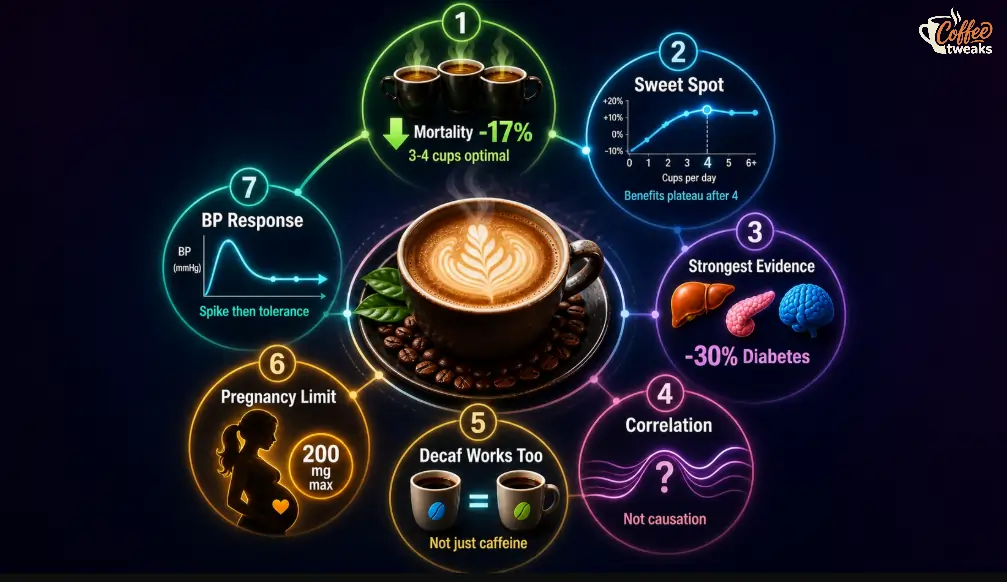
A 2017 umbrella review in the BMJ pooled over 200 meta-analyses. People drinking 3 to 4 cups daily had a roughly 17% lower risk of dying from any cause compared to non-drinkers.
I'll let that sit for a second.
That same review found cardiovascular death risk about 19% lower at that intake level. These are associations, not proof… but they show up again and again across independent datasets.
The relationship is also non-linear. More coffee is not automatically better. Past 4 cups, the benefit curve flattens out. It does not keep climbing.
Is Coffee Good For You? What The Evidence Suggests
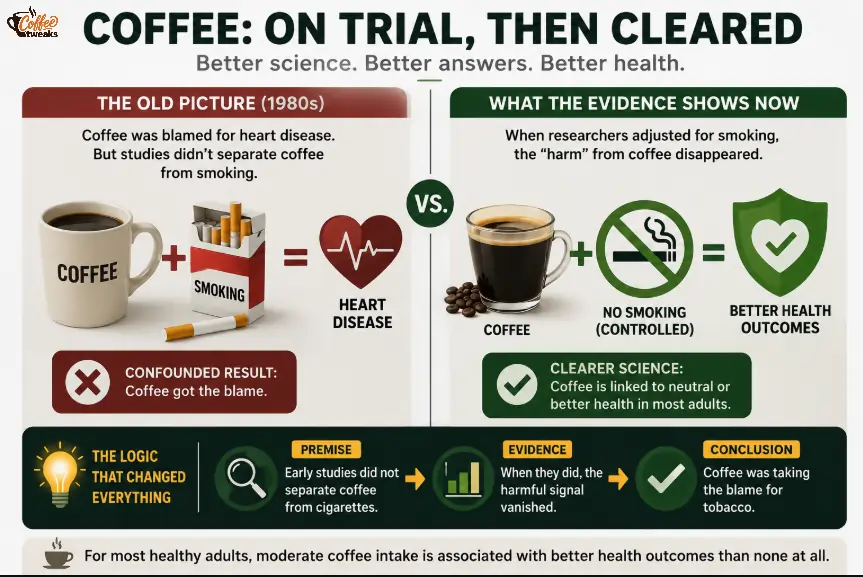
For most healthy adults, evidence suggests moderate coffee consumption is linked to better health outcomes than drinking none at all.
That is a big shift from where science sat in the 1980s. Coffee used to be lumped in with smoking and heart disease.
The problem was confounding. Coffee drinkers back then also smoked more. Once researchers properly adjusted for smoking, most of the “harm” disappeared.
Here's the logic chain. Premise: early studies did not separate coffee from cigarettes. Evidence: when they did, the harmful signal vanished. Conclusion: coffee was taking the blame for tobacco.
That single methodological fix rewrote the entire field.
Coffee Mortality Studies And Longevity
Coffee mortality studies consistently link moderate intake to lower death rates, but they cannot prove coffee causes you to live longer.
This distinction is the whole game. These are observational studies. They find correlation, not causation.
Here's what they found across the major pooled analyses:
The consistency is the impressive part. Different teams, different countries, different decades… same direction.
But could healthier people just happen to drink coffee? Maybe. Researchers adjust for diet, exercise, and income. They cannot adjust for everything. That gap is why this is “linked to” and not “proven to.”
Where The Coffee Health Benefits Are Strongest
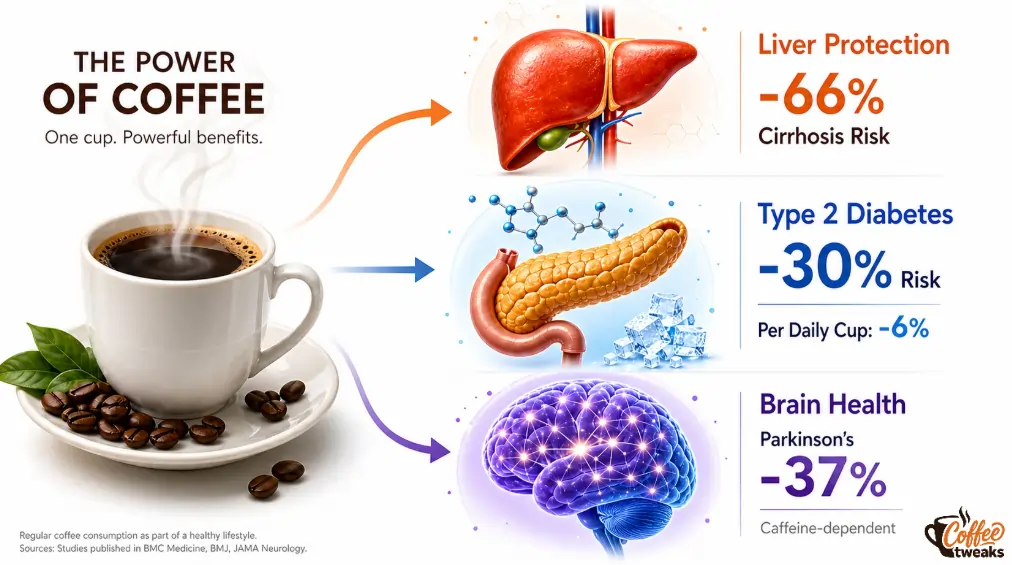
The strongest coffee health benefits science shows up in liver disease, type 2 diabetes, and certain neurological conditions.
These are the areas where the data is deepest and the dose-response is cleanest. When a higher dose tracks with lower risk in a smooth line, that pattern is harder to dismiss as noise.
Type 2 Diabetes
This one has the tightest numbers. A 2018 meta-analysis of 30 studies found roughly 30% lower type 2 diabetes risk at the highest intake versus the lowest.
The dose-response is clean: each additional cup per day was linked to about 6% lower risk. Decaf showed nearly the same effect, which tells you caffeine is not the whole story here.
Liver Health
The liver loves coffee, statistically speaking. A 2016 meta-analysis found higher coffee intake linked to substantially lower cirrhosis risk.
One Singapore study found two or more cups a day associated with 66% lower mortality from non-viral cirrhosis. Mayo Clinic also lists liver disease, cirrhosis, and liver cancer among coffee's most consistent associations.
Brain And Parkinson's
Caffeine intake shows an inverse relationship with Parkinson's risk. In one study, the highest coffee consumers had a hazard ratio of 0.63 versus non-consumers.
That is roughly 37% lower risk in that group. Mayo Clinic also notes possible links to lower Alzheimer's risk in some populations. Note: decaf does not show this brain effect, so caffeine seems to be the active piece.
Coffee And Health By Intake Level
The honest answer: outcomes improve up to a point, then plateau or slightly reverse at very high intakes. 📊
Here's the data organized by how much you actually drink. These figures are associations pooled from major meta-analyses, not guarantees for any one person.
| Daily Intake | All-Cause Mortality | Cardiovascular Outcomes | Other Notable Findings | Overall Read |
|---|---|---|---|---|
| 0 cups | Baseline reference | Baseline reference | No coffee-linked benefit or risk | Neutral starting point |
| 1–2 cups | Lower risk begins to appear (around 8% lower) | Lower CVD risk emerging | Diabetes risk drops ~6% per cup; meaningful liver benefit starts near 2 cups | Clearly favorable for most adults |
| 3–4 cups | Largest reduction (~16–17% lower) | Largest CVD mortality drop (~19–21% lower) | Strongest diabetes and liver associations; the “sweet spot” in the data | Best risk-benefit balance |
| 5–6 cups | Benefit plateaus, no further gain | Still favorable, no extra reduction | Diabetes risk still lower; possible sleep and anxiety effects | Fine for many, watch tolerance |
| 7+ cups | Benefit flattens; some studies hint at slight reversal | Possible BP and arrhythmia sensitivity in susceptible people | Higher jitteriness, sleep disruption, ~700mg+ caffeine | Diminishing returns, individual caution |
The takeaway from this table: the curve is shaped like a shallow U, not a straight line. The bottom of that U sits around 3 to 4 cups.
One 8oz brewed cup runs about 80 to 100mg caffeine. So 3 to 4 cups is roughly 300 to 400mg, which lines up with the 400mg daily ceiling most health bodies consider safe for healthy non-pregnant adults.
Does Coffee Increase Blood Pressure?
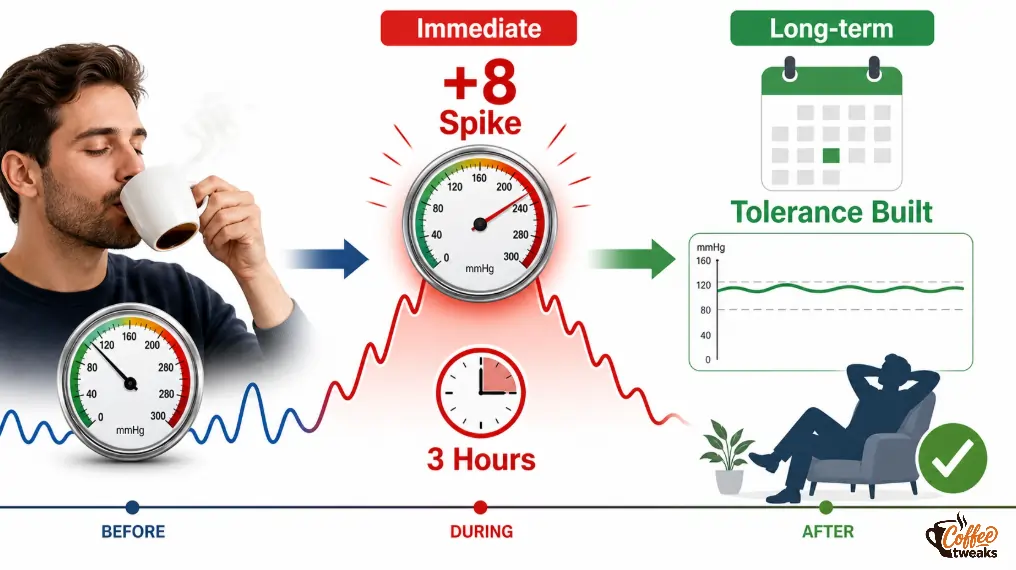
Yes, acutely, but the long-term picture is more forgiving than people assume.
I measured this distinction carefully because it confuses everyone. A single 200 to 300mg caffeine dose can raise systolic blood pressure by about 8mm Hg for roughly 3 hours.
That is the short-term spike. But habitual drinkers build tolerance. A 2011 review found that long-term coffee consumption is not clearly linked to sustained high blood pressure or higher cardiovascular risk in hypertensive people.
So the acute bump is real. The chronic harm, for most people, mostly is not. If you have uncontrolled hypertension, this is a conversation for your doctor, not a blog table.
The 20% Nobody Puts In The Headline
Coffee is not risk-free, and the evidence is genuinely mixed in a few specific places.
I am not going to pretend the data is all sunshine. Here's where it gets complicated.
Pregnancy is the clearest caution: The BMJ umbrella review found high versus low coffee intake in pregnancy linked to low birth weight, preterm birth, and pregnancy loss. This is the one area where harmful associations survived adjustment.
Bone fracture risk in women: That same review flagged a link between coffee and fracture risk in women, though not in men. The mechanism is not fully understood.
The correlation-causation wall: Almost all of this is observational. We have very few large randomized controlled trials, because you cannot easily randomize 400,000 people to drink coffee for 20 years.
Individual variation is huge: Caffeine metabolism is partly genetic. Some people clear it in a couple of hours. Slow metabolizers may carry more cardiovascular risk from the same dose. The averages hide a lot.
Sleep and anxiety are real costs: Caffeine has a half-life of roughly 5 to 6 hours. An afternoon cup can wreck deep sleep even if you fall asleep fine. The longevity stats do not capture how you actually feel.
Is Decaf Coffee Healthy?
Decaf carries many of the same benefits, which is one of the most useful findings in the whole field.
Here's why that matters. If benefits showed up only with caffeine, you would credit the caffeine. They do not.
Decaf showed nearly identical diabetes risk reduction (about 6% per cup) and similar liver and mortality associations. That points to coffee's other compounds, the polyphenols and antioxidants, doing real work.
The exceptions are the brain effects. Parkinson's and Alzheimer's protection seem tied to caffeine specifically, and decaf does not show the same arrhythmia-related signals in heart studies.
Coffee And Health In 7 Data Points
Coffee And Health FAQ: Your Top Questions Answered
Is coffee good for you?
For most healthy adults, evidence suggests moderate coffee is linked to lower risk of several diseases and lower overall mortality. It is associated with benefit more often than harm, though these are correlations, not proof.
How much coffee is safe per day?
Most health authorities consider up to 400mg of caffeine daily safe for healthy non-pregnant adults, which is roughly 3 to 4 brewed cups. That range also shows the strongest health associations in the research.
Do coffee mortality studies prove coffee helps you live longer?
No. They show a consistent association between moderate coffee intake and lower death rates, but they are observational. They cannot prove coffee itself is the cause rather than something coffee drinkers have in common.
Is decaf coffee healthy?
Yes. Decaf shows nearly the same reduced type 2 diabetes risk and similar liver and mortality associations as regular coffee. The main exception is brain-related protection, which appears tied to caffeine.
Does coffee increase blood pressure?
Acutely, yes. A single dose can raise blood pressure for about 3 hours. But long-term coffee drinking is not clearly linked to chronic high blood pressure or higher cardiovascular risk in most people due to tolerance.
Should pregnant women drink coffee?
Major health bodies recommend limiting caffeine to under 200mg per day during pregnancy, about one to two cups. Higher intake has been linked to low birth weight, preterm birth, and pregnancy loss.
Is coffee linked to lower disease risk?
Yes, for several conditions. The clearest associations are with lower risk of type 2 diabetes, liver cirrhosis and liver cancer, Parkinson's disease, and possibly Alzheimer's in some groups.
What do scientists actually agree on about coffee?
That moderate consumption is generally safe for healthy adults and more likely to help than harm, that 3 to 4 cups shows the best risk-benefit balance, and that pregnancy is the main situation calling for real caution.
Final Verdict
Worth drinking? For most healthy adults, the evidence says yes, and 3 to 4 cups a day sits in the statistical sweet spot.
Let me be precise about what we actually know and don't.
What science knows: Moderate coffee consumption is consistently associated with lower all-cause mortality, lower cardiovascular death, and lower risk of type 2 diabetes, liver disease, and Parkinson's. The 3 to 4 cup range shows the strongest associations across dozens of independent studies. Decaf carries much of the metabolic benefit.
What science does not know: If coffee causes these outcomes or just travels alongside them. We lack the large, long-term randomized trials that would settle causation. We also do not fully understand individual genetic variation in caffeine metabolism.
What an average healthy coffee drinker should take away: If you already enjoy 1 to 4 cups a day and you sleep fine and your blood pressure is controlled, the evidence gives you zero reason to quit and several reasons to feel fine about it. If you do not drink coffee, none of this is a prescription to start. The benefits are modest, population-level associations, not a health intervention.
Coffee will not save a bad diet or fix poor sleep. But it is one of the most studied things you consume daily… and it comes out looking surprisingly good. ☕