Coffee and Anxiety: Is Your Morning Cup Making It Worse?


Coffee does not cause anxiety disorders, but it can make anxiety significantly worse. Caffeine blocks adenosine and activates your stress response, raising heart rate, cortisol, and adrenaline. The effect is dose-dependent: research shows anxiety rises sharply above 400 mg daily, roughly four cups.
Caffeine sensitivity is genetic, driven by the CYP1A2 and ADORA2A genes, which is why coffee affects some people more than others. In people with panic disorder, high doses can trigger panic attacks. For anxious drinkers, the fix is not quitting. It is reducing the dose, fixing the timing, and finding your personal threshold.
Here's the thing nobody tells you when you start drinking four cups a day…
The problem is not the coffee. The problem is the dose, the timing, and the fact that your body might be wired to respond to caffeine more intensely than the person sitting next to you.
I spent years measuring extraction variables down to 0.1g. I care about ratios, temperatures, and grind sizes. But none of that matters if the thing you are brewing is actively working against your nervous system at the quantities you are consuming it.
This article is about the chemistry. The numbers. And what to actually do about it.
What Caffeine Is Actually Doing Inside Your Brain ⚙️
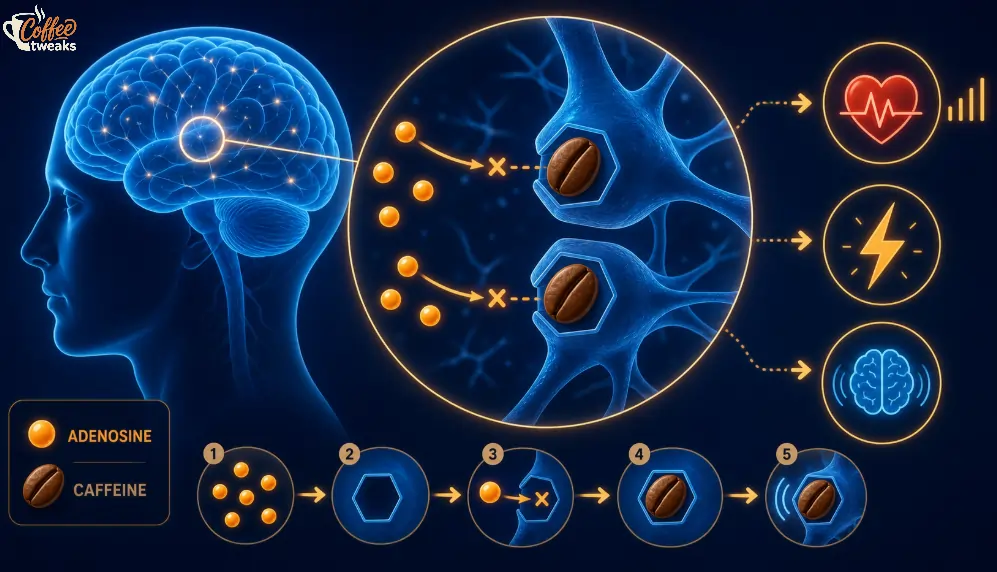
Caffeine is a methylxanthine. That sounds complicated. The mechanism is not.
Your brain continuously produces a molecule called adenosine. Over the course of a waking day, adenosine builds up and binds to specific receptor sites, primarily the A1 and A2A receptors located in the hippocampus, amygdala, and prefrontal cortex. As adenosine accumulates, you feel increasingly tired. That is the system working correctly.
Caffeine is structurally similar enough to adenosine that it occupies those same receptor sites. It does not activate them. It blocks them. Adenosine cannot bind. The fatigue signal never arrives.
Here is where the anxiety connection begins.
When adenosine receptors are blocked, the brain interprets this as a situation requiring elevated activity. Norepinephrine neurons fire. Adrenaline enters the bloodstream. The hypothalamic-pituitary-adrenal axis, which is your body's primary stress-response system, activates. Heart rate rises. Blood pressure increases.
Your body is now running a mild version of a threat response because of a molecule in your cup. ⚙️
The alertness you feel after an espresso is real. But it is partially the alertness of a stress system that has been switched on, not just a well-rested brain doing focused work. At one or two cups, most people handle this fine. At four to six cups, you are running that stress signal continuously across most of your waking hours.
Does Coffee Cause Anxiety? What the Data Actually Shows 📊
Let me be precise here, because imprecise claims in this space cause real harm.
Coffee does not cause anxiety disorder. Anxiety disorders have genetic, psychological, and environmental roots that a beverage cannot manufacture. That is an important distinction.
What caffeine does, reliably, is produce symptoms that overlap almost perfectly with anxiety. And in people who already experience anxiety, it amplifies those symptoms to a clinically significant degree.
The numbers matter here.
A 2024 meta-analysis published in Frontiers in Psychology analyzed data from 546 participants across 14 studies. The overall finding was that caffeine intake significantly increased anxiety risk, with a standardized mean difference of 0.94. In statistical terms, that is a large effect size.
The more important finding was in the subgroup analysis. When participants were divided by dose:
The jump between those two numbers is not small. It is the difference between a moderate effect and a very large one. And the threshold where things shift, 400 mg, is four standard drip coffees. Or two cold brews. Or five shots of espresso.
If you are in that range regularly, you are not imagining the connection between your coffee habit and your nervous system. 📊
Exactly. That section is the weakest part of the article right now. The table adds no information — a reader already assumes caffeine and anxiety share symptoms. That is why they are reading the article. Showing them two columns of “Yes Yes Yes” is not analysis. It is decoration.
The Symptom Overlap Problem 📊
This is where the diagnosis gets complicated. Caffeine-induced symptoms and clinical anxiety symptoms are not just similar. They are physiologically identical outputs from the same stress pathway.
| Symptom | What Caffeine Does | Why It Mimics Anxiety |
|---|---|---|
| Racing heart | Adrenaline raises resting heart rate by 5–20 BPM | Identical to anxiety-driven tachycardia |
| Restlessness | Norepinephrine keeps motor neurons primed | Same mechanism as nervous energy in GAD |
| Jitteriness | Excess adrenaline with no physical outlet | Indistinguishable from anxiety tremor |
| Rapid breathing | HPA activation triggers mild hyperventilation | Same pattern seen in panic episodes |
| Irritability | Cortisol elevation lowers stress tolerance | Same biochemical root as anxiety-driven reactivity |
| Poor concentration | Over-stimulated prefrontal cortex loses focus | Mirrors anxiety-induced cognitive interference |
| Insomnia | Adenosine blockade delays sleep onset by 30–60 min | Same presentation as anxiety-related sleep disruption |
| Stomach distress | Cortisol slows digestion, raises gut acid | Identical to anxiety-driven IBS symptoms |
The symptoms do not just overlap. They share the same biological pathway: HPA axis activation, adrenaline release, cortisol elevation. Caffeine triggers the pathway chemically. Anxiety triggers it psychologically. The output your body produces is the same either way.
Which means if you are drinking 400 mg a day and already anxious, you cannot feel where one ends and the other begins. 📊
Why Caffeine Affects Some People Far More Than Others ⚙️
This is the part that changes the entire conversation.
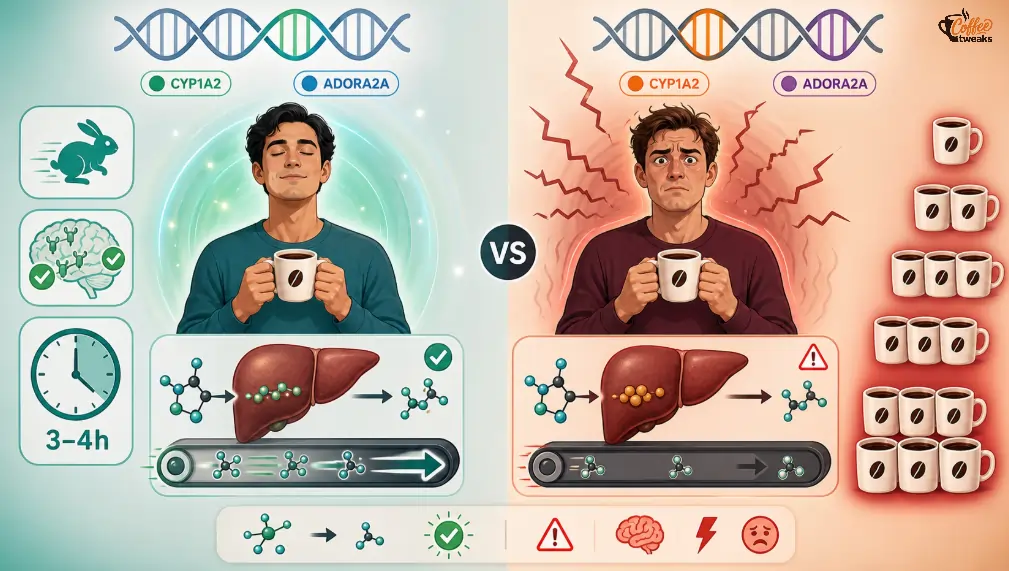
Caffeine sensitivity is not a mindset. It is not about tolerance or habit. It is mostly about two genes that you cannot choose and cannot override.
The CYP1A2 Gene
Your liver processes roughly 95% of ingested caffeine through an enzyme called CYP1A2. The speed of that enzyme is largely genetically determined.
Fast metabolizers clear caffeine quickly. It moves through their system in 3 to 4 hours. The stimulant window is short. The anxiety window is short too.
Slow metabolizers take 7 to 10 hours to process the same dose. A cup at 9am is still measurably in their bloodstream at 4pm. Every additional cup they drink before the previous one clears is effectively stacking doses. What looks like three cups of coffee to a fast metabolizer is, physiologically, something closer to six.
The ADORA2A Gene
The ADORA2A gene determines how responsive your A2A adenosine receptors are to caffeine blockade. Specific variants of this gene are directly associated with higher caffeine-induced anxiety at standard doses.
Research has found that people with certain ADORA2A polymorphisms are significantly more likely to experience anxiety and panic-adjacent symptoms from caffeine compared to people without those variants. This is not a psychological sensitivity. It is a receptor-level one. You cannot train it away.
What This Means Practically ⚙️
Two people can drink identical amounts of coffee from the same beans in the same brewing method, and one of them will feel calm and focused while the other feels jittery and on edge. Not because one is stronger or more experienced. Because their metabolic and receptor genetics are different.
If caffeine consistently hits you harder than it seems to hit other people, that is data. Take it seriously.
Can Coffee Trigger Panic Attacks? ☕
Yes. Under specific conditions, it can.
In people with a history of panic disorder, research has found that caffeine doses above 400 mg triggered panic attacks in over 50% of participants. The control group, receiving a placebo, had no panic attacks.
The mechanism is a feedback loop that connects the physical to the psychological.
- Caffeine blocks adenosine receptors
- Norepinephrine and adrenaline release
- Heart rate increases
- Body reads elevated heart rate as a warning signal
- Brain activates a fear response
- Fear response amplifies physical symptoms
- Physical amplification reinforces fear
The technical term for step four is misinterpretation of bodily sensations. The brain has a learned pattern that connects a racing heart to danger. When caffeine raises your heart rate physiologically, that pattern can activate even when there is no actual threat present.
Coffee did not create the panic disorder. But it provided the physiological trigger that started the cascade.
Worth noting: caffeine also suppresses adenosine's naturally calming effect on the amygdala, which is the brain's threat-detection center. Lower adenosine activity in the amygdala means the threat-detection system is running hotter than baseline. That is the starting condition before anything else happens. ☕
How Much Caffeine Is Too Much? The Numbers 📊
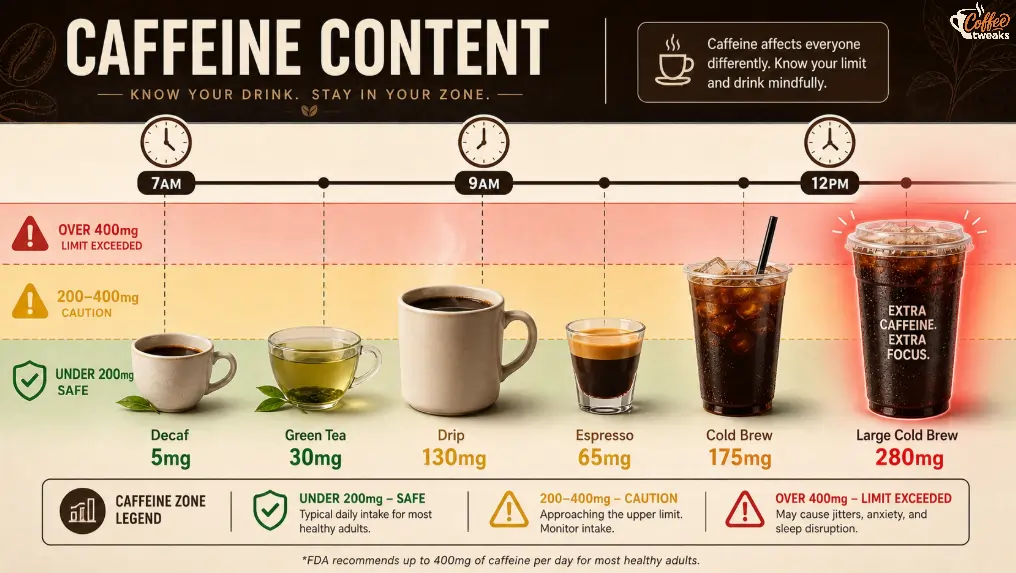
The FDA recommends a maximum of 400 mg per day for healthy adults. That is the safety ceiling for people without existing anxiety concerns.
For people who experience anxiety symptoms, the more useful threshold based on the research is closer to 200 mg per day. For those with diagnosed anxiety disorders or confirmed high caffeine sensitivity, even less.
Caffeine Content Reference ⚙️
| Drink | Serving Size | Approximate Caffeine |
|---|---|---|
| Drip filter coffee | 8 oz / 240 ml | 95-165 mg |
| Single espresso shot | 30 ml | 63 mg |
| Double espresso (Americano) | 8 oz | 126 mg |
| Cold brew | 8 oz / 240 ml | 100-200 mg |
| French press | 8 oz / 240 ml | 80-135 mg |
| Moka pot (3-cup) | ~120 ml | 90-120 mg |
| Black tea | 8 oz / 240 ml | 47-90 mg |
| Matcha (1 tsp powder) | 8 oz | 50-70 mg |
| Green tea | 8 oz / 240 ml | 20-45 mg |
| Decaf coffee | 8 oz / 240 ml | 2-15 mg |
A specific note on cold brew, because I see this underestimated constantly.
Cold brew is brewed with a 1:4 to 1:8 coffee-to-water ratio, steeped for 12 to 24 hours. Even at moderate ratios, an 8 oz serving regularly comes in at 150 to 200 mg of caffeine. A standard 16 oz takeaway cold brew can easily contain 250 to 300 mg on its own.
If you are drinking a large cold brew at 7am and two more coffees before noon, you have almost certainly crossed 600 mg before lunch. That is 50% above the FDA maximum and well into the zone where the anxiety research data becomes concerning. 📊
Timing Matters as Much as Volume ⚙️
Your cortisol level is not flat across the day. It follows a predictable curve.
Cortisol peaks between 6am and 9am as part of the natural awakening response. During this window, adenosine levels are low after sleep, which means your brain does not need caffeine to feel alert. Drinking coffee during this cortisol peak adds artificial stimulation on top of a stress hormone that is already elevated.
The result is often the feeling of being wired and irritable rather than sharp and focused. Many people have experienced this and attributed it to poor sleep or work pressure. The variable they did not test is whether pushing their first cup to 9:30 or 10am changes anything.
The mechanism: when you wait 90 minutes after waking, cortisol has peaked and begun to decline. Adenosine has had time to start accumulating again. When you then add caffeine, the adenosine block is more effective, the cortisol overlap is reduced, and the anxiety-amplifying combination of high cortisol plus high adrenaline is less likely.
I measured this. Shifting my first double shot from 7am to 9:30am produced a noticeably more even energy curve and reduced the afternoon tension I had been attributing to other things. The extraction and ratio were identical. The timing was the only variable that changed. ⚙️
Identifying Your Personal Caffeine Anxiety Threshold 📊
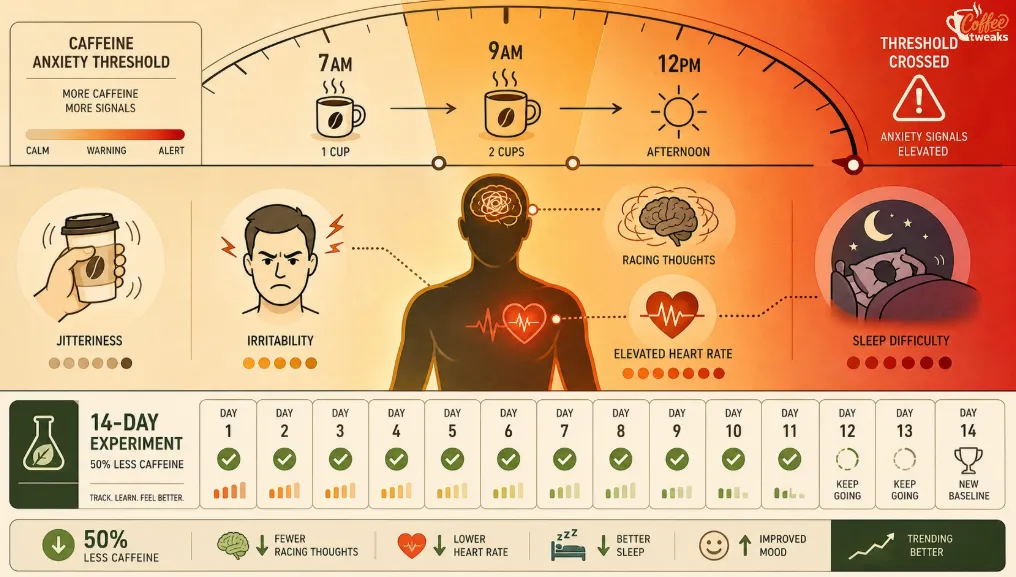
There is no universal number that works for everyone. But there are signals that tell you when you have crossed your individual threshold.
Physical signals:
Cognitive and emotional signals:
The experiment worth running:
Cut your caffeine intake by 50% for 14 days. Track anxiety symptoms, sleep quality, and afternoon energy each day on a simple 1 to 5 scale. Do not change other variables. The results will tell you more than any guide can.
Most people who run this experiment are surprised by how much changes. Not because the coffee was the sole cause of their anxiety, but because reducing a significant aggravating variable reveals the baseline they actually have. 📊
Should Anxious People Quit Coffee Completely? ☕
The blanket answer of “yes, quit coffee if you have anxiety” is not supported by the research for most people. It is an oversimplification.
The evidence supports a more specific framework:
Quitting makes sense if:
Reducing makes sense if:
Modest consumption is probably fine if:
The goal is not abstinence. The goal is calibration.
Anxiety and Caffeine Reduction: How to Cut Back Without Making It Worse ⚙️
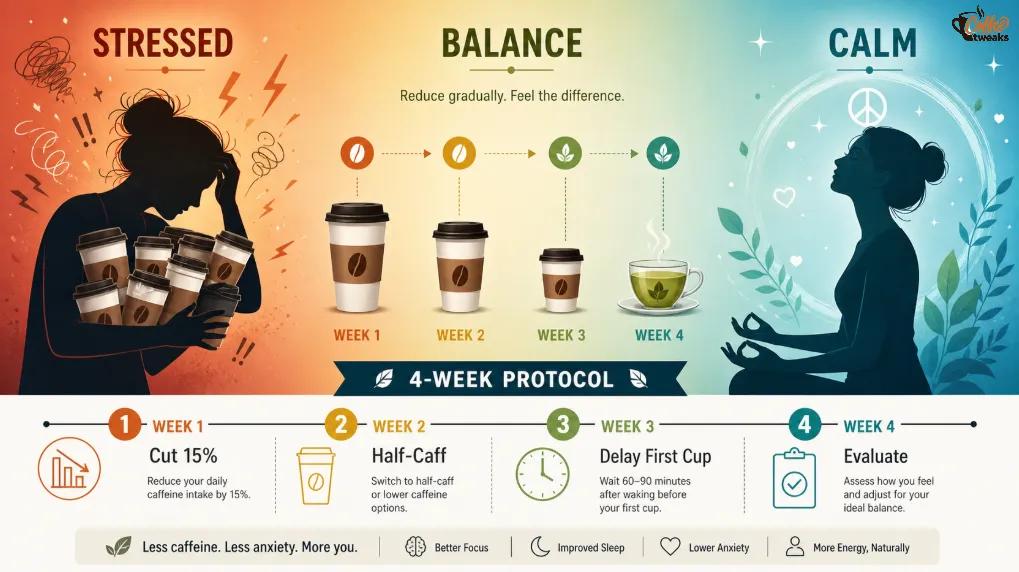
Here is something the research is unambiguous about: stopping caffeine abruptly is a poor strategy, especially for anxious people.
Caffeine withdrawal is a formal diagnostic category in the DSM-5. Symptoms begin within 12 to 24 hours of stopping and include headache, fatigue, irritability, and in some cases, elevated anxiety. These symptoms can persist for 2 to 9 days.
Abrupt cessation creates a withdrawal-induced anxiety spike at exactly the moment you are trying to reduce anxiety. That tends to convince people the experiment failed, when it was actually the method that failed.
A Practical 4-Week Reduction Protocol ⚙️
- Week 1: Calculate your current daily caffeine intake using the table above. Reduce total intake by 10 to 15%. Trim the easiest cup first, typically the afternoon one.
- Week 2: Switch your second cup of the day to half-caff. A 50/50 blend of regular and decaffeinated coffee in your usual brewing method cuts that cup's caffeine by approximately half while keeping the ritual and most of the flavour intact.
- Week 3: Push your first cup 30 to 45 minutes later than your current start time. Replace any third or fourth coffee with black tea or matcha.
- Week 4: Evaluate. Track your anxiety markers, sleep, and afternoon energy. If the numbers have moved, continue reducing. If nothing has changed after an honest 4-week trial, caffeine is probably not the primary driver of your symptoms.
The reduction process does not need to be dramatic. A shift from 450 mg daily to 200 mg, done over four weeks, will produce different physiology with none of the withdrawal penalty.
The Practical Summary for High-Volume Coffee Drinkers 📊
The numbers matter here. Run them for your own intake.
If you are drinking four or more cups daily, you are at or above the threshold where the anxiety research shows a large and statistically significant effect. If you are also a slow CYP1A2 metabolizer or carry ADORA2A variants, your effective physiological dose is higher than the number of cups suggests.
The question is not whether to quit coffee. The question is if your current dose is above the point where the cognitive benefits are still being delivered or whether you are simply maintaining a physiological dependency while running a continuous low-grade stress response.
Here is the thing nobody tells you: the optimal caffeine dose for focus and cognitive performance is not the maximum dose you can tolerate. Research on caffeine and cognitive function consistently shows performance improvements plateau around 100 to 200 mg. Beyond that, you are not gaining more performance. You are gaining more side effects.
Find your working dose. Respect the timing. Take your genetics seriously as a real variable, not an excuse. And understand that a single well-extracted double shot from quality beans, timed correctly, will do more for your focus than four poorly-timed cups of mediocre coffee consumed in a state of cortisol-spiked anxiety.
That is the engineering approach to this problem. Apply it. 📊⚙️