Mistobox Review: 1,000 Coffees. One Subscription. Worth It?

Quick Answer: Mistobox is the closest thing to a personalised speciality coffee discovery service in the US right now. If you're a jaded coffee drinker who's bored of buying the same bags on autopilot, it's genuinely worth it. If you want total control and the lowest possible price per bag, it isn't.
Everything You Need to Know About Mistobox 📊
| Factor | Rating | Quick Take |
|---|---|---|
| Coffee Selection | ⭐⭐⭐⭐⭐ | 440+ coffees, 60+ roasters, legit variety |
| Curation Quality | ⭐⭐⭐⭐ | Curator system is real, not algorithmic fluff |
| Price Per Bag | ⭐⭐⭐ | $19 to $26 per 12oz. Fair, not cheap |
| Discovery Factor | ⭐⭐⭐⭐⭐ | Best in class if you want to be surprised |
| Flexibility | ⭐⭐⭐⭐ | 1 to 4 week delivery cycles, easy to pause |
| Shipping | ⭐⭐⭐⭐⭐ | Always free. Ships direct from roaster |
| Negatives | ⭐⭐⭐ | No trial bags, onboarding can miss the mark |
| Overall Verdict | 4.2/5 | Worth it for discovery. Not for control freaks. |
What Is Mistobox and How Does It Actually Work?
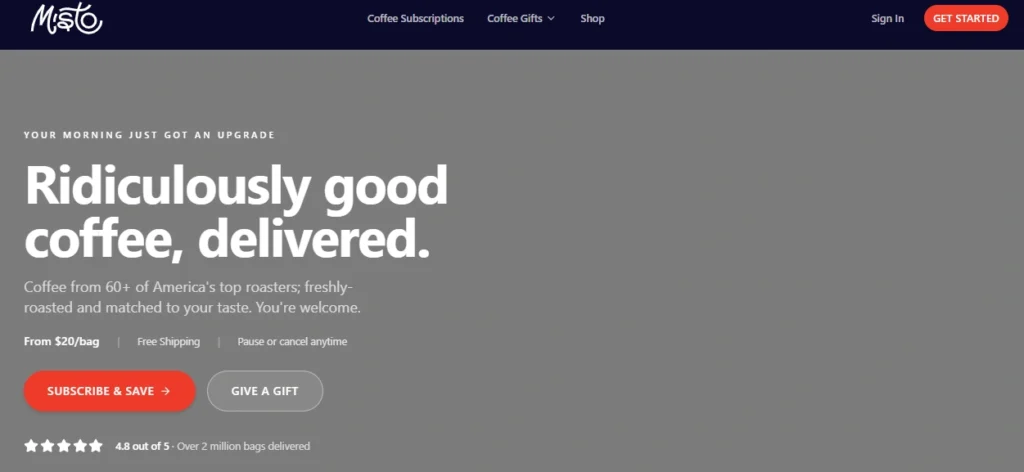
Mistobox is a curated coffee subscription service. They partner with 60+ specialty roasters across the US and ship you fresh-roasted coffee based on your flavor preferences and budget.
The pitch is simple: tell them what you like, they match you with a coffee, it ships directly from the roaster to your door. You rate it. The system learns. The next bag gets closer to your ideal cup.
That loop of rate, learn, adjust is what separates Mistobox from a standard subscription box.
Why I Tested Mistobox for Three Months Straight
Here's the thing nobody tells you about coffee subscriptions…
Most of them are just fancy bag delivery. You pick a roaster. They send the same profile every month. You drink it. Repeat.
That's not discovery. That's habit with a subscription fee attached.
I'd been stuck in that loop for about two years. Rotating between three roasters I already liked, occasionally grabbing something new from a café, never really venturing further. The Mistobox review question kept coming up in my inbox: “Is it actually good or just good marketing?”
So I signed up. Ran it for three months. Tracked every bag, every rating, every curator note. Here's what I found. ☕
The Mistobox review short version: it's the best coffee discovery service I've tested, with some real limitations that matter depending on what kind of drinker you are.
The Curator System: Algorithm or Actual Human?
This is where Mistobox earns its price point.
There's a real coffee curator behind your account. Not just an algorithm spitting out recommendations. An actual person whose job is to match your profile, read your ratings, and course-correct when you say a bag was too acidic or the body wasn't there.
I tested this directly. After my second bag, I left a note saying I wanted more body and less brightness. My third selection shifted noticeably. More Colombian, less Ethiopian. The curator had read it.
That's not something Trade Coffee's algorithm does with the same responsiveness.
The Onboarding Survey: Where It Gets It Right and Wrong
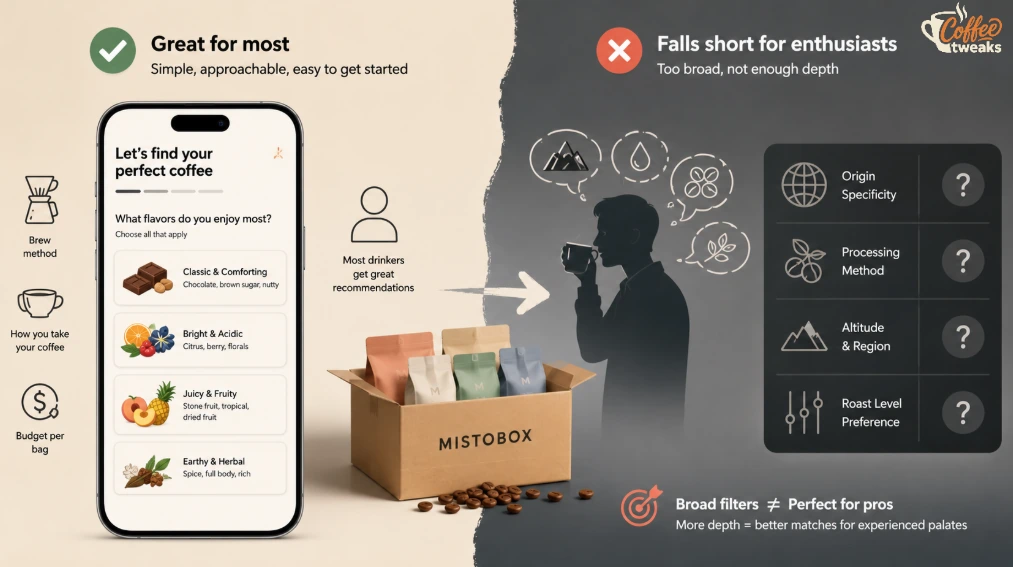
Mistobox starts with a short profile survey. Brew method, preferred flavor notes, how you take your coffee, how much you want to spend per bag.
The flavor categories they use are intuitive:
The problem: the onboarding is fairly blunt for experienced drinkers. If you already know the difference between a washed Kenyan and a honey-processed Colombian, the survey doesn't give you much room to get specific. You're narrowing by broad category, not by processing method or origin.
For most people, this is fine. For speciality-obsessed drinkers, it's a little frustrating at the start.
The Coffee Selection: 440+ Options Across 60 Roasters
The numbers matter here. 📊
Mistobox currently lists 440+ coffees from 60+ artisan roasters. The roster includes names like Verve, Bird Rock, Ruby Coffee, Sightglass, Ceremony, Olympia, Panther, and Methodical, among many others.
That's a genuinely impressive network. Most of these are roasters you'd need to track down individually. Having them accessible through one subscription, with fresh-roasted-to-order shipping, is the core value proposition.
What's in the Catalog
| Category | Count |
|---|---|
| Blends | 212 |
| Single Origin | 96 |
| Espresso | 94 |
| Decaf | 61 |
The blend-heavy catalog makes sense for a discovery service. Blends are more consistent, easier to profile, and less intimidating for people stepping up from grocery store coffee. Single-origin selection at 96 is solid but not exhaustive.
For reference, prices run from around $19 to $26 per 12oz bag. Standard for specialty, not budget territory.
Origins in the Catalog
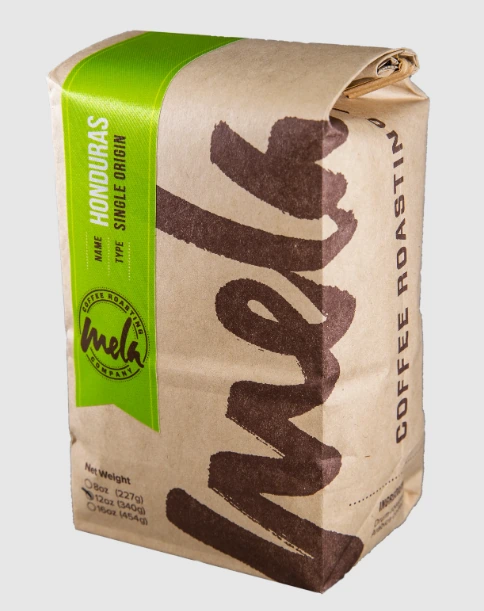
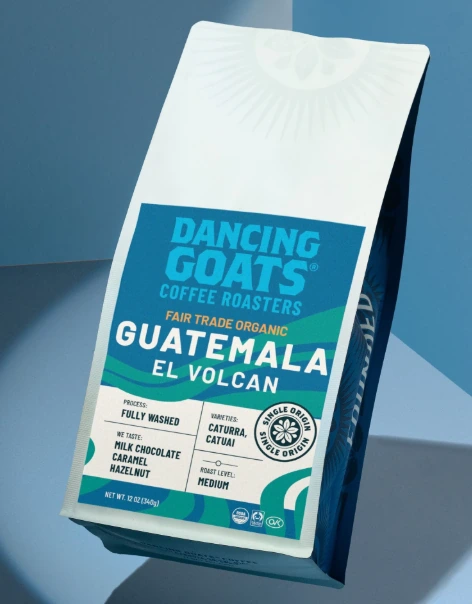
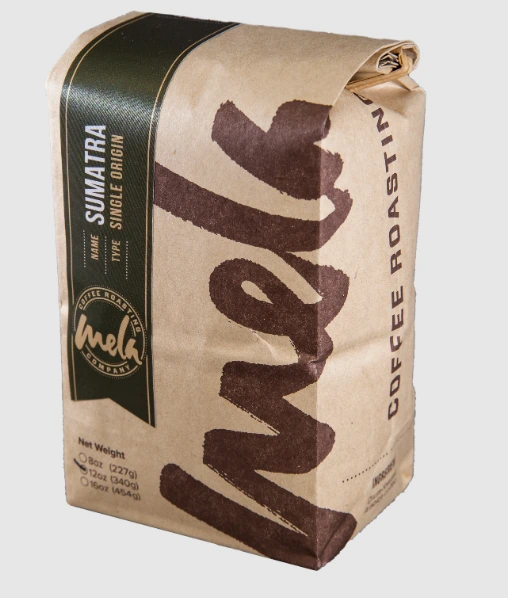
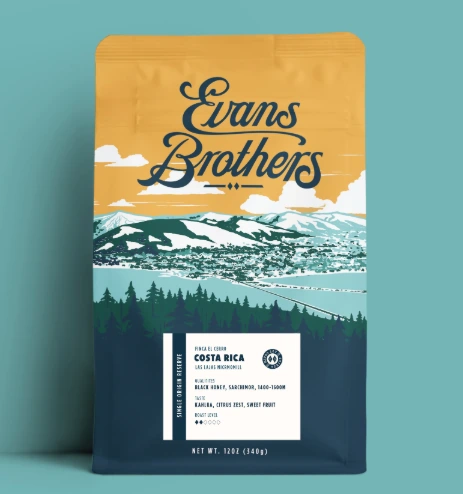
The geographic range is broad. Colombia leads the catalog at 137 listings, followed by Brazil at 81 and Ethiopia at 78. Guatemala, Honduras, Peru, Sumatra, and Costa Rica round out the main origins.
If you're chasing specific micro-lots or ultra-niche processing experiments, you probably won't find them here. But for exploring a wide range of origin profiles across reputable roasters? The selection is genuinely good.
My Three-Month Discovery Check-In: Bag by Bag
I tracked every bag I received over 12 weeks. Here's how the experience actually unfolded. ☕
👉 Month 1 — Getting Calibrated
The first bag was from Methodical Coffee. A medium blend, chocolate and brown sugar notes. Solid, technically clean, but not surprising. I rated it a 3 and said I wanted something with more fruit-forward character.
Second bag was a washed Colombian from Centri Coffee. Better. More clarity, stone fruit on the finish, better structure. Rated it a 4.
By bag three, I was getting something genuinely interesting: a natural-processed Ethiopian from Portrait Coffee that had bright berry character and a syrupy body. That one was a 4.5. The curator had tracked my feedback.
👉 Month 2 — The Discovery Phase Kicks In
This is where Mistobox earns its name as the best coffee discovery service.
Bags four through seven came from roasters I'd never heard of: Forecast Coffee, Good Folks Coffee, Tuckaway, Great North. Not massive names. Exactly the kind of regional roasters I'd never stumble on buying coffee myself.
One of them, a washed Guatemala from Kuma Coffee, became the best bag I'd had in six months. I never would have found it otherwise.
👉 Month 3 — Plateauing
Bags eight through twelve started repeating familiar profiles. The curator had found what I liked and was staying in that lane. That's technically working as designed.
But it also means the discovery factor diminishes over time. By week 12, I was getting good coffee but not surprising coffee. That shift matters if the reason you signed up was to be challenged.
Mistobox Pricing: Worth the Math? 📊
Mistobox doesn't publish a rigid tier breakdown on the public site, but here's how it works in practice.
You set a maximum price you're willing to pay per bag. The higher the max, the bigger the pool of coffees available for curation. The lower the max, the more repeat-heavy your selections might become.
Bags in the catalog range from $19 to $26 per 12oz bag. Most land around $21 to $23.
Shipping is always free. Ships direct from the roaster. This is a real differentiator because several competing services still charge $2 to $5 per delivery.
Delivery frequency: 1 to 4 week cycles. Adjustable. You can pause anytime.
The Opportunity Cost Calculation
At $22 per bag, weekly delivery works out to roughly $88 per month. That's in the same territory as buying two bags a month from a premium local roaster, except you're getting exposure to 60 roasters instead of one.
If you're spending $5 to $6 per day at a café on specialty coffee, a weekly Mistobox subscription at $22 covers your home brewing for that entire week. The math works for home brewers.
Mistobox vs Trade Coffee: The Real Differences
This question comes up constantly. Here's the honest breakdown.
| Dimension | Mistobox | Trade Coffee |
|---|---|---|
| Curation | Human curator + ratings | Algorithm-led matching |
| Roaster Network | 60+ roasters | 55+ roasters |
| Price Per Bag | $19 to $26 | $15 to $22 |
| Shipping | Always free | $2 delivery fee |
| Catalog Size | 440+ coffees | 400+ coffees |
| Discovery Focus | High | Medium |
| Control | Medium | High |
| Best For | Being surprised | Staying consistent |
Trade Coffee gives you more control over exactly what you receive. Mistobox is better if you trust the curation process and want the discovery experience to do the heavy lifting.
For the jaded specialty drinker who's already explored the major roasters? Mistobox pulls you further into the network. Trade tends to recommend roasters you'd find on your own anyway.
If you're weighing other options, our guide to the best coffee subscriptions for pour-over drinkers is worth reading alongside this one. And if you're considering Atlas Coffee Club, it solves a different problem entirely: geographic origin exploration, not roaster network depth.
What Mistobox Gets Right ⚙️
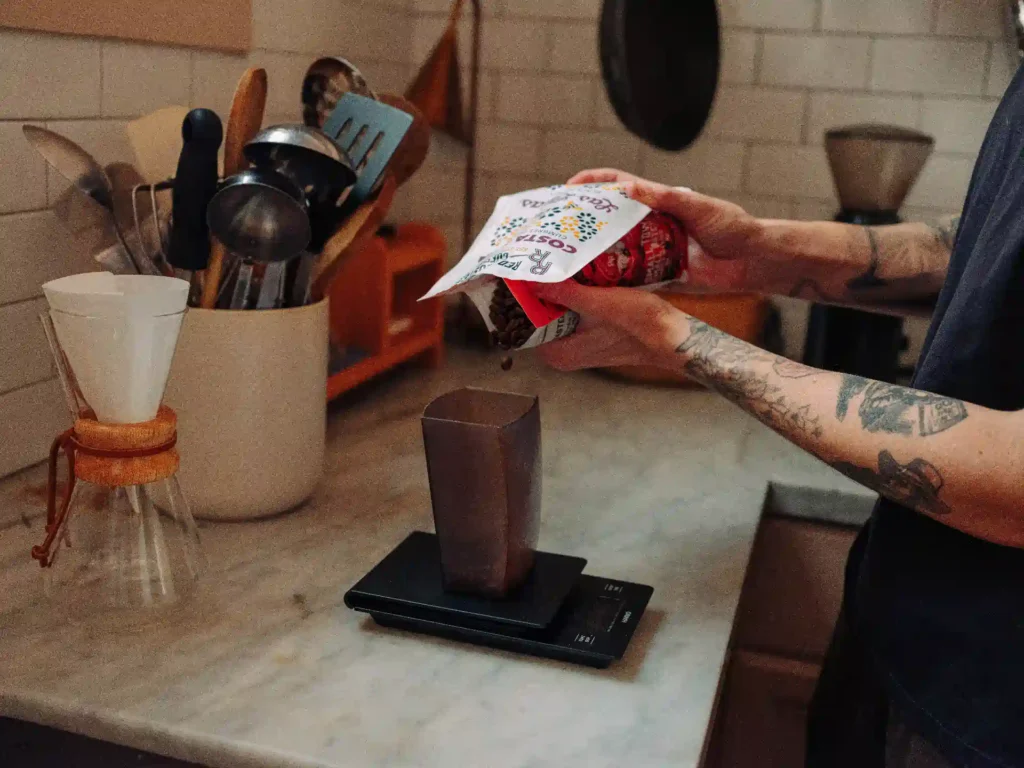
Let me be direct about the things that actually work.
The roaster network is real. Sixty-plus artisan roasters, many of them regional names that don't market heavily online. This is not a recycled list of the usual suspects. There are genuinely obscure, excellent roasters in here.
Fresh-roasted to order. This is the part that matters most for taste. Your coffee isn't sitting in a warehouse. It's roasted after your order is placed and ships directly from the roaster. Most grocery store coffee is weeks or months old by the time it reaches you. The freshness difference is measurable.
The curator system has teeth. I gave the system feedback on five separate bags over three months. Four of those adjustments were reflected in the next selection. That's a 80% response rate from a curation system. That's good.
Free shipping, always. No delivery fee, no minimum order threshold, no fine print.
440+ coffees means genuine variety. Including 61 decaf options and 94 espresso-oriented selections. This is unusually broad for a curated service.
What Mistobox Gets Wrong
Here's where I'm going to be honest, because a 5/5 from me would be a lie.
No sample or trial bag option. Several competing services let you start with a sampler set of 2oz or 4oz bags to calibrate your preferences before committing to full bags. Mistobox doesn't. You're jumping straight into full 12oz bags from day one. If the first two picks miss the mark, you've spent $40+ before the curation even clicks.
Onboarding is too blunt for advanced drinkers. If you know your brewing parameters, understand processing methods, and have opinions about water chemistry, the onboarding survey will feel like it was built for someone a level below you. The flavor category system is accessible but imprecise.
Discovery flattens after month two. Once the curator locks onto your profile, the selections get safe. Good coffee, but you stop being surprised. The service is best in its first 60 days. After that, you might need to manually shake up your preferences to keep it interesting.
No single-bag trial. You can buy individual bags from the shop, but there's no lower-commitment entry point for people who want to test the curation quality before subscribing. The subscription is the product, full stop.
Reddit signal check. There are some complaints online about the curation becoming repetitive over longer subscriptions and occasional customer service friction around cancellations. Nothing catastrophic, but worth knowing before you commit. The experience is better in months one through three than it is in months six through twelve.
Who Is Mistobox Actually For?
Not everyone. That's worth saying plainly.
Mistobox is the right call if you:
Mistobox is not the right call if you:
Mistobox FAQ: Your Top Questions Answered (2026)
Is Mistobox worth it in 2026?
Yes, for coffee drinkers who want to discover new roasters without doing all the research themselves. The curation quality is strong and the roaster network is one of the broadest in the US. It's worth it if discovery is your goal.
How does the Mistobox curator work?
A real human curator is assigned to your account. They select coffees based on your flavor profile and adjust selections based on your ratings and feedback. It's not purely algorithmic. Most feedback adjustments show up within one to two bags.
How much does Mistobox cost per month?
Bags range from $19 to $26 per 12oz. Shipping is always free. At weekly delivery, that's roughly $80 to $104 per month. At every two weeks, it's $38 to $52.
What is the difference between Mistobox and Trade Coffee?
Mistobox uses a human curator and focuses on discovery across 60+ roasters. Trade Coffee uses an algorithm and gives you more direct control over selections. Mistobox is better for exploration. Trade is better for consistency.
Can I cancel my Mistobox subscription?
Yes. Mistobox subscriptions auto-renew but can be cancelled at any time. You can also pause between deliveries if you need a break.
Does Mistobox have decaf options?
Yes. As of 2026, Mistobox offers 61 decaf options across the catalog. They span a range of origins and flavor profiles, so decaf drinkers aren't getting a token one-size option.
Mistobox Verdict
Mistobox is the best coffee discovery service I've tested for what it sets out to do.
The human curator model beats algorithmic matching for actual discovery. The roaster network is genuinely broad, the freshness-to-door model works, and the feedback loop is more responsive than it has any right to be at this price point.
The limitations are real though. No trial bag, discovery flattens over time, and onboarding is rough for experienced drinkers. These aren't dealbreakers but they're not nothing either.
If your problem is that you keep buying the same coffee out of habit and you want the speciality coffee world to surprise you again… Mistobox is built for exactly that.
Ravi Santos is CoffeeTweaks.com's equipment and origins specialist. He tests gear, tracks extraction data, and occasionally spends too much money on grinders. He does not apologize for this.